A prepositional phrase is a group of words that begins with a preposition and includes its complement, commonly a noun phrase or pronoun. In the sentence “The keys are on the shelf,” the words on the shelf form the phrase. The preposition is on, and the shelf is its complement.
Prepositional phrases add information about place, time, direction, manner, cause, purpose, and other relationships. They can modify nouns, verbs, adjectives, or entire clauses. The most reliable way to identify one is to find the preposition, locate its complement, and then decide what the complete phrase describes.
What Is a Prepositional Phrase?
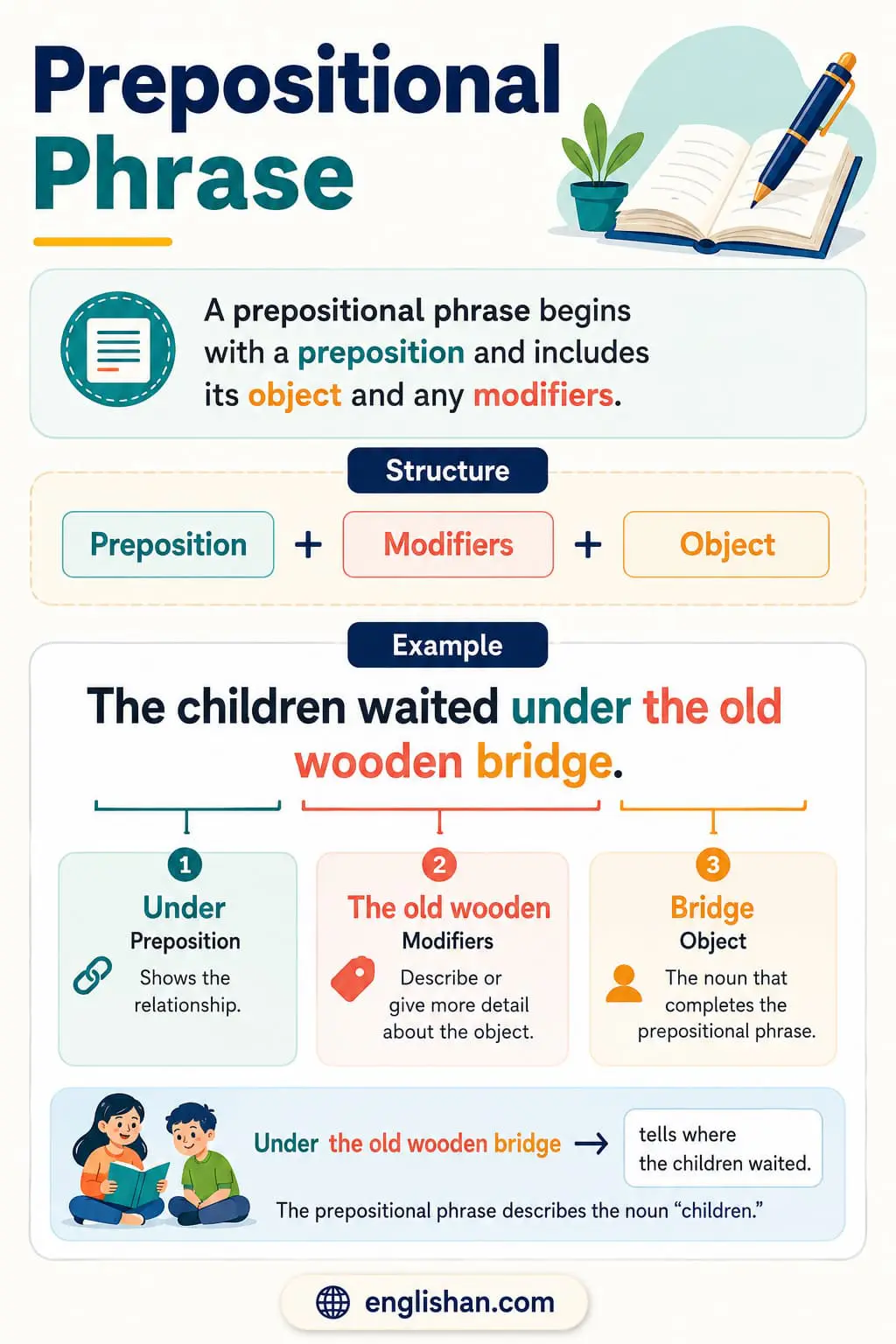
A prepositional phrase follows the basic pattern preposition + complement. The complement completes the meaning of the preposition. It is often a noun phrase or pronoun, but it can also be an -ing form, an adverb, another prepositional phrase, or a clause.
In “We waited until after lunch,” the preposition until is followed by the smaller phrase after lunch. In “She succeeded by working patiently,” the complement is the -ing form working patiently.
The complete phrase acts as one grammatical unit. A single preposition such as under is not a prepositional phrase by itself. It becomes one in expressions such as under the table or under heavy pressure.
Parts of a Prepositional Phrase
Most prepositional phrases contain three identifiable elements. The preposition begins the phrase, the complement completes it, and modifiers can add detail inside the complement.
| Part | Role | Example |
| Preposition | Shows the relationship and begins the phrase. | under the old bridge |
| Complement | Completes the preposition and is commonly a noun phrase or pronoun. | under the old bridge |
| Internal Modifier | Adds information within the complement. | under the old bridge |
In under the old bridge, under is the preposition, the old bridge is the complement, and old modifies bridge. For a focused explanation of the noun or pronoun after the preposition, see object of a preposition.
How to Identify a Prepositional Phrase
Use the following four-step test when a sentence contains a word that may be a preposition.
- Find a likely preposition, such as at, by, for, from, in, on, under, with, or after.
- Look for its complement. Ask what follows the preposition and completes its meaning.
- Include all words inside the complement. In beside the very old gate, the whole expression belongs to the phrase.
- Identify the function. Decide what the phrase modifies or what role it fills in the sentence.
Example: In “The bicycle beside the gate belongs to Amir,” the phrase modifies the noun bicycle. It answers the question Which bicycle?
A word that looks like a preposition does not always begin a prepositional phrase. In “She looked up the number,” up belongs to the phrasal verb looked up. It has no complement of its own.
Multiword prepositions also begin prepositional phrases. Expressions such as because of, in front of, and in spite of function as complete prepositions, so the phrase begins with the whole expression. In “The match continued in spite of the rain,” do not treat of the rain as a separate phrase.
Phrase boundaries matter when one prepositional phrase appears inside another. In “The key on the shelf beside the window,” on the shelf modifies key, while beside the window modifies shelf. Read from the nearest noun outward instead of marking the whole ending as one undivided phrase.
A quick removal test can confirm the function. Remove the suspected phrase and read the remaining sentence. If the core sentence still works, the removed words are probably adding modification rather than serving as the main subject or verb. The test is useful, but the preposition-and-complement pattern remains the decisive check.
Types of Prepositional Phrases
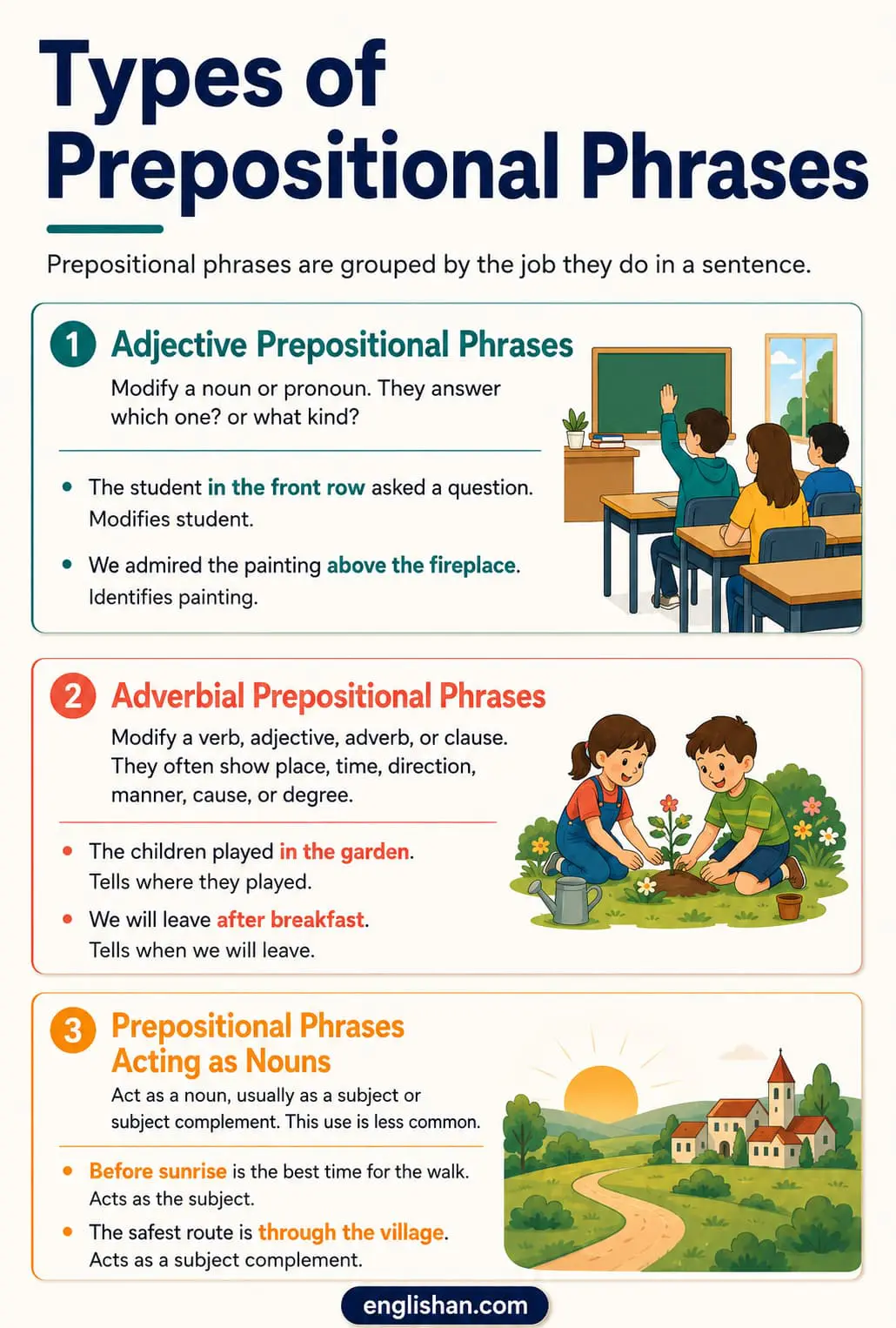
Prepositional phrases are classified by the job they perform. The two most common types are adjective prepositional phrases and adverbial prepositional phrases. Some phrases also fill noun-like positions.
Adjective Prepositional Phrases
An adjective prepositional phrase modifies a noun or pronoun. It usually answers Which one? or What kind?
- The student in the front row asked a question. The phrase modifies student.
- We admired the painting above the fireplace. The phrase identifies which painting.
- The road through the forest is closed today. The phrase modifies road.
- Her message about the meeting arrived late. The phrase modifies message.
Adverbial Prepositional Phrases
An adverbial prepositional phrase modifies a verb, adjective, adverb, or clause. It often expresses place, time, direction, manner, cause, or degree.
- The children played in the garden. The phrase tells where they played.
- We will leave after breakfast. The phrase tells when we will leave.
- She spoke with confidence. The phrase tells how she spoke.
- The room was quiet during the test. The phrase adds a time condition.
Prepositional Phrases Acting as Nouns
A prepositional phrase can occasionally fill a noun-like position, especially as a subject or subject complement. This pattern is less common than adjective and adverbial use.
- Before sunrise is the best time for the walk. The phrase acts as the subject.
- The safest route is through the village. The phrase acts as a subject complement.
- From here to the station is about two kilometers. The phrase acts as the subject.
Prepositional Phrase Examples in Sentences
The meaning of a prepositional phrase depends on the relationship expressed by the preposition and its complement. The examples below group common meanings so the pattern is easier to recognize.
Place
- The cat is sleeping under the sofa.
- A small café stands across the street.
- The documents are inside the blue folder.
- We met near the main entrance.
Time
- The train arrived at noon.
- She has worked here since January.
- We stayed indoors during the storm.
- Please finish the report by Friday.
Direction
- The hikers walked toward the lake.
- A bird flew over the fence.
- He stepped into the lift.
- The dog ran through the open gate.
Manner
- She answered the question with care.
- The team completed the task without delay.
- He traveled by train.
- The children arranged the books in alphabetical order.
Cause and Purpose
- The match was canceled because of heavy rain.
- They collected donations for the local shelter.
- The road was closed due to flooding.
- We met for a final review.
Common Prepositional Phrases With Examples
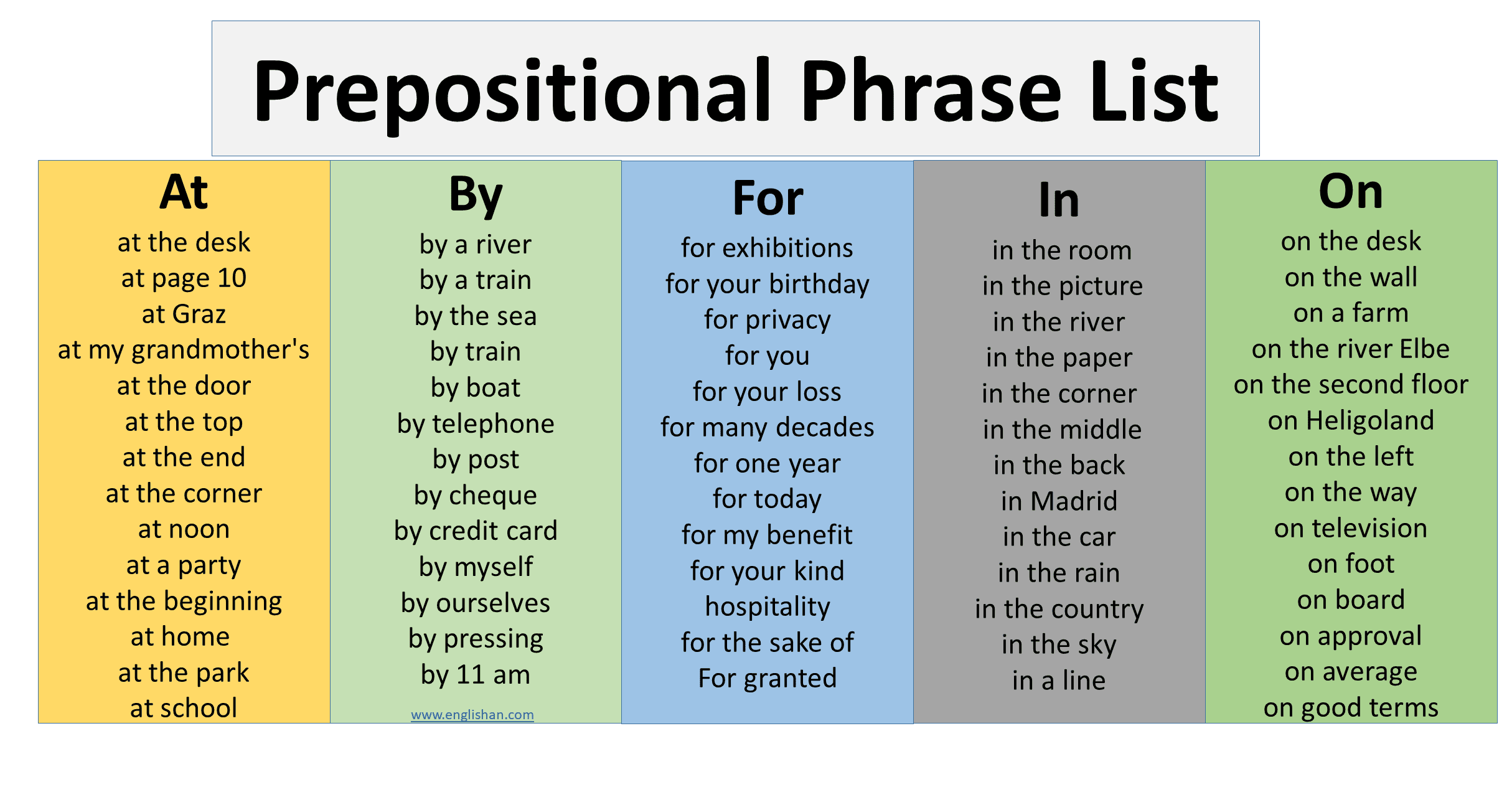
The prepositions at, by, for, in, and on appear in many everyday phrases. Their meaning changes with the complement, so learn each phrase in a complete sentence rather than as an isolated word.
At
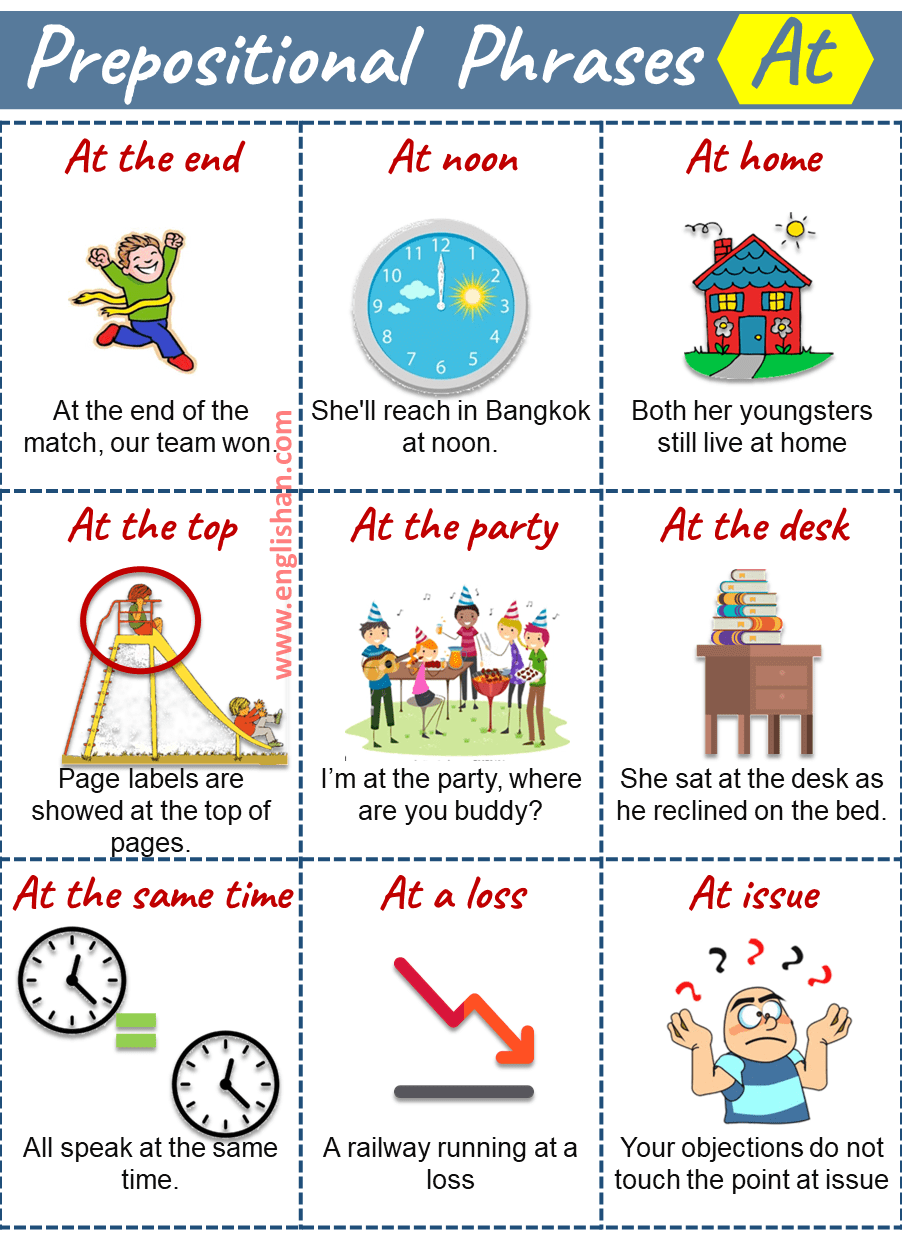
Use at for a specific point, event, address, or time.
- She waited at the door.
- Our class begins at nine o’clock.
- We met at the conference.
- The taxi stopped at the corner.
- He is studying at the library.
- They arrived at the airport before sunset.
By
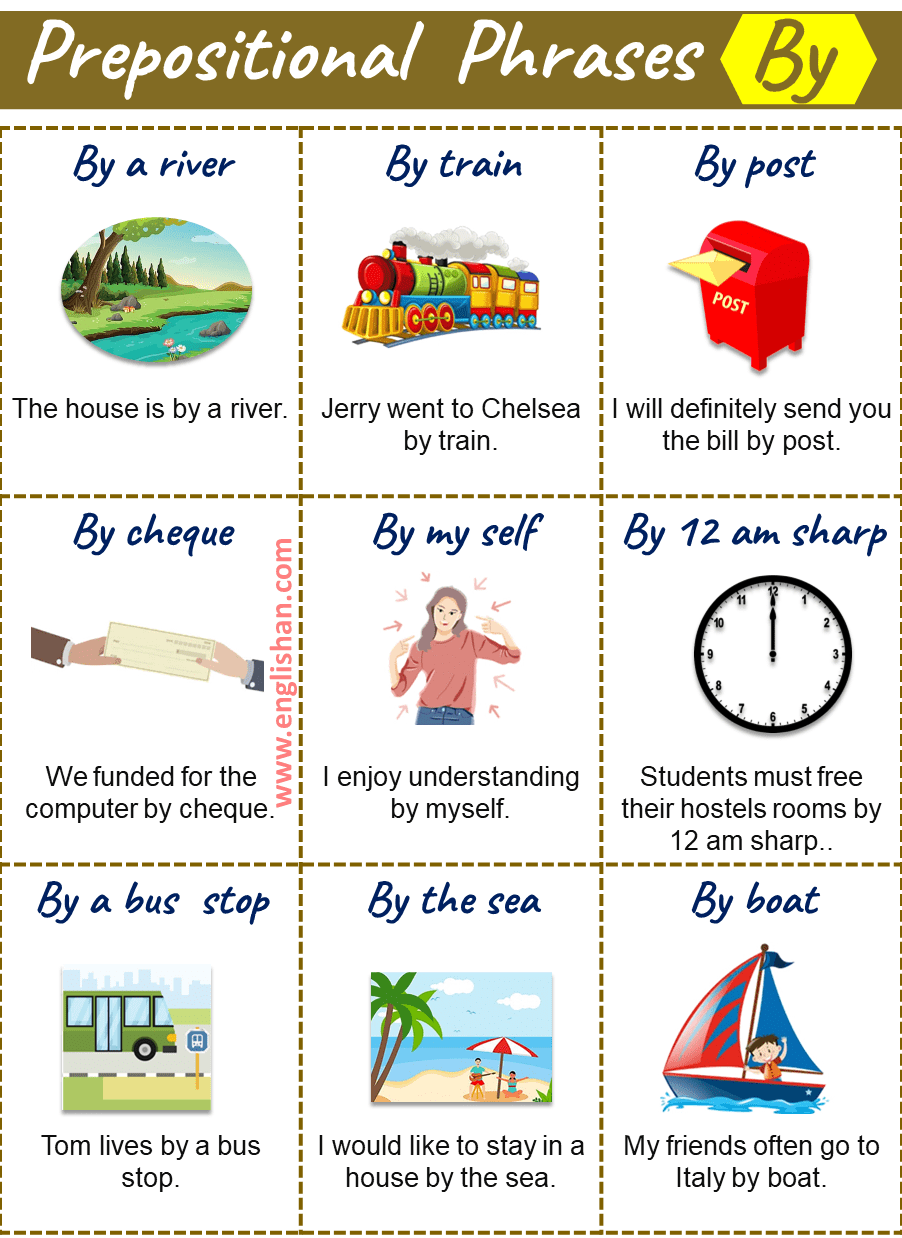
Use by for position beside something, method, transport, agency, or a deadline.
- Their house stands by the river.
- We traveled by bus.
- Please send the form by email.
- The payment was made by credit card.
- The novel was written by a Nigerian author.
- Submit your application by 5 p.m..
For
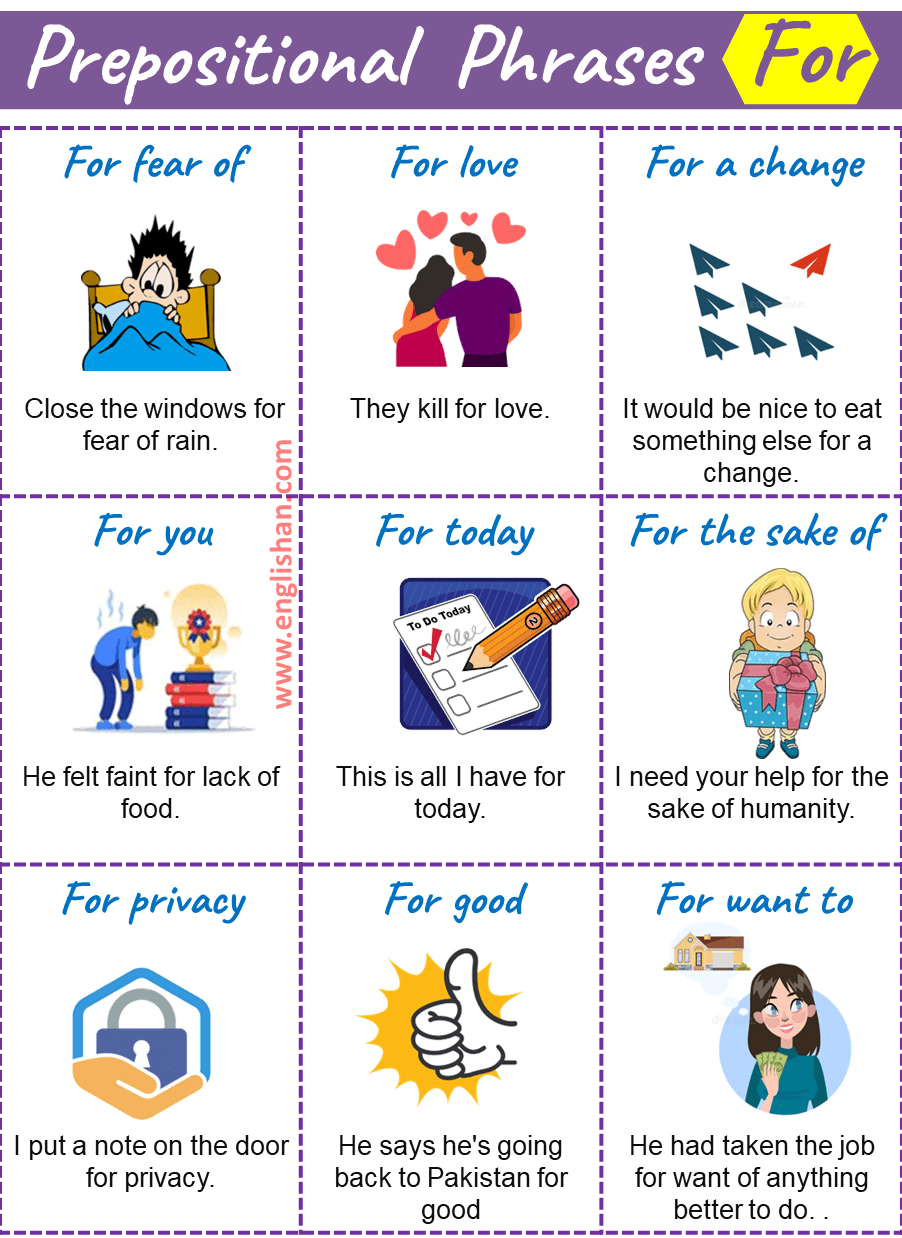
Use for to express purpose, benefit, duration, reason, or intended recipient.
- This room is for private meetings.
- I bought a present for my sister.
- They stayed in Lahore for three days.
- She is known for her patience.
- We saved two seats for our guests.
In
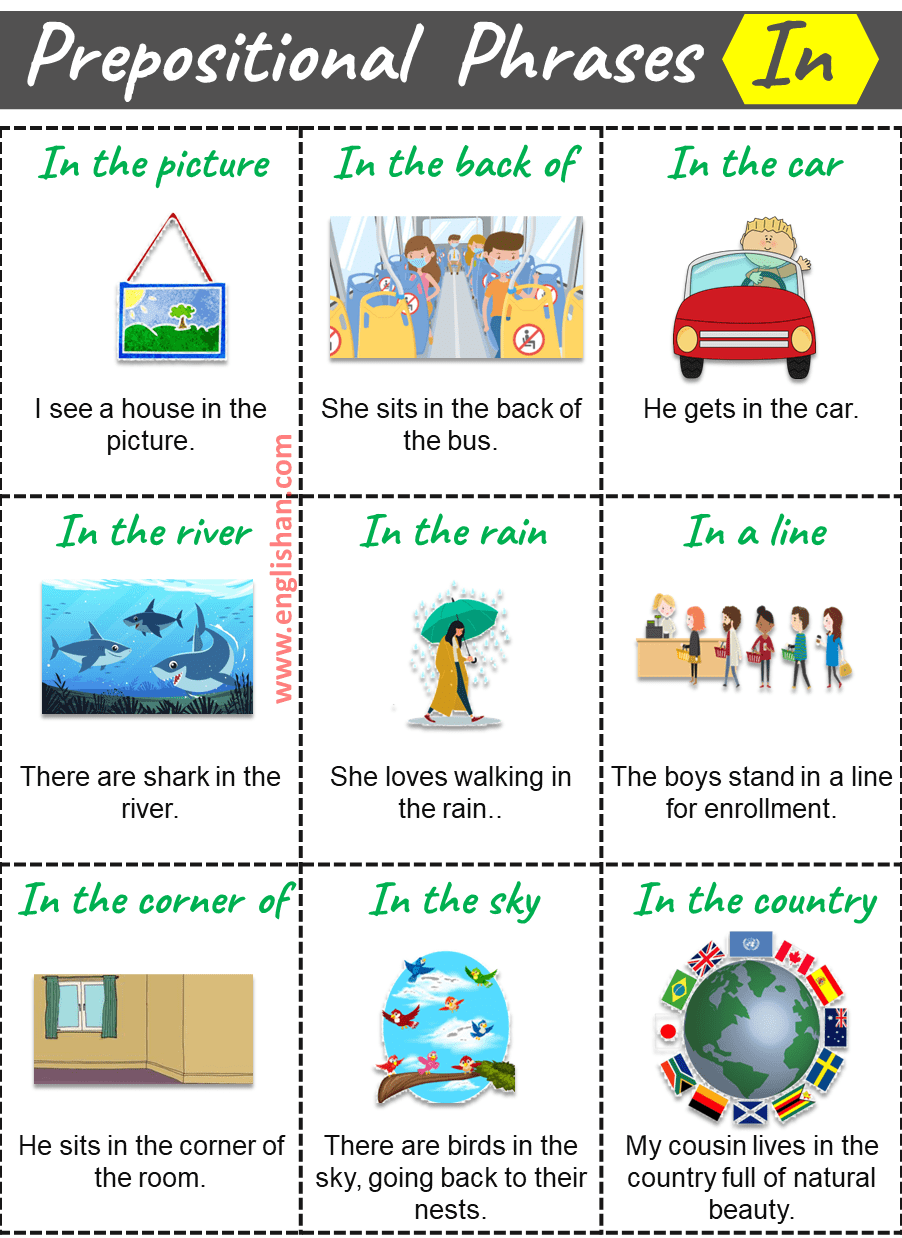
Use in for enclosed spaces, larger areas, longer periods, conditions, and states.
- The children are in the classroom.
- He lives in Manchester.
- The flowers bloom in spring.
- She wrote the note in pencil.
- The audience listened in complete silence.
- We found the receipt in the bottom drawer.
On
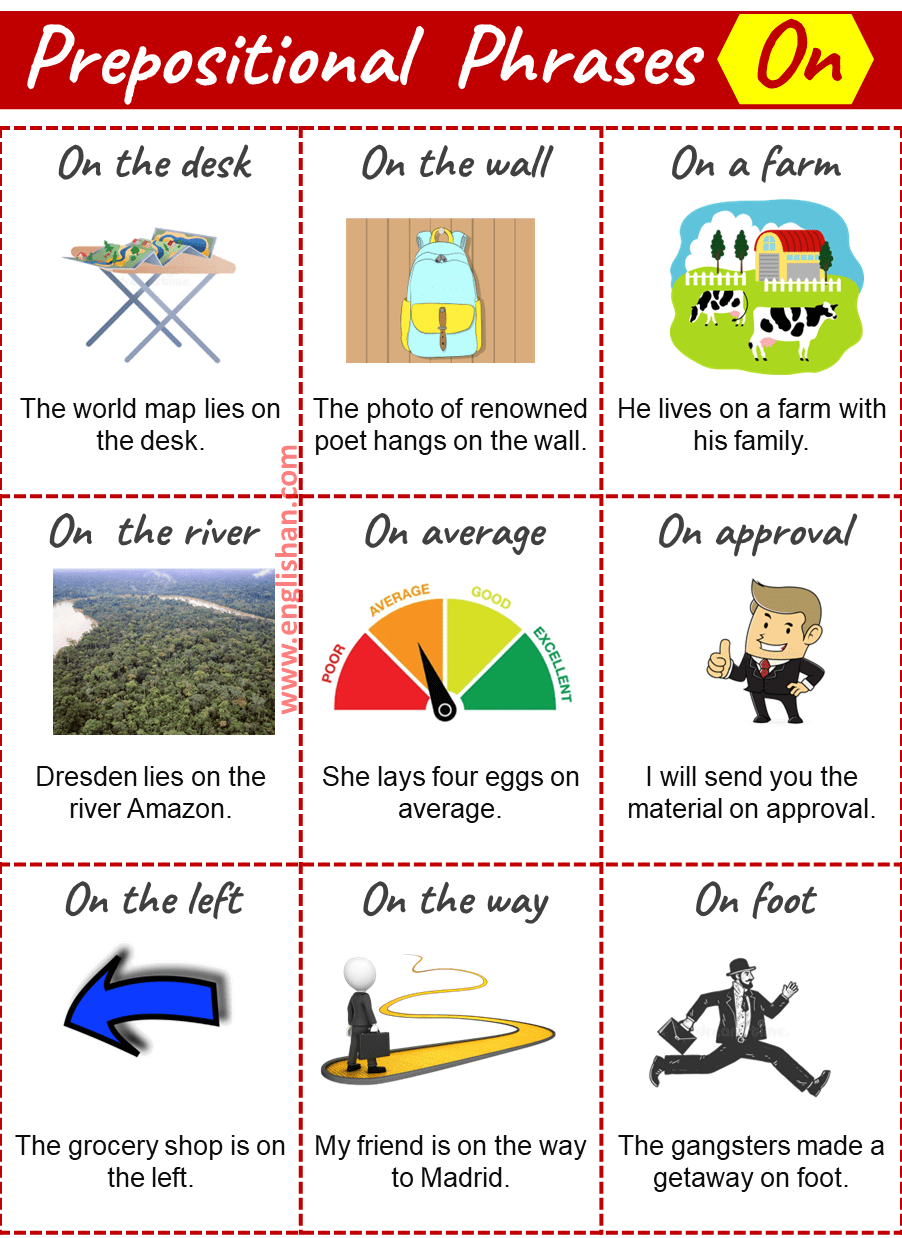
Use on for surfaces, days and dates, communication media, transport, and certain fixed expressions.
- The map is on the desk.
- Our appointment is on Monday.
- They watched the match on television.
- All passengers are on board.
- She traveled on foot.
- The two colleagues remained on good terms.
Many combinations with at, by, for, in, and on are fixed by usage. Compare in the morning with at night, or on the bus with in the car. Learn the complete expression and its context instead of translating one preposition word for word.
Introductory Prepositional Phrases and Commas
A prepositional phrase can appear at the beginning, middle, or end of a sentence. An introductory phrase often sets the time, place, or condition before the main clause.
Use a comma after a long introductory prepositional phrase or when the comma prevents confusion: “After several hours in heavy traffic, we reached the airport.”
A short, clear introductory phrase often needs no comma: “At noon we left.” A comma is still possible when the writer wants a deliberate pause: “At noon, we left.”
Comma Rule
Use a comma when an introductory phrase is long, contains several words, or could be misread.Do not insert commas around every prepositional phrase. Most phrases inside or at the end of a sentence are not set off.
Common Prepositional Phrase Mistakes
The phrase itself is often easy to spot, but it can create errors when a writer mistakes its object for the subject, attaches it to the wrong word, or confuses a preposition with an infinitive marker.
Subject Verb Agreement
The noun inside a prepositional phrase does not normally control the verb. Match the verb with the actual subject.
The box of old files is in the office. ✅
The box of old files are in the office. ❌
Misplaced Prepositional Phrases
Place a prepositional phrase close to the word it modifies. A distant phrase can create an unintended meaning.
She served sandwiches to the children on paper plates. ❌
She served sandwiches on paper plates to the children. ✅
Too Many Prepositional Phrases
Several phrases in one sentence can make the main idea difficult to follow. Keep the phrase that adds necessary information, then rewrite or remove the rest.
The report on the results of the survey from the students in the evening class was placed on my desk. ❌
The evening class completed a survey. Its results were summarized in a report on my desk. ✅
Prepositional Phrase or Infinitive?
The word to begins a prepositional phrase when it is followed by a noun phrase or pronoun. It introduces an infinitive when it is followed by the base form of a verb.
We walked to the station. To is a preposition because the station is its complement. ✅
We plan to leave early. To leave is an infinitive, not a prepositional phrase. ✅
Ending a sentence with a preposition is not automatically an error. Natural questions and relative clauses often place the preposition at the end, as in “Which chair did you sit on?” or “That is the colleague I spoke with.” Move the preposition only when the result sounds clearer and more appropriate for the register.
Practice: Find the Prepositional Phrase
Identify the complete prepositional phrase in each sentence. Then state what it modifies or what relationship it expresses.
- The notebook beside the lamp belongs to Maya.
- We waited outside the theater for twenty minutes.
- After the final lesson, the students packed their bags.
- The dog ran through the garden gate.
- The portrait on the wall was painted by my aunt.
- She improved her pronunciation by practicing every day.
- The basket of fresh apples is on the counter.
- They hope to finish the project before Friday.
Answer Key
- beside the lamp modifies notebook; to Maya completes the meaning of belongs.
- outside the theater expresses place; for twenty minutes expresses duration.
- After the final lesson expresses time and introduces the sentence.
- through the garden gate expresses direction.
- on the wall modifies portrait; by my aunt identifies the agent.
- by practicing every day expresses method.
- of fresh apples modifies basket; the singular subject basket takes is.
- before Friday expresses time. To finish is an infinitive, not a prepositional phrase.
FAQs
A prepositional phrase begins with a preposition and includes its complement. It works as one unit to show a relationship or to modify another part of the sentence.
Find the preposition, locate the word group that completes it, and include any modifiers inside that group. Then ask what the complete phrase describes or expresses.
The essential parts are the preposition and its complement. The complement can contain determiners, adjectives, and other modifiers.
The main types are adjective prepositional phrases, which modify nouns or pronouns, and adverbial prepositional phrases, which modify verbs, adjectives, adverbs, or clauses.
A preposition is one word or a fixed expression such as under or because of. A prepositional phrase contains that preposition plus its complement, such as under the chair.
Yes. An introductory prepositional phrase can establish time, place, or context before the main clause. A comma is common after a long or potentially confusing introductory phrase.
Yes. A sentence can contain several prepositional phrases, but each phrase should have a clear function. Too many closely packed phrases can make the sentence difficult to read.
Once you can identify the preposition and its complement, a prepositional phrase becomes much easier to classify and use. Check what the phrase modifies, keep it close to that word, and use punctuation only when the sentence needs it.
You May Also Like