

An adjective phrase is a group of words that describes a noun or pronoun, and an adverb phrase is a group of words that modifies a verb, an adjective, or another adverb. In any adjective phrase vs adverb phrase question, the deciding point is the word the phrase modifies, because the same words can function as either one.
Both phrases function as a single word inside a sentence: an adjective phrase functions as an adjective, and an adverb phrase functions as an adverb. The phrase “with a red roof” in “the house with a red roof” describes the noun “house”, while “with great care” in “She packed the glasses with great care” modifies the verb “packed”. The two phrases have the same form, a preposition and a noun, so only their job in the sentence gives each one its name.
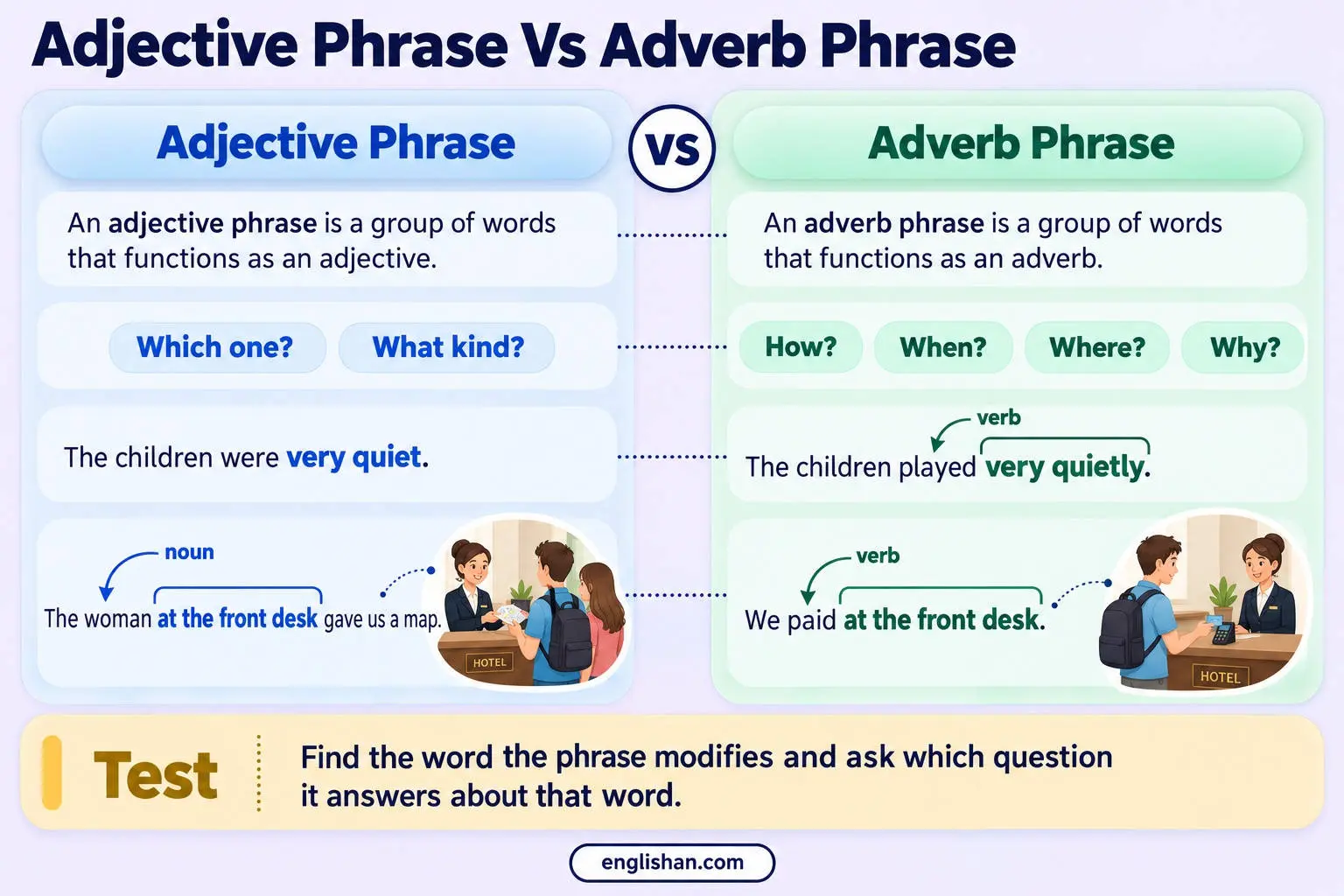
The adjective phrase vs adverb phrase choice depends on the word the phrase modifies. An adjective phrase describes a noun or pronoun and tells us which one or what kind, as in “the woman in the red coat“. An adverb phrase modifies a verb, an adjective, or an adverb and tells us how, when, where, or why, as in “We left after lunch“.
What Are Adjective And Adverb Phrases?
Adjective and adverb phrases are groups of words that function as one adjective or one adverb in a sentence. An adjective phrase, also called an adjectival phrase, answers the question “which one?” or “what kind?” about a noun. An adverb phrase, also called an adverbial phrase, answers “how?”, “when?”, “where?”, or “why?” about an action or a description.
- The man in the gray suit is my new manager. (adjective phrase)
- I need a phone with a longer battery life. (adjective phrase)
- My sister drives very carefully. (adverb phrase)
- The pharmacy closes at six o’clock. (adverb phrase)
A single adjective such as “friendly” becomes an adjective phrase when other words are added to it, as in “very friendly” or “friendly to everyone”. Neither kind of phrase has a subject and a verb of its own, so an adjective phrase or an adverb phrase is always part of a sentence and never a clause.
Difference Between Adjective Phrase And Adverb Phrase
The difference between an adjective phrase and an adverb phrase is the word each one modifies. An adjective phrase modifies a noun or a pronoun, and an adverb phrase modifies a verb, an adjective, or another adverb. Both phrases can contain the same words, often a preposition and a noun, so the words alone do not show the name.
| Feature | Adjective phrase | Adverb phrase |
|---|---|---|
| Modifies | A noun or pronoun | A verb, an adjective, or an adverb |
| Answers | Which one? What kind? | How? When? Where? Why? How often? |
| Second name | Adjectival phrase | Adverbial phrase |
| Usual position | Directly after the noun, or after a linking verb | After the verb or object, or at the start |
| Movement | Usually stays next to its noun or linking verb | Can usually move to the start |
| Example | The café near the station | We waited near the station |
To name a phrase, find the word it modifies and ask which question it answers about that word. A pair of sentences with the same subject and the same degree word shows the contrast:
- The children were very quiet. (describes “children”)
- The children played very quietly. (modifies “played”)
After a linking verb such as “be”, “seem”, or “become”, a phrase describes the subject, so it is an adjective phrase. After an action verb, the phrase modifies the verb, so it is an adverb phrase and its main word takes the adverb form.
The children played very quiet. ❌
The children played very quietly. ✅
The verb “played” is an action verb, so the phrase that modifies it is an adverb phrase with the adverb “quietly”. The opposite error happens with “look” in its meaning ‘seem’, which is a linking verb:
She looks very happily. ❌
She looks very happy. ✅
The phrase “very happy” describes “she”, so it is an adjective phrase, and the adjective form is correct.
A prepositional phrase can be either kind of phrase. It is an adjective phrase when it modifies a noun and an adverb phrase when it modifies a verb, so one phrase can change its job with its position:
- The woman at the front desk gave us a map. (which woman?)
- We paid at the front desk. (where?)
The full contrast, with the hard case of a phrase after an object, is taught on the page about adverbial prepositional phrases.
Examples Of Adjective And Adverb Phrases
Adjective and adverb phrases have several forms, and some of them show the job of the phrase by their form alone. A phrase with an adjective as its main word is an adjective phrase, and a phrase with an adverb as its main word is an adverb phrase. Prepositional phrases and infinitive phrases can function as either kind, so their position and meaning show the name.
Forms Of Adjective Phrases
There are four main forms of adjective phrases: an adverb and an adjective, an adjective with a prepositional phrase after it, a prepositional phrase after a noun, and a participle phrase.
Adverb and adjective: A degree word such as “very”, “quite”, “really”, or “extremely” comes before the adjective and changes how strong it is. An adjective phrase of this form can go before a noun or after a linking verb.
- It was an extremely long meeting.
- The soup is a little too salty.
Adjective and prepositional phrase: Some adjectives are followed by a fixed preposition, as in “proud of”, “good at”, “afraid of”, and “interested in”. The adjective and the prepositional phrase after it form one adjective phrase, which comes after a linking verb or directly after the noun.
- Nadia is proud of her work.
- My brother is good at fixing bikes.
- Anyone interested in the course can join the group chat.
An adjective with a prepositional phrase after it comes after the noun, not before it. In Chinese, Japanese, Korean, and Turkish, a describing phrase comes before the noun, and that word order, used in English, is the source of this error:
I met an interested in art student. ❌
I met a student interested in art. ✅
An adjective with a prepositional phrase after it follows the noun it describes.
Noun and prepositional phrase: A preposition and its object come directly after a noun and tell us which one or what kind.
- The house on the corner has a new owner.
- I ordered the pasta with mushrooms.
Participle phrase: A present participle (“-ing” form) or a past participle with the words after it comes directly after the noun it describes.
- The woman sitting by the window is our new teacher.
- The cakes made for the party were gone by noon.
Forms Of Adverb Phrases
There are three main forms of adverb phrases: an adverb with another adverb before it, a prepositional phrase, and an infinitive phrase of purpose.
Adverb and adverb: An adverb of degree such as “quite”, “very”, “so”, or “almost” comes before a second adverb and changes how strong it is.
- The old car started quite slowly this morning.
- She answered my message almost immediately.
Prepositional phrase: A prepositional phrase functions as an adverb when it tells us when, where, how, or why something happens.
- Let’s meet after lunch.
- He fixed the shelf with a screwdriver.
- The flight was canceled because of the storm.
Infinitive phrase of purpose: The word “to”, a verb, and the words after it tell us why someone does something. An infinitive phrase of purpose means the same as “in order to” and the verb.
- We cook at home to save money.
- Did you call the hotel to change the booking?
An infinitive phrase directly after a noun describes that noun, so it is an adjective phrase, as in “a good place to eat” and “We need someone to fix the roof“. Where the infinitive phrase answers “why?”, it is an adverb phrase.
Position Of Adjective And Adverb Phrases In A Sentence
An adjective phrase usually comes directly after the noun it describes or after a linking verb. An adverb phrase is freer, and it can usually go at the end, at the start, or in the middle of a sentence.
Adjective phrases: Most adjective phrases follow the noun, and those after a linking verb describe the subject. Of the four forms, the adverb and adjective form, such as “really comfortable”, is the one that usually goes before a noun.
- The flowers on the table are for you.
- The manager seemed pleased with the results.
- We bought a really comfortable sofa.
An adjective phrase can also open a sentence when a comma separates it from the subject it describes. In “Tired after the long flight, Maria went straight to bed”, the phrase describes Maria, so it is an adjective phrase even at the start.
Adverb phrases: The end of the sentence is their usual position. At the start, the phrase sets the time or place for the rest of the sentence, and an adverb and adverb form can go in the middle, before the main verb. At the end of a sentence, adverbial prepositional phrases usually follow the order place, then time, as in “We met at the café on Monday”.
- We went for a walk after dinner.
- After dinner, we went for a walk.
- She very nearly missed the train.
Commas: An adverb phrase at the start of a sentence usually takes a comma after it, but after a short phrase of up to about four words, the comma is often left out, as in “On Monday we start the new project”. A long introductory phrase or an infinitive phrase of purpose takes the comma, as in “To save money, we cook at home”. At the end of a sentence, an adverb phrase takes no comma.
FAQs
Both names usually mean the same thing: a group of words that describes a noun or pronoun. In stricter grammar, an adjective phrase has an adjective as its main word, as in "very tired", and an adjectival phrase is any phrase that functions as an adjective, such as "on the corner" in "the house on the corner".
No, a verb is not required, and most adverb phrases have none, such as "quite slowly" and "after lunch". An infinitive phrase of purpose such as "to save money" contains a verb form, but it has no subject, so it is still a phrase and not a clause.
An adverbial clause has a subject and a verb, and an adverbial phrase does not. The words "after lunch" form an adverbial phrase, while "after we had lunch" is an adverbial clause with the subject "we" and the verb "had". The same rule separates adjective and adverb phrases from adjective and adverb clauses, which always have their own subject and verb.
Yes, an adverb becomes the main word of an adverb phrase when another adverb comes before it, as in "very carefully" or "quite often". In stricter grammar, a single adverb such as "carefully" also counts as an adverb phrase of one word.
Related:
- Adverb
- Types of Phrases
- Adverb vs Adjective
- Participial Phrase
- Phrases and Clauses
- Parts of Speech
- Comma After Introductory Phrase
