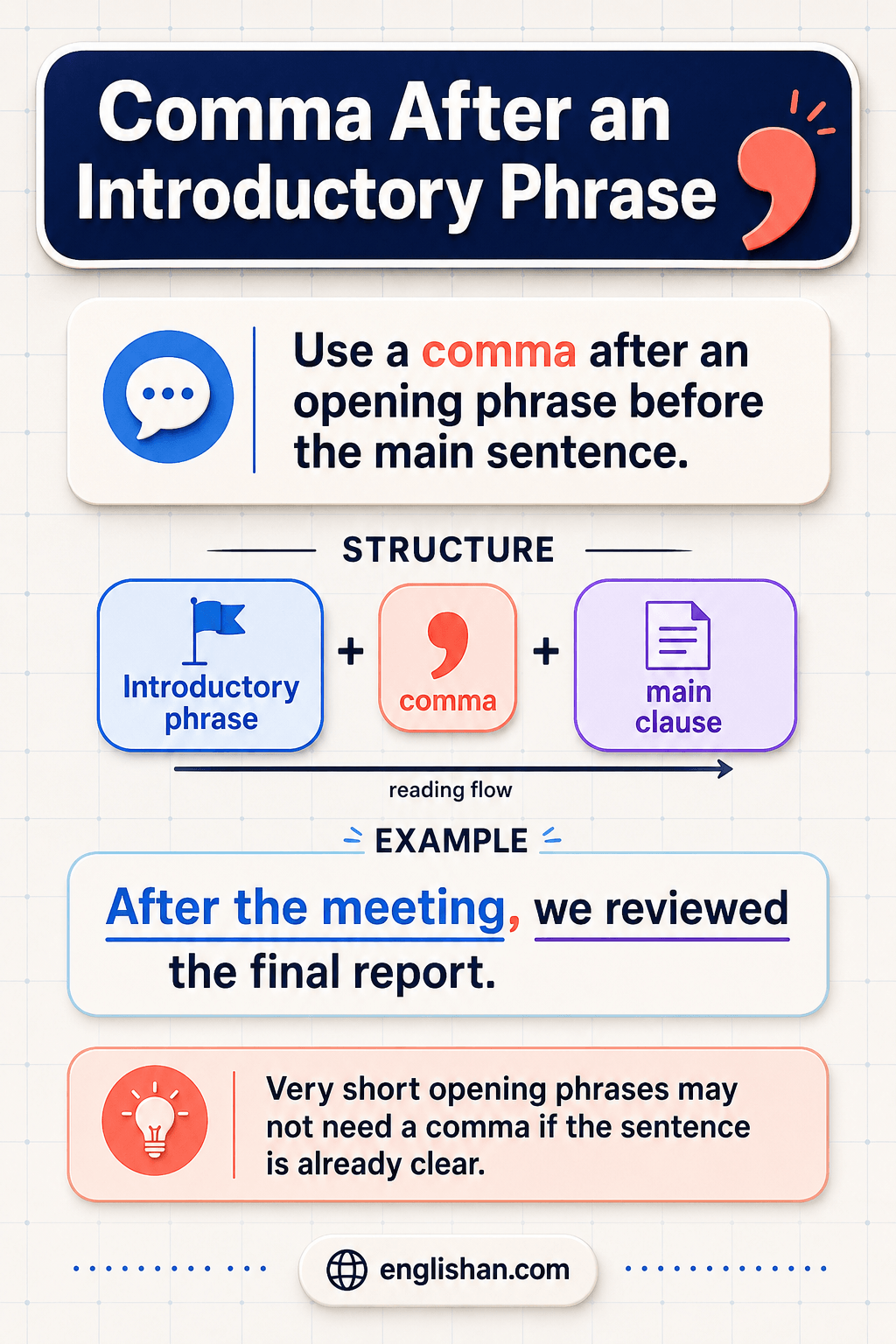
Quick answer: Place a comma after an introductory phrase in most sentences. The comma separates the setup from the main clause and prevents misreading.
After the meeting, the team reviewed the notes. ✅ Running through the park, she spotted an old friend. ✅ To finish on time, we started an hour early. ✅
The comma is optional only when a prepositional phrase is very short (under four words) and the sentence reads clearly without it.
In July we moved to Denver. ✅ In July, we moved to Denver. ✅
The Default Rule: Comma After an Introductory Phrase
An introductory phrase is a group of words at the start of a sentence that provides context before the main clause. It does not contain its own subject-verb pair (that’s what separates it from an introductory clause).
The default rule is direct: place a comma after the introductory phrase. The comma tells the reader that the setup is over and the main clause is about to begin.
Despite the heavy rain, the outdoor concert went ahead as planned. ✅
Hoping to catch the early train, Marcus left the house at six. ✅
This default holds for all phrase types below unless a specific exception applies. When in doubt, include the comma. It never harms readability, and it often prevents confusion.
Introductory Prepositional Phrases
A prepositional phrase opens with a preposition (in, on, at, after, before, during, between, without, through) and ends with its object. Most introductory prepositional phrases take a comma.
Before the deadline, the team submitted their final draft. ✅
Without any warning, the power went out across the building. ✅
Short Prepositional Phrases (Under Four Words)
When the prepositional phrase is very short and the sentence reads clearly without a pause, the comma becomes optional.
In May we hired three new developers. ✅
In May, we hired three new developers. ✅
At dawn the birds started singing. ✅
At dawn, the birds started singing. ✅
Both versions are correct. Style guides differ on the exact threshold: some set it at three words, others at four or five. The safest approach is to include the comma whenever a pause feels natural and to always include it if skipping it could cause even momentary confusion.
Stacked Prepositional Phrases
When two or more prepositional phrases appear before the main clause, always use the comma. The combined length makes a pause necessary for readability.
During the production of the film the director nearly quit. ❌
During the production of the film, the director nearly quit. ✅
On the morning of the third day of the conference, the keynote speaker canceled. ✅
Introductory Participial Phrases
A participial phrase begins with a present participle (-ing form) or a past participle (-ed form, or an irregular past participle). It modifies the subject of the main clause and always takes a comma.
Running late for the interview, she grabbed a cab instead of waiting for the bus. ✅
Frustrated by the lack of progress, the manager called an emergency meeting. ✅
Having reviewed the contract twice, the lawyer flagged three problematic clauses. ✅
The comma is never optional with participial phrases. Without it, the reader’s eye runs the participle into the main clause and stumbles:
Typing furiously the intern tried to meet the deadline. ❌
Typing furiously, the intern tried to meet the deadline. ✅
Watch for Dangling Modifiers
A participial phrase must modify the subject that immediately follows the comma. If a different noun comes first, the modifier “dangles” and the sentence says something unintended.
Walking through the park, the fountain caught her eye. ❌ (The fountain wasn’t walking.)
Walking through the park, she noticed the fountain. ✅
If the participial phrase can’t logically modify the subject, rewrite the sentence rather than just adding a comma.
Introductory Infinitive Phrases
An infinitive phrase begins with to + a base verb (to finish, to understand, to improve). When it functions as an introductory modifier, it takes a comma.
To pass the certification exam, you need at least six months of preparation. ✅
To keep the project on schedule, the team worked weekends through March. ✅
To avoid further delays, management approved the additional budget. ✅
When the Infinitive Phrase Is the Subject
Not every sentence that starts with to contains an introductory phrase. Sometimes the infinitive phrase functions as the subject of the sentence. In that case, no comma belongs after it, because separating a subject from its verb with a comma is always incorrect.
To start a business without a plan would be reckless. ✅ (The infinitive phrase is the subject.)
To start a business without a plan, would be reckless. ❌ (Comma separates subject from verb.)
The test: ask whether the infinitive phrase answers “what?” or “why?” If it answers “what?” (What would be reckless? To start a business without a plan), it’s the subject. If it answers “why?” or “for what purpose?” (Why did she study? To pass the exam), it’s an introductory modifier and takes a comma.
Introductory Absolute Phrases
An absolute phrase combines a noun with a participle (or participial phrase) and modifies the entire main clause rather than a single word. It always takes a comma.
The sun setting behind the mountains, the hikers decided to make camp. ✅
Her voice wavering, the witness described what she had seen. ✅
Arms crossed, he waited for an explanation. ✅
Absolute phrases are set off by commas regardless of where they appear in the sentence, but they are most common at the beginning.
Introductory Appositive Phrases
An appositive phrase renames or identifies a noun. When a nonrestrictive appositive phrase opens a sentence, it takes a comma.
A former competitive swimmer, Rachel now coaches the university team. ✅
An accomplished violinist, David performed at Carnegie Hall before the age of twenty. ✅
Restrictive Introductory Appositives: No Comma
When the appositive phrase is restrictive (necessary to identify which person or thing the sentence is about), skip the comma. Restrictive appositives often start with the and narrow down a specific individual.
The award-winning teacher, Mrs. Becky Armstrong, was honored at graduation. ❌ (The commas make “Mrs. Becky Armstrong” nonessential, implying there’s only one award-winning teacher.)
The award-winning teacher Mrs. Becky Armstrong was honored at graduation. ✅ (The name is essential to identifying which teacher.)
The novelist Toni Morrison won the Nobel Prize in 1993. ✅ (Restrictive: the name specifies which novelist.)
Introductory Words (Single-Word Adverbs and Transitions)
Single-word adverbs and transitional words at the start of a sentence generally take a comma. These words frame the sentence with an attitude, a contrast, or a logical connection to the previous idea.
Unfortunately, the shipment arrived two days late. ✅
Meanwhile, the rest of the team continued testing. ✅
Yes, I reviewed the final draft. ✅
However, the data told a different story. ✅
For conjunctive adverbs like however, therefore, furthermore, and consequently, the comma after the word is required when the word means “nevertheless” or provides a logical transition.
When a single adverb modifies the verb rather than framing the entire sentence, no comma is needed:
Quickly she scanned the room for an exit. ✅ (The adverb modifies scanned, not the whole sentence.)
Quickly, she scanned the room for an exit. ✅ (Also acceptable if you want a pause.)
Both are correct here. The comma adds a slight pause but is not required when the adverb directly modifies the verb.
The Ambiguity Test: When the Comma Prevents Misreading
The strongest reason to include the comma after an introductory phrase is preventing ambiguity. Some sentences read as nonsense or say something unintended without it.
While eating the cat meowed loudly. ❌ (Reads as if someone is eating the cat.)
While eating, the cat meowed loudly. ✅
If it is raining spaghetti will be served. ❌ (Reads as if it could rain spaghetti.)
If it is raining, spaghetti will be served. ✅
Whenever removing the comma creates even a momentary misread, the comma is required regardless of phrase length or type. This principle overrides the short-phrase exception for prepositional phrases.
The Subject Trap: When the Opening Words Are Not an Introductory Phrase
Not every group of words before the verb is an introductory phrase. Sometimes what looks like an introductory element is actually the subject of the sentence. Placing a comma after a subject separates it from its verb, which is always incorrect.
Following a strict budget, allows for better financial stability. ❌ (Following a strict budget is the subject, a gerund phrase.)
Following a strict budget allows for better financial stability. ✅
To learn a second language, takes dedication. ❌ (To learn a second language is the subject, an infinitive phrase.)
To learn a second language takes dedication. ✅
Compare these with genuine introductory phrases using the same words:
Following a strict budget, they saved enough for a down payment. ✅ (Participial phrase modifying they.)
To learn a second language, one must practice consistently. ✅ (Infinitive phrase modifying the action in the main clause.)
The test: if the opening words answer “who?” or “what?” for the verb that follows, they are the subject, and no comma belongs. If the opening words provide context for an action performed by a different subject after the comma, they are an introductory phrase and take a comma.
Quick-Reference Table
| Phrase Type | Comma Required? | Example |
|---|---|---|
| Prepositional (4+ words) | ✅ Yes | Before the final deadline, the team submitted their work. |
| Prepositional (under 4 words) | Optional | In June we relocated. / In June, we relocated. |
| Stacked prepositional phrases | ✅ Yes | On the morning of the last day, she resigned. |
| Participial (-ing or -ed) | ✅ Yes | Exhausted from the hike, they collapsed on the couch. |
| Infinitive (to + verb) | ✅ Yes | To win the contract, the firm cut its margins. |
| Infinitive as subject | ❌ No | To win the contract was their only goal. |
| Absolute (noun + participle) | ✅ Yes | Hands trembling, she opened the envelope. |
| Appositive (nonrestrictive) | ✅ Yes | A gifted surgeon, Dr. Patel led the operation. |
| Appositive (restrictive) | ❌ No | The surgeon Dr. Patel led the operation. |
| Single-word adverb/transition | ✅ Yes | Fortunately, the backup system activated. |
| Subject (gerund or infinitive) | ❌ No | Running every morning keeps her focused. |
FAQ
Q1. Do you always need a comma after an introductory phrase? In most cases, yes. The comma separates the introductory phrase from the main clause and prevents misreading. The one common exception is a very short prepositional phrase (under four words) where the sentence reads clearly without a pause. Even then, including the comma is never wrong.
Q2. What is the difference between an introductory phrase and an introductory clause? An introductory phrase does not have its own subject-verb pair. An introductory clause does. Both take a comma after them when they open a sentence, but the distinction matters because introductory clauses (beginning with words like after, although, because, if, when, while) always require a comma, while very short introductory prepositional phrases allow the comma to be optional.
Q3. How do you tell if the opening words are a subject or an introductory phrase? Ask what the opening words do in the sentence. If they answer “who?” or “what?” for the verb that follows (Running every morning keeps her focused = “What keeps her focused?”), they are the subject, and no comma goes after them. If they set the scene for a different subject (Running every morning, she stays focused), they are an introductory phrase and take a comma.
Q4. Does the comma rule for introductory phrases change across style guides? The core rule (comma after introductory phrases) is consistent across Chicago, AP, APA, and MLA. The only point of variation is the short-prepositional-phrase exception. Some guides set the threshold at three words, others at four or five. When in doubt, include the comma. No style guide penalizes a comma after a short introductory prepositional phrase.
You May Also Like