Ever wondered why some conversations in writing feel smooth and natural while others seem confusing? The secret often lies in dialogue punctuation. It’s not just about adding quotation marks—it’s about placing commas, periods, and question marks correctly so the reader can clearly understand who is speaking and how the words should sound.
In this article, you’ll learn the simple rules of dialogue punctuation in English writing, along with easy examples to make everything clear. Whether you’re a student, writer, or just improving your English, these rules will help you write conversations that feel natural, clear, and professional.
What Is Dialogue Punctuation?
Dialogue punctuation is the set of rules we use to write spoken words clearly in a text. It helps the reader understand who is speaking, what exactly is being said, and how the sentence should sound, whether it is a question, a statement, or an expression of emotion.
When we write dialogue, we usually use quotation marks to show speech. For example:
Example 1: He said, “I am ready.” (Here, the quotation marks show the exact words spoken.)
Along with quotation marks, we also use punctuation like commas, periods, question marks, and exclamation marks to match the tone of the sentence.
Example 2: “Are you coming?” she asked.
Example 3: “Yes, I am,” he replied.
Example 4: “Stop right there!” he shouted.
A key part of dialogue punctuation is also how we connect speech with tags like he said or she replied. These tags help us understand who is speaking without confusion.
So, in short, dialogue punctuation makes written conversations clear, natural, and easy to follow—almost like you are hearing people talk in real life.
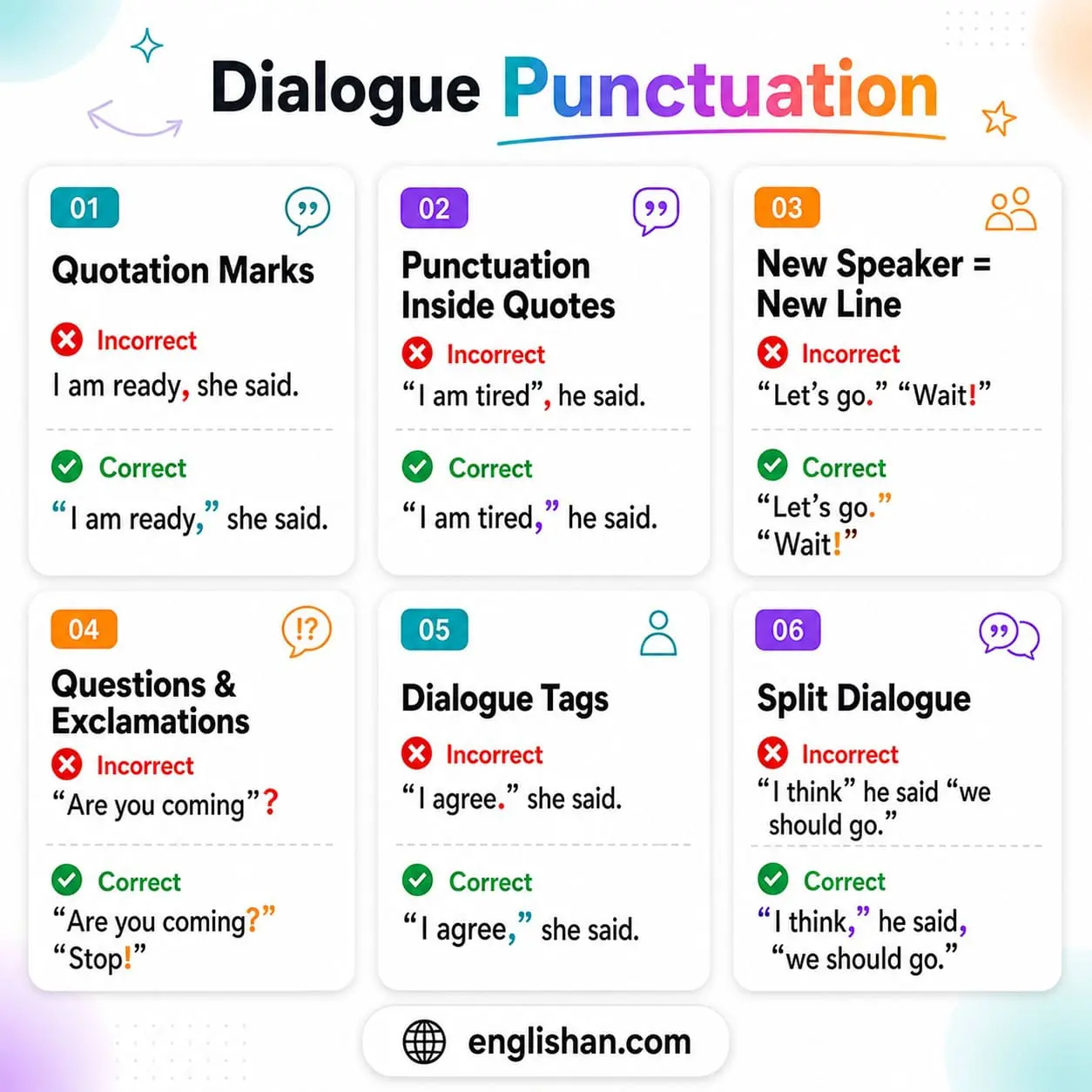
Basic Rules of Dialogue Punctuation
Before you start writing conversations, it is important to understand the basic rules of dialogue punctuation. These rules help you present spoken words clearly and correctly, so your reader can easily follow who is speaking and what is being said.
Once you learn these simple guidelines, your dialogue will feel more natural, organized, and professional. It will read smoothly and sound closer to real-life conversations, making your writing easier to understand and more engaging.
Rule 1: Use Quotation Marks for Spoken Words
Whenever someone speaks, their exact words must be placed inside quotation marks. This is the most basic and important rule because it clearly separates spoken words from the rest of the sentence. Without quotation marks, the reader may not understand what is being said aloud.
Example 1: “I am learning English.”
Example 2: “Please close the door.”
Example 3: “I will call you later.”
In simple terms, quotation marks act like a boundary; they show the reader, “These are the exact words someone said.” This makes your writing clear and easy to follow.
Rule 2: Comma with Dialogue Tags
When you use a dialogue tag such as he said, she asked, or they replied, you usually place a comma before the closing quotation mark instead of ending the sentence with a full stop. This keeps the dialogue and the tag connected as one complete thought.
Example 1: “I am ready,” he said.
Example 2: “She is waiting,” Ali replied.
Example 3: “We should leave now,” she suggested.
Using a comma here helps the sentence flow smoothly. If you use a full stop instead, it breaks the connection and makes the sentence feel awkward or incorrect.
Rule 3: Capitalisation Rule
The first word inside quotation marks always begins with a capital letter because it represents the start of a complete sentence being spoken. This rule applies even if the dialogue appears in the middle of a sentence.
Example 1: “She is coming home.”
Example 2: “They are playing outside.”
Example 3: “We need to talk.”
Capitalization gives your writing a polished and correct look. It also helps the reader immediately recognize the beginning of spoken words.
Rule 4: Ending Punctuation Rules
In dialogue writing, punctuation marks like commas and periods are always placed inside the quotation marks. Question marks and exclamation marks also go inside if they are part of the spoken sentence. These marks help show the tone and emotion of the speaker.
Example 1: “Where are you going?” she asked.
Example 2: “Stop right there!” he shouted.
Example 3: “I can’t believe this,” she said.
These punctuation marks are not just grammatical—they help bring the dialogue to life by showing whether the speaker is asking, shouting, or simply stating something.
Rule 5: New Speaker = New Paragraph
Each time the speaker changes, you should start a new paragraph. This is a formatting rule that makes dialogue much easier to read and understand, especially in longer conversations.
Example 1:
“I will go first,” Ali said.
“No, I will,” Sara replied.
Example 2:
“Are you ready?” he asked.
“Yes, let’s go,” she answered.
Example 3:
“I don’t agree,” he said.
“That’s okay,” she responded.
By giving each speaker a new line, you avoid confusion and help the reader quickly identify who is speaking at any moment.
Rule 6: Nested Quotes (Quotes inside Quotes)
Sometimes a speaker includes another person’s words inside their dialogue. In such cases, you use single quotation marks inside the main double quotation marks. This helps clearly separate the two layers of speech.
Example 1: “She said, ‘Practice makes perfect.’”
Example 2: “He told me, ‘Never give up.’”
Example 3: “They said, ‘Honesty is the best policy.’”
This rule is useful when reporting speech within speech. It keeps your writing organized and prevents confusion between different voices.
Rule 7: Dialogue Without Tags
Not every line of dialogue needs a tag like he said or she replied. If it is already clear who is speaking, you can leave out the tag. However, the punctuation rules still remain the same.
Example 1: “I don’t understand.”
Example 2: “This is amazing!”
Example 3: “Can we try again?”
This approach makes dialogue feel more natural and less repetitive. It is often used in stories where the speakers are already clear from the context.
Rule 8: Multi-Paragraph Dialogue Rule
When one speaker talks for more than one paragraph, you start each paragraph with quotation marks, but you only close the quotation marks at the end of the final paragraph. This shows that the same person is still speaking.
Example 1: “I want to explain something important.
We have been working on this for months.”
Example 2: “This is not easy to say.
But we need to make a decision today.”
Example 3: “I remember those days clearly.
They were the best moments of my life.”
This rule is especially useful in longer speeches or storytelling. It helps maintain clarity while allowing the speaker to continue without interruption.
US vs UK Dialogue Punctuation Rules
Dialogue punctuation can be slightly different in American and British English.
Dialogue punctuation can vary slightly between American and British English, and this difference mainly appears in how punctuation is placed with quotation marks. In American English, commas and periods are almost always placed inside the quotation marks, even if they are not part of the original spoken words. In British English, however, punctuation is placed inside the quotation marks only if it is part of the actual speech; otherwise, it is placed outside.
Example 1 (American): “I am ready,” he said.
Example 2 (British): ‘I am ready’, he said.
This difference may seem small, but it plays an important role in maintaining accuracy and consistency in writing. It is especially useful for students, writers, and content creators who are targeting a specific audience or following a particular style guide. The key is not which style you choose, but how consistently you apply it throughout your writing, so your work looks clear, polished, and professional.
Inner vs Outer Dialogue
Outer dialogue refers to the words that are spoken out loud, while inner dialogue shows a character’s thoughts. Outer dialogue is written using quotation marks, but inner dialogue is often written in italics or simply as a normal sentence without quotes.
Example 1 (Outer): “I don’t agree,” he said.
Example 2 (Inner): I don’t agree with this at all.
Example 3 (Mixed): “I understand,” she said, but she thought, This doesn’t make sense.
This difference helps the reader clearly separate what is being said from what is being thought. It adds depth to writing by showing both speech and internal feelings.
Dialogue Tag Integration
Dialogue and its tag, such as he said or she replied, usually work together as one complete sentence. This is why punctuation like commas is used to connect them properly.
Example 1: “I am tired,” he said.
Example 2: “Let’s go home,” she suggested.
Example 3: “I can help you,” he offered.
Treating dialogue and tags as one unit makes your sentences smoother and more natural. It also helps avoid common punctuation mistakes and keeps your writing clear and professional.
Common Mistakes in Dialogue Punctuation
Even when you understand the rules of dialogue punctuation, it is still very easy to make small mistakes while writing. These mistakes can make your dialogue look confusing or grammatically incorrect. That is why it is important to recognize the most common errors so you can avoid them and improve the clarity and quality of your writing.
Using hyphen or dash instead of comma
One of the most common errors in dialogue writing is using a hyphen or dash between spoken words and the dialogue tag instead of a comma. In proper punctuation, a comma is required to connect the spoken sentence with the tag. Using a dash makes the sentence look incorrect and breaks the natural flow of dialogue.
Wrong: “I am coming”-he said.
Correct: “I am coming,” he said.
In correct usage, the comma smoothly links the spoken words with the speaker, making the sentence grammatically accurate and easy to read.
Incorrect capitalization
Another frequent mistake is not capitalizing the first word of the spoken sentence. Every piece of dialogue should start with a capital letter because it is treated as a complete sentence, even if it appears in the middle of another sentence.
Wrong: “i am ready.”
Correct: “I am ready.”
Proper capitalization gives your writing a clean and professional appearance and ensures that the dialogue follows standard English grammar rules.
Mixing punctuation styles
Writers sometimes make the mistake of placing punctuation marks in the wrong position or mixing sentence structure incorrectly, especially with question marks and dialogue tags. The punctuation must match the meaning of the sentence and be placed inside the quotation marks when it belongs to the spoken words.
Wrong: “Where are you going,” She asked?
Correct: “Where are you going?” she asked.
In correct form, the question mark stays inside the quotation marks, and the dialogue tag continues in lowercase because it is part of the same sentence.
Forgetting paragraph breaks
Another important mistake is not starting a new paragraph when the speaker changes. If all dialogue is written in one block, it becomes confusing for the reader to understand who is speaking.
Wrong: “I will go first,” Ali said. “No, I will,” Sara replied.
Correct: “I will go first,” Ali said.
“No, I will,” Sara replied.
Breaking paragraphs when the speaker changes makes the conversation clear, organized, and easy to follow. It helps the reader instantly recognize each speaker without confusion.
Practice Exercises: Dialogue Punctuation
Complete the exercises below to test your understanding of dialogue punctuation rules. The answers are given at the bottom.
Exercise 1: Add Correct Punctuation (Quotation Marks + Comma)
Rewrite the sentence with proper dialogue punctuation.
- She said I am learning English
Exercise 2: Fix the Mistake (Comma + Capitalization)
Correct the punctuation and capitalization in the sentence.
- “i am ready” he said
Exercise 3: Change into Correct Dialogue Format
Combine the idea using proper dialogue punctuation.
- He asked Are you coming with us
Exercise 4: Choose the Correct Version (Question Mark Placement
Select and rewrite the correct sentence.
- “Where are you going” she asked
Exercise 5: Fix Paragraph Break Error
Correct the dialogue by using proper paragraph breaks.
- “I will go first,” Ali said. “No, I will go first,” Sara replied. “Okay, decide quickly,” Ali said again.
Answer Key:
- She said, “I am learning English.”
- “I am ready,” he said.
- He asked, “Are you coming with us?”
- “Where are you going?” she asked.
- “I will go first,” Ali said.
“No, I will go first,” Sara replied.
“Okay, decide quickly,” Ali said again.
Final Thought
Dialogue punctuation may seem like a small part of writing, but it plays a very important role in making conversations clear, natural, and easy to understand. When you correctly use quotation marks, commas, capitalization, and proper formatting, your writing immediately becomes more polished and professional.
Once you practice these rules with examples, they start to feel automatic in your writing. In the end, good dialogue punctuation is not just about grammar, it is about helping your reader experience smooth, realistic conversations without confusion.
FAQs: Dialogue Punctuation
Dialogue punctuation refers to the rules used to write spoken words correctly in a text. It includes quotation marks, commas, question marks, and exclamation marks to show exactly what is being said and how it should sound.
Yes, quotation marks are used to show the exact words spoken by a person. Without them, it becomes unclear which part of the sentence is speech and which part is narration.
When a dialogue tag like he said or she replied is used, the comma is placed inside the quotation marks before the tag. This connects the spoken words smoothly with the speaker.
Question marks and exclamation marks go inside the quotation marks if they are part of the spoken sentence. They help show the tone, such as asking a question or showing strong emotion.
Dialogue punctuation is important because it makes conversations clear, readable, and natural. It helps the reader easily understand who is speaking and how the dialogue should sound, just like real-life speech.
You May Also Like