Abbreviations are a normal part of everyday writing. We see them all the time in words like “Mr.”, “Dr.”, “U.S.”, or “etc.” Most of us use them without thinking, but the punctuation inside these short forms plays an important role in keeping writing clear and correct. Even a small dot or its absence can change how something is understood.
When you learn how punctuation in abbreviations works, your writing automatically looks more polished and professional. It also helps avoid confusion in formal and informal texts. The rules are not difficult, and once you understand them, you can apply them easily in your daily writing. In this article, we’ll learn about punctuation in abbreviations: rules, usage, and examples.
What Are Abbreviations?
Abbreviations are short forms of words or phrases that we use to save time and space while writing. Instead of writing a full word like “doctor,” we often write “Dr.” or instead of “for example,” we use “e.g.” They are commonly used in both formal and informal writing to make sentences quicker and easier to read.
We see abbreviations in many places in daily life, such as titles, addresses, measurements, and even messages. They help keep writing neat while still carrying the same meaning as the full words.
Examples:
- Doctor → Dr.
- Mister → Mr.
- For example → e.g.
- United States → U.S.
- Etcétera → etc.
Understanding abbreviations makes your writing more efficient and professional. Once you know how they work, you can use them confidently in both formal and casual communication without any confusion.
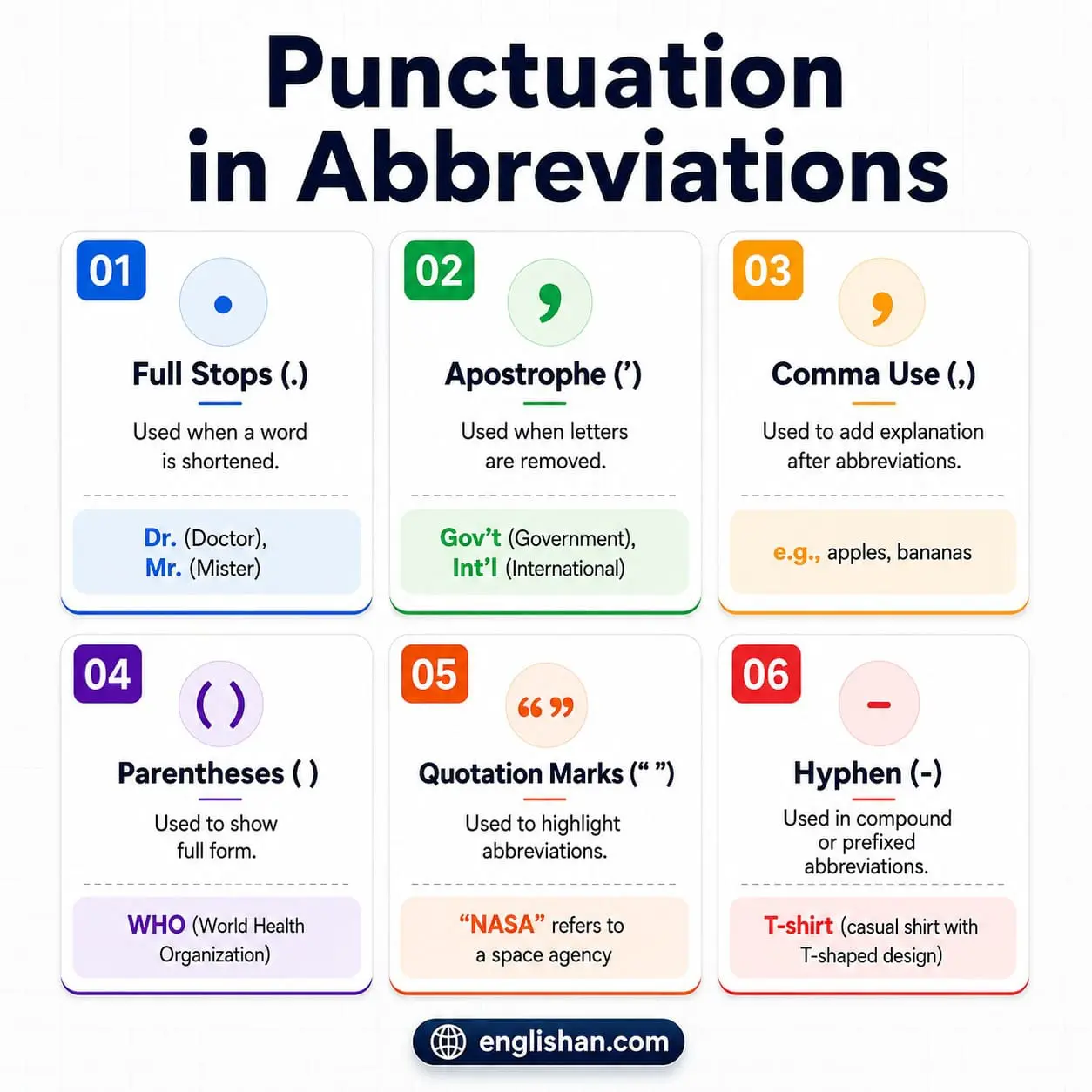
Types of Abbreviations
Abbreviations come in different forms, and each type is used in a slightly different way depending on how the words are shortened and how they are spoken or written. Understanding these types helps you use them correctly and avoid common mistakes.
Acronyms
Acronyms are abbreviations formed from the first letters of a group of words, and they are pronounced as a single word. Instead of reading each letter separately, we say them as one word, which makes communication easier and faster.
In most cases, no punctuation is used in acronyms.
Example 1: NASA
Example 2: NATO
Example 3: UNESCO
Acronyms are widely used in science, government, and international organizations because they make long names easier to remember and use in everyday writing.
Initialisms
Initialisms are also formed from the first letters of words, but each letter is pronounced separately rather than as a single word. They are very common in formal writing and everyday communication.
In modern usage, they usually do not include punctuation.
Example 1: USA
Example 2: BBC
Example 3: FBI
Initialisms help shorten long names while keeping the meaning clear, especially in news, official documents, and general communication.
Contractions
Contractions are shortened forms of words where some letters are omitted to make writing quicker and simpler. They are often used in titles, common expressions, and informal writing.
They may include full stops or apostrophes depending on style.
Example 1: Dr.
Example 2: Gov’t
Example 3: Mr.
Contractions make writing more efficient, and they are especially useful in everyday communication where shorter, simpler forms are preferred.
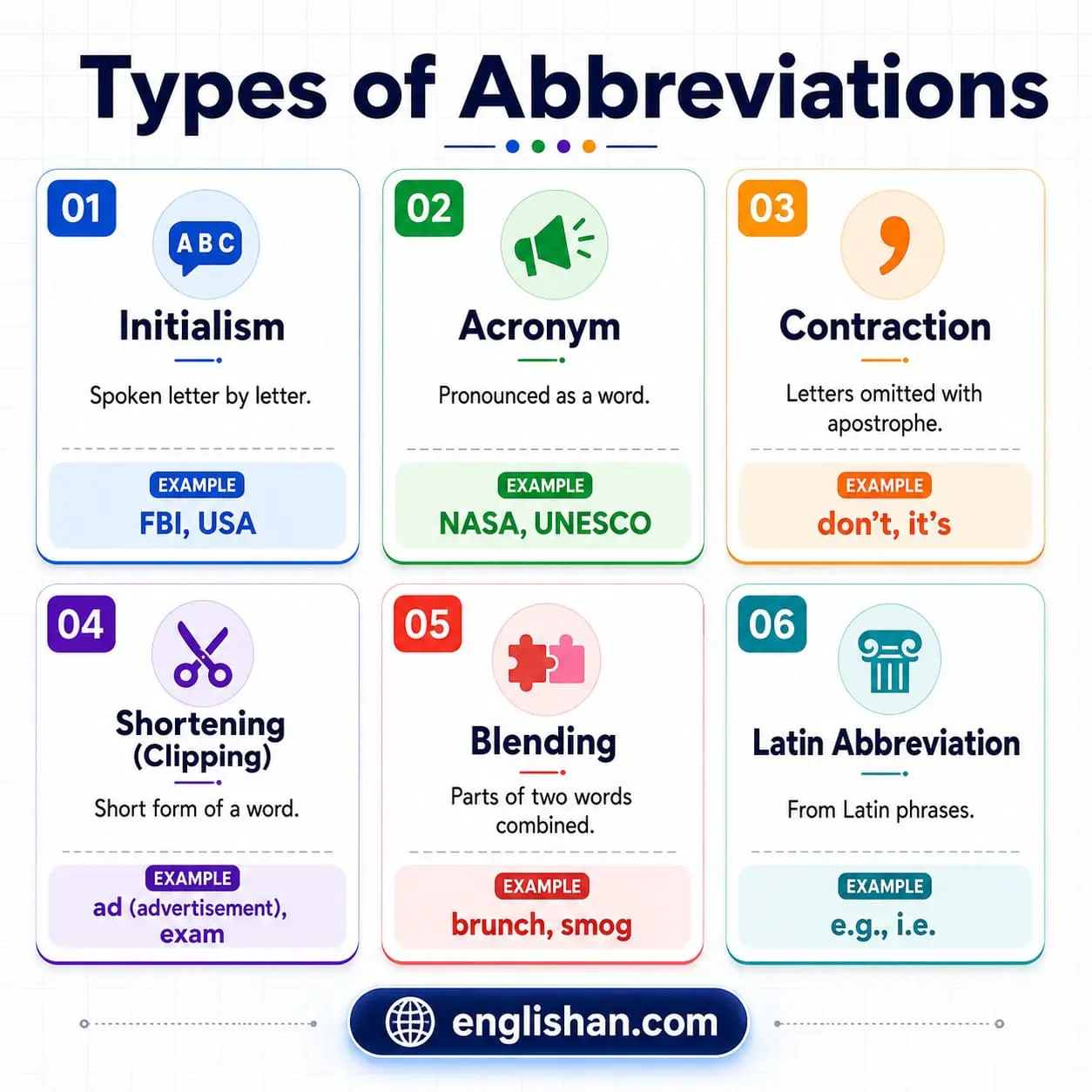
Rules of Punctuation in Abbreviations
Punctuation in abbreviations can vary depending on style, region, and purpose. Some styles prefer full stops, while others avoid them completely. The key is understanding the rule behind each type so you can use abbreviations correctly and consistently in your writing.
Rule 1: Traditional Use of Full Stops
In older or more formal British English writing, full stops are commonly used after abbreviations. This style clearly shows that a word has been shortened.
Example 1: Dr.
Example 2: Mr.
Example 3: e.g.
This approach is still seen in many formal texts and traditional writing styles.
Rule 2: Modern Style Omits Full Stops
In modern writing, especially in American English and contemporary communication, full stops are often dropped. This makes writing cleaner and faster to read.
Example 1: Dr
Example 2: Mr
Example 3: USA
This style is now widely accepted in most informal and professional contexts.
Rule 3: Latin Abbreviations Keep Periods
Some Latin-based abbreviations traditionally keep full stops, and they are still commonly written this way in academic and formal writing.
Examples:
Example 1: e.g. (for example)
Example 2: i.e. (that is)
Example 3: etc. (and so on)
These are standard forms, especially in essays and formal documents.
Rule 4: Units of Measurement Have No Punctuation
Scientific and technical abbreviations never use full stops. This keeps measurements simple and universally understood.
Examples:
Example 1: kg
Example 2: cm
Example 3: km
This rule is important in science, maths, and technical writing.
Rule 5: Acronyms Never Use Periods
Acronyms are written without punctuation because they are pronounced as full words rather than letter by letter.
Examples:
Example 1: NASA
Example 2: UNESCO
Example 3: NATO
This makes them easier to read and recognize quickly.
Rule 6: Consistency Rule (Most Important)
The most important rule is consistency. Once you choose a style, you should follow it throughout your writing. Mixing styles can make your work look unprofessional and confusing.
Maintaining consistency ensures clarity and gives your writing a polished, well-structured appearance.
Importance of Using Punctuation Correctly in Abbreviations
Using correct punctuation in abbreviations is important because it directly affects how clear, professional, and reliable your writing appears. Even though abbreviations are meant to make writing shorter, incorrect or inconsistent punctuation can create confusion and reduce the quality of the text.
- Improves readability
- Enhances professional writing
- Avoids confusion
- Maintains consistency across documents
- Helps meet academic and SEO writing standards
Overall, correct punctuation in abbreviations is not just a grammar rule—it is a key part of clear, professional, and effective communication.
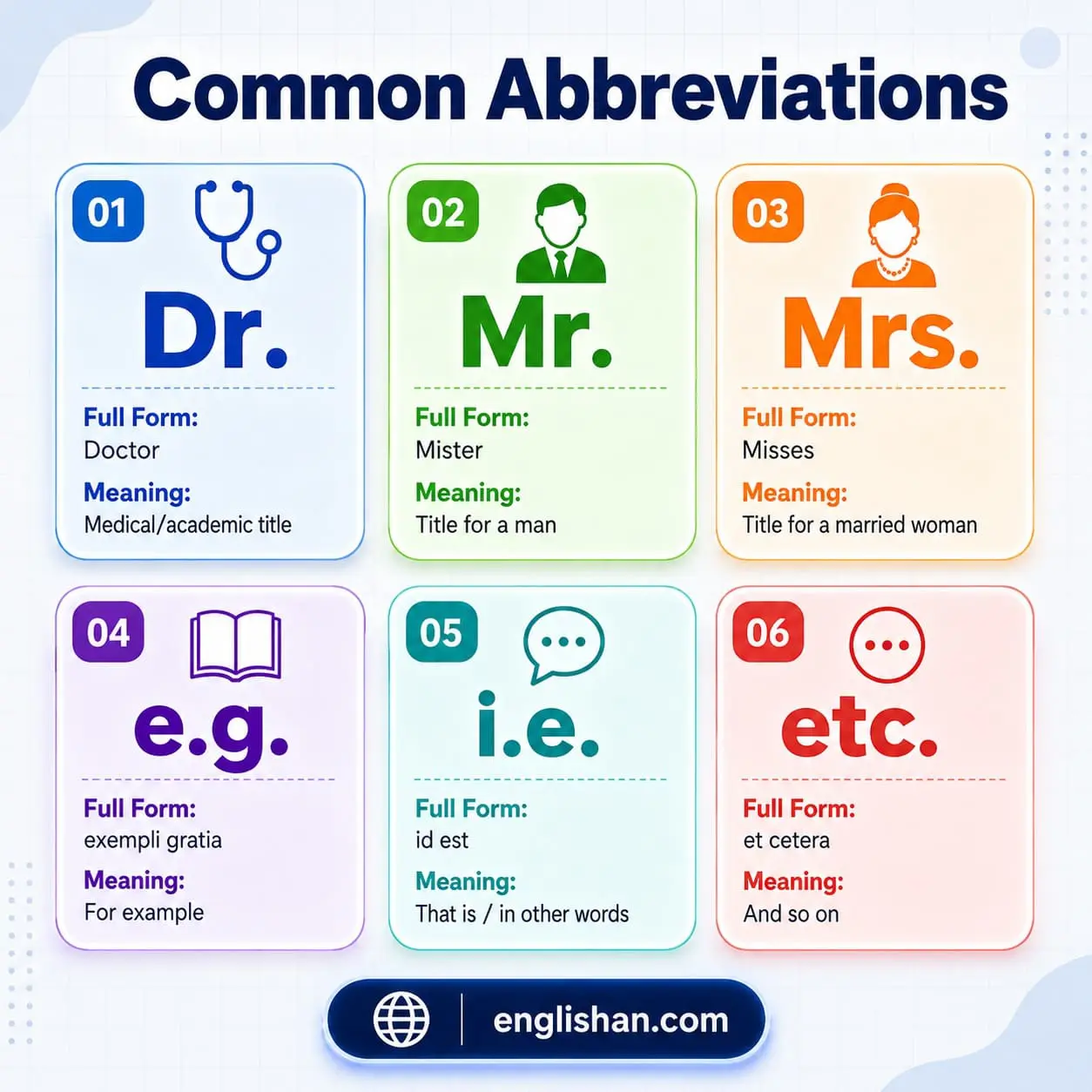
Common Mistakes in Abbreviations
Even though abbreviations look simple, many writers make small mistakes that can affect clarity and professionalism. These errors often happen when rules are mixed or when abbreviations are used without consistency. Let’s look at some common issues and how to avoid them.
Mixing Styles in One Document (Dr vs Dr.)
One of the most common mistakes is switching between styles in the same piece of writing. For example, using a full stop in one place and dropping it in another can make your writing look inconsistent and unpolished.
- ❌ Incorrect: Dr. Ahmed is here, and Dr Khan will join later.
- ✔ Correct: Dr. Ahmed is here, and Dr. Khan will join later.
(or consistently: Dr Ahmed is here, and Dr Khan will join later.)
Sticking to one style throughout your document keeps everything neat and professional.
Adding Periods to Acronyms
Acronyms are pronounced as words, so they do not need full stops between letters. Adding periods makes them look outdated and harder to read.
- ❌ Incorrect: N.A.S.A. launched a new mission.
- ✔ Correct: NASA launched a new mission.
Modern writing always avoids punctuation in acronyms.
Inconsistent Formatting
Sometimes writers use different formats for similar abbreviations, which creates confusion. This can happen when switching between formal and informal styles without noticing
- ❌ Incorrect: The meeting is at 5 p.m and will end by 6 PM.
- ✔ Correct: The meeting is at 5 p.m. and will end by 6 p.m.
(or consistently: 5 PM and 6 PM)
Keeping the same format makes your writing clearer and easier to follow.
Overusing Informal Abbreviations in Formal Writing
Informal abbreviations are common in texting and casual writing, but they should be avoided in formal or academic work. Using them in the wrong context can make your writing seem unprofessional.
- ❌ Incorrect: The report was delayed bcz of issues.
- ✔ Correct: The report was delayed because of issues.
Choosing the right type of abbreviation based on context helps maintain the tone and quality of your writing.
Practice Exercises: Punctuation in Abbreviations
To get better at punctuation in abbreviations, practice is really important. These exercises will help you understand when to use full stops, when to avoid them, and how to stay consistent in your writing. Try to answer them on your own first, then check your answers below.
Exercise 1: Add the correct punctuation (full stop or no full stop).
She met ___ Ahmed at the clinic.
Exercise 2: Fix this sentence. Replace the incorrect punctuation.
He works at N.A.S.A. as an engineer.
Exercise 3: Choose the correct form (with or without full stop).
The meeting is scheduled at 5 p.m / 5 pm.
Exercise 4: Correct the abbreviation style.
The package weighs 5 k.g and is 20 c.m long.
Exercise 5: Fix the mistake.
The report includes examples e.g, grammar rules and usage.
Answer Key:
1. She met Dr. Ahmed at the clinic.
2. He works at NASA as an engineer.
3. The meeting is scheduled at 5 p.m. (or consistently: 5 pm)
4. The package weighs 5 kg and is 20 cm long.
5. The report includes examples e.g., grammar rules and usage.
Final Thought on Punctuation in Abbreviations
As we learned, punctuation in abbreviations may seem like a small detail, but it plays a big role in making your writing clear, consistent, and professional. From knowing when to use full stops to understanding modern style preferences, each rule helps you avoid confusion and present your ideas more effectively.
The key takeaway is to choose a style and stick with it throughout your writing. With a little practice, using abbreviations correctly becomes natural, and it can significantly improve the overall quality of your communication.
FAQs: Punctuation in Abbreviations
No, not all abbreviations need full stops. In traditional or British-style writing, you will often see full stops used in abbreviations like “Dr.” and “Mr.” to show that the word has been shortened. However, in modern writing, especially in American English, these full stops are often removed to keep the text clean and simple. The important thing is to choose one style and use it consistently throughout your writing.
No, acronyms should not have periods between their letters. Since acronyms are pronounced as full words, such as “NASA” or “UNESCO,” adding periods like “N.A.S.A.” is considered outdated and unnecessary. Modern writing always prefers the cleaner version without punctuation.
Latin abbreviations like “e.g.”, “i.e.”, and “etc.” usually keep their full stops because they follow traditional rules that are still widely accepted in formal and academic writing. These abbreviations come from Latin phrases, and the punctuation helps maintain clarity and distinction in meaning, especially in structured or scholarly content.
No, units of measurement such as “kg”, “cm”, and “km” do not use full stops. This rule is followed in scientific, technical, and everyday writing to keep measurements clear and universally understood. Adding punctuation in these cases would be incorrect and could create confusion.
The most important rule is consistency. Whether you choose to use full stops or not, you should follow the same pattern throughout your document. Inconsistent use of punctuation can make your writing look unprofessional and may confuse the reader. Consistency ensures clarity and gives your writing a polished, well-organized appearance.
You May Also Like