

Hyphens and dashes may look quite similar at first glance, but they play very different roles in writing. This small detail often creates confusion, even for those who write regularly. Knowing how each one functions not only improves clarity but also gives writing a more natural and polished flow.
In this article, we will learn the clear differences between hyphens vs dashes, along with simple rules and practical examples. The discussion will make it easier to understand where each punctuation mark fits and how they shape the meaning and rhythm of a sentence in everyday writing.
Hyphen vs Dash: What’s the Difference?
A hyphen (-) vs a dash (—) may look similar, but they serve different purposes in writing. Understanding the distinction is not just about punctuation rules, but about how words and ideas are structured within a sentence. Both marks help improve clarity, but they do so in different ways.
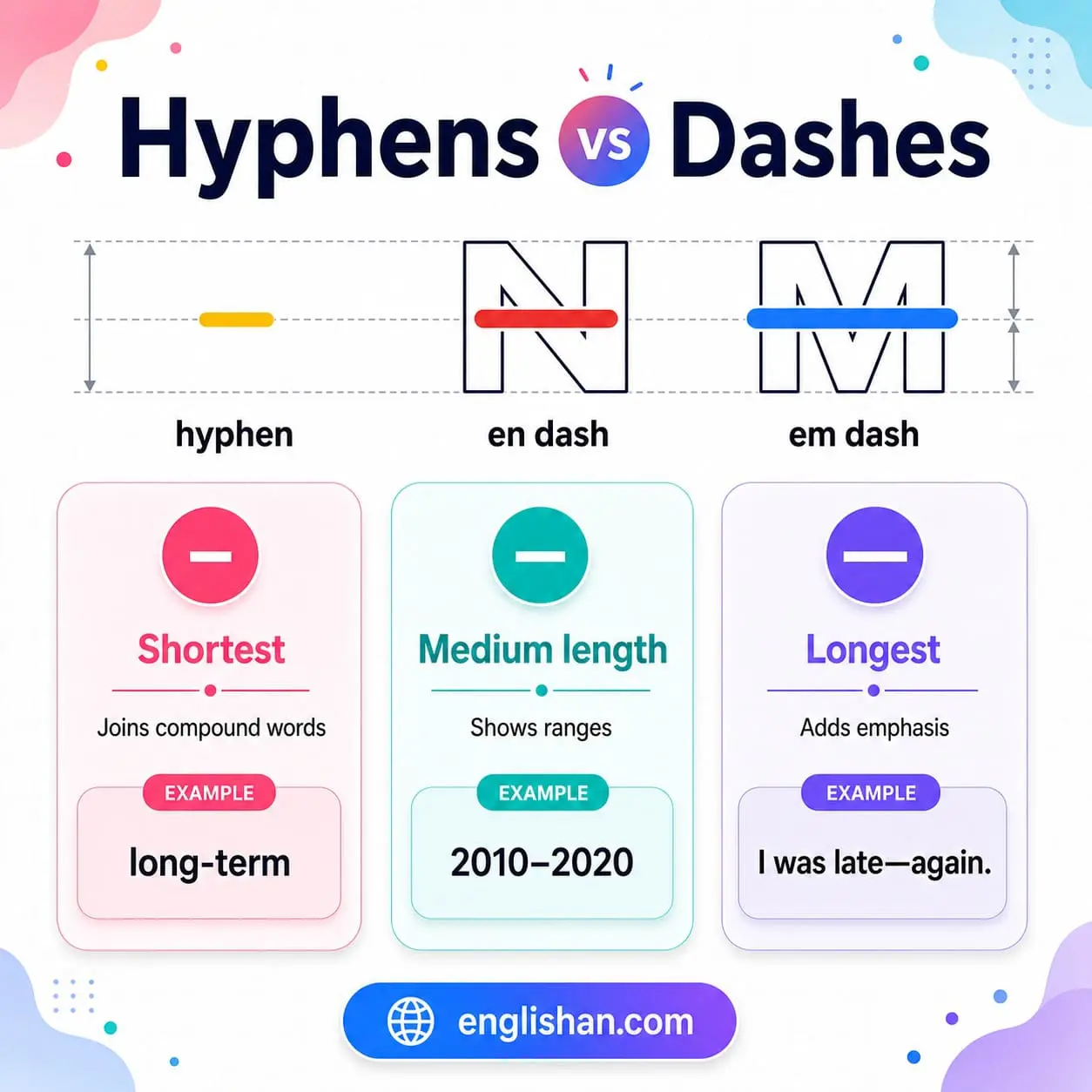
A hyphen (-) is used to join words or parts of words so they function together as a single idea. It is commonly found in compound words and numbers, helping avoid confusion and making meaning more precise.
Example 1: She is a well-known author.
Example 2: There are twenty-one students in the class.
Example 3: He has a part-time job after school.
A dash (—), on the other hand, is used to create a break in a sentence. It adds emphasis, inserts extra information, or shows a shift in thought. It makes writing feel more natural and expressive.
Example 1: She was ready to leave—until the phone rang.
Example 2: My brother—who lives in Lahore—is visiting next week.
Example 3: He finally answered—after hours of waiting.
Simply put, a hyphen connects words so they work together as one idea, while a dash is used to add a pause, extra detail, or a bit of emphasis in a sentence.
What Is a Hyphen (-)?
A hyphen (-) is a punctuation mark used to connect words or parts of words so they function together as one unit. It helps make meaning clearer by linking terms that describe a single idea, and is mainly used to join words in compound forms or to avoid confusion in writing.
For Example:
- well-known author
- mother-in-law
- high-speed train
- six-year-old child
What Is a Dash (—)?
A dash (—) is a punctuation mark used to create a pause, add emphasis, or separate parts of a sentence more strongly than a comma or hyphen.
There are two main types of dashes: en dash (–) and em dash (—).
For Example:
- She was going to leave—until she changed her mind.
- My brother—who lives in Canada—is visiting us.
- The meeting will run 10–12 a.m.
Types of Dashes: En Dash (–) and Em Dash (—)
Dashes are punctuation marks that come in two main types, each used for different purposes in writing.
En Dash (–)
The en dash is slightly longer than a hyphen and is mainly used to show a range or connection between numbers, dates, or places.
For Example:
- 2010–2020
- pages 5–15
- Lahore–Karachi route
Em Dash (—)
The em dash is longer than the en dash and is used to create strong pauses, add extra information, or emphasize parts of a sentence.
For Example:
- She was ready to leave—until she got the news.
- My friend—who lives abroad—is visiting today.
- I wanted to call you—but I forgot.
When to Use Hyphens (5 Rules)
Hyphens are used in writing whenever words need to be closely linked so they work together as a single, clear unit of meaning. The following rules explain how hyphens are correctly used in different situations.
Rule 1: In compound adjectives before a noun
Hyphens are used when two or more words jointly describe a noun. This connection ensures that the description is understood as one complete idea rather than separate words.
Example 1: We traveled on a high-speed train that reduced our journey time significantly.
Example 2: He found a full-time job soon after completing his degree.
Example 3: They adopted a six-year-old child who quickly became part of their family.
This use helps descriptive words stay connected so they clearly act together as a single, precise description of a noun.
Rule 2: In fixed compound terms
Hyphens are used in expressions where words naturally belong together and represent a single role, title, or concept. This keeps the meaning stable and avoids breaking the expression into separate parts.
Example 1: My mother-in-law arrived yesterday and stayed for the weekend.
Example 2: The editor-in-chief approved the final draft before publication.
Example 3: Passengers must complete their check-in before boarding the flight.
This usage keeps established word combinations intact so they are understood as one complete and meaningful unit.
Rule 3: With prefixes (for clarity and readability)
Hyphens are sometimes added when prefixes are attached to words to ensure clarity and smooth reading. They help avoid awkward formations and make the structure easier to interpret.
Example 1: The company plans to re-enter the international market after several years of preparation.
Example 2: He is an ex-president who still plays an advisory role in the organization.
Example 3: Self-respect is an important quality for personal development.
This use improves readability by clearly separating word parts when needed, ensuring the meaning remains direct and easy to follow.
Rule 4: To avoid confusion in meaning
Hyphens are used when a word or phrase could be interpreted in more than one way. They remove ambiguity by clearly showing how the words should be grouped or understood.
Example 1: The workers will re-cover the damaged roof after the heavy storm.
Example 2: After the operation, she began to recover quickly.
Example 3: He is a small-business owner who runs a bakery in the city.
This function ensures that sentences are interpreted correctly by preventing possible confusion in meaning.
Rule 5: In written numbers (when spelled out)
Hyphens are used to connect compound numbers written in words so they flow as one unit. This makes them easier to read and understand smoothly.
Example 1: She scored twenty-one marks in her final mathematics exam.
Example 2: The delivery will arrive in forty-eight hours.
Example 3: His grandmother is ninety-nine years old and still very active.
This usage helps number words connect naturally so they are read as a single continuous value rather than separate parts.
When to Use En Dashes (–) (4 Rules)
An en dash is used when writing needs to show a connection, range, or relationship between two things. It is slightly longer than a hyphen and is mainly used to express “from one point to another” or “between two related items.” Unlike a hyphen, which joins words into one idea, the en dash often shows a span or link between separate elements.
Rule 1: To show ranges (numbers, dates, time)
One of the most common uses of an en dash is to indicate a range, meaning “from…to…” in a compact form. It is often used for numbers, years, pages, or time periods.
Example 1: The meeting will be held from 10–12 a.m.
Example 2: She studied at the university from 2015–2019.
Example 3: Please read pages 45–60 for homework.
In ranges, the en dash neatly replaces words like “to” or “through,” making numbers, dates, and times easier to read and more compact.
Rule 2: To show connections between places or equal relationships
En dashes are used to show a link or relationship between two separate places or concepts, especially when both carry equal importance.
Example 1: The Lahore–Karachi motorway is one of the busiest routes in the country.
Example 2: The India–Pakistan match attracted a huge audience worldwide.
Example 3: The teacher–student interaction is very important in learning.
In such cases, the en dash expresses a direct connection or balance between two items, showing that both sides are equally significant.
Rule 3: To indicate direction or movement
Sometimes en dashes are used to show movement from one point to another, especially in journeys or transitions.
Example 1: The flight from New York–London was delayed due to weather conditions.
Example 2: The train runs on the Karachi–Lahore route daily.
Example 3: The hiking trail connects valley–mountain regions.
Here, the en dash helps show direction or travel between two points in a clear and concise way.
Rule 4: In complex compound structures (advanced usage)
En dashes are also used in more complex writing where words or phrases already contain internal elements, helping avoid confusion.
Example 1: The post–World War II era brought major global changes.
Example 2: She specializes in semi–government organizational policies.
Example 3: The Nobel Prize–winning scientist gave a lecture.
In these cases, the en dash improves readability by separating complex parts while still keeping them clearly connected.
When to Use Em Dashes (—) (5 Rules)
An em dash is used when writing needs a strong pause, an interruption, or an added piece of information that feels more important or dramatic than a comma would allow. It is flexible and often replaces commas, parentheses, or even colons when a sharper or more noticeable break is needed in a sentence.
Rule 1: To add extra information or explanation
An em dash can insert additional details into a sentence without breaking its flow. This added information usually gives more clarity or context.
Example 1: My brother—who lives in Canada—will visit us next month.
Example 2: The book—written over ten years—became an international bestseller.
Example 3: The city—famous for its rich culture—attracts thousands of tourists every year.
In this use, em dashes smoothly insert extra information that supports the main idea without interrupting the overall sentence structure.
Rule 2: To show sudden interruption or break in thought
Em dashes are used when a sentence is suddenly interrupted, either by another speaker or by a shift in thought.
Example 1: I was about to leave—when the phone suddenly rang.
Example 2: He wanted to explain—but there was no time left.
Example 3: “I think we should—” she paused and looked at the door.
Here, the em dash captures a natural break in thought or speech, making the sentence feel more realistic and expressive.
Rule 3: To emphasize a point
An em dash can be used to highlight or stress an important idea at the end or middle of a sentence.
Example 1: There is one thing everyone needs—discipline.
Example 2: He finally achieved what he wanted most—success.
Example 3: The answer is simple—hard work.
In this case, the em dash draws attention to the key idea, making it stand out strongly for emphasis.
Rule 4: To replace commas for clearer structure
When a sentence already contains commas or feels too complex, em dashes can be used to make the structure easier to read.
Example 1: The manager, after reviewing the reports—some of which were incomplete—decided to delay the meeting.
Example 2: My friend, who had been traveling for months—finally returned home.
Example 3: The project, despite many challenges—was completed successfully.
Em dashes in this case improve readability by separating complex parts of a sentence more clearly than multiple commas would.
Rule 5: To introduce a conclusion or result
An em dash can lead into a final idea or outcome, often giving a sense of closure or final emphasis.
Example 1: She studied for years, stayed focused, and never gave up—she finally became a doctor.
Example 2: The team worked hard, faced setbacks, and kept going—they won the championship.
Example 3: He saved money for a long time, planned carefully, and took risks—he built his own business.
Here, the em dash creates a strong ending effect, highlighting the result or conclusion in a clear and impactful way.
How to Type Hyphens, En Dashes, and Em Dashes
These three marks look similar, but they are typed in slightly different ways depending on the keyboard or device.
Typing a Hyphen (-)
The hyphen is the simplest to type because it is already present on all keyboards. This is how to type hyphen:
- Press the key next to “0” (minus/hyphen key)
The hyphen can be typed instantly using a single standard keyboard key.
Typing an En Dash (–)
The en dash is not directly available on most keyboards, so it is entered using shortcuts or special options such as:
- Windows: Alt + 0150 (using numeric keypad)
- Mac: Option + Hyphen
- Google Docs / Word: Insert → Special Characters
The en dash is typed using shortcuts or insert tools since it is not a direct keyboard key.
Typing an Em Dash (—)
The em dash also requires shortcuts or automatic formatting depending on the software.
- Windows: Alt + 0151 (numeric keypad)
- Mac: Shift + Option + Hyphen
- Word: typing — often converts automatically into an em dash
The em dash is entered through shortcuts or automatic replacement rather than a single key.
Practice Exercises: Hyphen vs Dash
Complete the exercises below to test your understanding. The answers are listed at the bottom.
Exercise 1: Add the correct punctuation (hyphen or dash).
She is a well _____ known author who has written many books.
Exercise 2: Fix this sentence. Replace the incorrect punctuation.
I finally met my teacher – who had been on leave – after two weeks.
Exercise 3: Combine the idea using a hyphen where needed.
He works full time. He is a dedicated employee.
Exercise 4: Choose the correct mark (hyphen or dash).
The meeting will take place from 9 _____ 11 a.m.
Exercise 5: Fix the mistake.
My mother – in – law is visiting us this weekend.
Answer Key:
- She is a well-known author who has written many books.
- I finally met my teacher—who had been on leave—after two weeks.
- He is a full-time employee and a dedicated worker.
- The meeting will take place from 9–11 a.m.
- My mother-in-law is visiting us this weekend.
Final Thought
These punctuation marks may seem small, but they play a big role in making writing clear and easy to follow. Each one helps shape meaning in a slightly different way, guiding how a sentence is read and understood.
With regular use, they become a natural part of writing rather than something technical to think about. They simply help ideas flow better and make communication more precise without adding complexity.
You May Also Like