Parentheses ( ) are small punctuation marks, but they play a useful role in writing. They are used to add extra information, explanations, or side notes without interrupting the main sentence. You’ll often see them in everyday writing, whether it’s giving a quick detail, clarifying something, or adding a helpful comment.
Understanding how to use parentheses correctly can make your writing clearer and more natural. They help you include additional ideas while keeping your sentence smooth and easy to read. In this article, you’ll learn the basic rules of parentheses along with simple examples to help you use them with confidence.
What are parentheses?
Parentheses ( ) are punctuation marks used in writing to include extra information within a sentence. This information is not essential to the main idea, but it helps to explain, clarify, or add supporting details. The sentence remains complete and meaningful even if the words inside the parentheses are removed.
In writing, parentheses are used to keep sentences clear and well-structured by separating the main message from additional information. They are commonly used in both formal and informal contexts to make communication more precise and easier to understand.
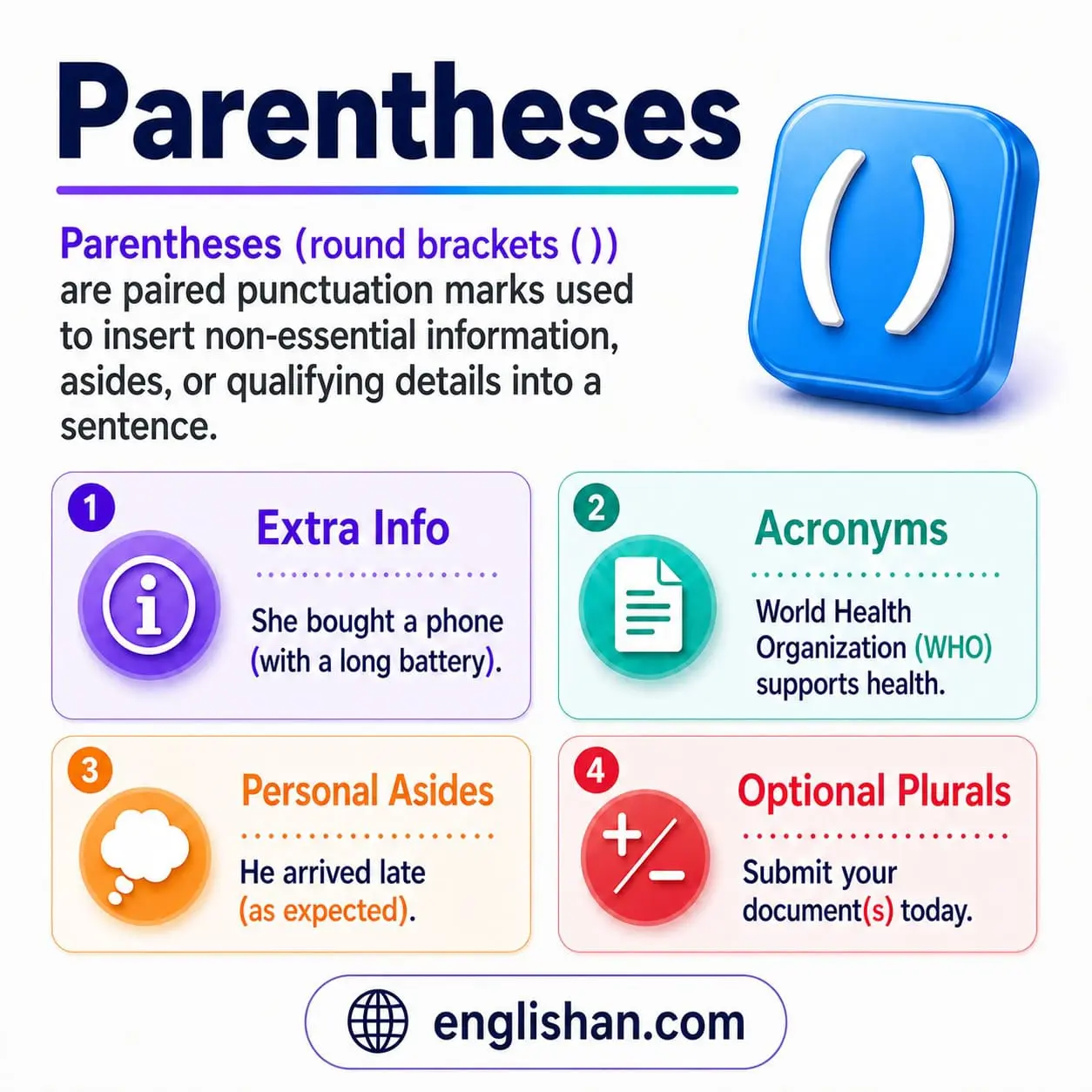
When to Use Parentheses
Parentheses are not used randomly in writing; they follow specific situations where extra or supporting information needs to be added without interrupting the main sentence. Understanding these situations helps in using them correctly and making writing more clear and organized.
Using Parentheses to add extra information
Parentheses are often used to include additional details that enhance the sentence but are not necessary for its basic meaning. This helps avoid overloading the main sentence with too much information.
Example 1: She bought a new phone (with a long-lasting battery) for her daily use.
Example 2: The school is located in Lahore (a major educational hub of Pakistan).
Using Parentheses to give explanations
They are used to briefly explain a word, idea, or situation without interrupting the flow of the sentence. This keeps writing simple and easy to understand.
Example 1: The match was postponed (due to heavy rainfall in the city).
Example 2: He could not attend the meeting (because of sudden illness).
Using Parentheses to define acronyms
Parentheses are commonly used when introducing abbreviations. The full form is written first, followed by the short form in parentheses for clarity.
Example 1: World Health Organization (WHO) provides international health support.
Example 2: Light Emitting Diode (LED) bulbs are energy efficient.
Using Parentheses to add personal comments
Sometimes parentheses are used to include a small personal remark or observation within a sentence. These comments are usually informal but help add a natural tone to writing.
Example 1: The task was completed before the deadline (which was quite surprising).
Example 2: He arrived late again (as expected).
Using Parentheses to show optional plurals
Parentheses can also indicate that both singular and plural forms are acceptable, especially in instructions or formal writing.
Example 1: Please submit your application(s) before the closing date.
Example 2: Bring your ID card(s) for verification.
Using Parentheses to Include Citations
In academic or research writing, parentheses are used to mention sources, references, or author details. This adds credibility to the information presented.
Example 1: Education is a key factor in development (Khan, 2021).
Example 2: This concept was further developed in later studies (Ali & Ahmed, 2019).
Parenthesis vs. Parentheses
The words parenthesis and parentheses are closely related but have different meanings and uses. The difference mainly comes from singular and plural form, and understanding this helps avoid confusion in grammar and writing.
Parenthesis is the singular form and refers to just one of the two punctuation marks. In simple terms, it means a single bracket ( ). It is rarely used alone in writing because punctuation normally comes in pairs.
Example: The word inside a single parenthesis is not complete punctuation usage.
On the other hand, parentheses is the plural form and refers to both opening and closing brackets together. In actual writing, this is the correct and commonly used term because the marks always work as a pair.
Example: Always make sure both parentheses are used together in a sentence.
Parentheses in a Sentence (Main Rule)
The main rule of using parentheses in a sentence is simple: they are used to add extra, non-essential information that supports the main idea but is not required for the sentence to be grammatically correct or complete. The sentence should still make full sense even if the words inside the parentheses are removed. This is what makes parentheses different from other punctuation marks—they are optional additions, not part of the core message.
Parentheses are placed immediately after the word or phrase they relate to, and the sentence continues normally after them. The content inside should be closely related to the topic but should not interrupt the main flow of the sentence.
Example 1: She finally completed her assignment (after working all night).
Example 2: The Taj Mahal (one of the wonders of the world) is located in India.
In both examples, the main sentence remains complete even without the information inside parentheses. This is the key principle: parentheses should enhance meaning, not change or break the structure of the sentence.
Subject–Verb Agreement with Parentheses
Subject–verb agreement means that the verb in a sentence must match the subject in number (singular or plural). When parentheses are used in a sentence, they do not affect the main subject. The verb should agree with the subject outside the parentheses, not the words inside them. This is the key rule that keeps the sentence grammatically correct.
If the information inside parentheses is removed, the sentence should still have correct subject–verb agreement. That is why the main subject is always considered, while the parenthetical information is treated as additional and non-essential.
Example 1: The teacher (along with her students) is attending the seminar.
Here, the main subject is teacher (singular), so the verb is is used.
Example 2: The students (including Ali and Ahmed) are preparing for exams.
Here, the main subject is students (plural), so the verb are is used.
In both cases, the words inside parentheses do not change the grammatical structure. The verb always agrees with the main subject of the sentence, not the extra information inside parentheses.
Punctuation Rules with Parentheses
When parentheses are used in writing, punctuation rules become important to keep the sentence clear and grammatically correct. One of the key areas is how to place the period (full stop) in relation to the closing parenthesis. The placement depends on whether the content inside the parentheses forms a complete sentence or only part of a sentence.
Rule 1: Period Placement
The position of the period depends on the structure of the sentence. If the parenthetical part is a full sentence, the period goes inside the parentheses. If it is not a complete sentence, the period is placed outside.
Example 1: She was late for the meeting (traffic was terrible).
Example 2: The lecture ended early (the teacher was unwell).
Rule 2: Period Inside (Complete Sentence)
When the information inside parentheses is a complete sentence on its own, it starts with a capital letter and ends with a period inside the brackets. This is treated as an independent thought within the main sentence.
Example 1: She was very tired. (She had not slept all night.)
Example 2: The results were announced. (The students were very happy.)
Rule 3: Period Outside (Incomplete Sentence)
When the content inside parentheses is only a phrase or part of a sentence, it does not take a period inside. Instead, the main sentence continues and the period comes after the closing parenthesis.
Example 1: He visited Lahore (a historic city in Pakistan).
Example 2: The project was completed on time (despite many challenges).
Question Marks & Exclamation Marks with Parentheses
When question marks or exclamation marks are used with parentheses, their placement depends on whether the question or emotion belongs to the information inside the parentheses or to the main sentence. The punctuation stays inside the parentheses only if it directly relates to the content within them. Otherwise, it remains outside as part of the main sentence.
If the sentence inside parentheses is a question or an exclamation, the mark is placed inside. But if the main sentence carries the question or emotion, the mark is placed outside the closing parenthesis.
Example 1 (inside): He finally arrived (was he really late?).
Example 2 (outside): Did she really say that (I can’t believe it)?
Another examples are:
Example 3 (inside): The result was announced (what a surprise!).
Example 4 (outside): That was an unexpected result (truly shocking)!
Commas with Parentheses
Commas are generally not placed directly before an opening parenthesis because parentheses already act as a natural interruption in the sentence. The punctuation inside parentheses is kept separate from the main sentence structure, so commas are usually avoided at that point unless required by the grammar of the sentence itself.
In most cases, the sentence flows directly into the parentheses without a comma. After the closing parenthesis, normal punctuation rules apply based on the sentence structure.
Example 1: She brought her notebook (which was completely new) to class.
Example 2: The manager approved the plan (after careful review), and the team started work immediately.
So Rudimentary, question marks and exclamation marks depend on meaning placement, while commas are generally not used before parentheses unless the sentence structure specifically requires them.
Common Mistakes with Parentheses
Parentheses are simple to use, but small mistakes can easily affect the clarity and correctness of writing. These errors usually happen when writers misuse parentheses for important information, disrupt sentence flow, or place punctuation incorrectly. Understanding these common issues helps improve accuracy and readability.
Including Essential Information
One of the most common mistakes is putting important information inside parentheses. Since parentheses are meant for extra or supporting details, removing them should not change the meaning of the sentence. If essential information is placed inside, the sentence becomes unclear or incomplete.
- Incorrect: Students (must submit their assignments on time) will pass the course.
- Correct: Students must submit their assignments on time to pass the course.
Breaking Sentence Structure
Another mistake is using parentheses in a way that disrupts the natural flow of the sentence. This often happens when parentheses are placed awkwardly or overused, making the sentence harder to read.
- Incorrect: She went to the market (and bought fruits and vegetables and returned home early).
- Correct: She went to the market and bought fruits and vegetables, then returned home early.
Incorrect Punctuation Placement
Improper punctuation with parentheses is another frequent error. The position of commas, periods, question marks, or exclamation marks depends on whether they belong to the parenthetical content or the main sentence. Placing them incorrectly can change meaning or create confusion.
- Incorrect: She completed the task (which was difficult).,
- Correct: She completed the task (which was difficult).
Final Thoughts
As we learned, parentheses are a simple but very useful punctuation tool in English grammar. They help include extra information, explanations, or supporting details without disturbing the main idea of a sentence. This makes writing clearer, more organized, and easier to understand.
Proper use of parentheses ensures that sentences remain smooth and meaningful while still allowing additional context where needed. When used correctly, they improve readability and add precision to writing.
FAQs about Parentheses
Parentheses are used to add extra or non-essential information in a sentence. This information supports the main idea but is not required for the sentence to remain complete and meaningful.
Yes, a sentence should always remain clear and grammatically correct even if the words inside parentheses are removed. That is the main purpose of using them.
No, parentheses do not affect subject–verb agreement. The verb always agrees with the main subject of the sentence, not the words inside parentheses.
Punctuation depends on structure. If the parenthetical part is a complete sentence, the period or other punctuation goes inside. If it is not complete, punctuation stays outside the closing parenthesis.
Yes, parentheses are commonly used in formal writing, especially for explanations, citations, acronyms, and additional clarifying information.
You May Also Like