The en dash (–) is a mid-length punctuation mark built for ranges, scores, routes, and relationships. It sits between the hyphen (-) and the em dash (—) in width, but its purpose is not decorative. The mark carries a specific grammatical function that separates it from both neighbors.
You’ll find an en dash between numbers, dates, page references, time spans, and place names. In most of these positions, it replaces words like to, through, or versus without making the sentence heavier. A date range written as 2018–2023 reads faster and takes up less space than from 2018 to 2023, and readers trained in formal writing expect the compressed form.
Once you separate the en dash from the hyphen and the em dash by function rather than by appearance, the rules fall into place quickly.
What Is An En Dash?
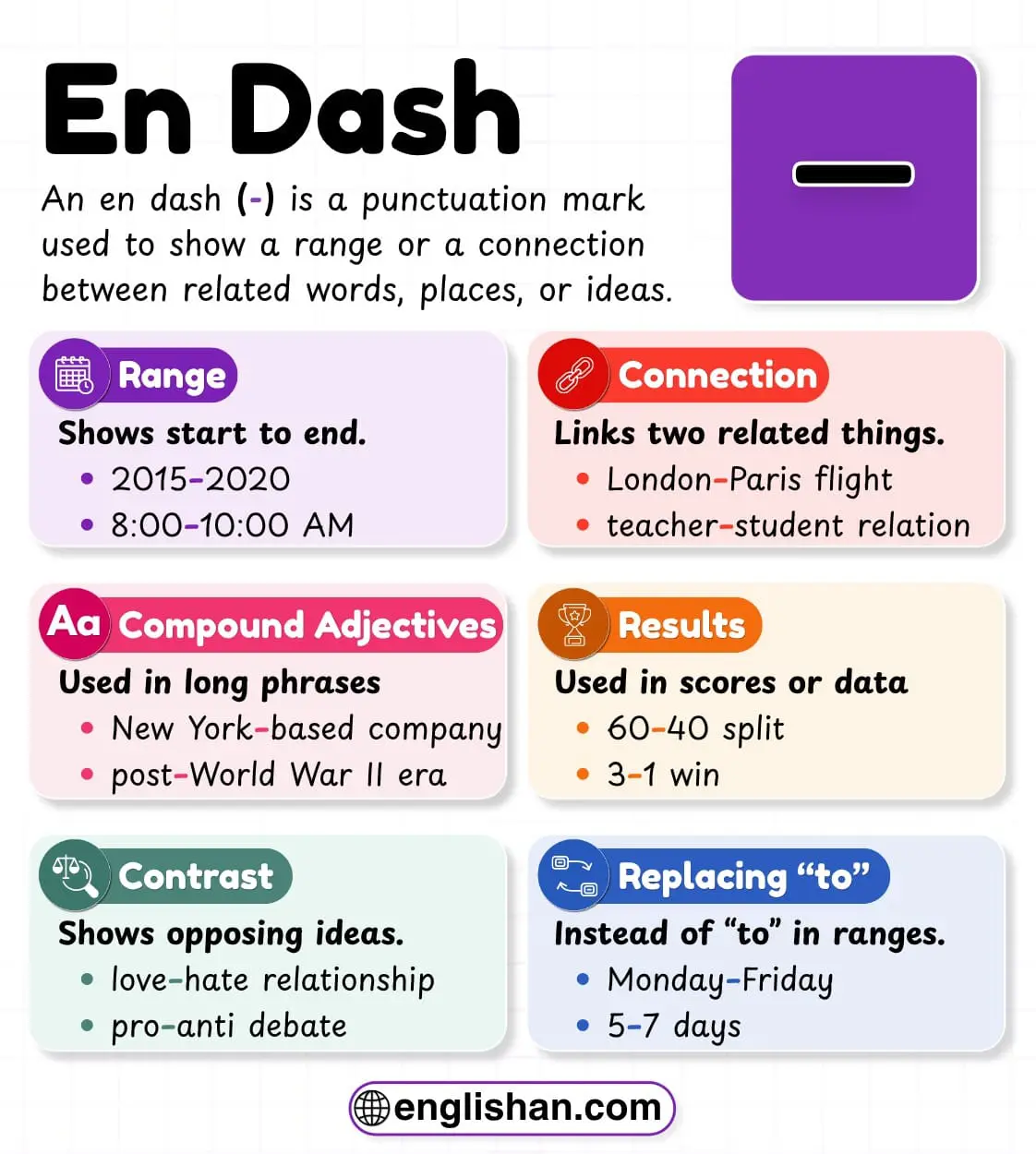
An en dash (–) is a punctuation mark that signals a span, connection, or relationship between two elements. The name comes from traditional typesetting, where the mark was roughly the width of the letter N. That width sits between the shorter hyphen and the longer em dash, and each mark does different work in a sentence.
The en dash connects items of equal weight. Two dates, two page numbers, two places, or two ideas that share a relationship without merging into a single compound word.
- The conference runs 10–12 April.
- Read pages 45–52 before class.
- The final score was 3–2.
- The London–Paris route draws millions of travelers each year.
In the first sentence, the en dash compresses a date range. In the second, it marks a page span. The third separates two sides in a score, and the fourth connects two independent cities along a travel route.
A hyphen would not work in these positions because hyphens join words into a single compound term. The en dash keeps both sides distinct while signaling the relationship between them.
When To Use An En Dash
The en dash belongs wherever a range, connection, contrast, or equal relationship needs a compact mark. It appears most often in formal writing, publishing, academic work, news articles, and editorial content where precision matters.
Date, Time, And Number Ranges
Use an en dash between numbers, dates, and times when the meaning runs from one point to another. The mark compresses the range into a tighter visual form while preserving the full meaning.
- 2015–2020
- 10–12 April
- 9:00–11:00 a.m.
- Ages 18–25
- Chapters 4–6
Both sides of the range should match in form. A balanced range reads naturally because the reader’s eye moves from one number or date to the next without interruption.
- ✅ 2018–2022
- ❌ 2018–the present
- ✅ From 2018 to the present
The second version mixes a compact range mark with a phrase, and the mismatch weakens the structure. When one side of the range is not a matching number or date, words do the job better than the en dash.
Page Ranges And Reference Spans
In books, articles, reports, and research papers, the en dash marks a span of pages or reference points. This is one of its most frequent roles in academic and editorial writing because it keeps citations compact without removing meaning.
- The answer is on pages 14–18.
- Study sections 2–4 before the exam.
- The quotation appears in lines 7–12.
Readers interpret the mark instantly. The material runs from the first point through the second, and no extra words are needed.
Scores, Votes, And Results
An en dash separates two sides in a score, vote count, or result. The mark replaces to or versus depending on context, and it keeps the numbers clean on the page without adding unnecessary words around them.
- Argentina won 2–1.
- The proposal passed 56–44.
- The final set ended 7–5.
Scores and vote counts should always have enough context so the reader knows what the numbers represent. A bare number pair can feel ambiguous without a surrounding sentence.
- ❌ The result was 85–90.
- ✅ The visitors won 90–85.
- ✅ The exam score range was 85–90.
Routes, Directions, And Connections
The en dash also connects two places, names, or ideas when the mark signals a relationship rather than a compound word. This usage shows up in transport routes, political relationships, academic pairings, and concept connections.
- The New York–London flight was delayed.
- The Pakistan–China trade corridor has expanded.
- The article examines the teacher–student dynamic.
- The debate centered on the work–life balance.
Each side remains independent. The en dash shows that the two parts are connected by direction, opposition, or partnership without merging them into a single term the way a hyphen would.
Complex Compound Adjectives
One of the en dash’s strongest editorial uses is inside compound modifiers where one part of the modifier is already an open compound or a multiword proper noun. In these cases, the en dash creates a stronger visual link than a hyphen because it holds a larger phrase together.
- A Pulitzer Prize–winning journalist
- A New York–based agency
- A World War II–era policy
- A post–Cold War agreement
A regular hyphen works for short compound words like well-known or twenty-year-old. The en dash steps in when the modifier contains a multiword name or phrase that would blur with a standard hyphen.
| Form | Correct Mark | Reason |
|---|---|---|
| Well-known author | Hyphen | Two ordinary words form one compound modifier. |
| Pulitzer Prize–winning author | En dash | A two-word proper noun connects to another word. |
| New York–based company | En dash | A two-word place name connects to another word. |
| Twenty-year-old student | Hyphen | A standard compound age phrase takes hyphens. |
The distinction is small, but it gives the sentence stronger typographic accuracy and prevents the reader from misreading where the modifier begins and ends.
En Dash Rules And Common Mistakes
Most en dash errors come from confusing it with a hyphen, spacing it incorrectly, or pairing it with words that already express a range. The following rules cover the mark’s correct behavior and the mistakes that appear most often.
No Spaces In Standard Ranges
In standard American English, an en dash has no spaces around it when it connects numbers, dates, times, pages, or places. The mark should sit tight against both elements.
- ✅ 2010–2020
- ❌ 2010 – 2020
- ✅ Pages 20–25
- ❌ Pages 20 – 25
Extra spaces weaken the visual connection and make the range look less precise. The reader should see one unbroken unit.
British English follows a different convention for sentence breaks, where a spaced en dash takes the place of an em dash.
- British style: The answer was obvious – at least to the editor.
- American style: The answer was obvious—at least to the editor.
That convention applies to sentence-level pauses, not to ranges. For ranges and relationships, keep the en dash unspaced unless your style guide says otherwise.
Never Mix The En Dash With “From…To” Or “Between…And”
The en dash already carries the meaning of to or through inside a range. When a sentence begins with from, the structure demands to as its partner. When it begins with between, it demands and. Mixing the word-based structure with the dash-based mark creates a grammatical mismatch.
- ❌ The program ran from 2015–2020.
- ✅ The program ran from 2015 to 2020.
- ✅ The program ran 2015–2020.
- ❌ The meeting is scheduled between 9:00–11:00 a.m.
- ✅ The meeting is scheduled between 9:00 and 11:00 a.m.
- ✅ The meeting is scheduled 9:00–11:00 a.m.
The logic is structural. From sets up a two-part construction that needs to as its closing partner. Dropping an en dash into the middle of that construction leaves the sentence half-worded and half-symbolized.
Do Not Use It For Ordinary Compound Words
Ordinary compound words take a hyphen. The en dash belongs only where two sides remain distinct and carry a span, route, or relationship.
- ✅ well-known writer
- ❌ well–known writer
- ✅ mother-in-law
- ❌ mother–in–law
- ✅ part-time job
- ❌ part–time job
If the term already exists as a familiar compound modifier or compound noun, the hyphen is the correct mark. The en dash enters only when the modifier involves a multiword name, a proper noun phrase, or a span.
Confusing The En Dash With A Hyphen
Because the two marks look similar at small font sizes, writers often type a hyphen where an en dash belongs. The difference shows up most clearly in ranges and dates.
- ❌ 2015-2020 (hyphen)
- ✅ 2015–2020 (en dash)
- ❌ Pages 10-15 (hyphen)
- ✅ Pages 10–15 (en dash)
The hyphen is shorter and belongs inside compound words. The en dash is wider and belongs between separate elements.
Adding Spaces Around The Mark
Standard range usage does not take spaces. Writers who add spaces are usually applying the British sentence-break convention to a range, which does not work.
- ❌ Monday – Friday
- ✅ Monday–Friday
Overusing The En Dash
The en dash should not replace commas, conjunctions, or ordinary sentence punctuation. Stacking dashes where commas belong fragments the sentence.
- ❌ I enjoy reading–writing–editing every evening.
- ✅ I enjoy reading, writing, and editing every evening.
The sentence lists three activities in parallel, and commas with and handle that structure properly. Dashes would signal ranges or relationships where none exist.
Another sign of overuse is dropping en dashes into places where the sentence already reads well without any mark at all. If the relationship between two words is already understood from context, the en dash adds visual clutter rather than precision.
The En Dash Is Not A Minus Sign
The en dash and the mathematical minus sign look similar on screen, but they belong to different systems. The en dash (–) is punctuation. The minus sign (−) is a mathematical operator.
- En dash: 2010–2020
- Minus sign: 8 − 3 = 5
In blog writing and everyday content, this distinction rarely causes confusion. In mathematics, technical publishing, and typeset documents, the correct symbol matters because screen readers and accessibility tools process each mark differently.
En Dash Vs Hyphen Vs Em Dash
The hyphen, en dash, and em dash belong to the same visual family, but each one does different work. Treating them as interchangeable weakens the sentence structure and can mislead the reader about the relationship between words.
| Mark | Name | Function | Example |
|---|---|---|---|
| – | Hyphen | Joins words into compounds | A well-known author |
| – | En dash | Marks ranges, scores, routes, and relationships | Pages 10–15 |
| — | Em dash | Creates a strong break or interruption | She arrived late—again. |
Hyphens join words tightly. They appear in compound modifiers (well-known), compound nouns (mother-in-law), and certain prefix constructions (self-taught).
En dashes connect separate but related elements. They work across ranges (2010–2020), scores (3–1), routes (Boston–Chicago), and complex modifiers where one part is already a multiword phrase (Nobel Prize–winning).
Em dashes mark a stronger interruption, an aside, or a shift in the sentence’s direction. They carry more dramatic weight than commas or parentheses.
- She finally arrived—after two hours of waiting.
- The answer was obvious—nobody wanted to say it aloud.
The fastest way to choose the right mark: hyphens join, en dashes connect or span, and em dashes interrupt.
How To Type An En Dash
Typing an en dash depends on the device, operating system, and writing tool. The following methods work across the most common environments.
| Device Or Tool | Method |
|---|---|
| Mac | Press Option + Hyphen |
| Windows (numeric keypad) | Hold Alt, type 0150, release |
| Microsoft Word | Type a space, hyphen, space and keep typing — Word auto-converts it |
| Google Docs | Go to Insert → Special Characters, search en dash |
| HTML | Use – |
Autocorrect behavior varies between platforms, so writers working in WordPress, Google Docs, Canva, or design tools should confirm the mark renders correctly before publishing. The en dash should look noticeably wider than a hyphen but shorter than an em dash.
En Dash Examples In Sentences
The same mark shifts its meaning depending on context. These sentence-level examples show how the en dash works across different types of content.
| Use | Example |
|---|---|
| Date range | The exhibition runs March 3–April 14. |
| Year span | The main data covered 2016–2021. |
| Page range | The grammar rule is on pages 72–75. |
| Time span | Office hours are 2:00–4:00 p.m. |
| Score | Spain won the match 2–0. |
| Vote count | The motion passed 48–41. |
| Route | The Boston–Chicago train was delayed. |
| Relationship | The editor–writer conversation shaped the final draft. |
| Complex modifier | She interviewed a National Book Award–winning novelist. |
| Direction | The north–south corridor carries most of the freight traffic. |
Strong examples give the reader enough context around the mark. A range, score, or relationship should never feel like a pair of numbers dropped into a sentence without direction.
Final Thought
The en dash is a narrow mark with a precise job. It compresses ranges, connects equal elements, separates scores, and holds complex modifiers together where a hyphen would be too small for the structure.
Choosing the right mark comes down to function, not appearance. Hyphens join words into compounds. En dashes connect or span across independent elements. Em dashes interrupt the sentence. Once that distinction feels automatic, the en dash stops being a mark you second-guess and becomes one you reach for with confidence in dates, references, scores, routes, and editorial writing.
FAQs
An en dash marks ranges, spans, scores, routes, and relationships between two independent elements. It replaces to, through, or versus in compact writing: 2015–2020, pages 10–15, a 3–2 victory, and the London–Paris route.
A hyphen joins words inside a compound term (well-known, mother-in-law), while an en dash connects separate elements or marks a range (2010–2020, New York–London). The two marks differ in both width and function.
In standard ranges and relationships, the en dash sits tight against both elements with no spaces: Monday–Friday, not Monday – Friday. A spaced en dash appears in some British English sentence breaks, but that is a separate punctuation convention from range usage.
Yes, but only in compact ranges where both sides match in form: 2018–2022, pages 4–9. Do not pair the en dash with from. Write from 2018 to 2022, not from 2018–2022, because from sets up a word-based structure that needs to as its partner.
No. The en dash (–) is a punctuation mark used in writing. The minus sign (−) is a mathematical operator used in equations. They look similar on screen, but they belong to different systems and are processed differently by screen readers and typesetting software.
Use a hyphen in ordinary compound words and compound modifiers: well-known writer, part-time role, twenty-year-old student. Switch to an en dash for ranges (2010–2020), scores (3–1), routes (Boston–Chicago), and compound modifiers that contain a multiword proper noun (Pulitzer Prize–winning journalist).
You May Also Like