Commas are an important part of English grammar that help make sentences clear and easy to read. They show small pauses in writing and help separate ideas so the meaning is not confusing. Even a small mistake in comma usage can change the sense of a sentence.
We use commas in many situations like listing items, separating clauses, and adding extra information. Once you understand the basic rules, you can improve both your writing and readability. In this article, we’ll learn how to use commas correctly with simple rules and examples.
What Is a Comma?
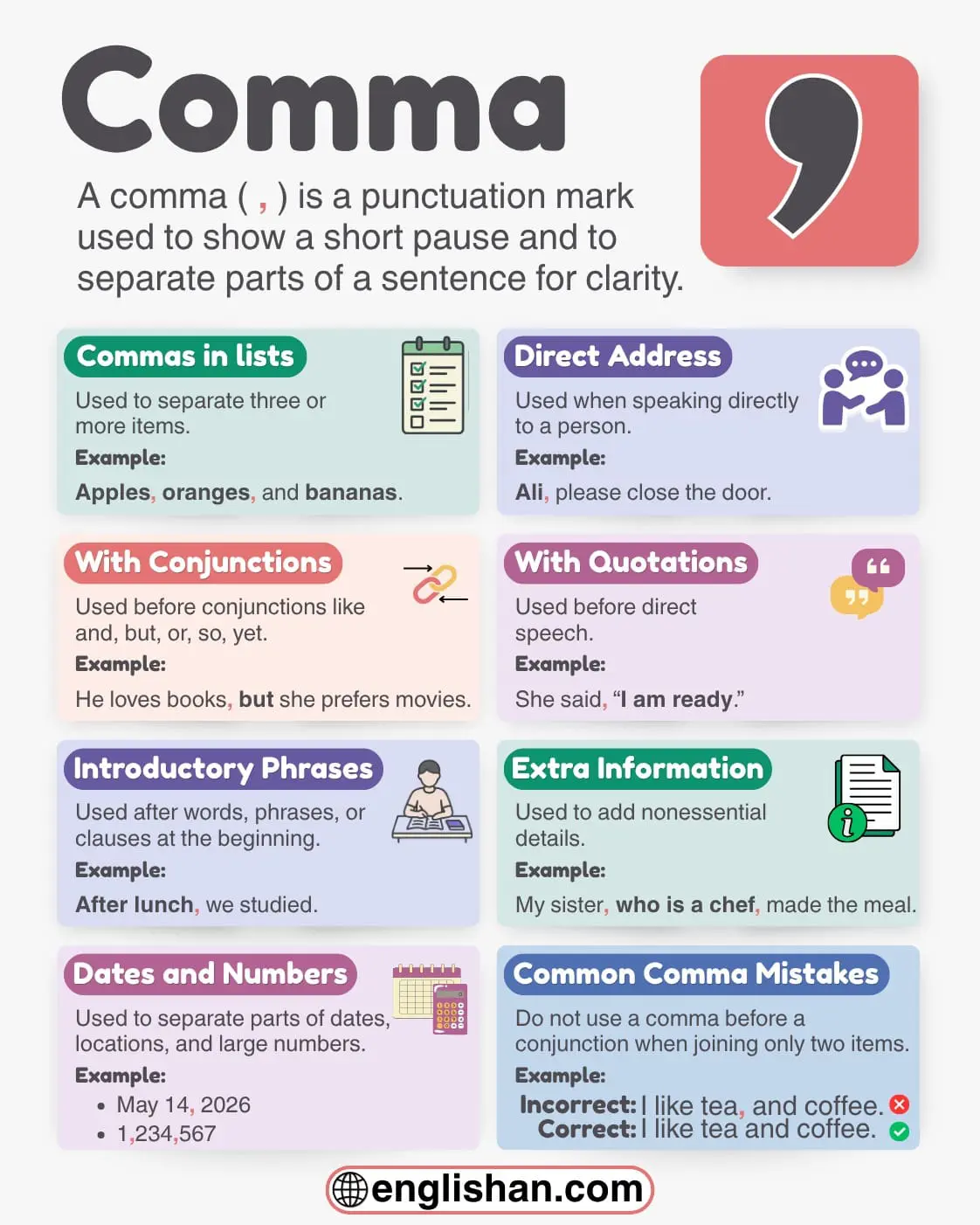
A comma ( , ) is a punctuation mark that shows a short pause in a sentence.
It does not end the sentence like a full stop. It simply gives the reader a moment to understand what is being said.
When we speak, we naturally pause between ideas. A comma shows that same pause in writing.
Example:
- I woke up, got ready, and left for work.
If you remove the commas, the sentence still makes sense, but it feels too fast and slightly confusing. So in simple words, a comma helps divide a sentence into clear and readable parts.
When We Use Comma?
Commas are used in many situations in English. Instead of learning everything at once, it’s better to understand them step by step from simple to slightly advanced.
Here are the most common uses in a good learning order:
- To separate items in a list
- After words or phrases at the beginning of a sentence
- To connect two complete sentences using words like and, but, so
- To add extra information about a person or thing
- To show extra or non-important details in a sentence
- To separate describing words (adjectives)
- To show small breaks or extra thoughts in the middle of a sentence
- When calling someone by name
- In short question tags at the end of sentences
- In dates
- In places like the city and the country
- In sentences with direct speech or quotations
These concepts can look difficult at first, but they will become clear as you read further.
Using Comma in Lists
When you write a list in a sentence, you use commas to separate the items so everything doesn’t stick together and become confusing. It basically helps the reader see each thing clearly, one by one.
If there are three or more items, you normally put a comma after each one.
For example:
- ❌Incorrect: I bought apples bananas oranges
- ✔ Correct: I bought apples, bananas, oranges
- ✔ Correct: I bought apples, bananas, and oranges
Both correct versions are fine, but the second one with “and” at the end sounds a bit more natural in everyday writing.
It’s the same when you talk about actions:
- ❌Incorrect: He woke up brushed his teeth went to school
- ✔ Correct: He woke up, brushed his teeth, went to school
- ✔ Correct: He woke up, brushed his teeth, and went to school
And also when you describe things:
- ❌Incorrect: The room was quiet warm comfortable
- ✔ Correct: The room was quiet, warm, comfortable
- ✔ Correct: The room was quiet, warm, and comfortable
So the idea is really simple: commas just help separate each item so the sentence feels smooth and easy to read, instead of everything being mixed together.
The Oxford Comma (last comma in a list)
When you list three or more things, sometimes people put a comma before “and” at the end. That last comma is called the Oxford comma.
Both ways are correct in most cases, it just depends on style.
For example:
- I invited my friends, Ali, Sara, and Ahmed.
- I invited my friends, Ali, Sara and Ahmed.
Most of the time both are fine, but the first one can be clearer because it separates each name properly. Sometimes, without that last comma, meaning can even get a little confusing.
Using comma with “and”
We use a comma before “and” when it joins two complete sentences (two full ideas).
For Example:
- ❌ I was tired and I went to sleep early
- ✔ I was tired, and I went to sleep early
But when “and” just connects words or short phrases, we don’t use a comma.
For Example:
- ❌ She is smart, and hardworking
- ✔ She is smart and hardworking
Using comma with “but”
We use a comma before “but” when it connects two opposite or contrasting complete ideas.
For Example:
- ❌ I wanted to go but I was busy
- ✔ I wanted to go, but I was busy
But if “but” is just joining simple words or short ideas, no comma is needed.
For Example:
- ❌ She is smart, but lazy
- ✔ She is smart but lazy
Fixing Comma Mistakes (Comma Splice)
Sometimes people try to join two full sentences with just a comma, but that doesn’t really work in English. It feels a bit incomplete, like something is missing.
For Example:
- ❌ We were hungry, we ordered food
- ✔ We were hungry, so we ordered food
So basically, if you’ve got two complete ideas, don’t just stick a comma in between them. You need a joining word like “so,” or you separate them properly.
Comma at the Beginning of a Sentence
When a sentence starts with a little extra detail before the main point, we usually pause it with a comma. It just makes the sentence smoother to read.
For Example:
- ❌ After dinner we went for a walk
- ✔ After dinner, we went for a walk
or
- ❌ In 2024 I started learning design
- ✔ In 2024, I started learning design
It’s not a strict rule every single time, but using the comma makes it feel more natural and clear.
Comma in Extra Information (Clauses)
Sometimes we add extra detail in a sentence (Clauses) that is not really needed, but just gives more information. That extra part goes inside commas.
For Example:
- ❌ My brother who lives in Dubai is coming today
- ✔ My brother, who lives in Dubai, is coming today
The main point is already clear that the brother is coming. The Dubai part is just extra.
But if the information is important to identify the person, then we don’t use commas:
- ✔ The boy who lives next door is my friend
Here, we need that detail to know which boy we’re talking about.
Comma with Extra Names or Details (Appositives)
Sometimes we add extra names or explanations (Appositives) just to make things clearer. If that extra part is not necessary, we put commas around it.
For Example:
- ❌ My teacher Mr Ali is very strict
- ✔ My teacher, Mr Ali, is very strict
or
- ❌ Karachi the biggest city in Pakistan is very busy
- ✔ Karachi, the biggest city in Pakistan, is very busy
But if the name is important to identify something, then no commas:
- ✔ The poet Allama Iqbal is my favorite
Comma for Extra or Interrupting Words
Sometimes we add small words in the middle of a sentence to show feeling or opinion. These are just little interruptions in thought, so we separate them with commas.
For Example:
- ❌ This is I think a good idea
- ✔ This is, I think, a good idea
or
- ❌ The movie was honestly very boring
- ✔ The movie was, honestly, very boring
These words can be removed and the sentence still makes sense — they just add a natural speaking tone.
Comma When Calling Someone
When you directly call someone’s name in a sentence, you pause a little before or after the name. In writing, we show that pause with a comma.
For Example:
- ❌ Mom I can’t find my shoes
- ✔ Mom, I can’t find my shoes
If the name comes in the middle, we still use commas on both sides:
- ❌ I need your help Ali right now
- ✔ I need your help, Ali, right now
It just makes it clear that you’re speaking to someone, not talking about them.
Comma in Quotes and Speech
When we report what someone says, we usually separate the spoken words from the rest of the sentence with a comma. It helps the reader clearly see where the speech starts or ends.
For Example:
- He said, “I am feeling tired.”
- She asked, “Where are you going?”
- “I will call you later,” he replied.
You can feel how the comma creates a small pause before the actual spoken words or after them, depending on the sentence.
Comma with Quotation Marks
When using quotation marks, commas are often placed with the spoken sentence to keep everything properly structured. In English writing, especially American style, the comma usually sits inside the quotation marks.
For Example:
- “I am coming,” he said.
- “We are ready,” she replied.
- “Don’t worry,” she told me, “everything will be fine.”
It just helps keep dialogue clean and properly separated from the rest of the sentence.
Comma in Question Tags
A question tag is a small question added at the end of a sentence, usually to check information or get agreement. We separate it with a comma because it’s like a quick pause before asking the question.
For Example:
- This is your book, isn’t it?
- You are coming with us, right?
- She finished the work on time, didn’t she?
It sounds very natural in speech, like you’re confirming something with the listener.
Comma in Dates
When we write dates, commas help separate different parts so everything is easy to read. Especially when you mention the day, month, and year together, the comma gives a natural pause.
For Example:
- July 4, 1776, is an important date in history.
- I was born on Monday, May 12, 2000.
- We met on Friday, March 15, at the airport.
It just keeps the date clear instead of all the information blending together.
Comma with Multiple Adjectives
When you use more than one describing word (adjectives) before a noun, you sometimes separate them with commas, but only if they describe the noun equally. It should still sound natural if you switch their order.
For Example:
- She wore a bright, beautiful dress.
- It was a cold, windy night.
- He is a kind, helpful teacher.
But when the adjectives don’t work equally, we don’t separate them:
- a small wooden table
- a big red car
Here, the words belong together as one idea, so no comma is needed.
Comma with “such as”
We use “such as” when we give examples. Commas depend on whether the examples are just extra information or necessary to understand the sentence.
For Example:
- Fruits such as apples and oranges are healthy.
- Fast food, such as burgers and fries, should be eaten in moderation.
- Some countries, such as Pakistan and India, have very rich cultures.
It simply helps the reader know that you are giving examples, not the whole list.
Comma with “as well as”
“As well as” is used when you add extra information. Usually, we don’t need a comma, but sometimes we use it to make the sentence easier to read or add emphasis.
For Example:
- He plays football as well as cricket.
- She speaks English as well as Urdu.
- The teacher, as well as the students, was happy with the result.
It often depends on how the sentence sounds when you read it out loud.
Comma with “too”
“Too” means “also,” and we sometimes use commas around it for emphasis or a natural pause, but it’s not always required.
For Example:
- I like coffee too.
- I, too, want to join the trip.
- She was tired, too.
Using commas with “too” can make the sentence feel a bit more expressive or dramatic.
Comma with Brackets (Parentheses)
Parentheses are used when you add extra information that is not really part of the main sentence. It’s like a small side note.
For Example:
- My brother (who lives in Dubai) is visiting today.
- We finally reached the station (after a long delay).
- She passed the exam (surprisingly) with high marks.
The main sentence should still make sense even if you remove the part inside the brackets. That’s the key idea.
Common Comma Mistakes
A lot of learners make small comma mistakes that can easily be avoided once you understand the basic rules. Here are the most common ones to watch out for:
- Don’t separate a verb from its object with a comma
- Don’t use commas with paired conjunctions (like either/or, neither/nor, not only/but also)
- Don’t put a comma between an article and a noun
- Don’t use a comma when making comparisons with “than”
- Don’t put a comma between the subject and the verb
- Don’t use commas in compound subjects or compound objects
- Don’t use commas in compound verbs
The main idea is simple: commas are there to make your sentence clearer, not to break its natural flow. If a comma makes the sentence sound awkward or confusing, it’s probably not needed.
Final Thoughts
As we learned, commas are small but very important in English writing. They help us make sentences clear by showing natural pauses and separating ideas in a simple way.
The main idea is to use commas where they improve understanding and avoid them where they interrupt the flow of the sentence. They are there to support your writing, not to make it complicated.
If you stay consistent and observe how commas are used in real writing, your accuracy and confidence will naturally improve over time.
FAQs about Comma
A comma is a punctuation mark ( , ) used in English writing to show a short pause. It helps separate ideas in a sentence so the meaning becomes clear and easy to understand.
We use commas in many places like in lists, after starting words or phrases, before some joining words, and when adding extra information. They help organize sentences in a clean and readable way.
Yes, sometimes a comma can slightly change or improve the meaning by making the sentence clearer. Without commas, a sentence may feel confusing or misread.
One of the most common mistakes is joining two complete sentences with only a comma. This is called a comma splice and it is grammatically incorrect.
Not always. Commas are used only where they improve clarity. If a sentence is already clear without them, you may not need to use a comma.
You May Also Like
- Direct and Indirect Speech in English
- Punctuation Rules with Examples
- Punctuation Worksheets and Exercises with Answers