A period, also called a full stop, is one of the most common punctuation marks in English. It may look small, but it plays a big role in making your writing clear and complete. Whenever you finish a thought or a sentence, you use a period to signal that pause. Without it, writing can feel confusing or unfinished.
In this article, you’ll learn how to use periods correctly, where to place them, and the common mistakes to avoid. From simple sentences to abbreviations and special cases, we’ll cover everything in an easy and practical way so you can use periods with confidence in your everyday writing.
What is a Period?
A period (also called a full stop) is a punctuation mark that shows a sentence has ended. It looks like a small dot (.) and is placed at the end of a complete thought. In simple words, whenever you finish saying or writing something fully, you put a period.
For example, when you write “I am going home.” the period tells the reader that the sentence is complete.
What Does a Period Do?
A period may look small, but it plays an important role in writing. It helps you organize your ideas and makes your sentences easy to understand. Let’s look at what it actually does in simple terms.
Marks the End of a Sentence
A period is mainly used to show that a sentence has finished. It tells the reader, “This thought is complete now.” Without it, writing would just keep running and become confusing.
For Example:
- I am going to school.
Shows a Complete Thought
A period also signals that you have finished expressing a complete idea. It means everything you wanted to say in that sentence is done, and nothing is left hanging.
For Example:
- She loves reading books.
Creates a Pause in Writing
When you use a period, it naturally creates a pause for the reader. This pause helps the reader understand one idea before moving on to the next one. It keeps your writing clear and easy to follow.
For Example:
- It was raining heavily. We stayed at home.
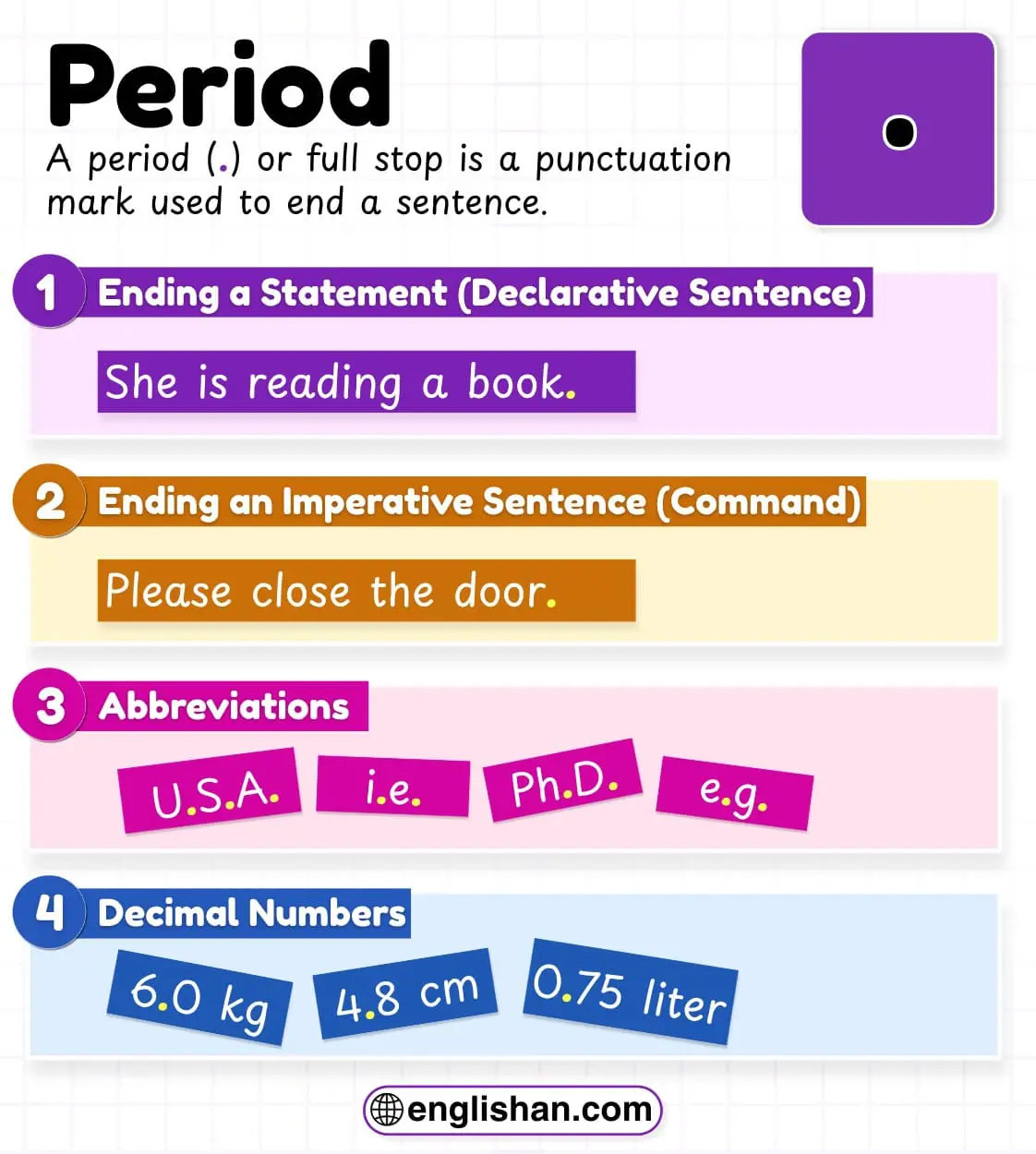
When to Use a Period?
A period is used in a few different situations in English. It mainly helps you show where a sentence ends or where an idea is complete. Let’s go through the most common uses in a simple way.
At the End of Declarative Sentences
A period is used at the end of a statement or fact. These are called declarative sentences because they simply give information.
For Example:
- She is reading a book.
- The sun rises in the east.
In Indirect Questions
When a question is reported instead of asked directly, we use a period instead of a question mark. This is called an indirect question.
For Example:
- He asked where I was going.
- She wondered if it would rain today.
In Abbreviations and Initials
Periods are often used in short forms of words and between initials in names. It’s just a way to show that the word is shortened.
For Example:
- Dr. Smith is my teacher.
- U.S.A. is a large country.
- J. K. Rowling is a famous writer.
To Indicate Omission (Ellipsis)
Sometimes we use three periods together (called an ellipsis) when we want to show a pause in thinking, or when some words are left out. It makes writing feel more natural, like someone is thinking or trailing off.
For Example:
- I was thinking… maybe we should wait a bit longer.
- He said he would call… but he never did.
How to Use a Period Correctly?
Using a period correctly isn’t complicated, but it does follow a few simple patterns. Once you understand these, your writing instantly becomes clearer and more natural.
Periods in Sentences (Basic Usage Rules)
The most basic rule is simple: use a period at the end of a complete sentence. If you’ve finished your thought, you stop it with a period.
For Example:
- I went to the market.
- She enjoys learning English.
It’s just a way of showing, “This idea is complete.”
Periods with Quotation Marks
When you’re using quotation marks, the period usually goes inside the quotation marks in American English. It helps close both the sentence and the quoted part neatly.
For Example:
- She said, “I am ready.”
- He called it “a great success.”
So the period stays inside, even if it’s just part of the sentence.
Periods with Parentheses
This one depends on the sentence. If the whole sentence is inside the parentheses, the period goes inside. But if only part of the sentence is in parentheses, the period stays outside.
For Example:
- (He was very tired.)
- I went home early (because I was tired).
It may look a little tricky at first, but once you see it in action, it becomes natural.
Common Mistakes with Periods
Even though a period is simple to use, people still make a few common mistakes with it. Let’s look at them in an easy and natural way so you can avoid them.
Using a Period Instead of a Question Mark
One common mistake is putting a period where a question mark should be used. If you’re asking something directly, you should always end it with a question mark, not a period.
For Example:
- ❌ Are you coming.
- ✔️ Are you coming?
Overusing Periods in Short Sentences
Sometimes people break ideas into too many short sentences using periods again and again. This can make writing feel choppy and unnatural. It’s better to connect related ideas when needed.
For Example:
- ❌ I went home. I ate food. I slept.
- ✔️ I went home, ate food, and slept.
Incorrect Use with Abbreviations
Another mistake is forgetting periods in abbreviations or using them incorrectly. Some abbreviations need periods, while others don’t, so consistency matters.
For Example:
- ✔️ Dr. Ahmed is my teacher.
- ✔️ U.S.A. (or USA in modern usage)
Misplacing Periods with Quotes or Brackets
People often place the period in the wrong spot when using quotation marks or brackets. The placement depends on whether the sentence is complete inside them or not.
For Example:
- ✔️ She said, “I am ready.”
- ✔️ I was late (because of traffic).
Key Takeaway
As we learned, a period is a small punctuation mark, but it plays an important role in making your writing clear and complete. It is mainly used at the end of a sentence, but it also appears in abbreviations, indirect questions, and a few other situations where we need to show a finished idea or a shortened form.
The key thing is to keep it simple. Whenever a thought is complete, just place a period at the end. With a bit of practice, it becomes natural, and your writing starts to look more clear, organized, and easy to read.
Period FAQs
You use a period when you are making a statement, not asking a question. If the sentence is giving information, it ends with a period.
Example:
I am going to school. (statement)
Are you going to school? (question)
Not always. Some abbreviations use periods, but many modern styles don’t use them anymore. It depends on the word and writing style.
Example:
Dr. Ahmed (with period)
USA (without periods in modern usage)
In most cases, the period goes inside the quotation marks, especially in American English.
Example:
She said, “I am ready.”
He called it “perfect.”
No, a normal sentence should only end with one period. However, you may see three periods together in an ellipsis, which is different and shows missing words or a pause.
Example:
I was thinking… maybe we should wait.
I like tea. (correct ending)
Usually, no. Titles and headings do not end with a period because they are not full sentences.
Example:
Correct: English Grammar Basics
Incorrect: English Grammar Basics.
You May Also Like