Talking about the future in English can be a little confusing, especially when you have to choose between “will” vs “going to.” Both are used for future actions, so many English learners are not sure which one sounds correct in different situations. Sometimes we use “will” for quick decisions or predictions, while “going to” is more common for plans that are already decided.
Don’t worry, the difference is not as difficult as it seems. Once you understand the basic idea and look at a few simple examples, it becomes much easier to use them naturally. In this article, you’ll learn the differences between “will” and “going to,” easy grammar rules, common examples, and other future forms that people use in everyday English.
Will vs Going To: Main Difference
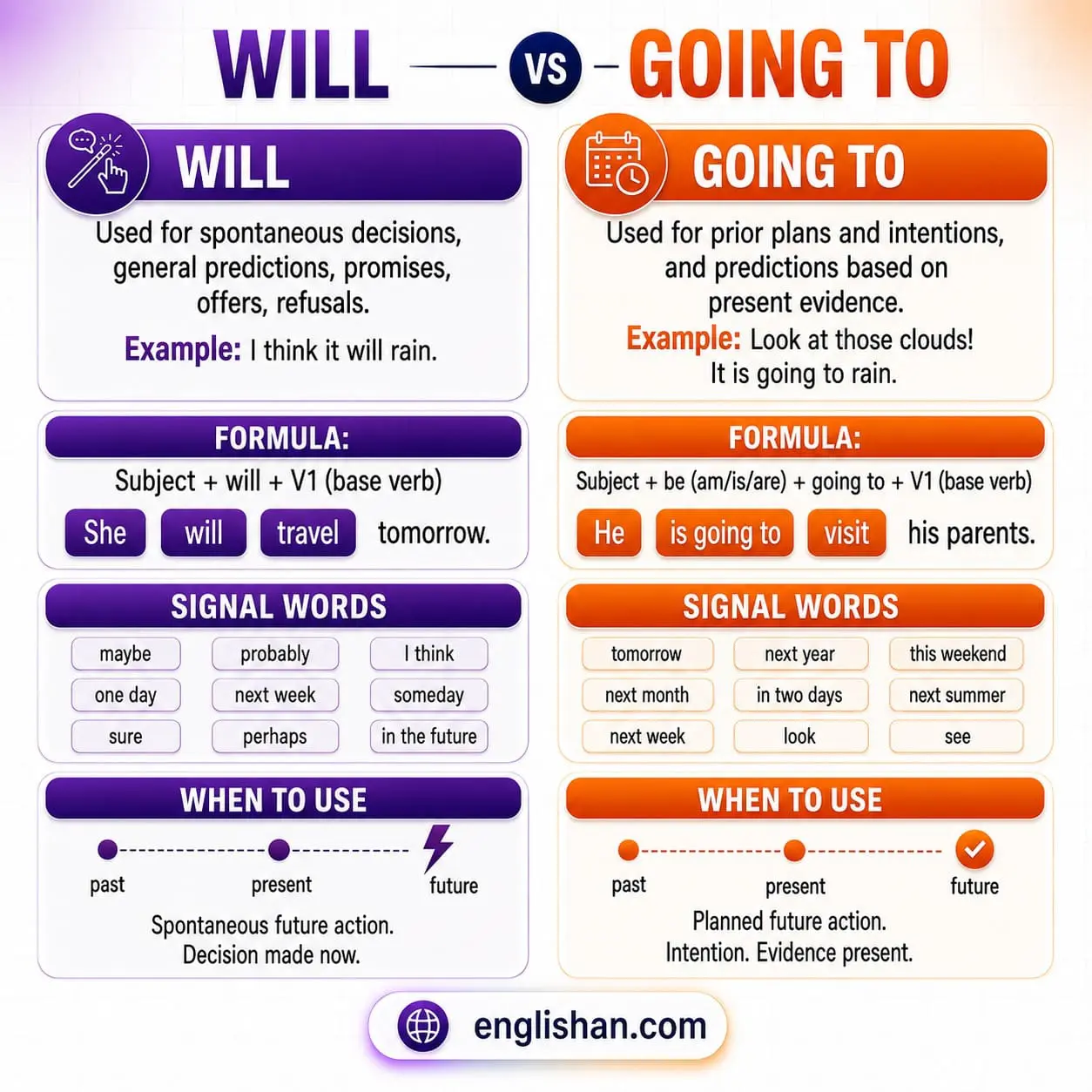
The main difference between “will” and “going to” is the way the future action is decided or expected to happen. Both talk about the future, but they are used in different situations.
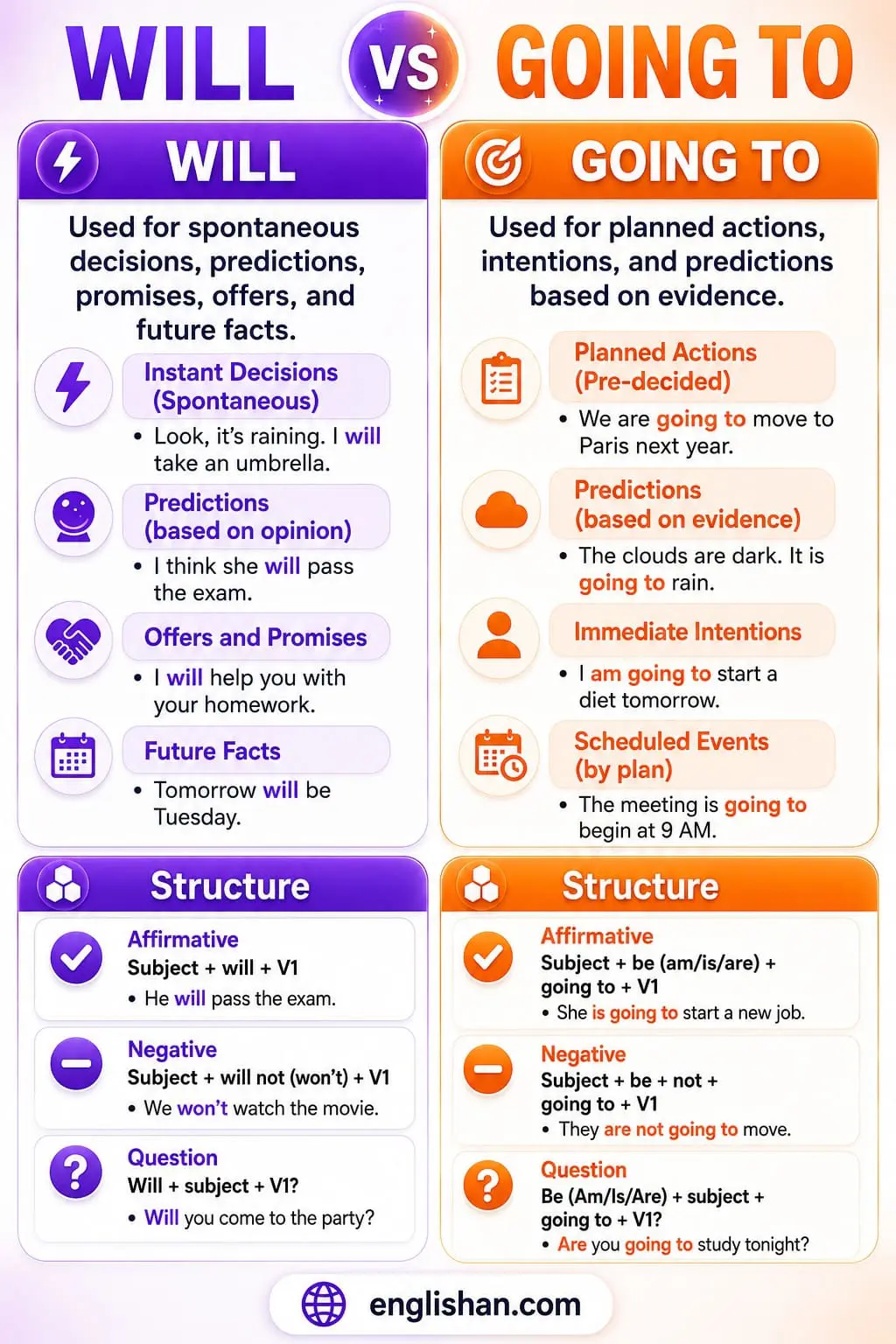
We usually use “will” for quick decisions, promises, offers, and predictions that are based on personal opinions. The decision is often made at the moment of speaking.
Example 1: I’ll answer the phone.
Example 2: I think she will win the match.
Example 3: Don’t worry, I will help you.
On the other hand, we use “going to” for plans and intentions that have already been decided before speaking. It is also used for predictions when there is clear evidence in the present.
Example 1: I’m going to start exercising next week.
Example 2: They are going to move to another city.
Example 3: Look at the sky. It’s going to rain.
Here is a simple comparison:
- “Will” = instant decisions, promises, opinions, predictions
- “Going to” = planned actions, intentions, visible evidence
In short, “will” is more spontaneous, while “going to” is more planned. Understanding this small difference makes it much easier to use both forms correctly in everyday English.
What Is “Will”?
“Will” is a helping verb that we use to talk about the future. It helps us describe actions, events, or situations that will happen after the present moment. In English, “will” is one of the most common ways to talk about the future, especially in everyday conversations and writing.
We often use “will” when we make a quick decision while speaking, give a promise, offer help, make a prediction, or talk about something we believe will happen in the future. Unlike “going to,” “will” is usually used when the decision has not been planned before the moment of speaking.
Example 1: I will call you tonight.
Example 2: Don’t worry, I will help you with your homework.
Example 3: I think the weather will be better tomorrow
The basic structure is very simple:
Structure: Subject + will + base verb
Example 4: He will travel next week.
Example 5: They will watch a movie tonight.
In spoken English, “will” is also commonly used in its short form:
- I’ll = I will
- She’ll = She will
- They’ll = They will
These short forms make conversations sound more natural and fluent.
In short, “will” is used to talk about future actions, decisions, promises, offers, and predictions. It is simple to use and is an important part of everyday English communication.
What Is Going To?
“Going to” is a future form that we use to talk about plans, intentions, and things that are expected to happen in the future. It is very common in everyday English and is often used when someone has already decided to do something before speaking.
We also use “going to” when there is present evidence that something will happen soon. In simple words, if a future action is already planned or if we can clearly see that something is likely to happen, we usually use “going to.”
Example 1: I am going to start a new course next month.
Example 2: She is going to visit her grandparents this weekend.
Example 3: Look at those dark clouds. It is going to rain.
The basic structure is:
Structure: Subject + am/is/are + going to + base verb
Example 4: He is going to play football tomorrow.
Example 5: We are going to travel during the holidays.
In spoken English, people also use short forms to sound more natural:
- I’m going to
- She’s going to
- They’re going to
These contractions are very common in conversations and informal writing.
In short, “going to” is mainly used for future plans, intentions, and predictions based on clear evidence. It helps make future actions sound more planned and certain.
When to Use “Will”
“Will” is one of the most common future forms in English. It is used in different situations such as making quick decisions, giving promises, offering help, making polite requests, and talking about predictions. Learning these uses can help make everyday English conversations sound more natural and clear.
Rule 1: For making instant decisions
One common use of “will” is when a decision is made at the exact moment of speaking. The action is not planned earlier and happens as a quick response to the situation.
Example 1: I feel tired, I will take a short break.
Example 2: This work is confusing, I will ask someone for help.
In both cases, the decision happens immediately based on what is happening right now.
In this case, “will” is used for quick decisions made on the spot without any prior plan.
Rule 2: To Make Promises
Another important use of “will” is to make promises about future actions. It shows a strong sense of commitment and responsibility toward someone.
Example 1: I will always stand by you in difficult times.
Example 2: I will complete the task before the deadline.
Each sentence clearly expresses a promise that something will be done in the future.
In this case, “will” is used to make promises and show a strong commitment for future actions.
Rule 3: To Offer Help
It is also used when someone volunteers to help or offers to do something for another person. It reflects willingness and a helpful attitude.
Example 1: I will help you carry those heavy bags.
Example 2: I will handle this situation for you.
Both examples show a readiness to support or assist without being asked.
In this case, “will” is used to offer help or do something willingly for someone.
Rule 4: To Make Requests
In question form, “will” is used to politely ask someone to do something. It helps make the request sound respectful and gentle instead of direct or strict.
Example 1: Will you please close the door quietly?
Example 2: Will you help me finish this assignment?
These sentences are polite ways of asking for help or action from someone.
In this case, “will” is used to make polite requests in a simple and respectful way.
Rule 5: To Make Predictions Without Evidence
A frequent use of “will” involves making predictions about the future based on opinion or guesswork rather than clear signs or proof.
Example 1: I think it will be a wonderful experience.
Example 2: She will probably arrive a bit late today.
Both sentences show personal predictions without any strong evidence.
So, “will” is used for predictions based on opinion or guess, not on clear facts or evidence.
Understanding these common uses of “will” makes it easier to speak and write about the future naturally. Once these patterns become familiar, choosing the correct future form becomes much simpler in everyday English conversations.
When to Use “Going To”
“Going to” is commonly used to talk about future actions that are already planned or expected to happen. Unlike “will,” this future form usually shows that the speaker has already thought about the action before speaking. It is also used when there is clear evidence that something is likely to happen soon.
Understanding these uses can make future sentences sound more natural and accurate in everyday English conversations.
Rule 1: To Talk About Future Plans
One common use of “going to” is for future plans that have already been decided. The speaker already has an idea or arrangement in mind before speaking.
Example 1: I am going to visit my grandparents this weekend.
Example 2: They are going to start a new business next year.
In both examples, the actions are already planned before the conversation takes place.
In this case, “going to” is used for future plans that are already decided before speaking. It shows that the action has been planned earlier and is likely to happen in the future.
Rule 2: To Express Intentions
Another important use of “going to” is to express intentions or things someone wants to do in the future. It shows a personal goal, aim, or decision.
Example 1: She is going to learn Spanish this year.
Example 2: I am going to save money for a new laptop.
Each sentence shows something the speaker intends or hopes to do in the future.
In this case, “going to” is used to express future intentions and personal goals. It helps show that someone already has a clear idea about what they want to do later.
Rule 3: To Make Predictions With Evidence
“Going to” is also used for predictions when there is visible evidence or a clear sign that something will happen soon.
Example 1: Look at those dark clouds. It is going to rain.
Example 2: He is driving too fast. He is going to cause an accident.
In both examples, the prediction is based on something that can already be seen or observed.
So, “going to” is used for predictions that are based on clear evidence or present signs. The speaker believes something will happen because there is already proof or a visible reason for it.
Learning these uses of “going to” helps make future sentences more natural and meaningful. It is especially useful when talking about plans, intentions, and situations where the future result already seems clear.
Present Continuous for Future
The present continuous tense can also be used to talk about future plans and arrangements. It is commonly used when a future action is already planned or scheduled. In everyday English, this form sounds natural when talking about meetings, trips, appointments, or fixed plans.
The basic structure is:
Subject + am/is/are + verb (-ing)
Example 1: I am meeting my friend tomorrow.
Example 2: She is traveling next week.
Example 3: They are coming to dinner tonight.
One common use of the present continuous for future meaning is to describe arrangements that are already planned and confirmed.
Example 1: We are visiting our cousins this weekend.
Example 2: He is meeting the doctor tomorrow.
Both sentences show future actions that are already planned.
Another common use is for personal plans that involve a specific time or place. These plans are usually certain and organized.
Example 1: I am attending a workshop on Monday.
Example 2: She is flying to Karachi next month.
These examples describe planned future events with clear timing.
So, the present continuous is often used for scheduled future plans and activities. Using the present continuous for future meaning helps conversations sound more natural and fluent in everyday English.
Present Simple for Future
The present simple tense can also be used to talk about the future. It is mainly used for fixed schedules, timetables, and official events that follow a set routine. This form is common when talking about transport schedules, school timetables, programs, or planned events.
The basic structure is:
Subject + base verb / verb-s
Example 1: The train leaves at 8 a.m.
Example 2: School starts next Monday.
Example 3: The movie begins at 7 tonight.
One common use of the present simple for future meaning is to talk about fixed schedules and timetables.
Example 1: The bus arrives at 6:30 in the morning.
Example 2: The meeting starts after lunch.
Both sentences describe future events that are scheduled and fixed.
In this case, the present simple is used for future events that follow a fixed timetable or schedule. It is also used for official programs or events that are certain to happen at a specific time.
Example 1: The exam ends at noon.
Example 2: The shop opens tomorrow at 9 a.m.
These examples show future actions that are already arranged officially.
So, the present simple is often used for official schedules, routines, and fixed future events. Using the present simple for future meaning makes English sound more natural when talking about timetables and scheduled activities.
Common Mistakes Learners Make with Will and Going To
Many English learners find will and going to confusing because both forms talk about the future. However, they are used in different situations. Learners often make mistakes when talking about plans, predictions, or sudden decisions. Understanding these common errors can make future sentences clearer and more natural.
Mistake #1: Using “Will” for Planned Actions
One of the most common mistakes is using will for actions that were already planned before speaking. In English, going to is usually better for intentions and future plans that have already been decided.
Incorrect: I will visit my cousin tomorrow.
Correct: I am going to visit my cousin tomorrow.
The visit was already planned before the speaker said it, so going to is the correct choice.
In this case, going to is more appropriate because the future action was already decided before speaking.
Mistake #2: Using “Going To” for Instant Decisions
Learners sometimes use going to for decisions made at the moment of speaking. In these situations, English normally uses will because the decision happens instantly.
Incorrect: The baby is crying. I am going to check.
Correct: The baby is crying. I will check.
The speaker decided to act immediately after hearing the baby cry, so will is more natural.
So, will is commonly used for spontaneous decisions that are made at the moment of speaking.
Mistake #3: Confusing Predictions
Another common problem is choosing the wrong future form for predictions. will is generally used for opinions or guesses, while going to is used when there is visible evidence.
Incorrect: Look at those dark clouds! It will rain.
Correct: Look at those dark clouds! It is going to rain.
The dark clouds provide clear evidence, so going to is the better option.
In short, use going to for predictions based on present evidence and will for general opinions or guesses.
Mistake #4: Using Incorrect Sentence Structure
Some learners know when to use will or going to, but they make grammatical mistakes in the sentence structure.
Incorrect: She will going to school tomorrow.
Correct: She will go to school tomorrow.
After will, the verb must stay in its base form without -ing. Therefore, learners should remember that will is always followed by the base form of the verb.
Mistake #5: Overusing “Will” in Everyday English
Many beginners rely too much on will because it seems simple and easy. However, native speakers often use other future forms, especially the Present Continuous, for arranged future activities.
Incorrect: I will meet my teacher at 5 PM.
Correct: I am meeting my teacher at 5 PM.
The meeting is already arranged with a specific time, so the Present Continuous sounds more natural.
In everyday conversation, native speakers often prefer the Present Continuous for fixed future arrangements.
So, Mistakes with will and going to usually happen because learners do not fully understand the difference between plans, instant decisions, and predictions. By practicing the correct structures and paying attention to context, learners can speak about the future more accurately and confidently.
Practice Exercises: Will vs Going To
To master will and going to, practice is very important. These exercises will help you understand the difference between spontaneous decisions, planned actions, and predictions. Try to solve them on your own first, then check the answers below.
Exercise 1: Choose the correct form (will / going to)
I forgot my pen. I think I ___ borrow one from you.
Exercise 2: Fix the mistake in the sentence
I am will going to visit my friend tomorrow.
Exercise 3: Choose the correct option
Look at those black clouds! It will rain / is going to rain.
Exercise 4: Correct the sentence structure
She will going to school next week.
Exercise 5: Choose the correct form (will / going to)
The phone is ringing. I ___ answer it.
Answer Key
- I think I will borrow one from you.
- I am going to visit my friend tomorrow.
- Look at those black clouds! It is going to rain.
- She is going to school next week.
- I will answer it.
Final Thought: Will vs Going To
Will and going to both talk about the future, but they are used in different situations. Use will for quick decisions, promises, and general predictions, especially when something is decided at the moment. Use going to for planned actions or when there is clear evidence that something will happen.
In real communication, people choose between them based on context, not strict rules. With practice, this difference becomes natural. Simply remember that will is often about instant thinking, while going to is about already made plans or visible certainty.
FAQs: Will vs Going To
The main difference is based on timing and certainty. Will is used when you decide something at the moment, make a promise, or give a general prediction. Going to is used when a plan is already decided or when there is clear evidence that something will happen.
Example:
I think I will call him now. (instant decision)
I am going to call him tomorrow. (pre-planned action)
In some cases, both can be used, but the meaning may slightly change. They are not always interchangeable because each form depends on the situation. Will shows a spontaneous choice, while going to shows a planned intention.
Example:
I will help you. (decision made now)
I am going to help you. (already decided before)
Use going to when you already have a clear plan or intention before speaking, or when something is likely based on present evidence.
Example:
She is going to start a new job next month. (planned)
Look at the sky, it is going to rain. (clear evidence)
Both are very common in spoken English, but their usage depends on context. Going to is often used for daily plans and intentions, while will is very common for quick reactions, offers, and promises.
Example:
I will open the door. (sudden action)
I am going to meet my friend later. (fixed plan)
Yes, “gonna” is an informal spoken form of going to. It is commonly used in casual conversation, but it is not correct in formal writing.
Example:
I am going to study tonight. (formal)
I’m gonna study tonight. (informal speech)
You May Also Like
Will vs Going To Quiz
Will vs Going To
Choose the verb form.
This bag is heavy. I ___ it for you.
An offer made at the moment of speaking takes 'will'.
will for an on-the-spot offer
I'll carry it for you.
Choose the verb form.
We ___ Spain next year; the trip is booked.
A plan already arranged takes 'be going to'.
be going to for a settled plan
We are going to visit Spain next year.
Choose the verb form.
Look at the sky — it ___ snow.
Present evidence for a future event takes 'be going to'.
be going to for evidence-based prediction
Look at the sky — it is going to snow.
Choose the verb form.
I think she ___ pass the exam.
An opinion or belief about the future takes 'will'.
will for opinions and beliefs
I think she will pass the exam.
Choose the verb form.
A: The phone's ringing. B: I ___ it.
A decision made while speaking takes 'will'.
will for a decision made now
I'll get it.
Choose the verb form.
She ___ start her own business; she's saved for years.
A long-held intention takes 'be going to'.
be going to for a firm intention
She is going to start her own business.
True or false?
'Be going to' fits a decision made at the moment of speaking.
A decision made while speaking takes 'will'; 'be going to' names a plan formed earlier.
will = decision now; going to = prior plan
I'll answer that.
True or false?
'Will' fits an opinion or prediction about the future.
An opinion about the future takes 'will'.
will for opinions
I think it will rain.
Choose the verb form.
I promise I ___ call you back.
A promise takes 'will'.
will for promises
I promise I will call you back.
Choose the verb form.
Careful — you ___ drop those plates!
Present evidence of what's about to happen takes 'be going to'.
be going to for an imminent, evidence-based event
You are going to drop those plates!
Type the correct form.
We ___ (go) to paint the house; we bought the paint.
A plan already prepared takes 'be going to': are going to paint.
be going to for a prepared plan
We are going to paint the house.
Choose the verb form.
That looks heavy. I ___ you a hand.
An offer of help takes 'will'.
will for offers of help
I'll give you a hand.
Choose the verb form.
Watch out — that branch ___ break!
Visible evidence of what's about to happen takes 'be going to'.
be going to for evidence right now
That branch is going to break!
Choose the verb form.
OK, I ___ have the soup, please.
An order chosen in the moment takes 'will'.
will for an in-the-moment choice
I'll have the soup, please.
Choose the verb form.
I'm sure they ___ win the match.
A confident prediction takes 'will'.
will for a confident prediction
I'm sure they will win the match.
True or false?
'Be going to' shows an intention formed before the moment of speaking.
'Be going to' names an intention decided earlier.
going to for prior intention
We are going to move house.
Choose the verb form.
The clouds are dark; it ___ pour.
Present evidence of a coming event takes 'be going to'.
be going to for evidence-based prediction
The clouds are dark; it is going to pour.
Choose the verb form.
I reckon prices ___ rise next year.
A personal forecast takes 'will'.
will for a personal forecast
I reckon prices will rise next year.
Choose the verb form.
Hold on, I ___ open the door.
A helpful action decided now takes 'will'.
will for an instant helpful action
Hold on, I'll open the door.
Choose the verb form.
They've saved for months — they ___ buy a car.
A prepared plan takes 'be going to'.
be going to for a prepared plan
They are going to buy a car.
Turn on JavaScript for the interactive quiz. The full practice set is shown above.