Ever noticed how a tiny comma can completely change the meaning of a sentence? That’s exactly where the Oxford comma comes in. It is the comma placed before the last item in a list, and while it may seem like a small detail, it often plays a big role in making your writing clear and easy to understand.
Some people always use it, while others skip it, so it often creates confusion. Once you understand how it works, it becomes much easier to decide when to use it and why it matters. In this article, we’ll learn about the Oxford comma, its rules, examples, and when you should and should not use it.
What Is the Oxford Comma?
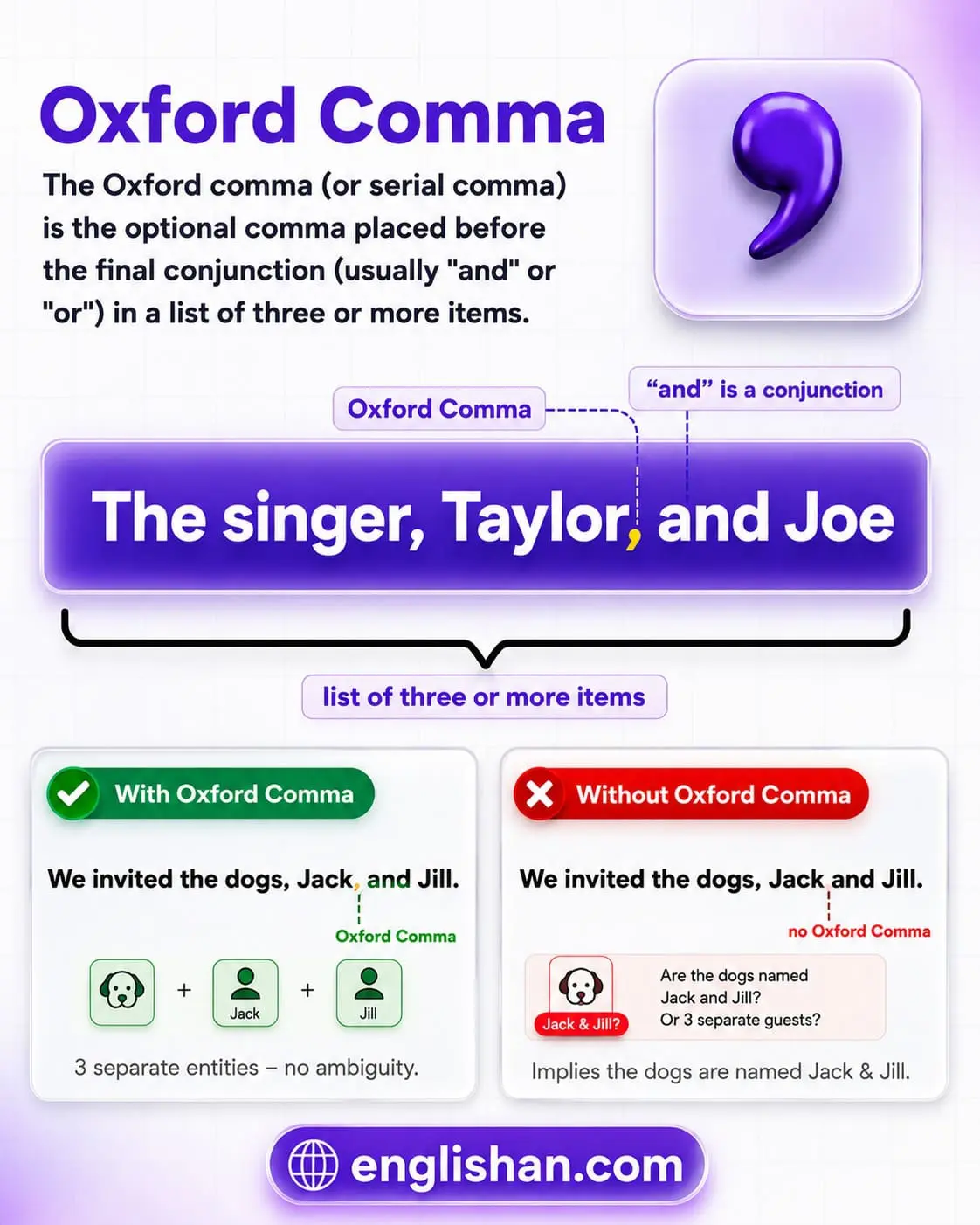
The Oxford comma is a punctuation mark used in a list of three or more items. It is placed right before the final item in the list, just after the second-to-last item. It is also known as the serial comma, a term commonly used in grammar and style guides. Both names refer to the same punctuation rule, depending on the writing style being followed.
For Example:
- With Oxford comma:
- I would like to thank my parents, Einstein, and Newton.
The Oxford comma makes the meaning clear here. It shows that three separate groups are being thanked: the parents, Einstein, and Newton.
- Without Oxford comma:
- I would like to thank my parents, Einstein and Newton.
Without the Oxford comma, the meaning becomes unclear. It can be understood as if “Einstein and Newton” are the parents. This small punctuation mark can change how a sentence is interpreted, which is why it is often used for clarity.
In simple terms, the Oxford comma improves clarity in lists by separating items clearly and reducing the chances of misunderstanding.
Who Uses the Oxford Comma?
The Oxford comma is not used uniformly across all types of writing. Its usage depends mainly on style guides and the purpose of the content. In academic and formal writing, it is commonly encouraged for clarity. In journalistic writing, it is often optional and used only when needed to avoid confusion.
Different style guides follow different rules:
- Chicago Manual of Style: Strongly recommends using it in all lists
- APA Style: Uses it for clarity in academic writing
- MLA Style: Encourages consistent use in formal work
- Associated Press (AP): Avoids it unless a sentence becomes unclear
- Many British editorial styles: Often omit it unless required for meaning
Example 1: The project was dedicated to my mentors, my parents, and my best friend.
(This clearly separates all three groups.)
Example 2: The project was dedicated to my mentors, my parents and my best friend.
(This can create ambiguity, suggesting the parents and best friend may be a single combined reference.)
In everyday writing, both forms can be correct. The main difference lies in clarity and style preference. Where precision is important, writers tend to include the Oxford comma. In simpler lists, it is often left out without causing any issue.
How to Use the Oxford Comma
The Oxford comma is a punctuation mark used in list writing to separate items in a clear and structured way. Its usage depends on specific conditions in a sentence where clarity, structure, and consistency matter most. The following rules explain exactly when and how it should be used.
Rule 1: Use it in lists of three or more items
The Oxford comma is mainly used when a sentence includes three or more items in a list. It appears right before the final word like “and” or “or,” helping to separate each item clearly and keep the sentence structured.
Example 1: She packed pens, notebooks, and markers.
Example 2: We visited Lahore, Karachi, and Islamabad.
Example 3: The recipe includes flour, sugar, and eggs.
This rule defines the basic function of the Oxford comma. It only appears in lists with three or more items and helps maintain clear separation between each element.
Rule 2: Never use it in two-item lists
When a sentence has only two items, there is no need for an Oxford comma. The structure is already clear, so adding a comma before “and” or “or” is unnecessary.
Example 1: He likes tea and coffee.
Example 2: I bought apples and oranges.
Example 3: She chose red or blue.
This rule sets a clear boundary for usage. The Oxford comma is not used in pairs because the sentence structure is already simple and unambiguous.
Rule 3: Use it when it prevents ambiguity
One of the most important uses of the Oxford comma is avoiding confusion or double meaning. Sometimes without it, a sentence can be misunderstood.
Example 1 (without clarity): I dedicate this book to my parents, Einstein and Newton.
(This sounds like parents are Einstein and Newton.)
Example 2 (clear with Oxford comma): I dedicate this book to my parents, Einstein, and Newton.
Example 3: We invited my cousins, John, and Sarah.
(Could be unclear whether John and Sarah are cousins or separate people.)
This rule focuses on clarity. The Oxford comma is especially useful when a sentence could be interpreted in more than one way without it.
Rule 4: Use it consistently once you choose a style
Once you decide whether to use the Oxford comma or not, the most important rule is consistency throughout your writing. Switching between styles makes writing look unprofessional and confusing.
Example 1 (consistent use): We bought apples, bananas, and oranges.
Example 2 (consistent no Oxford comma style): We bought apples, bananas and oranges.
Example 3 (inconsistent – incorrect style): We bought apples, bananas and oranges.
Consistency strengthens writing quality. Once a style is chosen, it should be applied uniformly to maintain clarity and professionalism throughout the text.
In summary, the Oxford comma is mainly used in lists of three or more items to improve clarity and structure. It is not used in two-item lists, but becomes important when a sentence could be unclear or open to more than one meaning. Once a style is chosen, the most important practice is to stay consistent throughout the writing.
Oxford Comma vs No Oxford Comma
A comparison shows how a single comma can change how a sentence is read. In some cases, both versions seem similar, but the Oxford comma often improves separation between items and reduces the chance of misreading.
| With Oxford Comma | Without Oxford Comma |
|---|---|
| I ordered pizza, pasta, and salad. | I ordered pizza, pasta and salad. |
| The team includes designers, developers, and testers. | The team includes designers, developers and testers. |
| She met Ali, Sara, and her teacher. | She met Ali, Sara and her teacher. |
| The prize goes to the poet, the artist, and the musician. | The prize goes to the poet, the artist and the musician. |
In the “with Oxford comma” version, each item in the list is clearly separated, so the reader can quickly identify all elements without hesitation. The structure feels more precise and controlled.
In the “without Oxford comma” version, the sentence is still grammatically acceptable, but in longer or more complex lists, the items can feel slightly less distinct, which may lead to momentary confusion or misreading.
The difference is mainly about clarity and readability. The Oxford comma doesn’t always change meaning, but it consistently improves how clearly each item in a list is understood.
Common Mistakes to Avoid
While using the Oxford comma is simple, a few common mistakes can affect clarity and consistency in writing. Understanding these helps in using it more effectively.
Inconsistent use
A frequent mistake is switching between using and not using the Oxford comma in the same piece of writing. This creates an uneven writing style and reduces professionalism.
Correct: We bought apples, bananas, and oranges.
Incorrect: We bought apples, bananas and oranges.
This inconsistency makes the writing look unorganized, so the chosen style should remain the same throughout.
Overuse in short lists
The Oxford comma is unnecessary in simple two-item lists. Using it in such cases does not improve clarity and can make sentences feel awkward.
Correct: He likes tea and coffee.
Incorrect: He likes tea, and coffee.
This shows that the comma should only be used when there are three or more items, not in basic pairs.
Ignoring clarity
The main purpose of the Oxford comma is to prevent confusion. Leaving it out when meaning becomes unclear can change how a sentence is understood.
Correct: I invited my friends, Ali, and Sara.
Incorrect: I invited my friends, Ali and Sara.
This can mistakenly suggest that Ali and Sara are the friends, which changes the meaning of the sentence.
Practice Exercises: Oxford Comma
Understanding the Oxford comma helps make writing clearer and avoids confusion in lists. These exercises are designed to help practice where to place the Oxford comma correctly. Try each question before checking the answers.
Exercise 1: Add the correct punctuation (Oxford comma or no change)
She packed a laptop books pens and a charger.
Exercise 2: Fix the sentence by correcting punctuation
The team includes Sara Ali and John.
Exercise 3: Rewrite the sentence using correct Oxford comma usage
The workshop covered grammar vocabulary punctuation and writing skills.
Exercise 4: Choose the correct option (with or without Oxford comma)
The meal included chicken rice and salad.
Exercise 5: Fix the mistake in the sentence
I want to thank my parents, Shakespeare and Aristotle.
Answer Key:
- She packed a laptop, books, pens, and a charger.
- The team includes Sara, Ali, and John.
- The workshop covered grammar, vocabulary, punctuation, and writing skills.
- The meal included chicken, rice, and salad.
- I want to thank my parents, Shakespeare, and Aristotle.
Final Thoughts on Oxford Comma
The Oxford comma may look like a small detail, but it can make a real difference in how clear a sentence feels. In some cases, it simply adds neat separation in a list, while in others it helps avoid confusion or double meanings.
There is no strict rule that forces everyone to use it in the same way. Some writing styles prefer it, while others use it only when needed. What matters most is clarity and consistency in writing.
In the end, it is less about right or wrong and more about making sentences easier to understand.
Oxford Comma FAQs
The Oxford comma is the comma placed before the final item in a list of three or more items. It is used to make sentences clearer and avoid confusion.
Example: I bought apples, bananas, and oranges.
In this sentence, the comma before “and oranges” is the Oxford comma. It clearly separates all three items in the list.
The Oxford comma is not strictly necessary in all cases. It is a style choice used by some writers and style guides. However, it becomes important when a sentence could be unclear or misunderstood without it.
Example: I thank my parents, Einstein, and Newton.
Without the Oxford comma, the meaning could become confusing. In such cases, using it helps improve clarity, but in simple lists, it is optional.
British writers do not use the Oxford comma as consistently as American writers. Many British style guides prefer leaving it out unless it is needed to avoid confusion. However, some British publications and authors still use it when clarity is important.
It is called the Oxford comma because it was traditionally used and promoted by Oxford University Press, a major academic publishing house. The term “Oxford” comes from this association, while another name for it is the “serial comma.”
You May Also Like