Punctuation in dates might look like a small detail, but it plays an important role in making your writing clear and easy to understand. Whether you are writing a formal document, an email, or even a simple note, the way you format dates can change how professional or confusing your text appears.
Many people use dates every day without thinking much about commas, slashes, or other punctuation marks. However, once you understand the basic rules, it becomes much easier to write dates correctly and consistently. In this article, we’ll go through simple rules and examples to help you get it right every time.
What is Punctuation in Dates?
Punctuation in dates refers to the way we use commas, slashes, dots, or other marks to correctly write dates so they are clear and easy to read. It helps organize the day, month, and year in a proper format, especially when writing in different styles like formal writing, informal notes, or international formats. It’s mainly used:
- To make dates clear and readable.
- To avoid confusion between different date formats.
- To ensure consistency in formal and informal writing.
- To support clear communication across different regions.
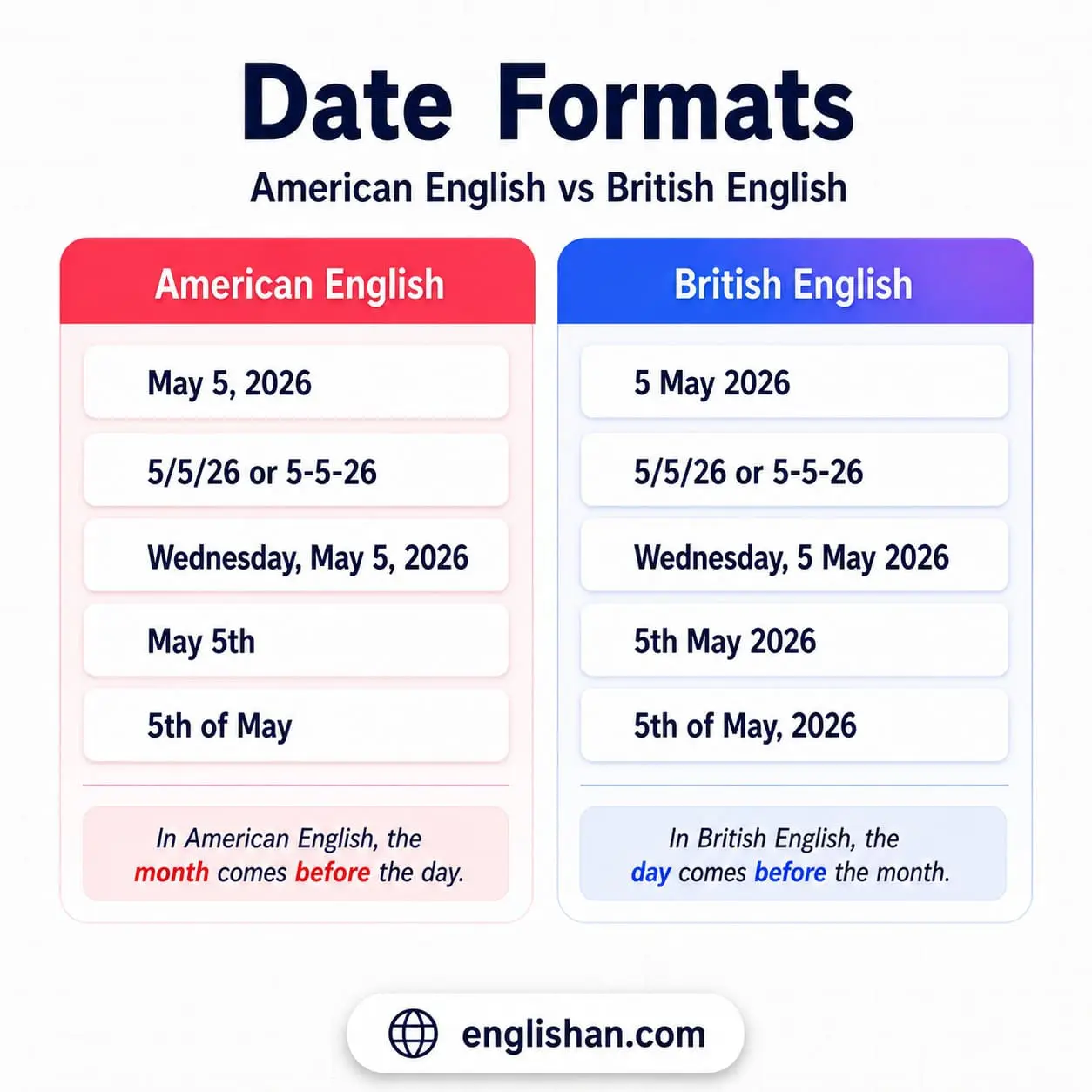
For example, July 4, 2026 is commonly used in American English, while 4 July 2026 is preferred in British English. In more informal or technical contexts, you may also see formats like 04/07/2026 or 04.07.2026, depending on the system or country.
Basic Formats of Writing Dates
Dates can be written in different styles depending on the region, context, and level of formality. Although the information is the same, the arrangement of day, month, and year changes. Understanding these formats is important because incorrect structure can create confusion for readers, especially in international communication.
American Style (Month – Day – Year)
In American English, the date is usually written by placing the month first, followed by the day, and then the year. This format is widely used in the United States in both formal and informal writing.
A comma is typically placed between the day and the year to separate them clearly.
Example 1: May 3, 2026
Example 2: December 25, 2025
So, if someone writes “May 3, 2026,” it is immediately understood that the event or action took place on the third day of May in the year 2026.
British Style (Day – Month – Year)
In British English, the structure is reversed compared to the American style. Here, the day comes first, followed by the month, and then the year. This format is commonly used in the United Kingdom and many other countries.
Unlike the American style, commas are generally not used between the elements of the date.
Example 1: 3 May 2026
Example 2: 25 December 2025
So, “3 May 2026” clearly indicates the third day of May in 2026 without any punctuation separating the parts.
Formal / Academic Style Usage
In formal writing, especially in academic or professional contexts, the same date formats are used but with careful attention to sentence structure and punctuation. The date is often included within a sentence, which requires proper placement of commas.
Example 1: The meeting was held on May 3, 2026.
Example 2: The report was submitted on 25 December 2025.
Here, the preposition “on” is used before the specific date, and the sentence is structured to maintain clarity and formality.
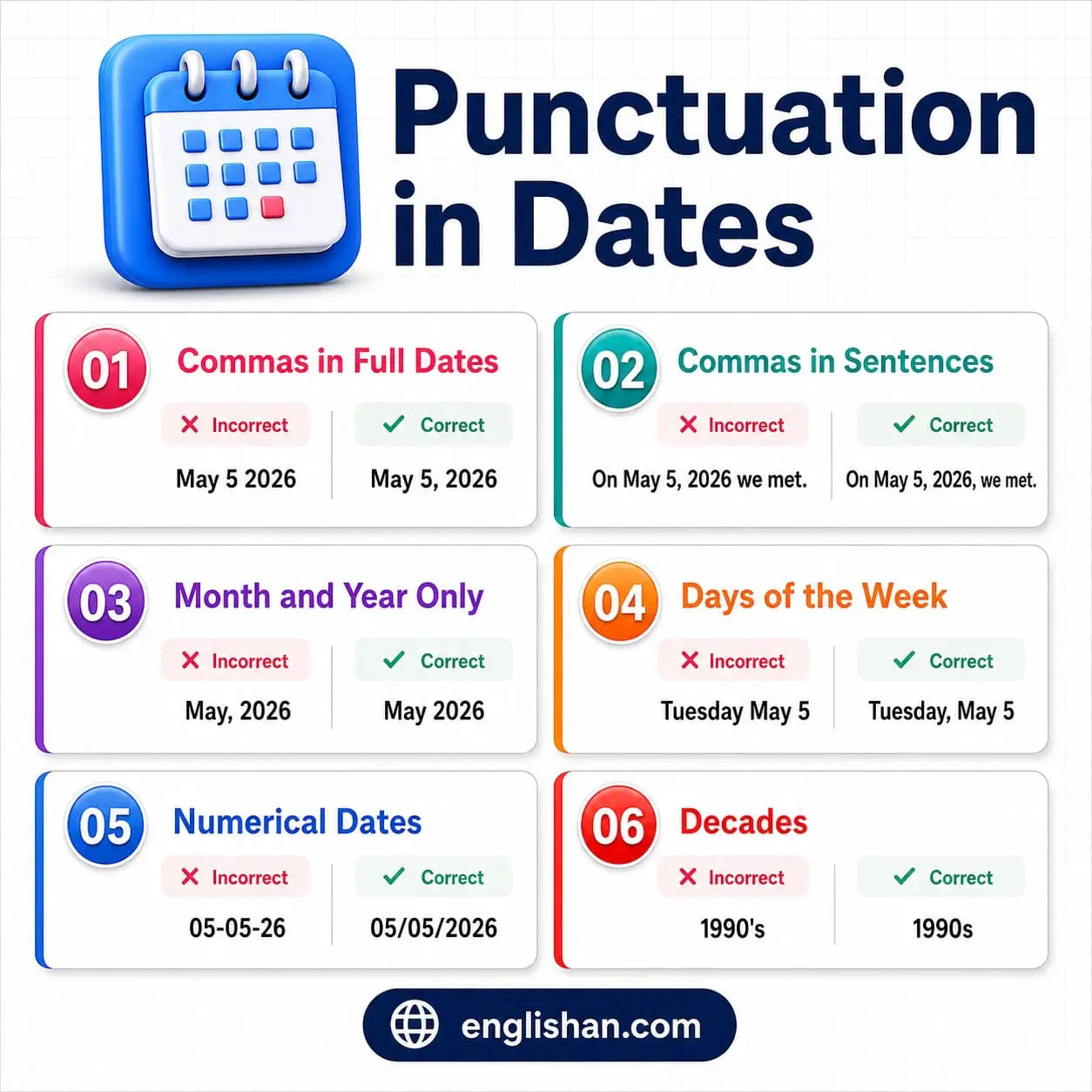
Use of Commas in Dates (Most Important Rules)
Dates in English writing follow specific punctuation rules that help make the meaning clear and avoid confusion. Among these, the use of commas is especially important in American style and in sentence structures where dates are included. Understanding these rules ensures your writing looks correct, professional, and easy to read.
Rule 1: Comma between day and year (American style only)
In American English, dates are written in the Month–Day–Year format. A comma is placed between the day and the year to separate them clearly. This punctuation helps the reader easily identify each part of the date without confusion.
Example 1: July 4, 2025
Example 2: March 10, 2024
This rule is essential in American writing style, and missing the comma is considered a common grammatical error.
Rule 2: Comma after the full date in a sentence
When a complete date is used inside a sentence, a comma is placed after the year if the sentence continues. This helps separate the date from the remaining part of the sentence and improves readability.
Example 1: On May 3, 2026, we will start the project.
Example 2: December 25, 2025, is a public holiday in many countries.
The comma after the date is only needed when the sentence does not end with the date itself.
Rule 3: No comma in British style
In British English, the date is written in the Day–Month–Year format. Unlike American style, no commas are used between the elements of the date, making the structure simpler and more direct.
✔ Example 1: 3 May 2026
✔ Example 2: 25 December 2025
This format is widely used in the UK and many other countries, and commas inside the date are not considered standard.
Prepositions Used with Dates
Understanding prepositions with dates is important because they show the relationship between time and actions in a sentence. Each preposition has a specific use depending on how precise or general the time reference is.
Rule 4: Use “on” for specific dates
The preposition “on” is used when referring to a particular and exact date. It connects an action or event directly to a specific day in the calendar.
Example 1: on May 3, 2026
Example 2: on 15 August 2024
Always use “on” when the date is fully specified, as it gives clarity about the exact timing of the event.
Rule 5: Use “in” for months and years
The preposition “in” is used when referring to a general time period such as a month or a year. It does not point to a specific day but rather a broader time frame.
Example 1: in May 2026
Example 2: in 2024
“In” is used when the exact date is not mentioned, only the general time period is known.
Rule 6: Use “by” for deadlines
The preposition “by” is used to indicate a deadline or final time limit. It shows that something must be completed on or before a specific date.
Example 1: Submit the assignment by May 3, 2026.
Example 2: Complete the report by 2024.
“By” is commonly used in instructions, schedules, and deadlines to indicate the last acceptable time for completion.
Ordinal Numbers in Dates (1st, 2nd, 3rd)
When we write dates in English, we often see numbers like 1st, 2nd, 3rd, 4th, and so on. These are called ordinal numbers, and they are used to show the position or order of a day in a month. While they are common in spoken English and informal writing, their use in formal writing depends on the context and style.
Informal Use of Ordinal Numbers
In everyday communication, ordinal numbers are often used because they sound more natural and conversational. People commonly use them in messages, invitations, notes, and casual writing.
Example 1: May 3rd, 2026
Example 2: 1st January 2025
In informal writing, this style feels more friendly and expressive, especially when the writing is not strictly academic or professional.
Formal Writing Style
In formal, academic, or professional writing, ordinal numbers are generally avoided. Instead of adding suffixes like “st,” “nd,” “rd,” or “th,” only the number is used. This keeps the writing clean, standard, and universally accepted.
Example 1: May 3, 2026
Example 2: January 1, 2025
This format is preferred in reports, essays, official documents, and business communication.
So, the main reason behind this difference is clarity and formality. Informal writing focuses on natural expression, while formal writing focuses on consistency and simplicity. Removing ordinal suffixes reduces clutter and makes dates easier to read in official contexts.
Common Mistakes in Date Punctuation
When writing dates in English, small punctuation or word choice mistakes can completely change the clarity of a sentence. These errors are very common, especially among learners, because different English styles (American and British) follow different rules. Understanding these mistakes helps you write dates more accurately and professionally.
Missing Comma (American Style)
In American English, when writing dates in the Month–Day–Year format, a comma must be placed between the day and the year. Many learners forget this comma, which makes the date look incomplete or incorrect in standard writing.
Incorrect: May 3 2026
Correct: May 3, 2026
In the correct form, the comma clearly separates the day from the year, making the date easier to read and grammatically correct.
Using Wrong Preposition
Another common mistake is using the wrong preposition with dates. Each preposition has a specific purpose, and using the wrong one changes the meaning or makes the sentence grammatically incorrect.
Incorrect: in May 3, 2026
Correct: on May 3, 2026
We use “on” for specific dates because it refers to an exact day, while “in” is used for months or years in general.
Mixing Formats
Sometimes writers mix American and British date formats, which creates confusion and looks inconsistent. Each style has its own structure, and combining them results in incorrect formatting.
Incorrect Example: 3, May, 2026
Correct Example: 3 May 2026
The correct British style follows the Day–Month–Year order without commas, keeping the format clean and consistent.
Practice Exercises: Punctuation in Dates
Understanding punctuation in dates is important because even a small mistake can change the clarity of your writing. These exercises are designed to help you practice correct comma usage, proper formats, and prepositions used with dates. Try to complete each question carefully before checking the answers.
Exercise 1: Add the correct punctuation (comma or no comma).
She was born on May 3 _____ 2026.
Exercise 2: Fix this sentence. Correct the punctuation mistake.
May 3 2026 is the deadline for submission.
Exercise 3: Rewrite the sentence using correct American date punctuation.
The event will take place on July 4 2025 and everyone is invited.
Exercise 4: Choose the correct format (American or British style).
The meeting was held on _____ 15 August 2024.
Exercise 5: Fix the mistake in the sentence.
On in May 3, 2026, the project will start.
Answer Key:
- She was born on May 3, 2026.
- May 3, 2026 is the deadline for submission.
- The event will take place on July 4, 2025, and everyone is invited.
- The meeting was held on 15 August 2024.
- On May 3, 2026, the project will start.
Final Thought on Punctuation in Dates
As we learned, punctuation in dates is not just a formatting choice but an important part of clear and correct writing. Different styles like American and British follow different rules, especially in comma usage and date order. Small elements such as placing a comma after the day or choosing the right preposition like on or in can make a big difference in how easily the reader understands the information.
Overall, mastering date punctuation helps improve both accuracy and professionalism in writing. Once these rules become familiar, they naturally become part of your writing style without much effort. In the end, it’s all about consistency and clarity—two things that make any piece of writing more effective and reliable.
FAQs: Punctuation in Dates
A comma is used in American English to separate the day and the year for clarity. It helps make the date easier to read and prevents confusion between different parts of the date.
Example: May 3, 2026
No, British English does not use commas in dates. The format is written as Day–Month–Year without any punctuation inside the date.
Example: 3 May 2026
We use “on” when referring to a specific date in a sentence. It connects the action to an exact day.
Example: on May 3, 2026
Yes, but mostly in informal writing. In formal writing, it is better to avoid ordinal numbers and use simple numbers instead.
Informal: May 3rd, 2026
Formal: May 3, 2026
One of the most common mistakes is forgetting the comma in American style or mixing American and British formats in the same sentence. This can make writing confusing and incorrect.
You May Also Like
- Semicolon Use in English Grammar
- Period (.) in English Grammar
- Ellipsis (…): Meaning, Uses, and Examples