The ellipsis (…) is the only punctuation mark that tells the reader something is missing. A period ends a sentence. A comma pauses it. A question mark turns it into an inquiry. But the ellipsis signals that words have been removed, a thought has trailed off, or the speaker is still deciding what to say next.
Three dots carry a surprising amount of weight in both formal and informal writing. In academic work, the ellipsis compresses quotations by removing words that don’t serve the argument. In fiction and dialogue, it creates pauses, hesitation, and unfinished thoughts that feel closer to real speech. In text messages and casual writing, it shifts tone in ways that a period or exclamation mark cannot match.
With that range of uses comes a set of rules that most writers never fully sort out. Spacing before and after the dots, the difference between a three-dot and four-dot ellipsis, placement inside quotation marks, and the line between effective pause and overuse all follow specific conventions. Here, you’ll work through each rule with real examples across academic, creative, and everyday writing.
What Is An Ellipsis?
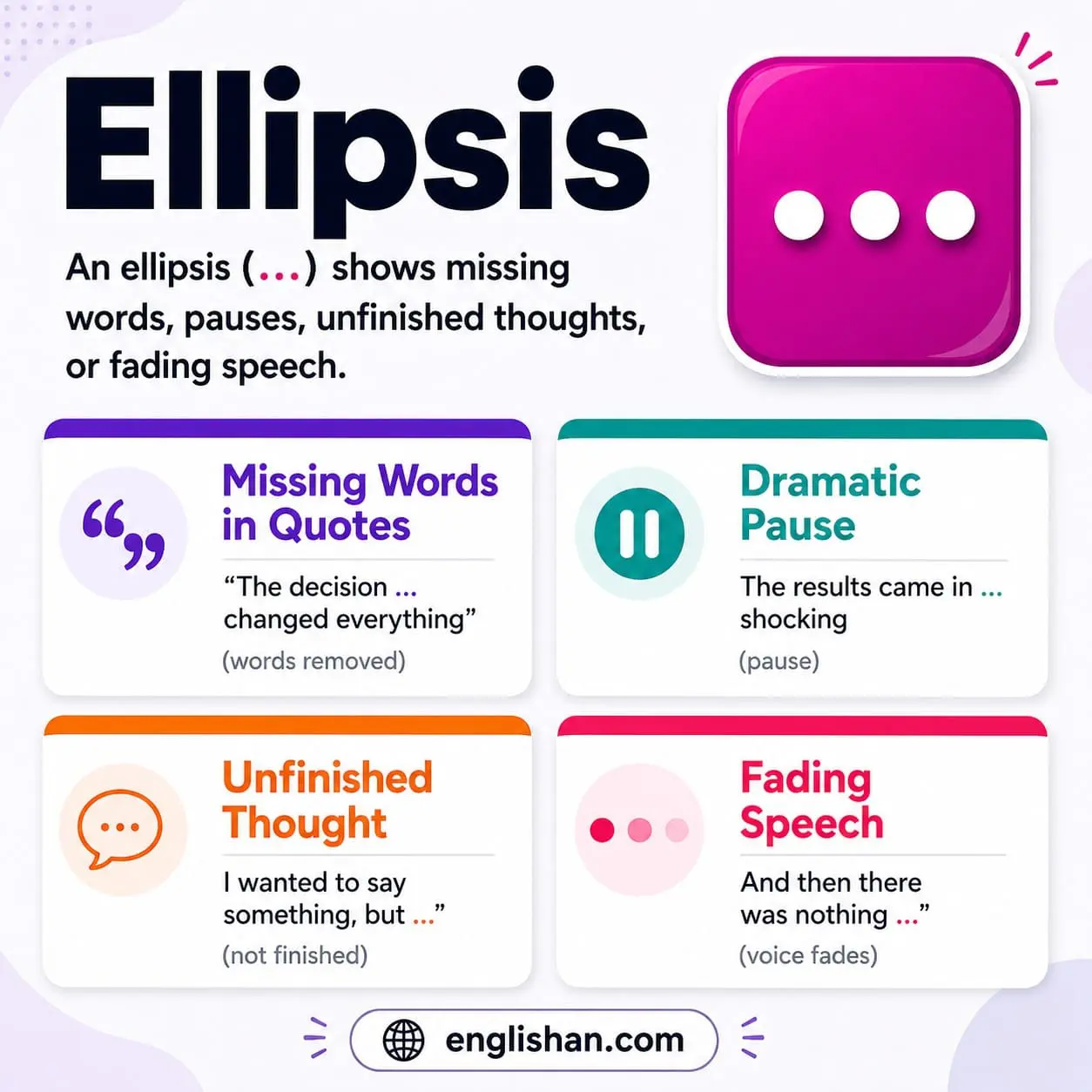
An ellipsis (…) is a punctuation mark made of three dots, used to show that words have been left out, a thought is unfinished, or the speaker is pausing. The word comes from the Greek élleipsis, meaning “to leave out,” and that origin captures the mark’s core function: it represents something absent.
The singular form is ellipsis. The plural is ellipses. One set of three dots in a sentence is an ellipsis. Two or more sets across a passage are ellipses. Both forms refer to the same punctuation mark.
In American English, the mark is sometimes called suspension points or simply three dots. Regardless of the name, the function stays the same: the ellipsis replaces what is not written and asks the reader to recognize the gap.
The mark works in three distinct ways:
- Omission: Removing words from a quotation without changing the original meaning. “The journey of a thousand miles… begins with a single step.”
- Pause or hesitation: Showing that a speaker is thinking, uncertain, or choosing words carefully. “I’m not sure… maybe we should wait.”
- Trailing off: Indicating that a thought fades without being completed. “I wanted to tell you, but…”
Each function follows its own placement rule, and the spacing around the mark changes depending on the style guide you follow.
When To Use An Ellipsis
The ellipsis earns its place in a sentence only when something is genuinely missing, unfinished, or deliberately paused. Dropping three dots into a sentence without a reason weakens the writing instead of strengthening it.
Omitting Words From Quotations
The most formal use of the ellipsis is to shorten a direct quotation by removing words that are unnecessary for the writer’s point. The remaining words must still form a grammatically correct sentence, and the original meaning must stay intact.
Original: “After years of careful research and repeated trials, the team confirmed that the results were consistent across all age groups.”
Shortened: “After years of careful research… the team confirmed that the results were consistent across all age groups.”
The ellipsis replaces and repeated trials, which is extra detail that the writer chose to remove. The sentence still reads naturally, and the meaning does not change.
This usage appears most often in academic writing, journalism, legal documents, and research summaries. The ellipsis tells the reader that the quote has been edited, which maintains transparency. Removing words without an ellipsis would misrepresent the original text.
One rule applies strictly here: the sentence must remain grammatically correct after the omission. Cutting the wrong words and leaving behind a broken sentence defeats the purpose.
- “She… going to the market.” ❌
- “She was… heading to the market.” ✅
The first version removes the verb was, which breaks the grammar. The second version removes a less critical word while keeping the sentence functional.
Showing A Pause Or Hesitation
In dialogue and creative writing, the ellipsis captures the moment when a speaker pauses mid-thought. The words on either side of the mark are complete, but the ellipsis tells the reader that the speaker hesitated before continuing.
- “I’m not sure… maybe we should reconsider.”
- “The answer is… actually, let me think about that.”
- “It’s not that I disagree… it’s more that I don’t understand.”
The pause feels different from a comma pause. A comma creates a brief, smooth separation. The ellipsis creates a longer, heavier silence that carries emotional weight. The reader senses the speaker thinking, doubting, or choosing words with care.
This usage belongs primarily to fiction, personal essays, informal blog writing, and dialogue. In formal or academic writing, a comma or a restructured sentence handles hesitation more cleanly.
Trailing Off Without Finishing
When a thought fades rather than stopping, the ellipsis sits at the end of the sentence and leaves the idea open. The speaker does not reach a conclusion, and the reader fills in the rest.
- “I thought I could trust him, but…”
- “We had plans, and then everything just…”
- “I was going to say something, but…”
The trailing ellipsis works because the reader already understands where the thought was heading. The mark gives the writer permission to leave the ending unspoken, which often carries more emotional weight than finishing the sentence would.
This is where the ellipsis and the em dash split apart. Both marks can appear at the end of an interrupted sentence, but they signal different things. An ellipsis shows a thought trailing off gradually, as though the speaker lost the thread or chose not to finish. An em dash shows a thought being cut off abruptly, as though something interrupted the speaker mid-word.
- “I was going to tell you, but…” (trailing off, fading)
- “I was going to tell you, but—” (cut off, interrupted)
Choosing the wrong mark changes the reader’s experience. The ellipsis feels quiet and reflective. The em dash feels sudden and sharp.
Indicating Continuation
An ellipsis at the end of a passage can signal that more exists beyond what is written. This appears in storytelling, serialized content, and informal writing where the writer wants the reader to sense that the narrative keeps going.
- “And then the lights went out…”
- “The story doesn’t end here…”
This usage is informal and works best in creative contexts. In formal writing, a complete sentence with a period is the standard way to close a passage.
Spacing And Formatting Rules
Ellipsis formatting is the single most inconsistent area in English punctuation. Style guides disagree on spacing, and writers who follow one guide often encounter text formatted under a different one. The mark itself is always three dots, but the space around those dots changes depending on the standard you follow.
Chicago Manual Of Style (CMOS)
CMOS treats the ellipsis as three spaced periods with a space before and after the mark:
I don’t know . . . I’m not sure.
Each dot is separated by a non-breaking space, and the whole mark is surrounded by spaces. This style appears most often in books, academic publishing, and long-form editorial work.
AP Style And General Blog Writing
AP style and most digital writing use the Unicode ellipsis character (…), which renders as three dots without internal spaces. A space goes before and after the mark:
I don’t know … I’m not sure.
Many content management systems and word processors automatically convert three typed periods into the Unicode ellipsis character. This is the style most blog writers, journalists, and online publishers follow.
Practical Recommendation
Whichever style you choose, stay consistent throughout the document. Switching between spaced and unspaced ellipses within the same piece of writing looks like an error, even when both styles are technically correct under different guides.
For blog writing and web content, the unspaced Unicode ellipsis (…) with a space on each side is the most widely used format.
The Four-Dot Ellipsis
When an omission falls at the end of a sentence, the period that closes the sentence joins the three ellipsis dots. The result is four dots: one period followed by three ellipsis dots (or, in some guides, three ellipsis dots followed by a period).
Original: “She studied every evening. She passed every exam. She graduated with honors.”
Shortened: “She studied every evening. … She graduated with honors.”
The period after evening closes the first sentence. The ellipsis that follows signals that the middle sentence has been removed. The reader understands that material has been cut between two complete sentences.
Some style guides place the period before the ellipsis (. …), while others place it after (… .). CMOS places the period first with no space between the period and the first ellipsis dot. The logic stays the same regardless of the format: the period belongs to the sentence, and the ellipsis belongs to the omission.
Ellipsis With A Question Mark Or Exclamation Mark
When a sentence trails off but the tone is questioning or emphatic, the question mark or exclamation mark follows the ellipsis.
- “Why would he do that…?”
- “I can’t believe you actually…!”
The ellipsis captures the trailing tone, and the terminal punctuation mark tells the reader whether the trailing thought was a question or an exclamation. Without the question mark or exclamation mark, the reader would not know how to read the sentence’s emotional register.
Capitalization After An Ellipsis
Whether to capitalize the word after an ellipsis depends on what the ellipsis is doing.
Mid-sentence pause or omission: The word after the ellipsis continues in lowercase because the sentence is still going.
- “The results were… unexpected.”
End-of-sentence omission followed by a new sentence: The next word takes a capital letter because a new sentence is beginning.
- “She studied every evening. … She graduated with honors.”
The rule mirrors the behavior of periods. When the ellipsis replaces material within a single sentence, lowercase continues. When it replaces material between two sentences, the next sentence starts with a capital.
Ellipsis Vs Dash Vs Colon
The ellipsis, the em dash, and the colon all create breaks in a sentence, but the type of break is different every time. Choosing the right mark depends on what you want the reader to experience at that moment.
| Mark | What It Does | Example |
|---|---|---|
| … (ellipsis) | Shows a trailing thought, omission, or pause | “I was thinking… maybe not.” |
| — (em dash) | Shows an abrupt interruption or strong aside | “I was thinking—forget it.” |
| : (colon) | Introduces an explanation, list, or elaboration | “I was thinking: we should leave.” |
The ellipsis creates a soft, gradual break. The reader feels the speaker slowing down, losing certainty, or letting a thought dissolve. The emotional register is quiet and reflective.
The em dash creates a hard, sudden break. The reader feels the speaker being interrupted or shifting direction sharply. The emotional register is dramatic and abrupt.
The colon creates a structured, deliberate break. The reader expects what follows to explain or expand on what came before. The emotional register is neutral and logical.
Mixing these marks up changes how the reader processes the sentence. “I was thinking… maybe not” sounds like hesitation. “I was thinking—maybe not” sounds like a sudden change of mind. “I was thinking: maybe not” sounds like a reasoned conclusion. The words are identical. The punctuation controls everything.
Ellipsis Examples Across Different Contexts
| Context | Example |
|---|---|
| Omission in a quotation | “The research confirmed… consistent results across all groups.” |
| Pause in dialogue | “I wanted to say… never mind.” |
| Trailing off | “We had so many plans, and then…” |
| Hesitation | “It’s not that I don’t trust you… it’s just complicated.” |
| Continuation | “The road stretched on and on…” |
| Four-dot (end-of-sentence omission) | “She worked tirelessly. … She earned the recognition.” |
| With a question mark | “Do you think he actually…?” |
| With an exclamation mark | “I can’t believe she…!” |
| Suspense in storytelling | “The door creaked open… and then silence.” |
| Informal writing | “So yeah… that happened.” |
Each example earns its ellipsis because the mark is doing real work: removing words, creating a pause, or leaving a thought deliberately open. An ellipsis placed where a comma or period would do the job just as well adds nothing and weakens the sentence.
Common Ellipsis Mistakes
Using More Than Three Dots
The ellipsis always consists of three dots. Adding four, five, or six dots is one of the most common mistakes in casual writing. Extra dots do not add extra emphasis. They add a formatting error.
- “I don’t know what to say……” ❌
- “I don’t know what to say…” ✅
The only time four dots appear is in the four-dot method, where a period closes the sentence and three ellipsis dots follow. That is a period plus an ellipsis, not an ellipsis with an extra dot.
Placing An Ellipsis Where It Has No Purpose
An ellipsis should mark something missing, something unfinished, or a deliberate pause. Placing it in a sentence where none of those conditions exist confuses the reader, because the mark promises something that the sentence does not deliver.
- “I woke up… and went to school.” ❌
- “I woke up and went to school.” ✅
The first version suggests a dramatic pause between waking up and going to school. Unless something significant happened in that pause, the ellipsis creates false suspense and makes the writing feel overdone.
Confusing The Ellipsis With The Em Dash
The ellipsis and the em dash handle two different types of interruption. The ellipsis signals a thought fading out. The em dash signals a thought being cut short. Using the wrong mark changes the reader’s experience entirely.
- “I was about to tell her—” (cut off by something external) ✅
- “I was about to tell her…” (trailing off by choice) ✅
- “I was about to tell her…” (used to mean interruption) ❌
The third version is wrong only when the writer intends to show interruption. A trailing thought and a cut-off thought feel fundamentally different, and the punctuation must match the intention.
Inconsistent Spacing
Switching between the spaced format (. . .) and the unspaced format (…) within the same document creates a visual inconsistency that looks like careless editing.
- “She paused . . . and then continued… walking.” ❌
- “She paused… and then continued… walking.” ✅
Pick one spacing style and apply it throughout the entire piece. Both styles are correct under different guides, but mixing them is always wrong.
Breaking The Grammar Of A Shortened Quotation
When removing words from a quote, the remaining sentence must still read as a grammatically correct statement. Cutting the wrong words and leaving behind a broken sentence misrepresents the original and creates a confusing reading experience.
- “The committee… the proposal was approved.” ❌
- “The committee reviewed… and the proposal was approved.” ✅
The first version removes so many words that the sentence no longer makes structural sense. The second version removes less and keeps the grammar intact.
Overusing Ellipses
Too many ellipses in a single paragraph make the writing feel breathless, uncertain, and unfinished. The reader starts to distrust the writer’s confidence, because every sentence seems to trail off without reaching a conclusion.
- “The weather was warm… we went outside… the kids played… we stayed until dark…” ❌
- “The weather was warm. We went outside, and the kids played in the garden. We stayed until dark.” ✅
The corrected version delivers the same information without any trailing uncertainty. The ellipsis should appear once or twice in a passage at most, reserved for the moment where the trailing effect genuinely strengthens the writing.
Final Thought
The ellipsis does what no other punctuation mark can. It tells the reader that something is absent, whether that absence is a removed word, an unspoken thought, or a moment of silence between two ideas. That ability to represent what is not on the page gives the ellipsis its unique power in both formal and creative writing.
The mark works best when it is used with purpose and restraint. A well-placed ellipsis creates genuine suspense, honest hesitation, or a clean quotation edit. A carelessly placed one makes the writer sound uncertain about their own sentences. The strongest approach is to write the sentence without an ellipsis first, then add one only when the sentence genuinely loses something without it.
FAQ
An ellipsis is a punctuation mark made of three dots (…) that signals omitted words, a pause in speech, or an unfinished thought. The word comes from the Greek élleipsis, meaning “to leave out.” The singular form is ellipsis, and the plural is ellipses.
Always three. Adding more dots is incorrect in standard English. The only exception is the four-dot method, which is a period closing a sentence followed by a three-dot ellipsis to show that material between two sentences has been removed.
An ellipsis shows a thought trailing off gradually, as though the speaker lost the thread or chose not to finish. An em dash shows a thought being cut off suddenly, as though something interrupted the speaker. “I was going to say…” (trailing off) vs. “I was going to say—” (interrupted).
It depends on whether the sentence continues or a new one begins. After a mid-sentence ellipsis, lowercase continues: “The results were… unexpected.” After an end-of-sentence ellipsis where a new sentence follows, the next word takes a capital letter: “She studied hard. … She graduated with honors.”
Yes, but only for shortening quotations. Academic papers, legal documents, and reports use ellipses to remove unnecessary words from direct quotes while maintaining the original meaning. Using ellipses for stylistic pauses or trailing thoughts belongs to informal and creative writing.
It depends on the style guide. The Chicago Manual of Style uses three spaced periods with spaces around the mark (. . .). AP style and most blog writing use the Unicode ellipsis character (…) with a space before and after. Both formats are correct. The rule is to choose one and stay consistent throughout the document.
There is no fixed number, but restraint produces better writing. One or two per page is usually enough in formal work. In creative writing and dialogue, the mark appears more frequently, but even there, too many trailing thoughts weaken the reader’s trust in the writer’s control over the narrative.
You May Also Like
- Em Dash (—): Rules, Uses, and Examples in English Grammar
- Hyphen in English Grammar
- Semicolon Use in English Grammar