The exclamation mark (!) changes the weight of a sentence. The same words carry different energy depending on what closes them. It is raining. reads as a neutral observation. It is raining! carries urgency, frustration, or disbelief. That single mark tells the reader to hear the sentence louder, faster, or with more force.
Exclamation marks work after sudden reactions (Wow!), firm commands (Stop!), emotional declarations (I passed the exam!), and short interjections (Oh no!). Each position follows a specific rule, and knowing those rules prevents the mark from weakening your writing instead of strengthening it.
Overuse is the most common mistake. One well-placed exclamation mark makes a sentence hit harder. Five in a row make the writer sound breathless. Below, you’ll learn exactly when the exclamation mark strengthens a sentence, when it weakens one, and how to use it with confidence in every writing situation.
What Is An Exclamation Mark?
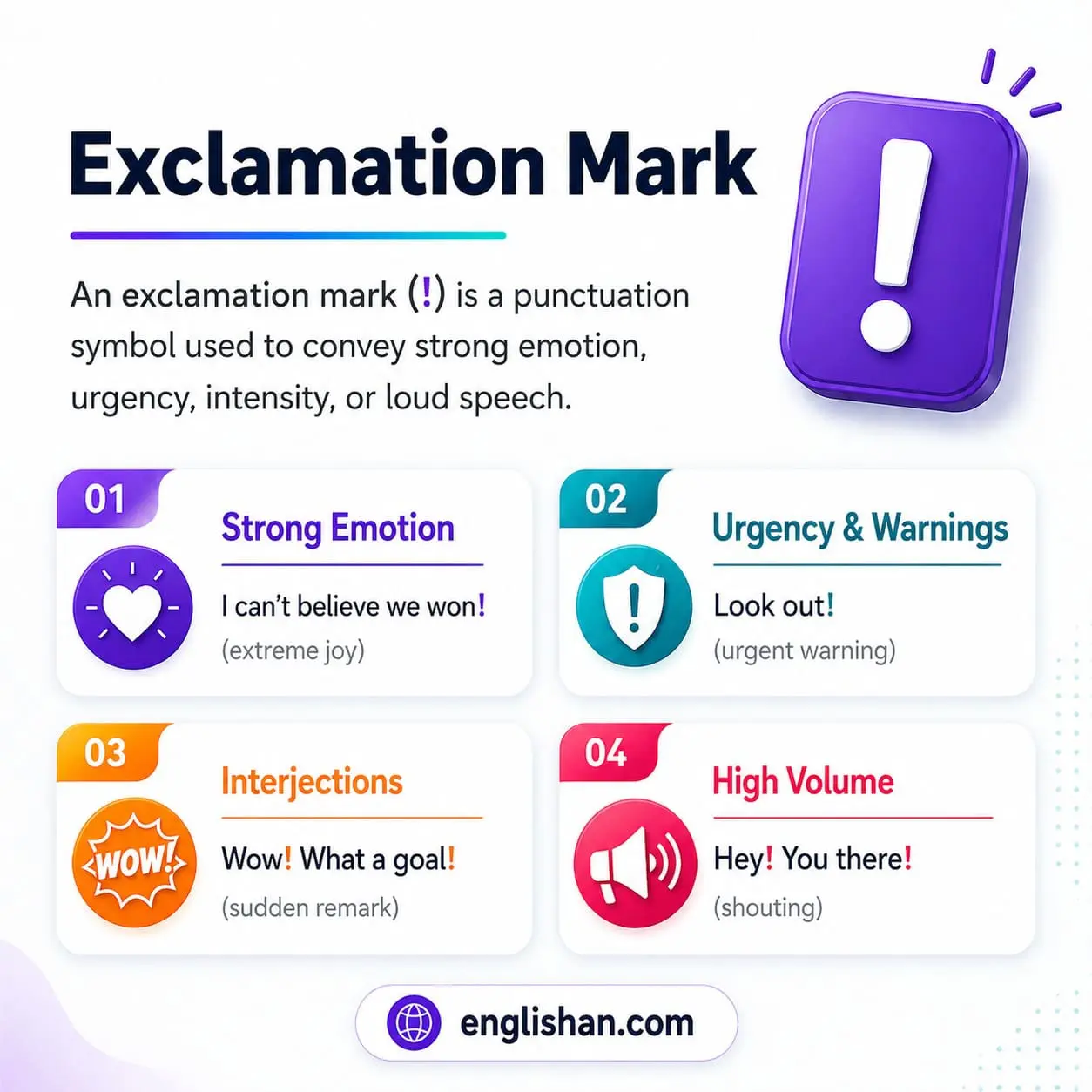
An exclamation mark (!) is a terminal punctuation mark placed at the end of a sentence, phrase, or single word to signal emphasis, strong emotion, or urgency. It belongs to the same family as the period and the question mark — all three end sentences — but the exclamation mark adds intensity that neither of the other two carries.
The mark originated from the Latin exclamation io, meaning joy or surprise. Over centuries, scribes shortened io into a vertical stroke above a dot, which eventually became the (!) symbol used across modern languages.
In American English, this mark is called an exclamation point. In British English and most international usage, it’s called an exclamation mark. Both names refer to the same symbol, and the rules are identical regardless of which term you use.
The core function is tonal. A period ends a sentence with neutral finality. A question mark signals inquiry. An exclamation mark tells the reader that the sentence carries emotional weight — excitement, fear, anger, disbelief, admiration, or urgency — and should be read with that energy.
- She finished first. — neutral statement.
- She finished first! — excitement, disbelief, or admiration.
- She finished first? — doubt or surprise, framed as a question.
The difference between these three sentences is not the words. The punctuation at the end controls how the reader hears them.
When To Use An Exclamation Mark
The exclamation mark fits specific sentence types, and each one demands a slightly different approach. The mark earns its place when the sentence carries genuine emotional force — not when the writer wants to make a flat statement sound more interesting.
After Exclamatory Sentences
An exclamatory sentence expresses a strong reaction or intense feeling. These sentences often begin with what or how and carry a built-in emotional structure that naturally pairs with the exclamation mark.
- What a brilliant performance!
- How fast that car was going!
- I can’t believe we actually won!
- That sunset was absolutely breathtaking!
Remove the exclamation mark from any of these, and the sentence loses its force. What a brilliant performance. reads flat — almost sarcastic — because the sentence structure promises emotion that the period does not deliver.
After Interjections
An interjection is a short word or phrase that captures a sudden feeling. Words like wow, ouch, oh no, hey, and hurray are interjections, and they almost always take an exclamation mark because their entire purpose is emotional reaction.
- Wow! I didn’t expect that.
- Ouch! That really stings.
- Oh no! The flight has been cancelled.
- Hey! Come back here.
The exclamation mark follows the interjection itself, not necessarily the sentence that comes after it. In the first example, Wow! takes the mark, but I didn’t expect that is a calm follow-up that ends with a period. This separation keeps the emotional punch on the reaction word where it belongs.
After Commands And Warnings
Commands that carry urgency, authority, or emotional force take an exclamation mark. The mark signals that the command is not a polite suggestion — it’s a directive with real weight behind it.
- Stop!
- Get out of the building immediately!
- Don’t touch that wire!
- Put the phone down and listen!
Not every command needs one. Please close the door. is a polite request, and a period fits. Close the door! is a sharp command, and the exclamation mark matches the intensity. The choice depends on the force the writer wants the reader to feel.
After Single Words And Short Phrases
A single word or a short phrase can carry enough emotion on its own to warrant an exclamation mark. These fragments work because the reader already understands the emotional context.
- Incredible!
- No way!
- Finally!
- Absolutely not!
These aren’t full sentences, but the exclamation mark makes the emotion unmistakable. Without it, Finally. reads as a flat observation. With it, Finally! reads as relief, triumph, or impatience — depending on context.
In Direct Speech And Dialogue
When a character or speaker delivers words with emotional force, the exclamation mark appears inside the quotation marks to reflect how the words were said, not how the surrounding sentence is structured.
- “Don’t move!” the officer commanded.
- “I got the job!” she shouted into the phone.
- “Watch out!” he yelled from across the street.
- “This is the best day of my life!” the child said, beaming.
The mark sits inside the closing quotation mark because it belongs to the spoken words. The reporting verb (commanded, shouted, yelled) describes the delivery, and the exclamation mark inside the quote confirms the tone.
Exclamation Marks With Quotation Marks
Placement depends on whether the exclamation belongs to the quoted material or to the sentence surrounding it.
When the exclamation belongs to the quote, the mark goes inside the closing quotation mark:
- He shouted, “Get away from the edge!”
- “That’s the funniest thing I’ve ever heard!” she said.
When the exclamation belongs to the surrounding sentence, the mark goes outside:
- I can’t believe he actually said “I quit”!
- She had the nerve to call it “a minor issue”!
In the second pair, the quoted words are calm — the writer’s reaction is what carries the force. The exclamation mark sits outside the quote because the emotion belongs to the sentence, not to the quoted phrase.
This rule catches many writers off guard, but the logic is consistent: the mark follows the source of the emotion.
Exclamation Mark Rules You Should Follow
The exclamation mark is one of the easiest punctuation marks to use — and one of the easiest to misuse. The following rules separate effective usage from the kind that weakens writing.
Use Only One At A Time In Formal Writing
Multiple exclamation marks (!! or !!!) appear in text messages and casual online writing, but they have no place in formal, professional, or published content. A single mark delivers the full effect. Stacking them suggests the writer doesn’t trust the sentence to carry its own weight.
- ❌ I passed the exam!!!
- ✅ I passed the exam!
- ❌ That’s incredible!!!
- ✅ That’s incredible!
In casual texts to friends, multiple marks are a style choice. In anything meant for publication, business, or academic work, one is the maximum.
Avoid Exclamation Marks In Formal Writing
Academic essays, business reports, legal documents, and professional emails rarely benefit from exclamation marks. The mark signals personal emotion, which clashes with the objective tone expected in formal contexts.
- ❌ The quarterly results exceeded expectations!
- ✅ The quarterly results exceeded expectations.
- ❌ Please submit your report by Friday!
- ✅ Please submit your report by Friday.
The second version in each pair sounds professional because the period lets the facts stand without editorial emotion. In formal writing, strong word choices and precise phrasing carry emphasis more effectively than punctuation.
There is one exception: formal announcements or congratulatory messages sometimes take an exclamation mark because the context is celebratory. Congratulations on your promotion! reads naturally even in a professional email. The key is that the emotion fits the occasion.
Do Not Pair It With A Period Or Comma
The exclamation mark replaces the period at the end of a sentence. It does not sit alongside one. The same applies to commas in dialogue attribution.
- ❌ “Watch out!,” he said.
- ✅ “Watch out!” he said.
- ❌ That was incredible!.
- ✅ That was incredible!
The exclamation mark already serves as the terminal punctuation. Adding a period or comma next to it doubles the signal and creates a grammatical error.
Do Not Overuse It
Overuse is the most damaging exclamation mark mistake because it erodes the mark’s power. When every sentence ends with one, none of them stand out. The reader stops registering the emphasis, and the writing starts to feel breathless or uncontrolled.
- ❌ The weather was perfect! We went to the beach! The water was so warm! We stayed until sunset!
- ✅ The weather was perfect. We went to the beach, and the water was so warm we stayed until sunset!
In the corrected version, only the final sentence takes the exclamation mark — the one that carries the genuine emotional payoff. The preceding sentences set the scene with neutral statements, which makes the closing mark land with real force.
Professional writers treat exclamation marks the way a chef treats chili pepper: a small amount at the right moment intensifies the dish, but too much overwhelms everything else on the plate.
Exclamation Mark Vs Other Punctuation
The exclamation mark belongs to a set of terminal punctuation marks that close sentences, but each one controls the reader’s experience differently.
| Mark | Name | Function | Example |
|---|---|---|---|
| . | Period | Ends a neutral statement | It is raining. |
| ? | Question mark | Ends a question or inquiry | Is it raining? |
| ! | Exclamation mark | Ends an emphatic, emotional, or urgent sentence | It is raining! |
The period closes a sentence with neutral finality. It delivers information without telling the reader how to feel about it. The train leaves at 6:00. — factual, calm, finished.
The question mark signals that the sentence is asking something. It shifts the reader’s posture from receiving information to answering or considering a question. Does the train leave at 6:00? — the reader expects an answer.
The exclamation mark tells the reader to feel the sentence, not just read it. The train leaves at 6:00! carries urgency, surprise, or frustration depending on context. The words are identical to the period version, but the mark changes everything about how the reader processes them.
Can You End A Question With An Exclamation Mark?
Yes — when the question carries more shock or emotion than genuine inquiry. A sentence like How could you do that! is grammatically a question, but the speaker isn’t asking for an answer. The exclamation mark signals that the emotion (disbelief, anger) outweighs the question.
Some writers combine both marks: How could you do that?! This combination appears in fiction, dialogue, and informal writing. In formal contexts, choose one mark — whichever reflects the dominant tone of the sentence.
Exclamation Mark Examples In Sentences
The following examples show how the exclamation mark works across different writing contexts, with each example demonstrating a different emotional register.
| Context | Example |
|---|---|
| Joy | We’re having a baby! |
| Surprise | You’re here already! |
| Anger | I told you not to touch that! |
| Urgency | The building is on fire! |
| Admiration | What an extraordinary achievement! |
| Warning | Don’t step on the broken glass! |
| Interjection | Wow! That was close. |
| Command | Everybody freeze! |
| Disbelief | You actually climbed the whole thing! |
| Relief | Thank goodness you’re safe! |
Each sentence earns its exclamation mark because the emotion is built into the words, not manufactured by the punctuation. We’re having a baby already carries excitement — the mark confirms it. A weaker sentence like I went to the store does not become emotional just because the writer adds an exclamation mark. The sentence itself must carry the weight.
Exclamation Marks In Digital Communication
Exclamation marks behave differently in emails, text messages, and workplace chat than they do in published writing. The same mark that signals enthusiasm in one context can read as aggression or sarcasm in another.
In casual texts and social media, exclamation marks signal friendliness and warmth. Thanks! reads more enthusiastic than Thanks. — and in many digital conversations, a period at the end of a short message can actually feel cold or passive-aggressive. The exclamation mark softens the message.
In professional emails, the rules shift. One or two exclamation marks in a longer email feel natural: Great news! The client approved the proposal. But filling every sentence with them makes the writer sound either unprofessional or insincere: Great news! The client approved! We start Monday! This is going to be amazing!
The safest approach in professional digital writing: use one exclamation mark per email, and place it where the enthusiasm is most genuine. Save the mark for the sentence that carries real feeling, and let the rest of the email speak in its normal voice.
Common Mistakes With Exclamation Marks
Using The Mark To Strengthen Weak Sentences
An exclamation mark does not fix a flat sentence. If the words carry no emotional weight, the mark feels forced and artificial.
- ❌ I went to the grocery store!
- ✅ I went to the grocery store.
- ❌ The meeting starts at 3:00!
- ✅ The meeting starts at 3:00.
The mark should confirm emotion that already exists in the sentence, not create it from scratch.
Confusing Emphasis With Volume
Writers sometimes use exclamation marks when they want emphasis but not emotional force. In those cases, bold text or a stronger word choice works better than punctuation.
- ❌ The deadline is tomorrow! (reads as panic)
- ✅ The deadline is tomorrow. (reads as a firm reminder)
- ✅ The deadline is tomorrow. (reads as emphasis without emotional overload)
The exclamation mark version implies urgency or alarm. If the writer only wants to stress the timing without sounding alarmed, other tools do the job with more control.
Placing The Mark Outside Quotation Marks When It Belongs Inside
If the emotion belongs to the quoted words, the mark goes inside the quotation marks — not after them.
- ❌ She said, “I can’t believe this”!
- ✅ She said, “I can’t believe this!”
The speaker’s emotion lives inside the quote. Moving the mark outside changes who “feels” the exclamation — and misplacing it distorts the sentence.
Final Thought
The exclamation mark does one thing: it raises the emotional volume of a sentence. A period delivers information. A question mark invites a response. The exclamation mark asks the reader to feel the words, not just read them.
That power works only when the mark appears where the emotion is earned. A well-placed exclamation mark makes a sentence land harder. A carelessly placed one makes the writer sound like they’re shouting into an empty room. The best practice is the same one professional editors follow: write the sentence with a period first, and switch to the exclamation mark only if the sentence genuinely loses something without it.
FAQs
An exclamation mark signals strong emotion, urgency, or emphasis at the end of a sentence, phrase, or single word. It tells the reader to process the sentence with more intensity than a period would suggest. What a match! carries excitement that What a match. does not.
No functional difference. “Exclamation point” is the standard term in American English, while “exclamation mark” is the standard term in British English and most international usage. Both refer to the same symbol (!), and the rules are identical.
If the exclamation belongs to the quoted words, the mark goes inside the closing quotation mark: “That’s incredible!” she said. If the exclamation belongs to the surrounding sentence, it goes outside: I can’t believe she called it “fine”!
Rarely. Academic papers, business reports, and legal documents rely on word choice rather than punctuation for emphasis. The one common exception is congratulatory or celebratory messages in professional contexts: Congratulations on the promotion!
Yes, when the sentence carries more emotion than inquiry. How could you forget! is structured as a question but functions as an emotional outburst. Some writers use both marks together (How could you forget?!), though this combination belongs to informal writing, not formal text.
There is no fixed number, but restraint matters. In professional and published content, most paragraphs should not contain more than one. In a full article or essay, two or three across the entire piece is usually sufficient. Each one should mark a genuine emotional peak, not a routine statement.
Yes. In casual texting, an exclamation mark signals warmth and enthusiasm — Thanks! reads friendlier than Thanks. In professional emails, one well-placed mark feels natural, but overusing them sounds either insincere or overly casual. The safest rule for workplace messages: one exclamation mark per email, placed where the enthusiasm is real.
You May Also Like