The word bracket can have different meanings depending on the context. In writing, it refers to punctuation marks used to add extra information or clarification within a sentence. In mathematics, brackets are symbols used to group numbers or expressions and show the order of operations.
Outside of language and math, a bracket can also mean a category or range used for grouping people or things, such as age brackets or income brackets. In general objects or structures, it refers to a support piece fixed to a wall or surface to hold something in place. In this article, the meaning of brackets, their types, and the basic rules for using them will be explained in a simple and easy-to-follow manner.
What is a bracket?
A bracket is a punctuation mark used to enclose extra or supplementary information within a sentence. The term “bracket” can be understood in different contexts:
- In writing: It is used to add explanations or additional details.
- In mathematics: It groups numbers or expressions and controls order of operations.
- In general usage: It refers to categories or ranges, such as age or income brackets.
- In physical objects: It is a support structure used to hold items like shelves.
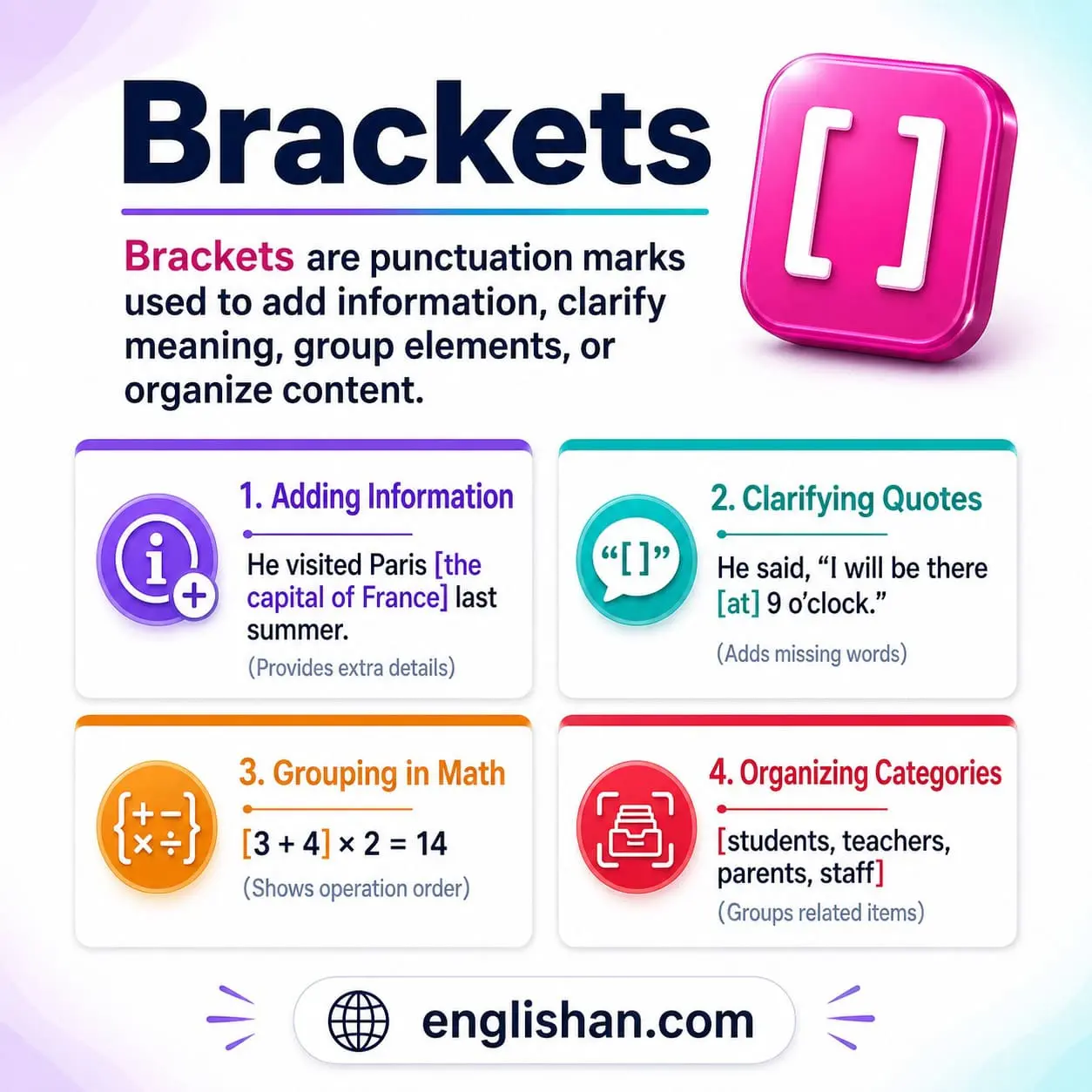
Why brackets are important in writing?
Brackets are essential because they help writers manage information effectively. They:
- Separate main ideas from additional details
- Improve sentence clarity and readability
- Prevent unnecessary interruptions in the flow of writing
- Allow explanations without rewriting the entire sentence
In short, brackets make writing more organized and reader-friendly.
Types of Brackets
Brackets come in different forms, and each type has its own purpose in writing and other fields. Let’s explore the different types of brackets and how they are used.
Parentheses ( )
Parentheses are used to include extra information that is not essential to the main sentence. Even if the content inside is removed, the sentence still remains complete.
Example 1: The final exam (which was quite difficult) ended on time.
Example 2: John missed the class (because he was not feeling well).
In simple terms, parentheses help a writer add side information in a natural and smooth way without breaking the flow of the sentence.
Square Brackets [ ]
Square brackets are used mainly to add clarification inside quoted text. They show editorial additions that were not part of the original statement.
Example 1: She said, “They [the teachers] were very helpful.”
Example 2: The report stated, “The data was incomplete [due to technical issues].”
These brackets are especially useful in formal writing where clarity and accuracy are important.
Curly Brackets { }
Curly brackets are mostly used in mathematics, set theory, and programming. They are not commonly used in general writing.
Example 1: {2, 4, 6, 8} represents even numbers.
Example 2: In coding, instructions are written inside { } to form a block.
So, curly brackets are mainly about structure and grouping in technical fields.
Angle Brackets < >
Angle brackets are used in technical fields such as HTML and coding to define tags or placeholders.
Example 1: The HTML tag for a paragraph is <p>.
Example 2: Enter your username in <user_name>.
So, these brackets are commonly used to keep technical elements clearly separated and well organised.
![Diagram showing different types of brackets: parentheses (), square brackets [], curly braces {}, and angle brackets <>.](https://englishan.com/wp-content/smush-webp/2026/04/Types-of-Brackets.jpeg.webp)
Brackets in Different Contexts
Brackets show up in different areas, and their use changes with the context. Sometimes they are used in writing, sometimes in maths, and sometimes in technical work—but in every case, they help keep information clear and properly arranged.
Grammar context (writing & sentences)
In writing, brackets are used to add extra information, clarifications, or small comments without disturbing the main sentence. They help separate additional details from the core idea so the sentence remains clear and readable. This makes the writing more organized and easier to understand.
Example: The meeting (which was held online) lasted for two hours.
Mathematics context (equations & sets)
In mathematics, brackets are used to group numbers or expressions and control the order of operations. They show which part of a calculation should be solved first, ensuring correct results. They are also used to represent sets, where elements are grouped together in an organized form.
Example: (5 + 3) × 2 = 16
Technical context (HTML, coding)
In coding and web development, brackets are used to define structure and organize instructions. They help separate different parts of a program or define elements in markup languages, making the code readable and functional.
Example 1: <p>This is a paragraph</p>
Social/contextual use (income bracket, age bracket)
In everyday language, “bracket” is used to describe categories or ranges used for grouping people or data. It helps classify information into clear sections, making it easier to analyze or compare.
Example: People in the 18–25 age bracket are more active online.
Uses of Brackets
Uses of Brackets refers to the different ways these punctuation marks help organize and clarify writing in various situations.
Adding extra information
Brackets are used to include additional details in a sentence without affecting its main meaning. This information is usually supportive and helps the reader understand the context more clearly. Even if the bracketed part is removed, the sentence still remains complete and meaningful.
Example 1: The match (which was delayed due to rain) finally started in the evening.
Example 2: David completed his project (after working late at night) before the deadline.
This use helps improve clarity by allowing extra information to be included in a smooth and non-interrupting way.
Clarifying Quotes
Brackets are also used inside quotations to clarify or slightly adjust the meaning of certain words. They help explain unclear references or add missing information so the reader can understand the quote more accurately. Importantly, they do not change the original message but only improve its clarity.
Example 1: She said, “They [the new students] arrived on time.”
Example 2: The report stated, “The results were unclear [due to missing data].”
This use ensures that quoted material is both accurate and easier to understand for the reader.
Grouping in Mathematics
Brackets are used in mathematics to group numbers, terms, or expressions so that calculations follow a clear order. They help decide which part of the expression should be solved first, making complex problems easier to manage and reducing confusion in step-by-step calculations.
Example 1: (2 + 3) × 4 = 20
Example 2: [10 − (2 + 1)] ÷ 3 = 7 ÷ 3
This use ensures that mathematical expressions are solved in a structured and accurate way.
Bracket as a Noun
As a noun, “bracket” can refer to different things depending on how it is used in real-life situations. It may describe a physical object used for support or a way of grouping things into categories or ranges.
Meaning as a physical object
As a noun, a bracket can refer to a solid support piece that is fixed to a wall or surface to hold or support something. It is commonly used in construction, furniture, and home fittings. This type of bracket is designed to provide strength and stability, such as holding shelves, frames, or other objects in place.
Example 1: The shelf was fixed to the wall using metal brackets.
Example 2: A strong bracket was installed to support the heavy mirror.
In this sense, a bracket is a physical object that plays a supporting role in structure and stability.
Meaning as a category/range
A bracket can also mean a category or range used to group people, values, or things based on specific criteria. This usage is common in everyday language, especially when discussing age, income, or performance groups. It helps in organizing information into clear sections for comparison or analysis.
Example 1: Students in the 15–18 age bracket are eligible for the competition.
Example 2: Families in the low-income bracket may receive financial support.
In this sense, a bracket works as a way to classify or group information into meaningful ranges.
Bracket as a Verb
As a verb, to bracket means to place people, things, or ideas into groups based on shared features or similarities. It is used when organizing or classifying information into clear categories or ranges. This helps in comparing data, sorting information, or understanding differences more easily.
Example 1: The candidates were bracketed according to their experience levels.
Example 2: Students are often bracketed by age in school competitions.
In this sense, “bracket” works as an action word that focuses on grouping or organizing information in a structured way.
Common Mistakes with Brackets
Brackets are helpful in writing, but they need to be used carefully. When used incorrectly, they can make sentences confusing or less clear. That’s why it’s important to understand some common mistakes people often make while using brackets.
Mixing bracket types incorrectly
One common mistake is using different types of brackets in the same place without a clear reason. Each bracket type has its own purpose, so incorrect mixing can confuse the structure and meaning of a sentence.
Incorrect: The meeting [which was important) was delayed.
Correct: The meeting (which was important) was delayed.
Using the right bracket type consistently helps maintain clarity and proper structure.
Overusing brackets in writing
Another common error is using too many brackets in a sentence or paragraph. While brackets are helpful for extra information, overusing them can make writing messy and difficult to read.
Incorrect: The student (who was very talented) (and also hardworking) (and always punctual) won the award.
Correct: The student, who was very talented and hardworking, won the award.
Brackets should be used only when necessary to keep writing smooth and readable.
Using brackets for essential information
Brackets should not contain important information needed to understand the main sentence. If essential details are placed inside brackets, the sentence may become unclear or incomplete.
Incorrect: The capital of Pakistan is (Islamabad).
Correct: The capital of Pakistan is Islamabad.
Essential information should always remain part of the main sentence without brackets.
Final Thoughts on Brackets
Brackets may seem like a small part of writing, but they play an important role in keeping information clear, organized, and easy to understand. They help separate extra details, clarify meaning, and structure information in different contexts without disturbing the main idea of a sentence.
When used correctly, brackets improve readability and make writing more precise. However, their effectiveness depends on proper usage, as overuse or incorrect use can lead to confusion. Overall, brackets are a simple but powerful tool that supports clear and well-structured communication.
FAQs about Brackets
Brackets are used in writing to add extra information, explanations, or comments without changing the main meaning of a sentence. They help keep sentences clear and organized by separating supporting details from the main idea.
The main types of brackets include parentheses ( ), square brackets [ ], curly brackets { }, and angle brackets < >. Each type has a different purpose depending on the context, such as writing, mathematics, or technical work.
Brackets are important because they improve clarity and structure in writing. They allow writers to include extra or clarifying information without interrupting the flow of the main sentence, making the message easier to understand.
No, brackets should not be used for essential information. They are meant for additional or supporting details only. If important information is placed inside brackets, it can make the sentence unclear or incomplete.
Outside of writing, brackets are commonly used in mathematics to group expressions and in programming to organize code. They are also used in everyday language to describe categories like age brackets or income brackets.
You May Also Like