Quick answer: Skip the comma before because in most sentences. The word because introduces a reason that’s grammatically tied to the main clause, and separating them with a comma weakens that connection.
Add a comma before because only when leaving it out creates ambiguity — when the sentence could be read two different ways.
❌ She didn’t leave, because the movie was boring. (unnecessary comma in an unambiguous sentence) ✅ She didn’t leave because the movie was boring. (one reading, no confusion)
✅ She didn’t leave, because she was waiting for a friend. (comma needed — without it, the sentence could mean she left for a different reason)
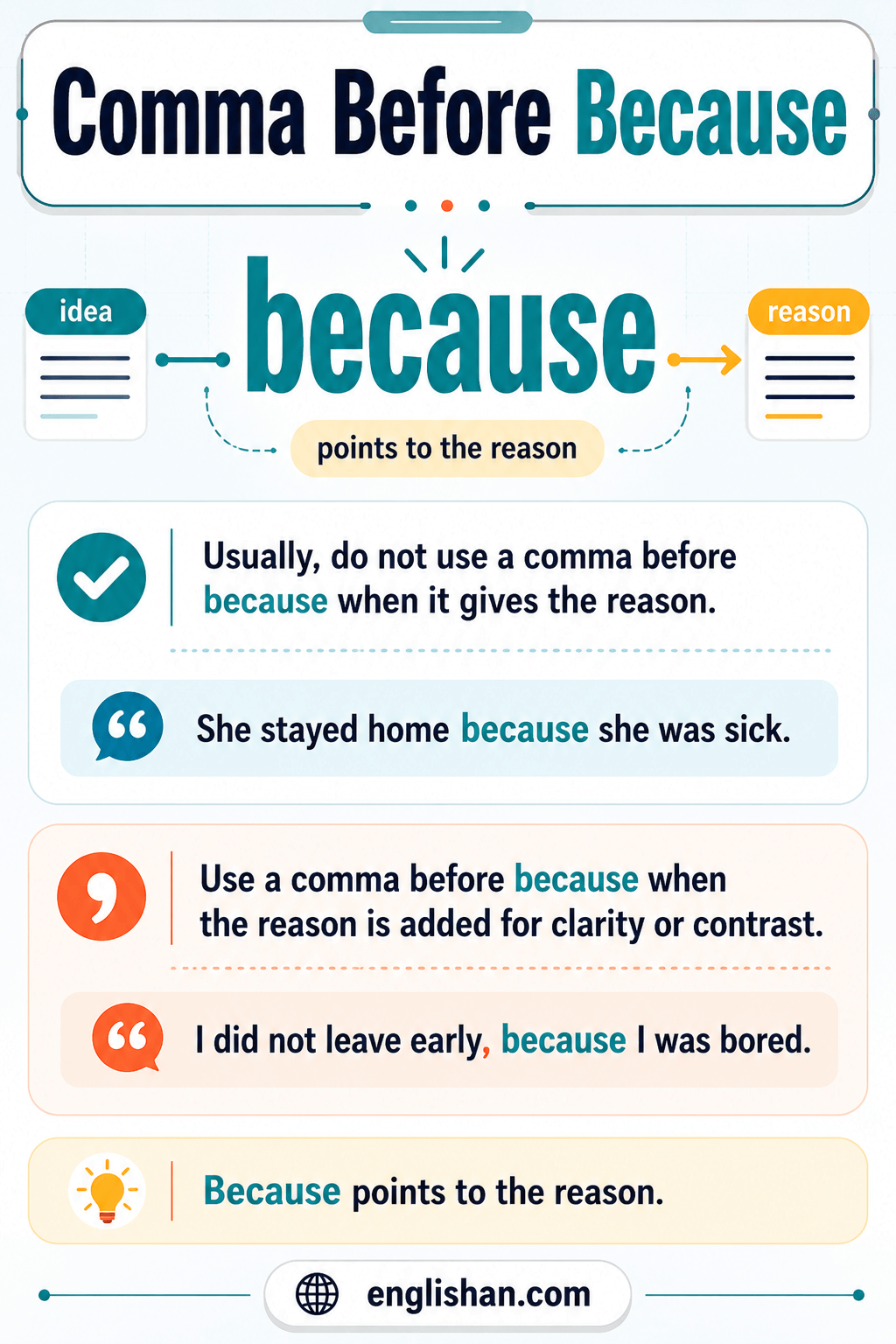
The Default Rule: No Comma Before “Because”
Because is a subordinating conjunction — it attaches a reason to the main clause. That reason is grammatically bound to what comes before it, so no comma belongs between them.
The project fell behind schedule because two developers quit in the same week.
She canceled the appointment because the office was closed.
He switched careers because the salary wasn’t competitive.
Each because clause answers a single question — why? — and attaches directly to the main clause. No ambiguity, no comma.
This is the default. It holds for the vast majority of sentences you’ll write. The exceptions below apply only when that direct attachment creates a problem.
Exception 1: Negative Statements That Create Two Readings
A comma before because becomes necessary when the main clause contains a negative (didn’t, wasn’t, hadn’t, won’t) and the absence of a comma lets the sentence be read two entirely different ways.
Take this sentence:
I didn’t call her because she was upset.
Two readings are possible here, and they contradict each other:
- Reading A: I didn’t call her. The reason I didn’t call? She was upset. (The because clause explains why I avoided calling.)
- Reading B: I did call her — but not because she was upset. I called for some other reason. (The because clause is being negated.)
If you mean Reading A — you didn’t call, and her being upset was the reason — add a comma:
✅ I didn’t call her, because she was upset.
The comma separates the main clause (I didn’t call her) from the reason, making it unmistakable that the because clause explains the not-calling rather than being negated by it.
How to Test for This Ambiguity
When your main clause contains a negative and a because clause follows it, run this two-step check:
- Read the sentence as if the negative applies only to the main verb. (I didn’t call her. Why? Because she was upset.)
- Read it as if the negative applies to the reason. (I called her, but not because she was upset.)
If both readings make sense, the sentence is ambiguous. Add a comma to lock in the meaning you intend.
If only one reading is plausible, the comma is unnecessary:
✅ He didn’t pass the exam because he studied all night. — Nobody would read this as “He passed the exam, but not because he studied.” The meaning is unambiguous. No comma needed.
Exception 2: When “Because” Could Attach to More Than One Clause
Ambiguity also arises when the sentence contains multiple clauses before because, and the reader can’t tell which one the because clause modifies.
Rachel suspected that there was a leak in her ceiling because her upstairs neighbor left the bathtub running.
Two readings again:
- Reading A: Rachel suspected a leak existed. Her reason for suspecting? The neighbor’s running bathtub.
- Reading B: A leak existed, and Rachel suspected the cause of the leak was the neighbor’s bathtub.
If you mean Reading A — the running bathtub is why Rachel suspected a leak, not the cause of the leak itself — a comma separates the because clause from the embedded clause (that there was a leak) and ties it back to suspected:
✅ Rachel suspected that there was a leak in her ceiling, because her upstairs neighbor left the bathtub running.
The underlying logic is the same as Exception 1: whenever the because clause could plausibly attach to more than one part of the sentence, a comma pins it to the main clause and removes the second reading.
Exception 3: Stylistic Pause for Emphasis or Contrast
Outside of ambiguity, a comma before because can serve a rhetorical purpose — adding a slight pause that gives the reason more weight or draws attention to a contrast.
I didn’t apologize, because I had nothing to apologize for.
She kept running, because stopping meant giving up.
Neither sentence is technically ambiguous. A reader would understand the meaning without the comma. The comma is a deliberate stylistic choice — it creates a beat before the reason lands, giving it more emphasis.
Use this sparingly. It works best when the reason carries emotional or argumentative weight. In neutral, factual sentences, skip it — the comma would feel like a speed bump rather than a purposeful pause.
Comma After “Because” — A Different Situation
A comma after because is unrelated to the rules above. It appears only when a parenthetical phrase or nonessential aside interrupts the because clause.
We left early because, if I’m being honest, the event was poorly organized.
Remove the parenthetical (if I’m being honest) and the sentence still works: We left early because the event was poorly organized. The commas fence off the interruption, not because itself.
Without a parenthetical, no comma goes after because.
❌ We left early because, the event was poorly organized. ✅ We left early because the event was poorly organized.
Starting a Sentence With “Because”
When a because clause opens the sentence — placing the reason before the main clause — a comma follows the because clause.
✅ Because the roads were flooded, we took a different route.
✅ Because he’d already eaten, Marcus skipped the dinner.
This follows the standard rule for introductory dependent clauses: when the dependent clause comes first, a comma separates it from the independent clause that follows.
Flip the order, and the comma disappears:
✅ We took a different route because the roads were flooded.
“Since” vs. “Because”
Since is widely accepted as a synonym for because in casual and semi-formal writing.
Since the store was closed, we went home.
The only risk: since also expresses time (I haven’t been there since March). If your sentence could be read as either time or cause, switch to because to remove the ambiguity.
Since she arrived, the project has improved. — Time or cause? Unclear.
✅ Because she arrived, the project has improved. — Cause. No confusion.
Avoid “The Reason Is Because”
Because already means for the reason that. Pairing it with the reason is creates a redundancy.
❌ The reason we were late is because the train broke down.
✅ We were late because the train broke down.
✅ The reason we were late is that the train broke down.
Both corrected versions say the same thing without doubling up on the causal logic.
How This Differs From Coordinating Conjunctions
If you’ve just learned the comma rule for but, and, or or, the rule for because flips the default.
With coordinating conjunctions (but, and, or, yet, so), a comma goes before the conjunction when it joins two independent clauses:
✅ I wanted to go, but it was raining.
With subordinating conjunctions like because, the default is no comma — the dependent clause is grammatically tied to the main clause:
✅ I stayed home because it was raining.
The comma before because is the exception. The comma before but is the rule. Keeping that contrast in mind prevents the most common punctuation mix-up between the two.
Quick-Reference Table
| Scenario | Comma Before Because? | Example |
|---|---|---|
| Standard cause-and-effect sentence | ❌ No | He left because the meeting ended. |
| Negative statement creating ambiguity | ✅ Yes | She didn’t win, because she wasn’t competing. |
| Multiple clauses — unclear attachment | ✅ Yes | He assumed the pipe burst, because the floor was wet. |
| Stylistic pause for emphasis | ✅ Optional | I stayed, because I had no other choice. |
| Parenthetical after because | Comma after, not before | We stopped because, frankly, it was dangerous. |
| Because clause opens the sentence | Comma after the clause | Because it was late, we left. |
FAQ
Q1. Do you need a comma before “because” in every sentence? No. Most sentences with because require no comma. The because clause is grammatically dependent on the main clause, and separating them weakens the cause-and-effect connection. A comma is needed only when leaving it out creates ambiguity — most commonly after a negative statement — or when you want a deliberate rhetorical pause.
Q2. Can you start a sentence with “because”? Yes. Because clauses regularly open sentences in professional, academic, and creative writing. When the because clause comes first, follow it with a comma before the main clause: Because the deadline moved, we adjusted the schedule.
Q3. What’s the difference between the comma rule for “because” and the comma rule for “but”? They work in opposite directions. But is a coordinating conjunction — it joins two independent clauses, and a comma goes before it by default. Because is a subordinating conjunction — it attaches a dependent clause to the main clause, and no comma is used by default. The comma before because is an exception for ambiguity; the comma before but is the standard rule.
Q4. Is “the reason is because” grammatically wrong? It’s redundant. Because already means for the reason that, so the reason is because doubles the causal logic. Replace it with the reason is that or restructure the sentence to use because directly: We were late because the train broke down.
You May Also Like