

The adjective form of a word is the adjective formed from a noun or a verb, usually by adding a suffix, an ending such as “-ful” or “-ous”. The adjective “dangerous” is derived from the noun “danger”, and “creative” from the verb “create”.
Adjective suffixes add their own meaning to the base word, so “-less” means ‘without’ in “careless” and “-able” means ‘can be done’ in “washable”. A few common words change their spelling before the suffix, and some form the adjective with no suffix at all.
The adjective form of a word is usually derived by adding a suffix to a noun or a verb, as in “hope” and “hopeful”, “nation” and “national”, and “attract” and “attractive”. Common adjective suffixes are “-ful”, “-less”, “-ous”, “-al”, “-ic”, “-y”, “-ish”, “-ive”, and “-able”. The suffix adds its own meaning, and some base words change their spelling before it.
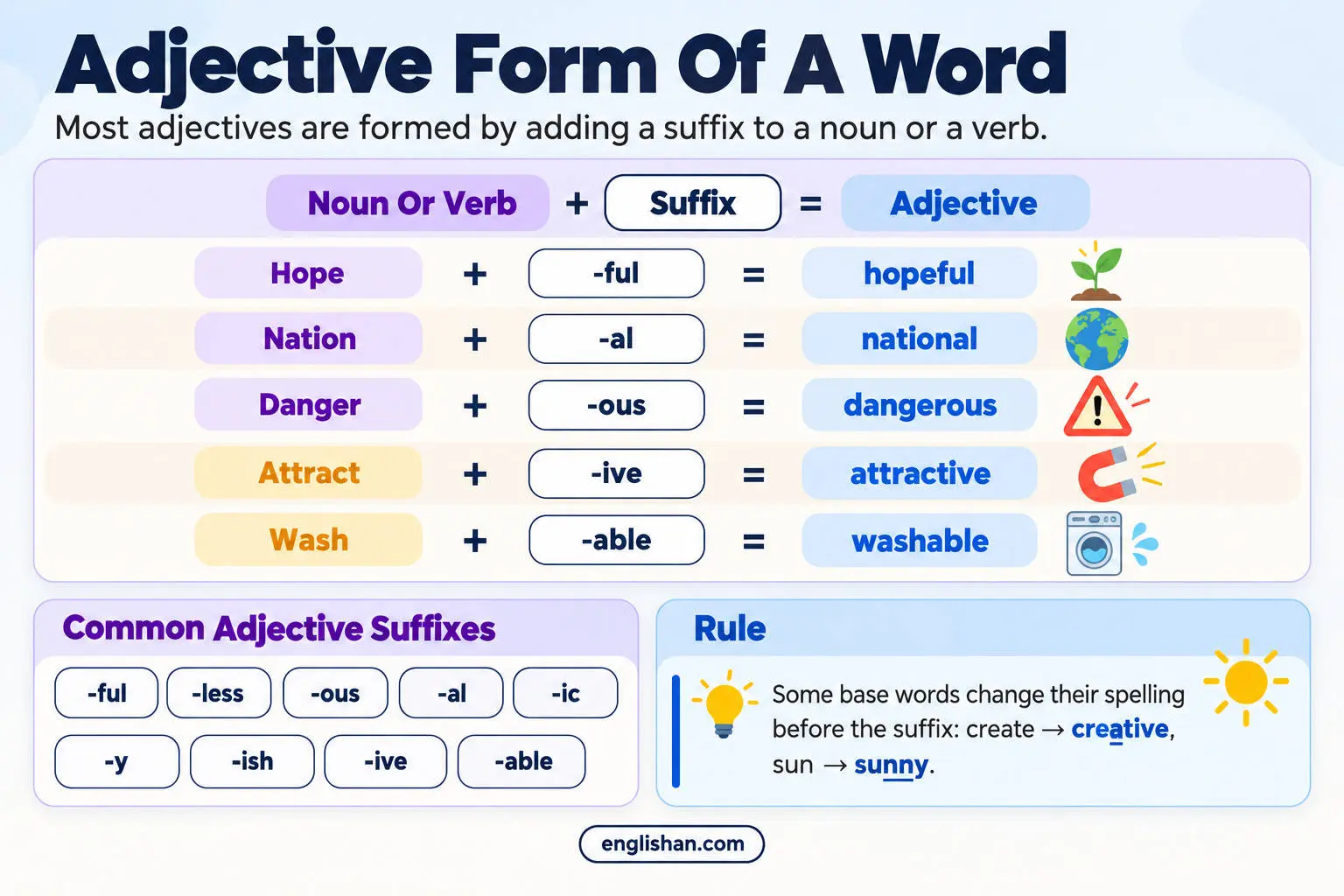
Adjective Suffixes And Their Meanings
An adjective suffix is an ending that forms an adjective from a noun or a verb. Most suffixes are added to nouns, and fewer are added to verbs.
| Suffix | Added to | Meaning | Examples |
|---|---|---|---|
| -ful | Nouns | Full of, having | Hopeful, careful, powerful |
| -less | Nouns | Without | Careless, homeless, endless |
| -ous | Nouns | Having the quality of | Dangerous, famous, poisonous |
| -al | Nouns | Relating to | National, cultural, musical |
| -ic | Nouns | Relating to, having | Artistic, heroic, energetic |
| -y | Nouns | Having, full of | Sunny, healthy, lucky |
| -ish | Nouns | Like, rather | Childish, foolish, reddish |
| -ly | Nouns | Like, happening every | Friendly, lovely, weekly |
| -en | Nouns | Made of | Wooden, golden, woolen |
| -ive | Verbs | Tending to, doing | Creative, active, talkative |
| -able, -ible | Verbs | Can be done | Washable, readable, visible |
| -ant, -ent | Verbs | Doing, being | Pleasant, different, dependent |
Suffix meanings are general senses, and a few adjectives depart from them. The adjective “priceless” means ‘too valuable to price’, not ‘without a price’.
Adjectives Formed From Nouns
A noun takes a suffix such as “-ful”, “-less”, “-ous”, “-al”, “-ic”, or “-y” to form an adjective. The adjective then describes another noun, as in “a dangerous road”, or follows a linking verb, as in “The road is dangerous“.
- The weather was sunny all weekend.
- She gave a powerful speech at the conference.
- The museum has a musical instrument from every country.
- Nobody expected such a heroic rescue.
Many nouns take both “-ful” and “-less” with opposite meanings, as in “careful” and “careless” or “hopeful” and “hopeless”. Not every noun takes both suffixes, so “beautiful” has no “beautiless”.
The road is very danger at night. ❌
The road is very dangerous at night. ✅
After the linking verb “is”, the word describes the road, so it takes the adjective form, and “very” modifies adjectives, not nouns. A noun can modify another noun only from the position before it, as in “a danger sign”, where the sign warns of danger.
Adjectives Formed From Verbs
Adjectives are formed from verbs with “-ive”, “-able” or “-ible”, or “-ant” or “-ent”. The “-ive” adjective describes a tendency, as in “a talkative child”, and the “-able” adjective describes what can be done, as in “a washable jacket”.
- This chair is more comfortable than it looks.
- Our new manager is very supportive.
- The mountain is visible from the hotel.
- He is still dependent on his parents.
The suffix “-able” usually follows a full English word, as in “wash” and “washable” or “rely” and “reliable”. Before “-ible”, the base is usually not a word on its own, as in “visible”, “edible”, and “possible”. A few words with a full base take “-ible”, such as “accessible”, “flexible”, and “collapsible”.
The building is accessable by wheelchair. ❌
The building is accessible by wheelchair. ✅
Although “access” is a full English word, it is one of the exceptions that take “-ible”.
Some adjectives from verbs need no suffix at all: the “-ing” and “-ed” forms, such as “boring” and “bored”, are participle adjectives and take no extra suffix.
Spelling Changes Before Adjective Suffixes
Whether the base word changes its spelling before an adjective suffix depends on its last letters and on whether the suffix starts with a vowel or a consonant:
| Rule | Examples |
|---|---|
| Final silent “e” drops before a vowel | Create to creative, fame to famous, value to valuable |
| Final silent “e” stays before a consonant | Hope to hopeful, care to careless |
| Final “e” stays after “c” or “g” before “-ous” and “-able” | Courage to courageous, notice to noticeable |
| Consonant plus “y” changes “y” to “i” | Beauty to beautiful, mystery to mysterious, rely to reliable |
| Vowel plus “y” keeps the “y” | Joy to joyful, play to playful |
| A final consonant after one vowel doubles before “-y” | Sun to sunny, fog to foggy, fun to funny |
| Final “-ce” often changes to “-cial” or “-cious” | Office to official, space to spacious |
The “e” after “c” or “g” keeps the letter soft, so “courageous” is pronounced with the same “g” as “courage”. Without the “e”, the spelling “couragous” would be read with a hard “g”.
Adjective Form Of Common Words
The adjective form of a word in everyday use follows the suffix and spelling rules for its ending. Where a word has two adjective forms, the two are not interchangeable, because their meanings differ.
| Word | Adjective form | Word | Adjective form |
|---|---|---|---|
| Anger | Angry | Fashion | Fashionable |
| Athlete | Athletic | Friend | Friendly |
| Attract | Attractive | Health | Healthy |
| Beauty | Beautiful | Imagine | Imaginative, imaginary |
| Comfort | Comfortable | Luck | Lucky |
| Courage | Courageous | Mystery | Mysterious |
| Create | Creative | Nature | Natural |
| Danger | Dangerous | Peace | Peaceful |
| Decide | Decisive | Please | Pleasant |
| Differ | Different | Poison | Poisonous |
| Economy | Economic, economical | Science | Scientific |
| Energy | Energetic | Society | Social |
| Fame | Famous | Success | Successful |
| Talk | Talkative | Wood | Wooden |
Shorter adjective forms: some nouns are formed from an adjective, so the adjective form is the shorter word with no suffix. The pairs are “truth” and “true”, “pride” and “proud”, “height” and “high”, “strength” and “strong”, “length” and “long”, “depth” and “deep”, and “heat” and “hot”.
Words With Two Adjective Forms
Some words have two adjective forms, and swapping one for the other changes the meaning of the sentence, as with “economic” and “economical”.
| Adjective | Meaning | Adjective | Meaning |
|---|---|---|---|
| Economic | Relating to the economy | Economical | Saving money |
| Historic | Important in history | Historical | Relating to the past |
| Childish | Silly, like a child | Childlike | Innocent, like a child |
| Sensible | Showing good judgment | Sensitive | Easily upset or affected |
| Imaginary | Not real | Imaginative | Full of new ideas |
| Respectful | Showing respect | Respectable | Deserving respect |
- The country faces a serious economic crisis.
- A small car is more economical to run.
- The town signed a historic agreement last year.
- She writes historical novels set in Rome.
The country faces an economical crisis. ❌
The country faces an economic crisis. ✅
A crisis in the economy takes “economic”; “economical” describes something that saves money.
FAQs
The adjective form of "courage" is "courageous", as in "a courageous decision". The final "e" stays before "-ous" to keep the "g" soft.
No, many nouns have no adjective form, such as "chair", "table", and "pencil". These nouns modify another noun from the position before it, as in "a chair leg" or "a pencil case".
Both, depending on the base word. Added to an adjective, "-ly" forms an adverb, as in "quick" and "quickly"; added to a noun, it forms an adjective, as in "friend" and "friendly". Adjectives ending in "-ly" have no adverb form with "-ly", so we say "in a friendly way".
No, "-er" and "-est" are endings of comparison, not suffixes that form a new adjective. They inflect an adjective that already exists, as in "tall", "taller", and "tallest", which are the degrees of comparison.
Related:
- List of Adjectives
- Types of Adjectives
- Types of Nouns
- Parts of Speech
- Verbs That Are Adjectives
- Nouns as Adjectives
- Adjectives and Prepositions

