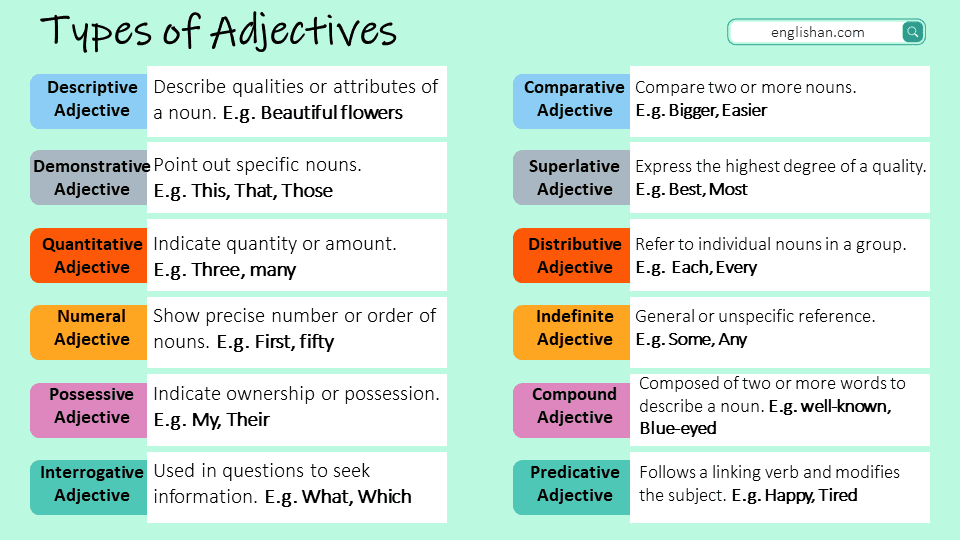
An indefinite adjective is a determiner that expresses the quantity or the identity of a noun without stating it exactly. In “Some guests arrived late”, the word “some” describes the noun “guests” without naming how many or which ones.
The indefinite adjective comes before the noun, and a descriptive adjective goes in between: some late guests. The noun is still general, because neither an exact number nor an exact identity is given.
Most indefinite adjectives have a second use as well. An indefinite adjective standing alone in place of a noun is an indefinite pronoun instead. The reading of each sentence depends on whether a noun comes after the word.
List Of Indefinite Adjectives
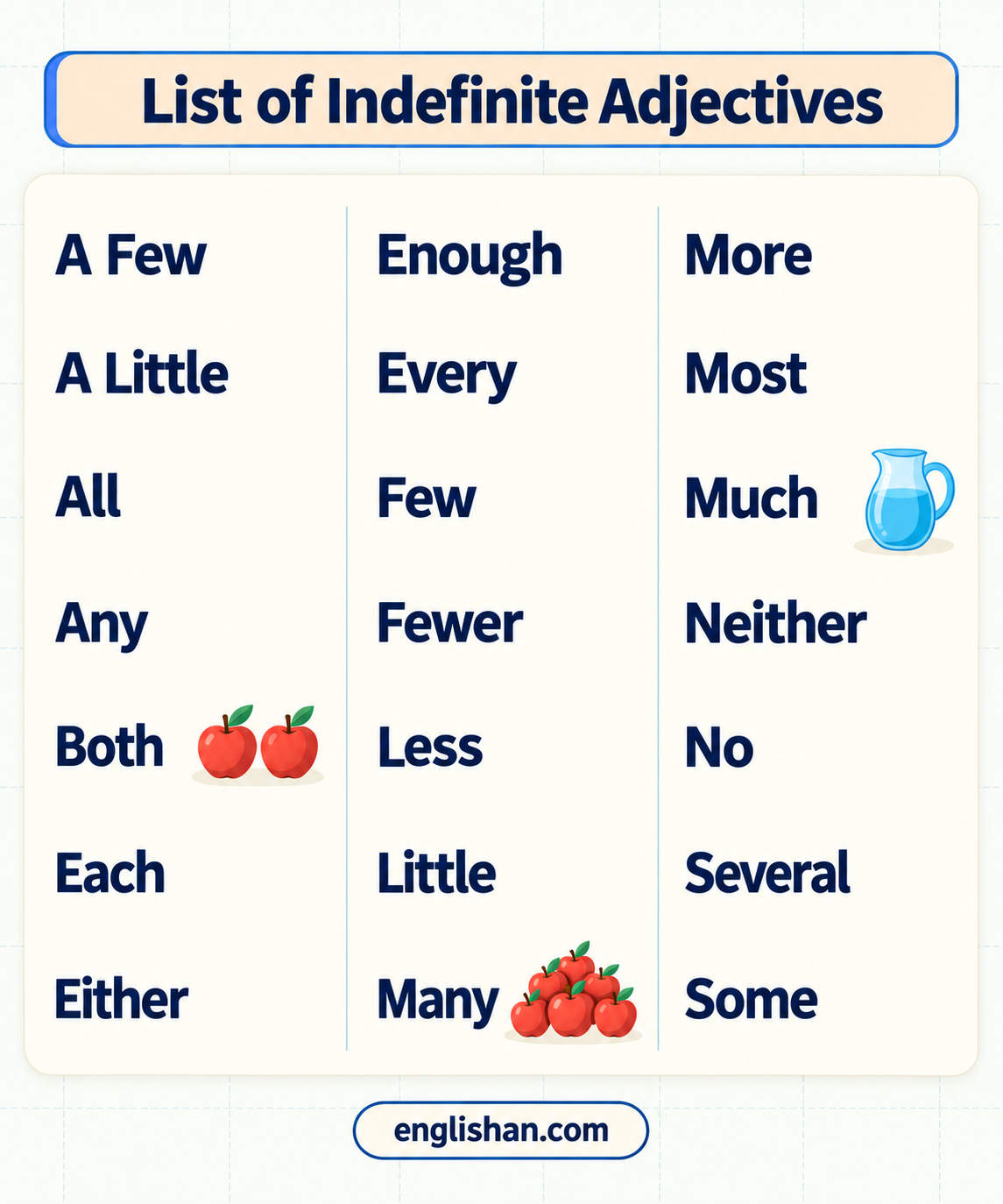
Twenty-one words count as indefinite adjectives in everyday English, among them “some” and “several”. All of them precede a noun and express a quantity or an identity in general terms, as in “Several letters were missing”. The noun that follows is countable or uncountable, depending on the word.
| Word | Noun that follows | Example |
|---|---|---|
| All | Plural countable or uncountable | All passengers must check in. |
| Another | Singular countable | Another train leaves at six. |
| Any | Plural countable or uncountable | Do you have any change? |
| Both | Plural countable | Both windows were open. |
| Each | Singular countable | Each ticket has a number. |
| Either | Singular countable | Either route takes an hour. |
| Enough | Plural countable or uncountable | There is enough paint for the hall. |
| Every | Singular countable | Every room has a window. |
| Few | Plural countable | Few shops open on Sunday. |
| Fewer | Plural countable | Fewer trains run at night. |
| Less | Uncountable | The new job brings less stress. |
| Little | Uncountable | Little rain fell in June. |
| Many | Plural countable | Many birds nest in the hedge. |
| More | Plural countable or uncountable | More volunteers arrived at noon. |
| Most | Plural countable or uncountable | Most cheese contains salt. |
| Much | Uncountable | Much work remains. |
| Neither | Singular countable | Neither answer was correct. |
| No | Singular, plural, or uncountable | No buses run after midnight. |
| Other | Plural countable or uncountable | Other guests complained. |
| Several | Plural countable | Several letters went missing. |
| Some | Plural countable or uncountable | Some milk was left in the jug. |
“Everybody”, “anything”, and “nothing” are indefinite pronouns only, because no noun ever follows them. Neither of them is ever an indefinite adjective:
❌ Everybody guests arrived on time. ✅ Everybody arrived on time.
One of these words is an adjective when a noun follows it, and a pronoun when no noun does.
Indefinite Adjectives Vs Indefinite Pronouns
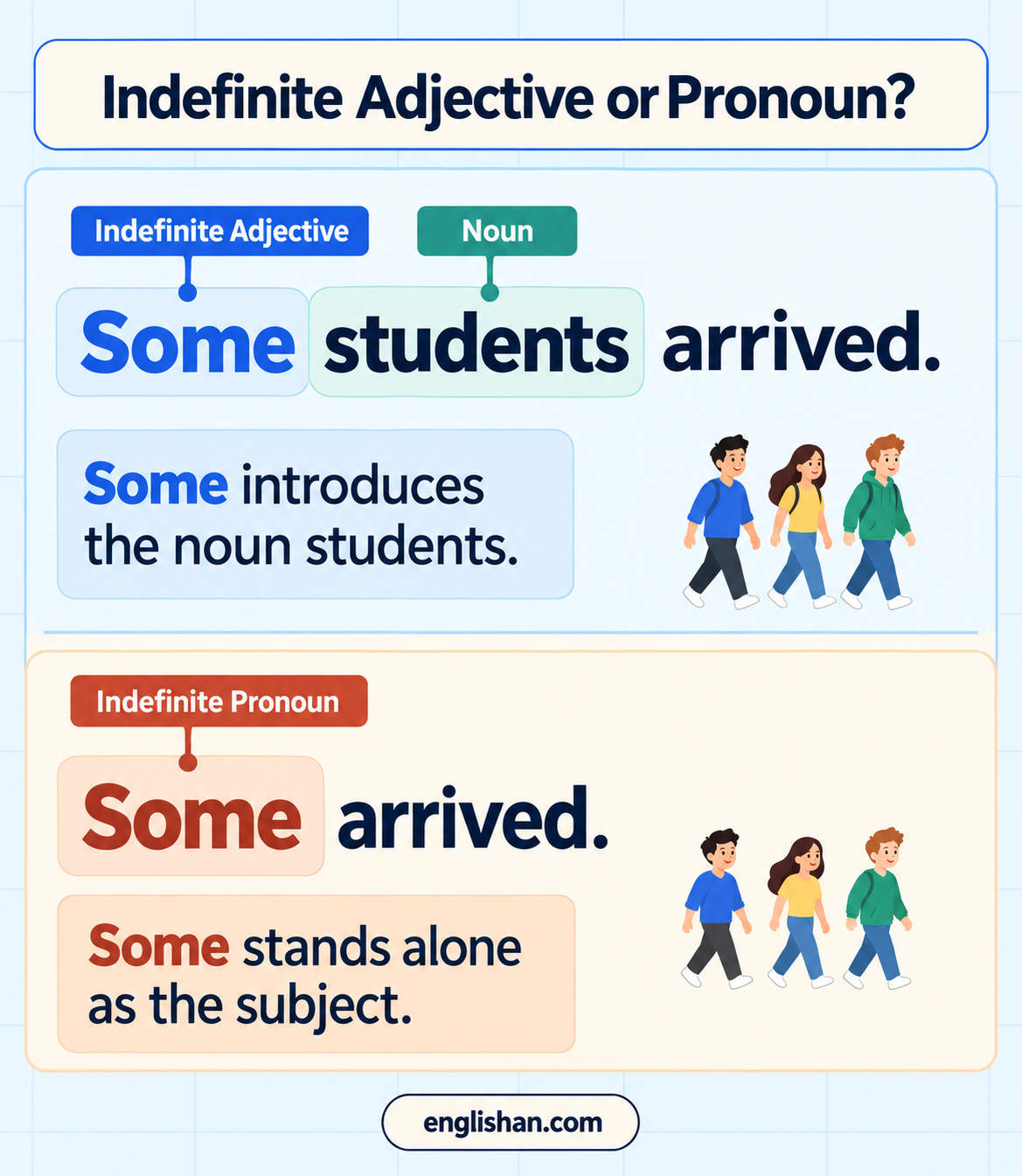
“Indefinite adjective” and “indefinite pronoun” name the same twenty-one words, and what separates the two terms is whether a noun follows. An indefinite adjective precedes a noun and modifies it. An indefinite pronoun comes in place of a noun, with no noun after it.
- Several letters were missing from the file.
- Several were missing from the file.
- I do not have any money.
- I do not have any.
In the first and third sentences, the nouns “letters” and “money” come directly after “several” and “any”, which makes both words indefinite adjectives. Nothing follows them in the second and fourth, so the same two words are indefinite pronouns.
In a sentence you have not seen before, look at what comes directly after the word. A noun there makes the word an indefinite adjective, and a verb or a full stop there makes it an indefinite pronoun.
Indefinite Adjective Word Order Before The Noun
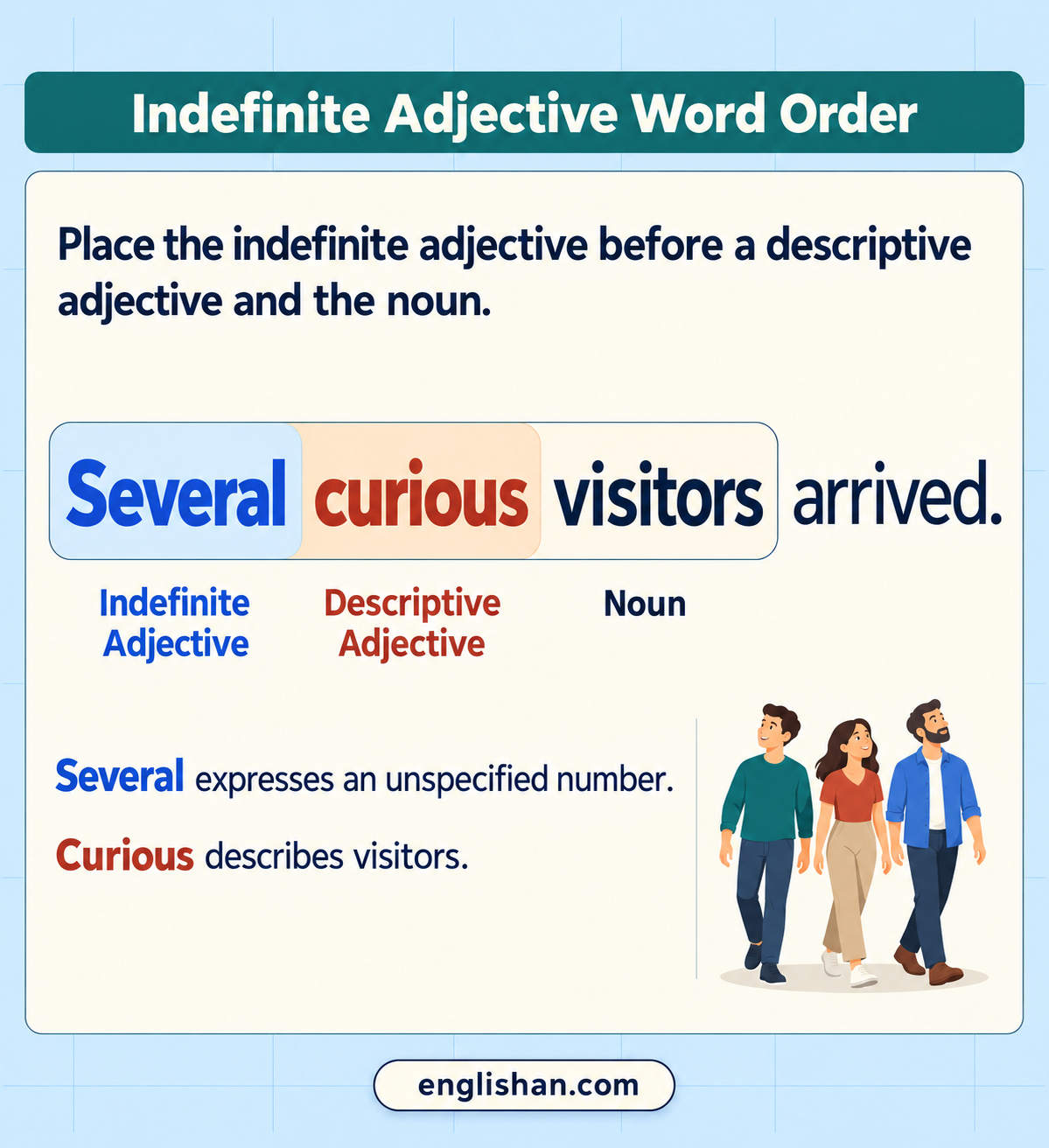
An indefinite adjective comes first in the noun phrase, before any descriptive adjective that modifies the same noun.
- Several old letters were found in the attic.
- Each new ticket carries a barcode.
- Some warm bread was still on the counter.
In the reverse order the phrase is ungrammatical:
❌ Warm some bread was still on the counter. ✅ Some warm bread was still on the counter.
With “some”, “many”, and “few”, the article “the” is not written directly after the word. To point at particular letters rather than letters in general, “of” comes first:
❌ Some the letters stayed unopened. ✅ Some of the letters stayed unopened.
“All” and “both” are the exception, because each one comes directly in front of “the”: All the passengers checked in.
“Every” takes no “of” phrase at all, so the noun comes straight after it: Every room has a window.
Indefinite Adjectives With Countable And Uncountable Nouns
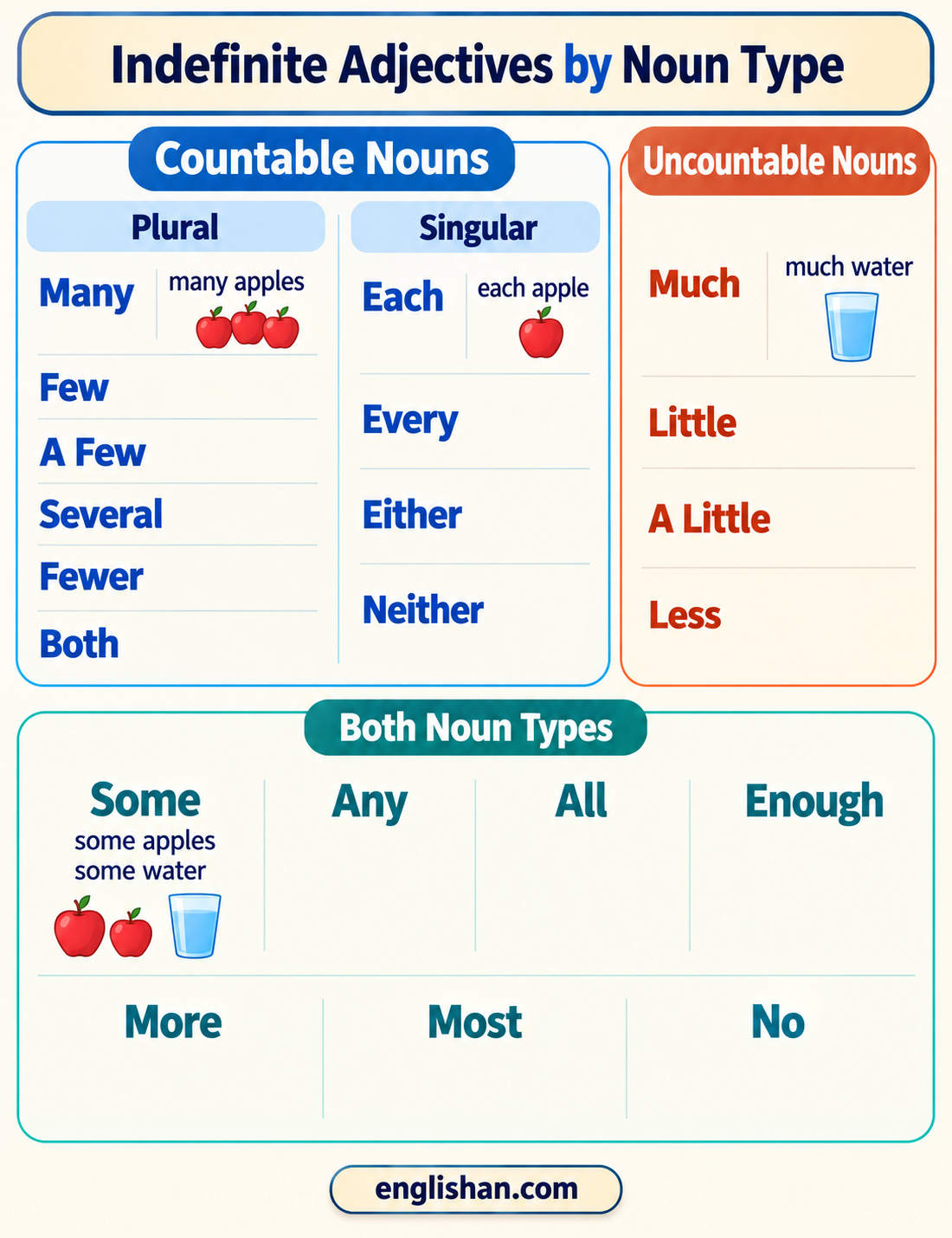
The choice between two similar words depends on the noun that follows. “Many”, “few”, and “fewer” are followed by a countable plural noun. “Much”, “little”, and “less” take an uncountable noun.
- ❌ Much passengers waited outside.
- ✅ Many passengers waited outside.
“Passengers” is a countable plural noun, so the countable word is required in front of it.
The same split separates “less” from “fewer”:
- ❌ Less mice got into the barn this year.
- ✅ Fewer mice got into the barn this year.
“Mice” is countable even though it has no “-s” ending, so “fewer” is correct here. “Less” precedes an uncountable noun such as “noise”, “traffic”, or “time”.
“Some”, “any”, and “no” precede a countable plural noun and an uncountable noun alike.
- Some chairs were still free.
- Some advice came from the coach.
In everyday speech, “a lot of” takes the place of “much” and “many” in a positive statement, as in “A lot of rain fell overnight”. In formal writing, “much” and “many” are written in full.
Related: Countable and Uncountable Nouns
Subject Verb Agreement After Indefinite Adjectives
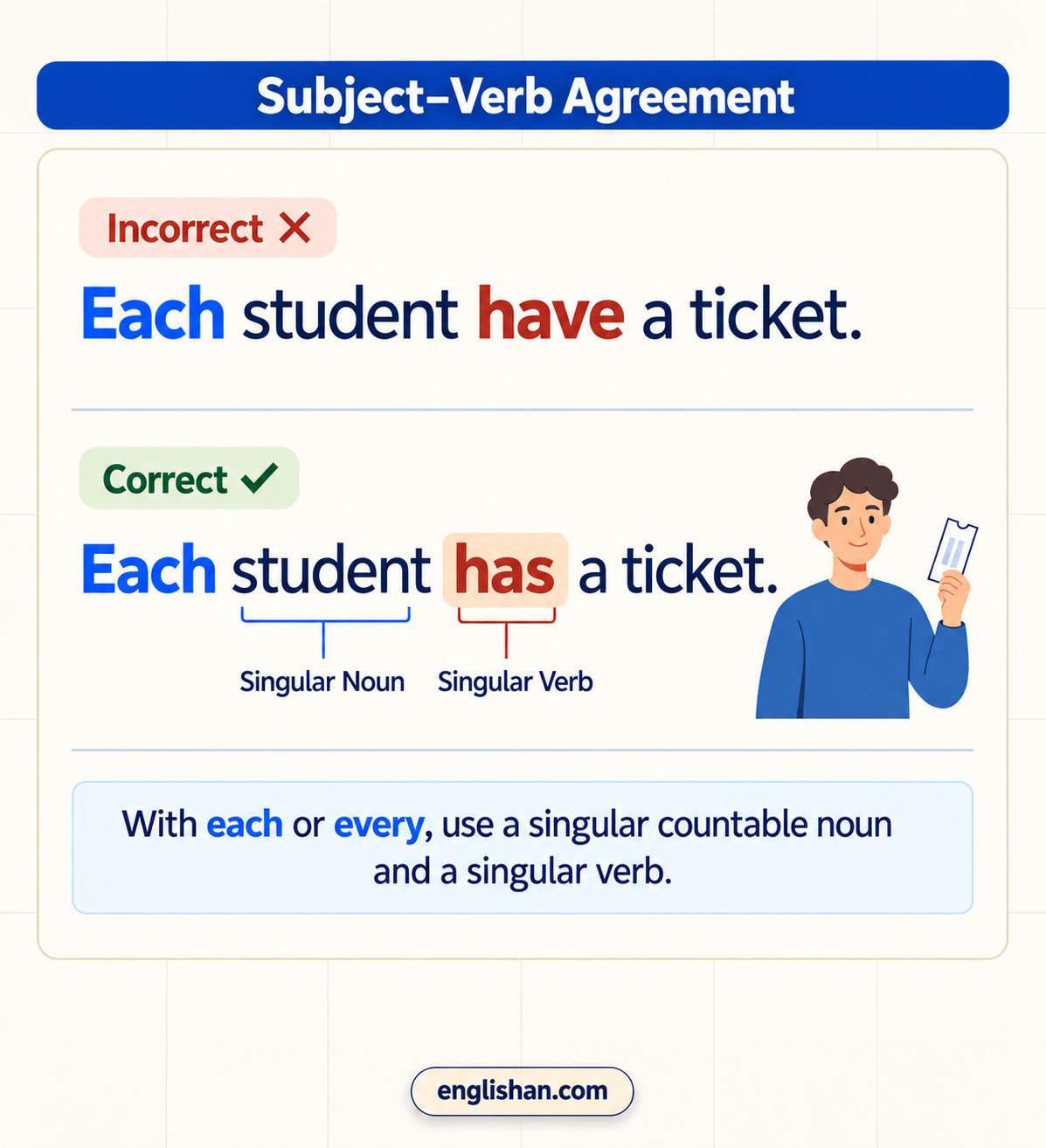
The verb agrees with the noun, and the indefinite adjective in front of that noun fixes whether the noun is singular or plural. “Each” and “every” come before a singular noun, and a singular verb then follows. “Either” and “neither” refer to one of two options, so the noun after them is singular as well.
- Each ticket has a number on the back.
- Every room is cleaned before noon.
- Neither answer was correct.
The plural words take a plural verb. “Many” and “several” come before a plural noun, so a plural verb follows: Several letters were missing from the file.
- ❌ Each students are responsible for their own bags.
- ✅ Each student is responsible for their own bags.
“Students” is plural, and “each” takes a singular noun, so the correction is written with “student” and with “is”.
Two nouns joined by “and” after “every” still take a singular verb, because “every” counts the two nouns one at a time: Every cup and plate was washed by hand.
After “some”, “any”, and “no”, the verb agrees with the noun rather than with the indefinite adjective. Compare “Some milk is left in the jug” with “Some letters are missing from the file”.
Confusing Pairs Of Indefinite Adjectives
Three pairs of indefinite adjectives are close enough in meaning for the wrong one to pass unnoticed. In each pair, a negative or a positive sentence, or the exact amount meant, decides which word is correct.
Difference Between Some And Any
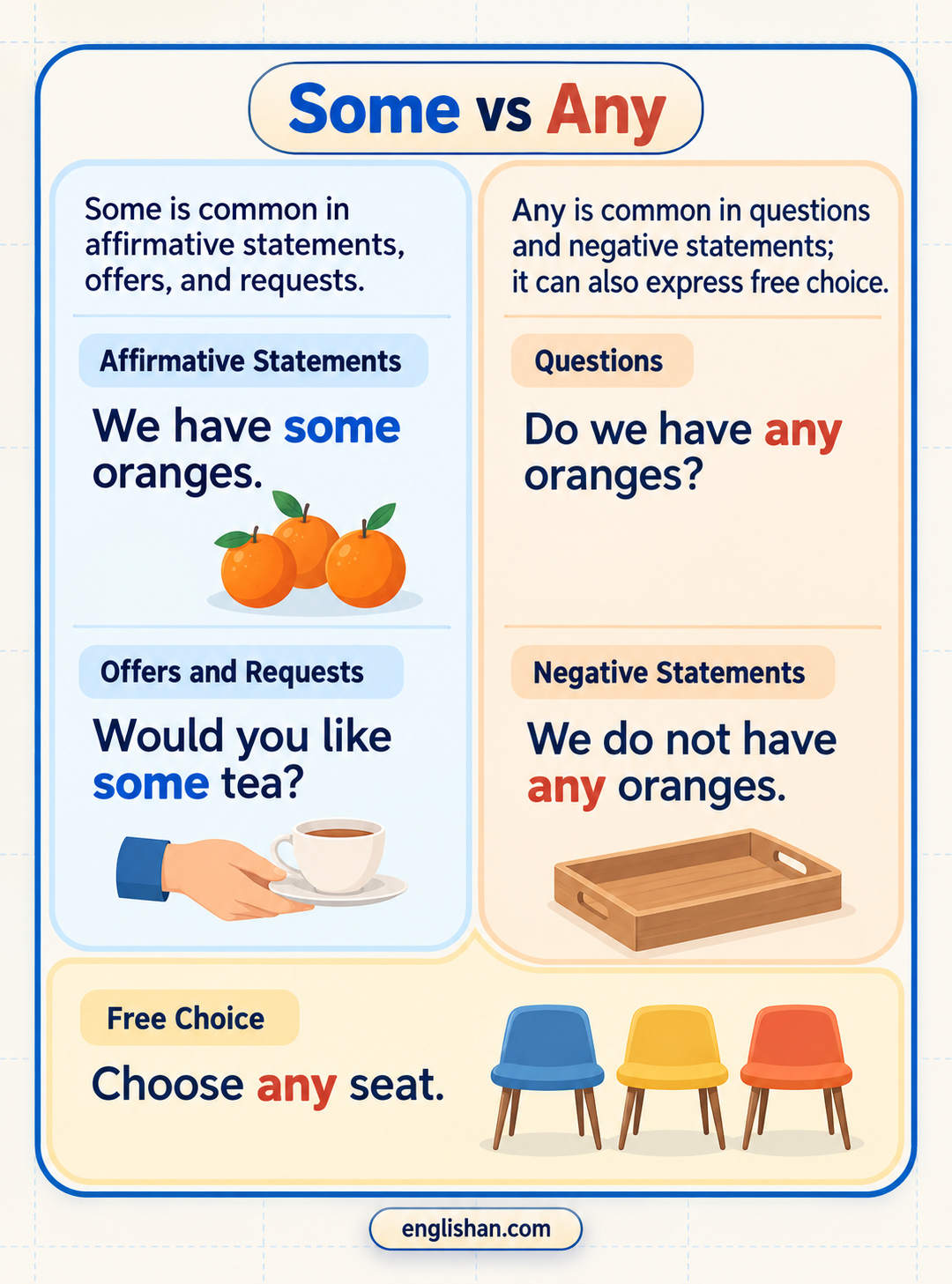
“Some” is written in positive statements, and in a question that invites the listener to accept: Would you like some tea? “Any” is the choice in negative statements and in questions.
- Some bread is in the cupboard.
- Is there any bread in the cupboard?
- ❌ I do not have some time this afternoon.
- ✅ I do not have any time this afternoon.
A positive statement with “any” is correct where the choice is open: Any bus takes you to the station.
Difference Between Few And A Few
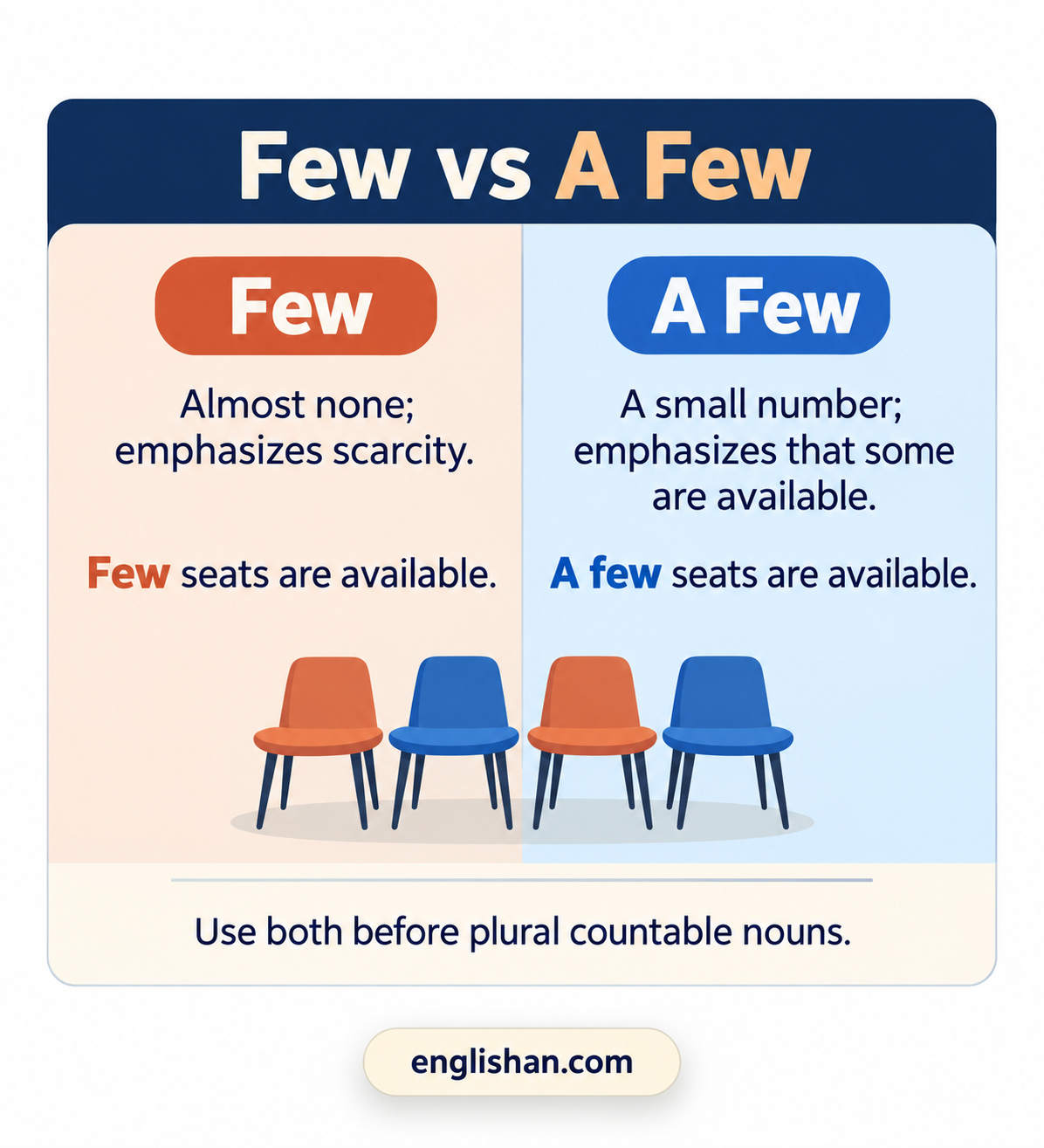
“Few” means almost none, and “a few” means a small number.
- Few passengers were on the platform.
- A few passengers were on the platform.
In the first sentence the platform is almost empty, and in the second a handful of travelers are there. Before an uncountable noun, “little” means almost none, and “a little” means a small amount.
Difference Between Each And Every
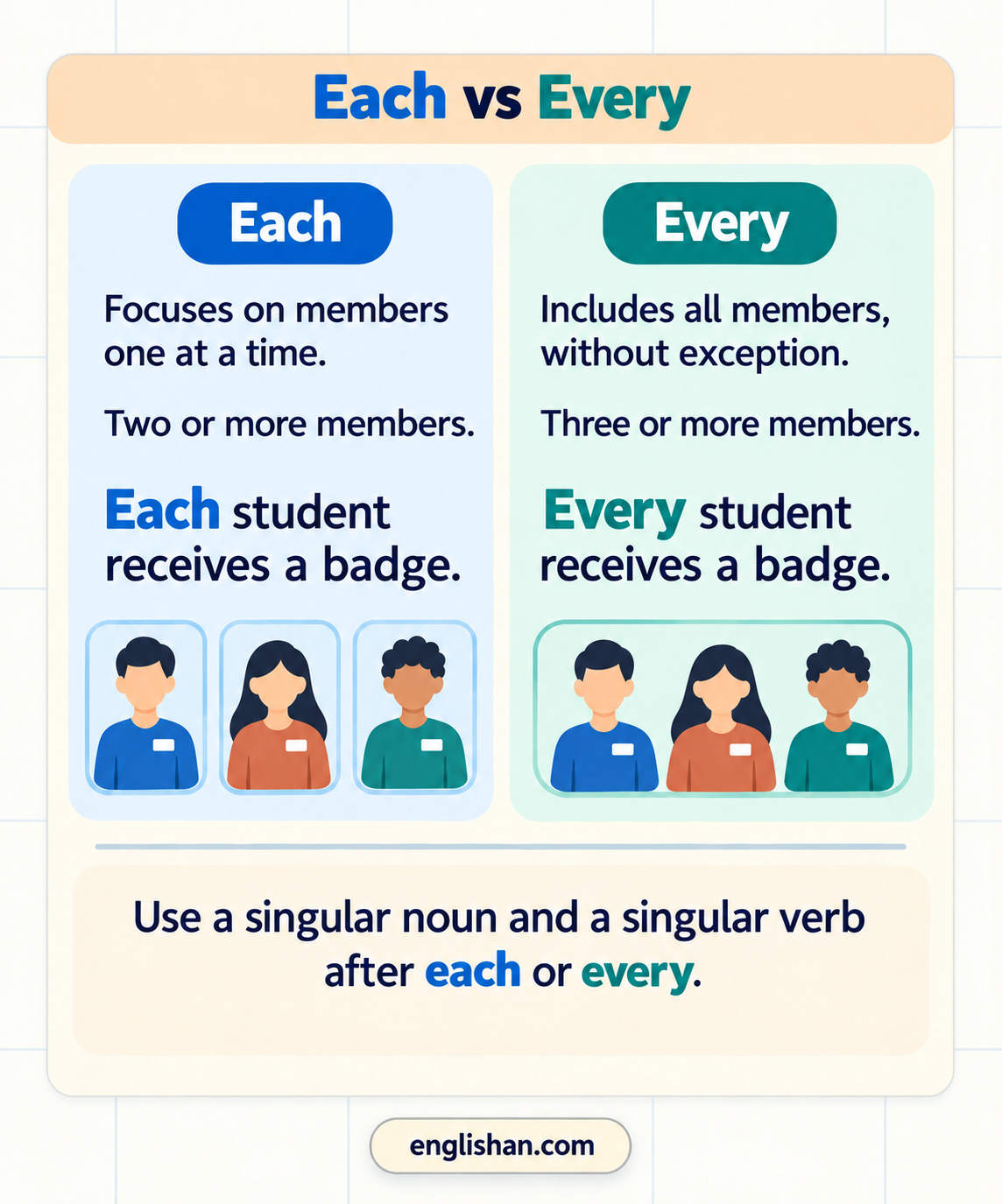
With “each”, the people or things are counted one at a time. “Every” means all of them at once. Where there are only two, “each” is correct and “every” is not: Each hand was bandaged.
Examples Of Indefinite Adjectives
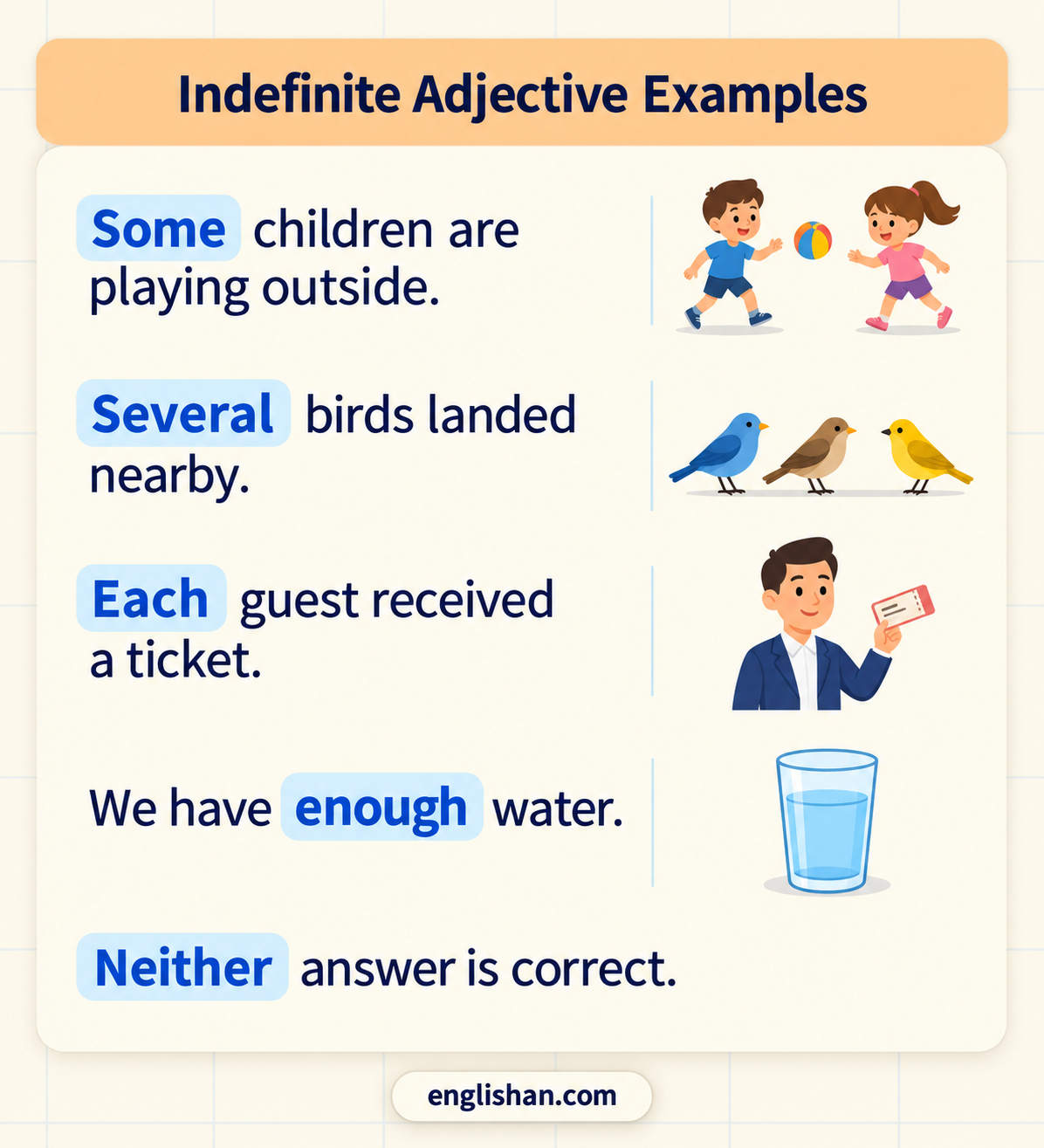
Three uses follow: a plain amount, part of a known quantity, and a noun left unidentified.
Amount: The indefinite adjective expresses how much there is, with no figure attached.
- Many passengers missed the last train.
- Much patience is needed at the airport.
- Few shops open before eight.
- Enough chairs were set out for the choir.
Part of a known quantity: The noun is already known, and the indefinite adjective limits how much of it is meant.
- All windows on the top floor were shut.
- Most letters in the box were unopened.
- Both keys fit the same lock.
- Several pages had been torn out.
Open identity: The noun is left unidentified.
- Any doctor will tell you the same thing.
- Another bus arrives in ten minutes.
- Either road takes you to the village.
- Other guests complained about the noise.
In “Much patience is needed at the airport”, the uncountable noun “patience” follows “much”, and the noun has no plural ending. The singular noun “road” follows “either” in “Either road takes you to the village”, even though two roads exist, because “either” refers to one of the two at a time.
Definite And Indefinite Adjectives Of Number
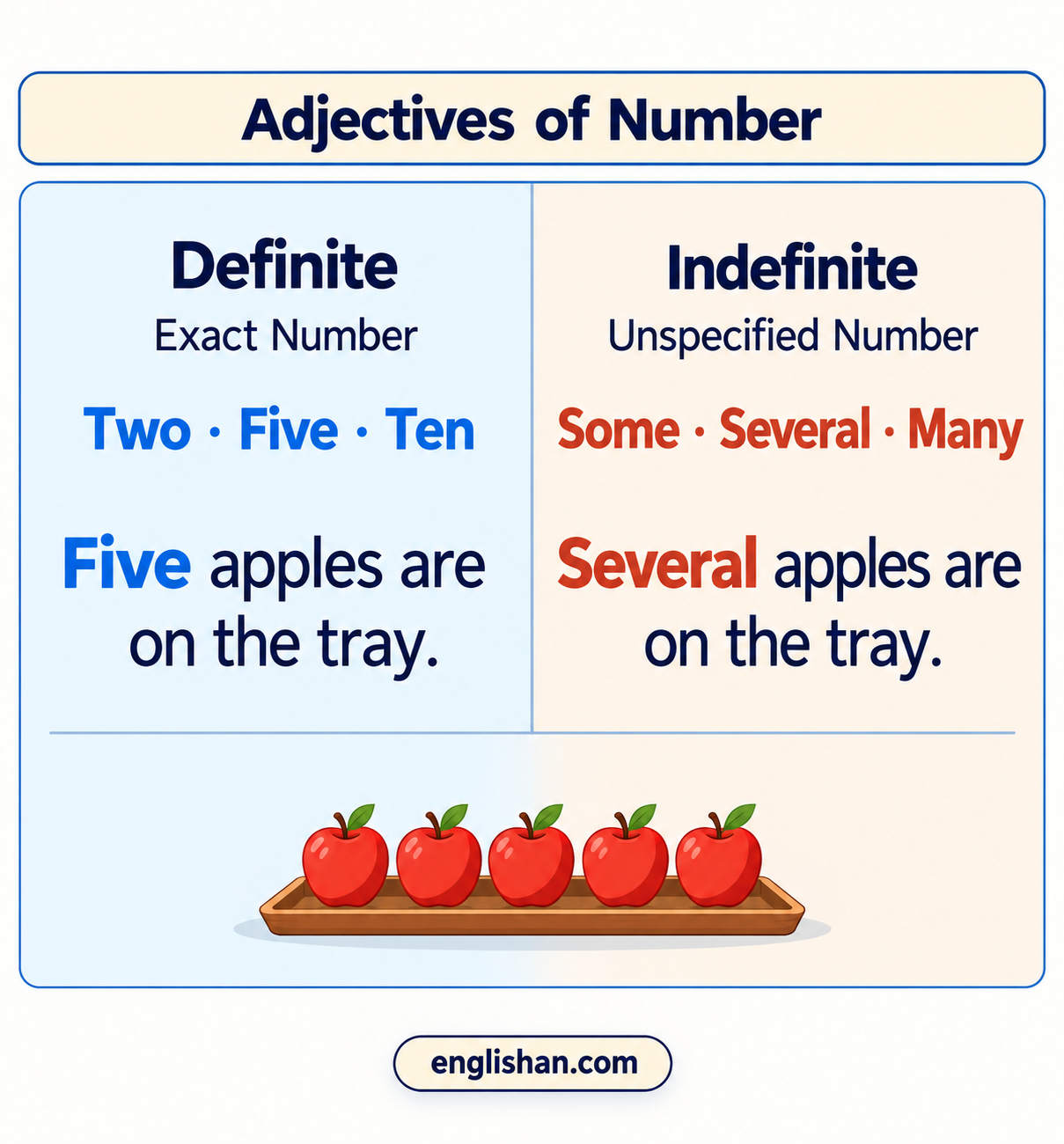
In traditional grammar, an adjective that answers the question “How many?” is an adjective of number, and the definite and the indefinite kinds are kept apart. A definite numeral adjective states an exact figure, as “two” and “first” do. An indefinite numeral adjective leaves the figure open, as “many” and “several” do.
- Three letters arrived on Monday.
- Several letters arrived on Monday.
An exact number is stated in the first sentence, and the count is left open in the second. “One” is a definite numeral adjective, even in a sentence such as “One passenger complained”, because an exact figure is still stated.
Indefinite Adjectives Are Also Called Quantifiers
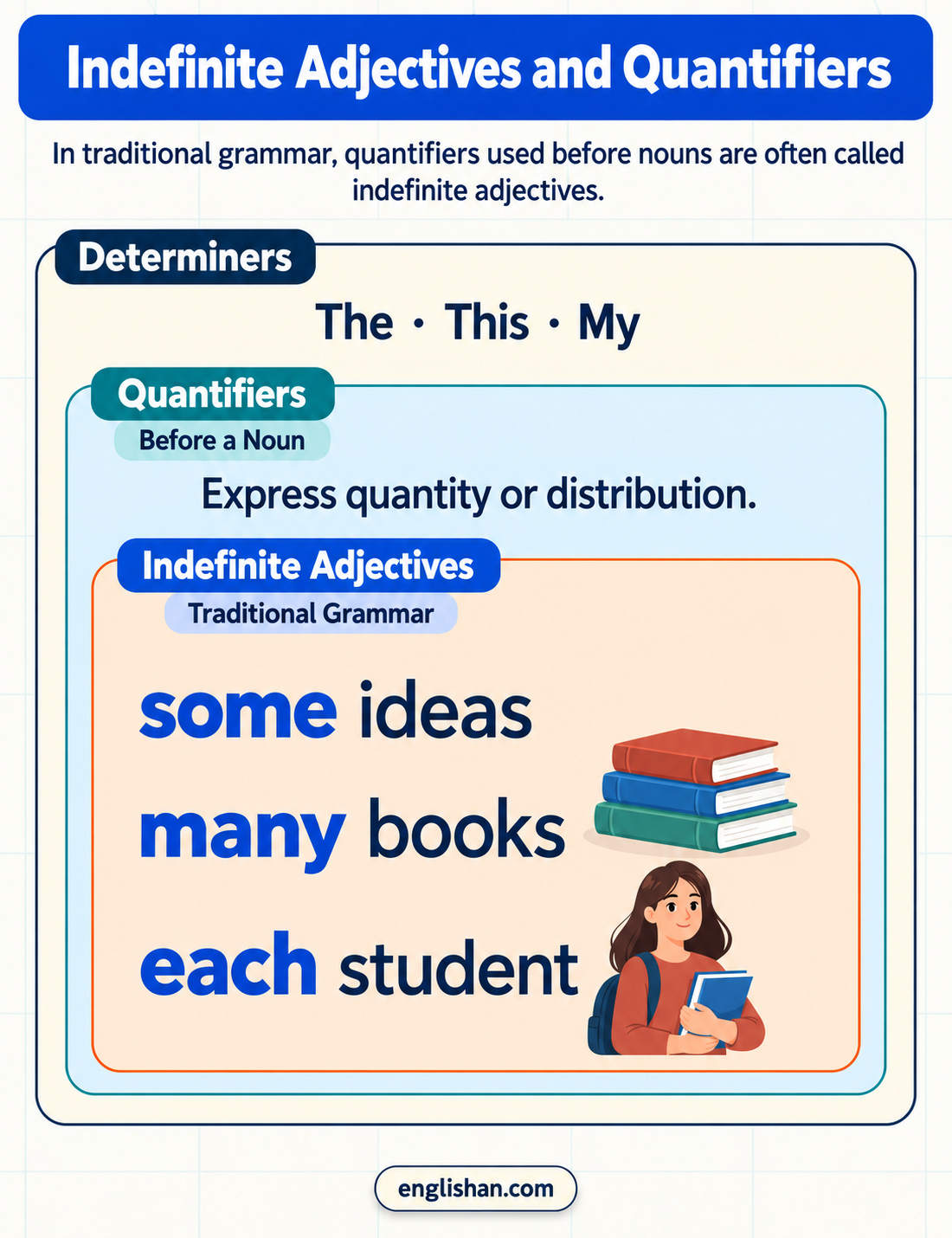
Indefinite adjectives are also named quantifiers, and every quantifier is a determiner. That second name comes from the quantity all twenty-one of them express.
After a linking verb, a descriptive adjective is correct, and most of these words are not:
- ✅ The letters were old.
- ❌ The letters were several.
A descriptive adjective also takes a grading word such as “very” in front of it. Among the indefinite adjectives, “very” comes only before “few” and “many”:
- ✅ Very few letters were found in the attic.
- ❌ Very several letters were found in the attic.
“A” and “an” are indefinite articles rather than indefinite adjectives. Both kinds of word belong to the determiner class, and an article names no quantity beyond the single one.
Related:
FAQs
Q1. What is an indefinite adjective?
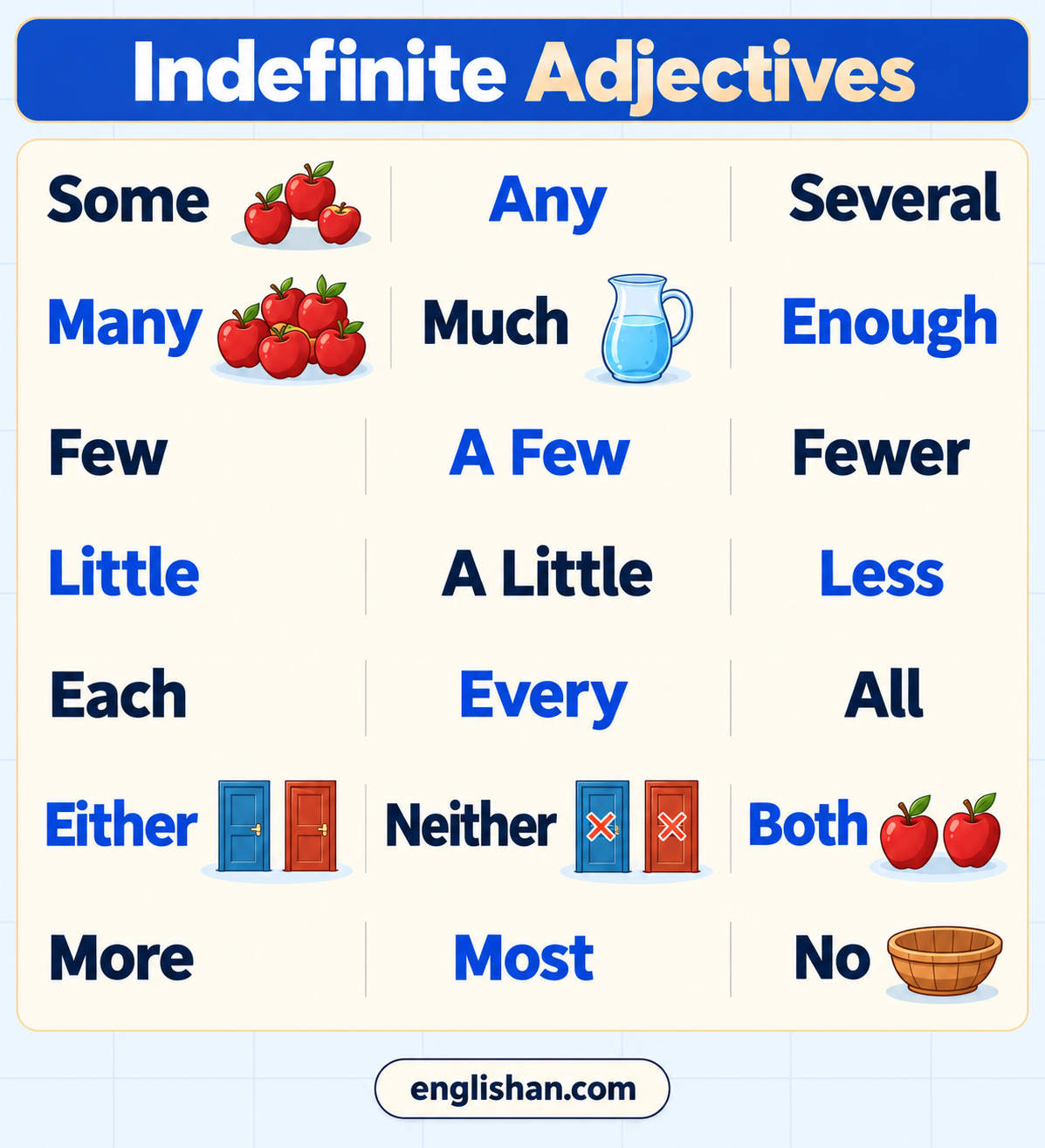
An indefinite adjective is a determiner written before a noun to express a quantity or an identity without naming it exactly. The determiners “some”, “any”, and “several” all precede a noun in this way. In each sentence, a noun comes directly after the determiner, which is what makes the determiner an adjective rather than a pronoun.
Q2. How many indefinite adjectives are there?
The total is twenty-one words, from “all” and “another” to “several”. No word among them states an exact number, which is what separates these words from the numerals.
Q3. Is “everybody” an indefinite adjective?
No, “everybody” is an indefinite pronoun and nothing else, because no noun ever follows it. “Everybody arrived on time” is correct, and “everybody guests arrived on time” is not. The same is true of “anything” and “nothing”.
Q4. Is “no” an indefinite adjective?
Yes, “no” is an indefinite adjective whenever a noun follows it, as in “No buses run after midnight”. The quantity named by “no” is zero, and the noun after it is singular, plural, or uncountable.
Q5. Are indefinite articles adjectives?
No, “a” and “an” are indefinite articles, and an article expresses no quantity beyond one. Articles and indefinite adjectives are both determiners, which is why the two terms are confused. In “A letter arrived”, “a” marks the noun as unidentified rather than counted.
Q6. What is the difference between an adjective of quantity and an indefinite adjective?
The difference is one of range. That range starts with the adjective of quantity, which answers the question “How much?” before an uncountable noun, as in “much water” and “little time”. An indefinite adjective is correct before a countable plural noun too, as in “many letters”, so both questions are covered.