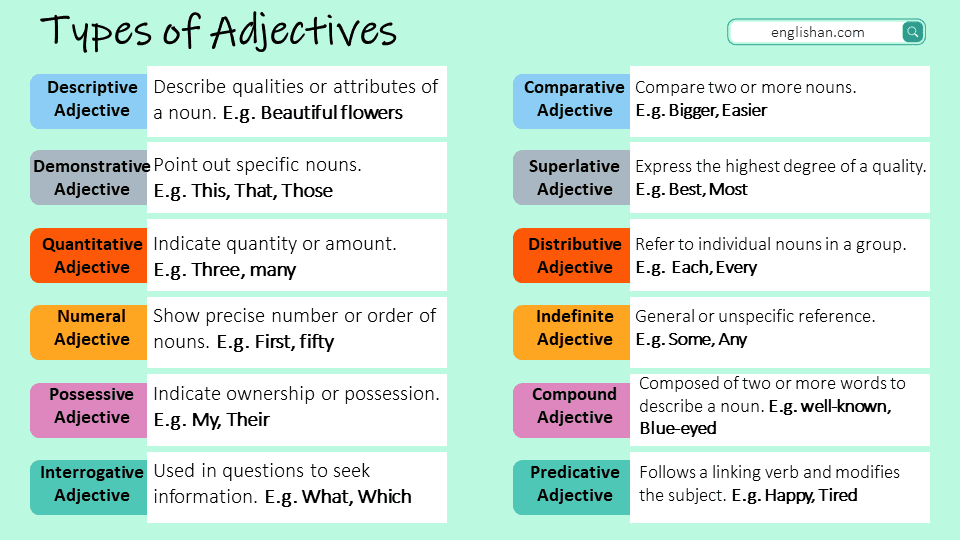

An absolute adjective is an adjective that names a complete state, one that is either present or absent with no degrees in between. A design is unique or not unique, and a battery is dead or not dead, so the adjective takes no comparative or superlative form: “more unique” and “deadest” imply degrees the state does not have.
Meaning alone separates these adjectives from ordinary descriptive adjectives. An adjective such as “cold” expresses a quality on a scale, while a word like “unique” names a point with no scale around it, and all their usage rules follow from that single difference.
An absolute adjective names a complete state with no degrees, so it takes no comparative or superlative form and no “very”: “unique”, “perfect”, “dead”, “complete”, “impossible”. Intensifiers of totality fit instead (“completely empty”, “absolutely perfect”), and “nearly” or “almost” describes an approach to the state.
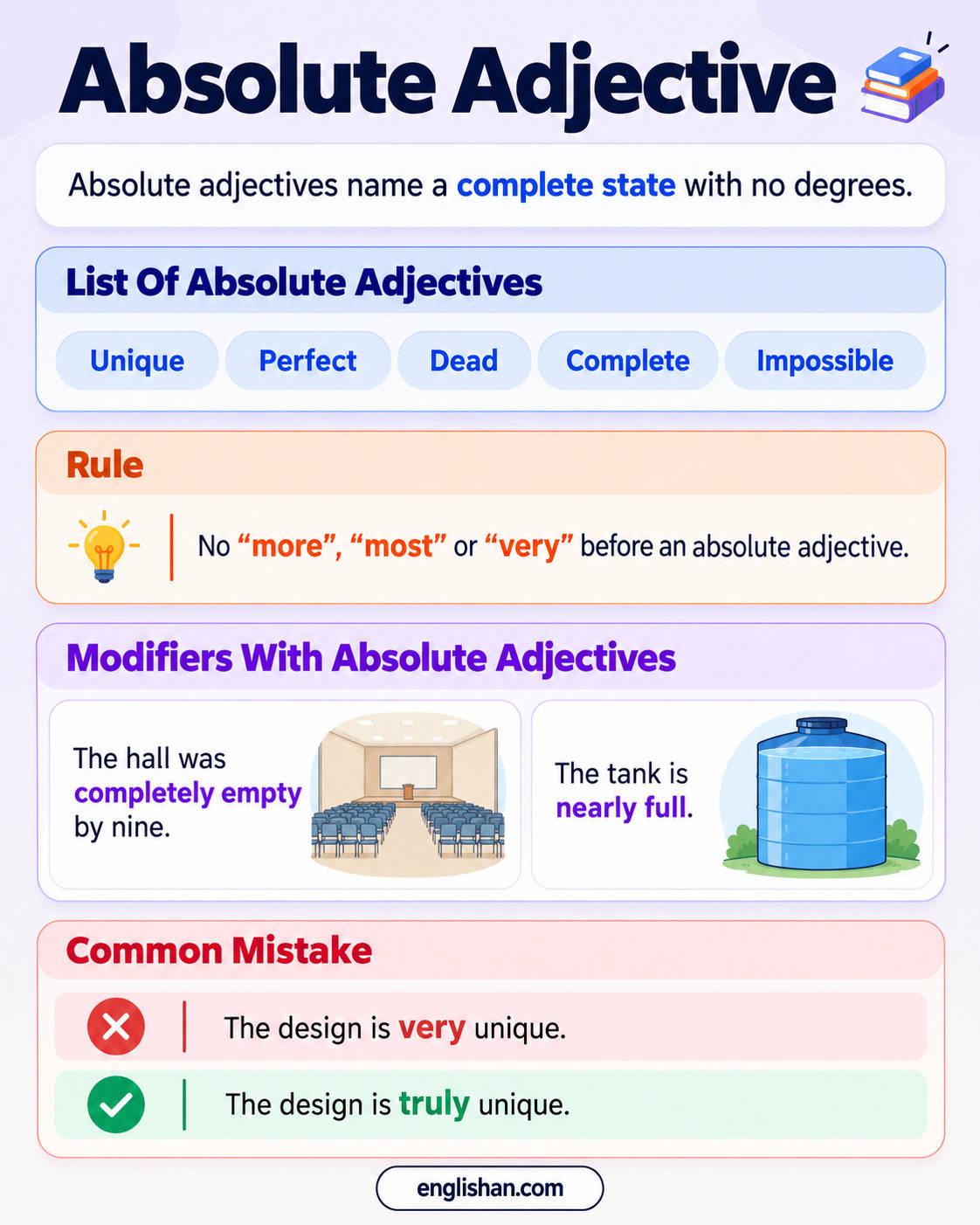
List Of Absolute Adjectives
For the common ones, the definition alone rules out degrees, since each names a state that is either reached or not.
- Unique: one of a kind, so no second thing shares the state.
- Perfect: without any flaw, so nothing further can be added.
- Dead: no longer alive, with no stage between the two.
- Complete: finished in full, so no part is missing.
- Empty and full: nothing inside, or no room left inside.
- Impossible: ruled out entirely, not merely difficult.
- Final: last in the sequence, with nothing after it.
- Fatal: causing death, a result with no degree.
- Pregnant: carrying a child, a state that is or is not.
Several of these words also have a weaker everyday sense, and in that weaker sense they are gradable. In “the most complete guide on the shelf”, the word “complete” means ‘thorough’ rather than ‘finished in full’, so the superlative is correct there.
Modifiers With Absolute Adjectives
An absolute adjective combines with modifiers of totality and approach, never with modifiers of degree. The intensifiers “completely”, “absolutely”, “utterly”, “truly”, and “entirely” confirm the whole state, and “nearly” or “almost” describes something short of it.
- The hall was completely empty by nine.
- Her timing was absolutely perfect on the second take.
- The tank is nearly full, so one stop covers the trip.
- The repair looked almost impossible until the part arrived.
The design is very unique. ❌
The design is truly unique. ✅
The adjective “unique” means one of a kind, so “very” adds a degree the state cannot have, while “truly” confirms the state as it is.
The objection to “very unique” depends on formality. In conversation and informal prose, “very unique” and “more perfect” are common with the weaker senses ‘unusual’ and ‘closer to ideal’, and in formal writing the absolute sense is standard, so only modifiers of totality and approach are correct.
Absolute Vs Gradable Adjectives
Gradable adjectives express scaled qualities, and absolute adjectives name complete states, so they take different modifiers. A gradable adjective such as “cold” takes “very” and forms “colder” and “the coldest”, while the absolute one rejects all three and accepts “completely” or “nearly” instead.
| Property | Gradable (“cold”) | Absolute (“dead”) |
|---|---|---|
| Takes “very” | Yes | No |
| Comparative and superlative | Colder, the coldest | None |
| Fits with “completely” or “nearly” | Unusual | Yes |
The degrees of comparison separate gradable adjectives from absolute ones most quickly: an adjective with natural “-er” and “-est” forms, or natural “more” and “most” forms, is gradable, and an adjective whose comparative sounds wrong is usually absolute.
FAQs
No, in their absolute sense they take no comparative or superlative form, because the state is complete as named: nothing is "deader" or "more impossible". A comparison is correct only when the word shifts to a weaker sense, as in "a more complete answer", where "complete" means ‘thorough’.
In careful writing, no: "unique" names a one-of-a-kind state, and "very" adds a degree that state cannot take, so "truly unique" or "nearly unique" is the standard wording. In informal use, "very unique" is common with the weaker sense ‘unusual’, and both readings are heard in speech.
No, the two share a name and nothing else. In some degree tables, "absolute" is the term for the base form of any adjective, as in "cold" beside "colder" and "coldest". Here the term means something separate, the adjectives whose meaning rules out degrees altogether.
Yes, "dead" names a state with no stages between its presence and its absence, so it takes no comparative form and no "very". It accepts modifiers of totality, as in "completely dead", and figurative uses such as "the phone went dead" keep the same absolute reading.
Related: