Reciprocal pronouns are a vital part of English grammar, helping speakers express mutual actions or feelings between two or more people. Understanding reciprocal pronouns can improve your communication skills, making it easier to convey the idea that people are doing something to or for each other. These pronouns are simple to learn and use, so even beginners can grasp this concept quickly.
What is a Reciprocal Pronoun?
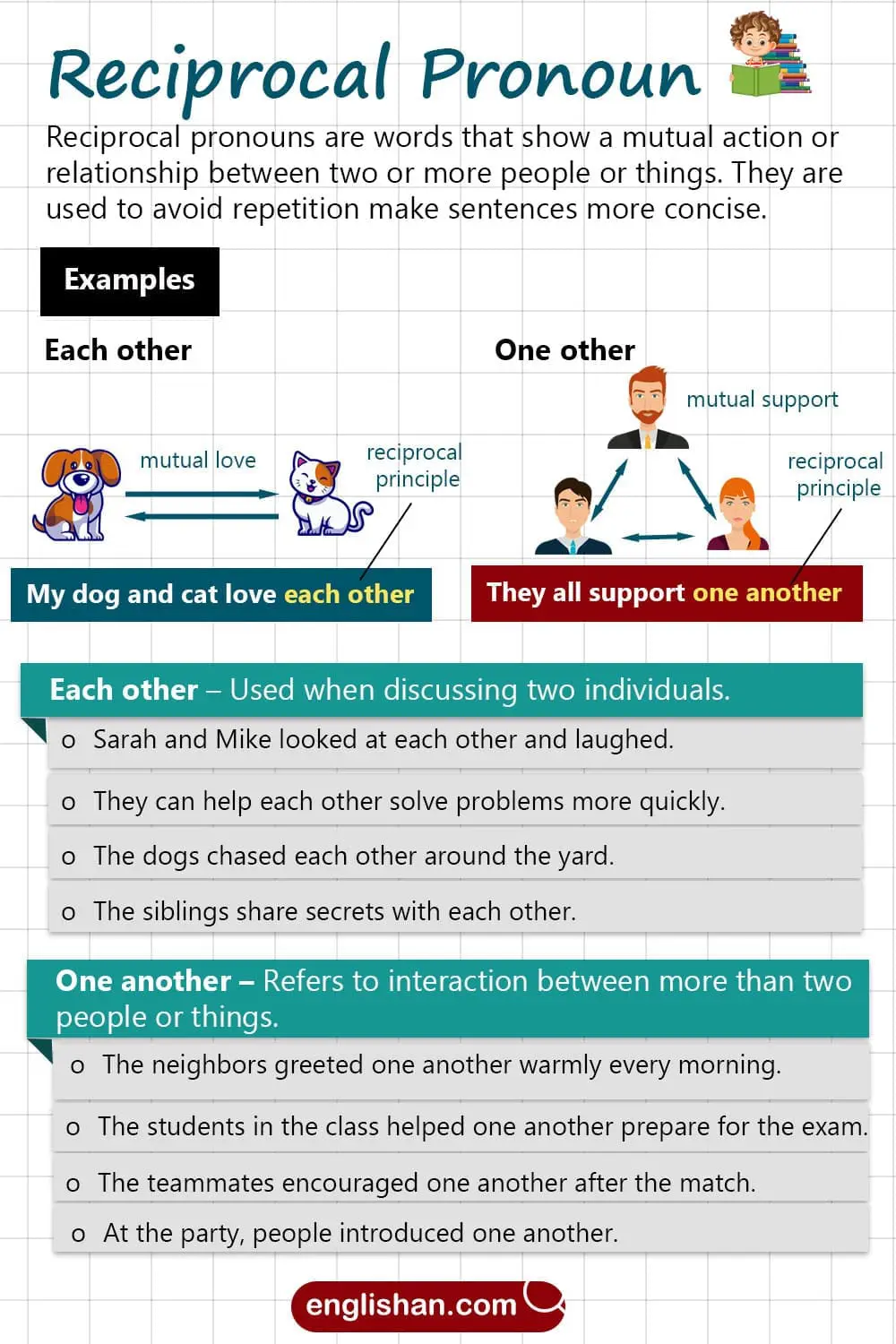
A reciprocal pronoun is used when two or more people, groups, or things are performing the same action toward each other. In English, we only have two reciprocal pronouns: each other and one another. These pronouns reflect that there is a mutual relationship between the subjects of the sentence.
For example:
- Each other: This is commonly used when we talk about two people or things.
- One another: This is used for more than two people or groups, though it can be used for two in modern usage as well.
These pronouns are necessary for avoiding repetition and making sentences smoother and more concise.
Reciprocal Pronouns Rules
Using reciprocal pronouns follows simple rules that are easy to remember. These rules ensure that we use these pronouns correctly in sentences:
- Always Involve Two or More Subjects:
Reciprocal pronouns are used when there are at least two people or more involved in an action.
✅ Ali and Ahmed respect each other.
❌ Ali respects each other.
Here, it is important to note that each other is only used when multiple subjects perform the same action toward one another. - Positioning in the Sentence:
The reciprocal pronoun usually comes after the verb in a sentence or after the object of the verb.
✅ The students helped each other during the exam.
❌ The students each other helped during the exam.
This rule emphasizes the correct placement of the pronoun to maintain clarity. - No Need for Possessive Forms:
Reciprocal pronouns do not need possessive forms. However, you can use them with possessive adjectives.
✅ They looked into each other’s eyes.
❌ They looked into each others eyes.
Real Life Examples
Now, let’s look at how reciprocal pronouns are used in real-life sentences. These examples will help you understand how to apply them naturally:
- Ali and Sara love each other.
(Ali and Sara share mutual feelings of love.) - The children played with one another during the break.
(The children interacted with each other during their free time.) - Zainab and Farooq helped each other finish their homework.
(Zainab and Farooq worked together on their tasks.)
Notice that in all these examples, the subjects are performing actions toward one another, which justifies the use of reciprocal pronouns.
Reciprocal Pronouns Example Sentences
Examples Using “Each Other”
- Ali and Ahmed always help each other with their studies.
- The two friends call each other every day.
- Sara and Asim smiled at each other during the meeting.
- They gave each other gifts on Eid.
- The students taught each other new concepts in the group discussion.
Examples Using “One Another”
- The team members supported one another during the project.
- At the family reunion, everyone greeted one another warmly.
- The neighbors take care of one another’s pets during vacations.
- The children played games with one another in the park.
- They shared their ideas with one another during the brainstorming session.
Key Notes
- Each other is primarily used when referring to two individuals or things, but can sometimes be used for more.
- One another is traditionally used for more than two individuals or groups but can also be used interchangeably with “each other” in modern grammar.
- Reciprocal pronouns simplify sentences and eliminate redundancy. Instead of saying, “Ali loves Sara, and Sara loves Ali,” we can say, “Ali and Sara love each other.”
By mastering the use of reciprocal pronouns, you can make your writing and speaking more fluid and natural. These pronouns play a key role in making communication smoother.
Read More
Reciprocal Pronouns Quiz
Reciprocal Pronouns
Choose the reciprocal pronoun.
The two friends helped ___ .
'Each other' shows a two-way action between two people.
each other -> a two-way action
The two friends helped each other.
Choose the reciprocal pronoun.
The team members support ___ .
'One another' shows a shared action among several members.
one another -> a mutual action in a group
The team members support one another.
Reciprocal or reflexive?
Sara and Ali blamed ___ , not each other.
'Themselves' turns the blame inward on each person.
reflexive turns inward; reciprocal goes between
Sara and Ali blamed themselves.
Choose the reciprocal pronoun.
The boxers respected ___ after the fight.
'Each other' shows a mutual respect between the two.
each other for two people
The boxers respected each other.
Choose the possessive form.
The students corrected ___ mistakes.
'Each other's' shows the mistakes belong across the pair.
reciprocal possessive: each other's
The students corrected each other's mistakes.
True or false?
Reciprocal pronouns show an action shared between members of a group.
'Each other' and 'one another' mark a two-way, shared action.
reciprocal = shared, two-way action
They greeted one another warmly.
Which reciprocal pronoun is traditional for two?
For exactly two people, tradition prefers ___ .
'Each other' is the traditional choice for two.
each other (two); one another (more than two)
The couple trust each other.
Which reciprocal pronoun suits a larger group?
For several members, tradition prefers ___ .
'One another' traditionally fits more than two.
one another for a larger group
The players passed to one another.
Fix the error.
They looked at themselves across the table and smiled.
A shared, two-way glance takes the reciprocal 'each other'.
reciprocal for a mutual action
They looked at each other and smiled.
Choose the reciprocal pronoun.
We should listen to ___ more.
'Each other' shows a two-way listening between us.
each other for a two-way action
We should listen to each other more.
Choose the possessive.
The twins wore ___ clothes by mistake.
'Each other's' shows the clothes belonged across the pair.
each other's for shared possession
The twins wore each other's clothes.
Reciprocal or reflexive?
The children introduced ___ to the guests.
Each child introduced their own self, so 'themselves' fits.
reflexive when each acts on their own self
The children introduced themselves to the guests.
Choose the reciprocal pronoun.
The two nations depend on ___ for trade.
'Each other' shows a two-way dependence between the pair.
each other for mutual dependence
The two nations depend on each other.
True or false?
'Each other' and 'themselves' mean the same thing.
'Each other' is a two-way action between members; 'themselves' turns the action inward.
reciprocal vs reflexive differ
They hugged each other; they blamed themselves.
Choose the reciprocal pronoun.
Neighbours should help ___ .
'One another' shows a shared action across the group.
one another for a group
Neighbours should help one another.
Type the reciprocal pronoun (two words).
The partners trust ___ completely.
'Each other' shows the two-way trust between the partners.
each other for two
The partners trust each other.
Type the reciprocal possessive.
They borrowed ___ notes. (belonging across the pair)
'Each other's' shows the notes belonged across the pair.
each other's for shared possession
They borrowed each other's notes.
Choose the correct word.
The dogs chased ___ around the yard.
A two-way chase between the dogs takes 'each other'.
each other for a mutual chase
The dogs chased each other around the yard.
Reciprocal or reflexive?
After the argument, they avoided ___ for days.
A two-way avoidance between them takes 'each other'.
reciprocal for a mutual action
They avoided each other for days.
True or false?
Reciprocal pronouns need at least two people or things.
A mutual action requires two or more members to share it.
reciprocal needs two or more
The friends called each other daily.
Turn on JavaScript for the interactive quiz. The full practice set is shown above.