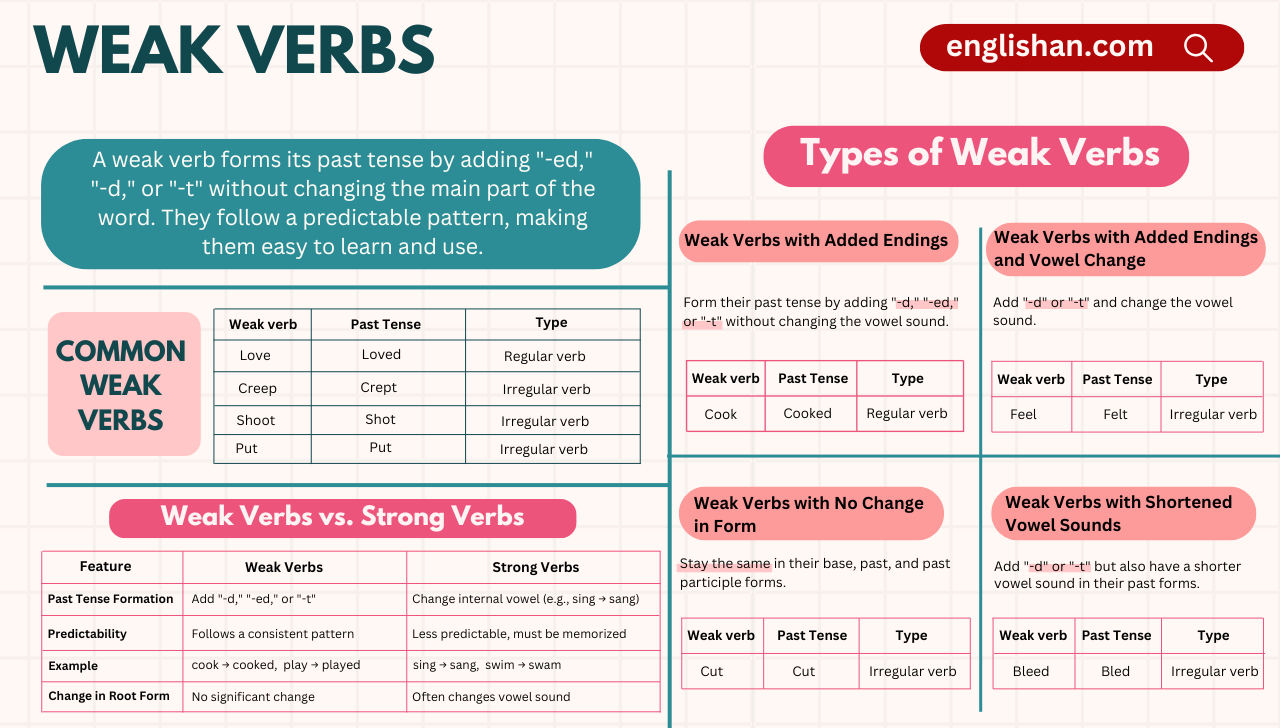
A weak verb is a verb that forms its past tense and past participle by adding a dental ending (a suffix containing -d or -t) to the base form. Walk becomes walked, feel becomes felt, keep becomes kept. The label “weak” comes from nineteenth-century Germanic linguistics, where the German philologist Jakob Grimm coined schwaches Verb (weak verb) to contrast with starkes Verb (strong verb). A strong verb changes its stem vowel to signal the past (sing → sang); a weak verb keeps its stem and takes an ending instead.
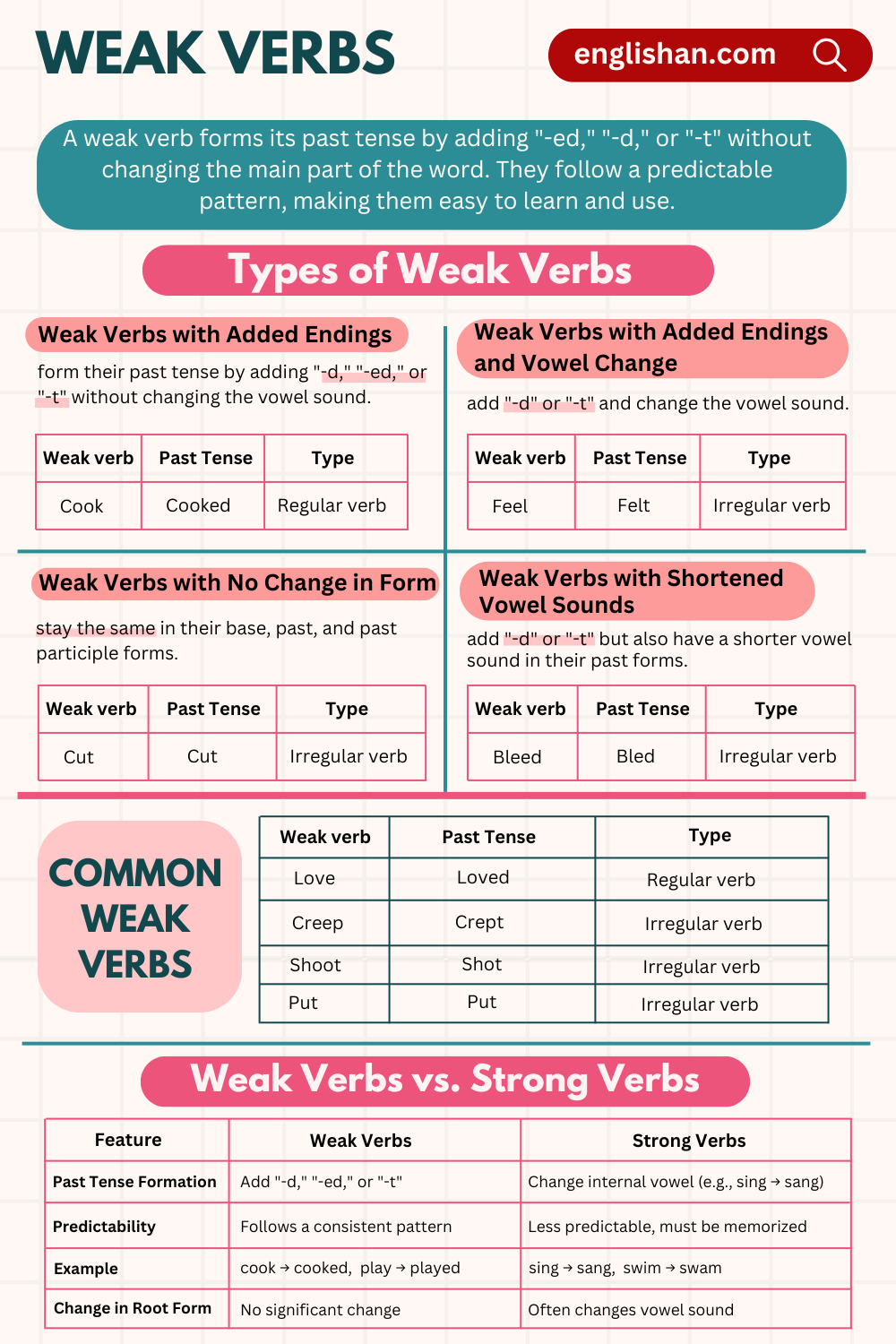
Most English verbs are weak. Only around 200 strong verbs remain in modern use, and even some of those (like cleave and dream) are drifting toward the weak class. Four recognisable classes cover the full set: verbs with plain dental endings, verbs that add an ending and change a vowel, verbs that add an ending and shorten the vowel sound, and a small group that stay the same across present and past.
What Is a Weak Verb?
A weak verb forms its past tense and past participle by attaching a dental suffix (a syllable containing -d or -t) to the base form. Ask takes asked. Watch takes watched. Send takes sent. Learn takes learnt in British English and learned in American English. The base stem stays intact; the past marker is a suffix, not a vowel shift.
The term was coined by the German philologist Jakob Grimm in the 1810s. Grimm noticed that Germanic verbs split into two conjugation systems: one that formed the past by changing the stem vowel (the older, Indo-European system), and one that formed the past by adding a dental suffix (a later Proto-Germanic innovation). He named the vowel-changing group starkes Verb and the suffix-taking group schwaches Verb. The English translations “strong” and “weak” have travelled with the terms ever since. The label describes mechanics, not value. A weak verb is not lesser than a strong one; it is built on a different past-tense mechanism.
Weak verbs make up the majority of English. Every new verb entering the language (Google → googled, tweet → tweeted, download → downloaded) joins the weak class by default. The strong class is closed, and its members shrink as verbs drift toward regular past-tense endings across generations.
The Four Classes of Weak Verbs
Class 1: Regular Dental Endings
This class contains the largest set of weak verbs. The past tense and past participle are formed by adding -ed, -d, or -t to the base with no other change.
| Base | Past tense | Past participle |
|---|---|---|
| Walk | Walked | Walked |
| Talk | Talked | Talked |
| Love | Loved | Loved |
| Play | Played | Played |
| Cook | Cooked | Cooked |
| Learn | Learned / learnt | Learned / learnt |
| Watch | Watched | Watched |
| Decide | Decided | Decided |
Every verb in this class is both weak and regular. The two labels overlap perfectly here.
Class 2: Dental Ending With a Vowel Change
A smaller set of weak verbs adds -d or -t and changes the stem vowel in the past tense. These verbs are irregular yet weak, because the past-tense marker is still a dental suffix.
| Base | Past tense | Past participle |
|---|---|---|
| Feel | Felt | Felt |
| Keep | Kept | Kept |
| Sleep | Slept | Slept |
| Sweep | Swept | Swept |
| Build | Built | Built |
| Buy | Bought | Bought |
| Bring | Brought | Brought |
| Catch | Caught | Caught |
| Teach | Taught | Taught |
| Think | Thought | Thought |
Buy, bring, catch, teach, and think combine a vowel shift with a dental ending. The vowel change alone does not qualify them as strong verbs, because the -t ending is still doing the work of marking past tense.
Class 3: Dental Ending With a Shortened Vowel Sound
A third group shortens the stem vowel and takes a -d ending. The change is smaller than the vowel shift in Class 2, and the ending itself is spelled the same as the base in some verbs (like read).
| Base | Past tense | Past participle |
|---|---|---|
| Bleed | Bled | Bled |
| Lead | Led | Led |
| Feed | Fed | Fed |
| Meet | Met | Met |
| Read | Read (pronounced “red”) | Read (pronounced “red”) |
| Speed | Sped | Sped |
Strictly, some grammarians group these with Class 2. The split is teachable because the vowel change in Class 3 is a shortening rather than a full ablaut shift.
Class 4: No Change in Form
A small group of English verbs stay the same across base, past tense, and past participle. Under strict Germanic linguistics these are not weak verbs at all, because they take no dental ending. Under most modern reference works they are grouped with the weak class as a special no-change type. Both readings are respectable.
| Base | Past tense | Past participle |
|---|---|---|
| Cut | Cut | Cut |
| Hit | Hit | Hit |
| Put | Put | Put |
| Set | Set | Set |
| Let | Let | Let |
| Shut | Shut | Shut |
| Cost | Cost | Cost |
| Hurt | Hurt | Hurt |
Context settles the tense of these verbs. I cut the rope yesterday and I cut the rope every day differ only in the time reference around them.
How to Identify a Weak Verb
Three steps settle any verb-classification question in under ten seconds.
Step 1: Write out the past tense form. Move the verb from present to past. Walk → walked. Sing → sang.
Step 2: Check for a dental ending. Does the past tense end in a sound spelled -ed, -d, or -t? If yes, the verb is weak. Walked ends in -ed; weak. Sang has no dental ending; strong.
Step 3: Check for a vowel change. If the verb both takes a dental ending and changes a vowel (feel → felt), it is irregular yet still weak. If the verb only changes a vowel with no dental ending (sing → sang), it is strong.
Worked application: think → thought. Dental ending -t: present. Vowel change from i to ough: present. Both changes together mark an irregular weak verb.
Second worked application: drink → drank. Dental ending: absent. Vowel change from i to a: present. No dental means strong.
Weak Verbs vs Strong Verbs
The full contrast:
| Feature | Weak verb | Strong verb |
|---|---|---|
| Past-tense mechanism | Adds a dental ending (-ed, -d, -t) | Changes the stem vowel (ablaut) |
| Historical origin | Proto-Germanic innovation | Proto-Indo-European inheritance |
| Regularity | Most are regular; some are irregular | Most are irregular |
| Modern share of the verb inventory | Vast majority | Roughly 200 verbs |
| Direction of drift | Growing class; new verbs join it | Shrinking class; verbs drift out |
| Past participle ending | Same dental ending as past tense | Often ends in -n or -en (broken, driven, ridden) |
| Sample verbs | Walk, talk, feel, keep, bring | Sing, drink, ride, write, speak |
Five paired sentences show the split:
- She walked home after the meeting. (weak: dental ending -ed)
- She sang the entire aria without notes. (strong: vowel shift from i to a)
- He built the shelf over the weekend. (weak: dental ending -t with vowel change)
- He drove the car to the coast. (strong: vowel shift from i to o)
- They kept their promise for years. (weak: dental ending -t with vowel shortening)
Weak Verbs vs Regular Verbs
The relationship reads flatly: all regular verbs are weak, but not all weak verbs are regular.
A regular verb follows the standard past-tense rule of the language: add -ed to the base. Every regular verb is a weak verb, because the -ed ending is a dental suffix. However, some weak verbs are irregular. Feel → felt, keep → kept, and bring → brought are all weak (they take a dental ending) but irregular (they change the stem vowel).
Three paired demonstrations:
- Walk → walked: weak and regular.
- Feel → felt: weak and irregular.
- Sing → sang: strong and irregular.
Regular verbs and weak verbs are frequently treated as synonyms in English classrooms, and the overlap is close but not total. Precision is what tells a reader that bring (weak but irregular) belongs to a different category from drink (strong and irregular).
Weak Verbs vs Irregular Verbs
Irregular is not a synonym for strong. Irregular means the past tense does not follow the standard -ed rule. That covers three sub-groups.
Weak irregular verbs. Verbs that take a dental ending but change form in some other way. Feel/felt, keep/kept, buy/bought, think/thought.
Strong irregular verbs. Verbs that change the stem vowel with no dental ending. Sing/sang/sung, drive/drove/driven.
No-change verbs. Verbs that stay the same across all three forms. Cut/cut/cut. Under strict linguistics, these are neither strong nor weak.
The four English verb labels operate on two axes:
| Regular | Irregular | |
|---|---|---|
| Weak (dental ending) | Most English verbs | Feel, keep, bring, catch, think |
| Strong (vowel change) | None in modern English | Sing, drink, ride, write, speak |
The matrix settles the confusion. A verb is weak or strong by the mechanism of its past tense. A verb is regular or irregular by whether it follows the standard -ed rule. The two axes cross to give four categories, three of which are populated in modern English.
Frequently Used Weak Verbs
A working set of common English verbs, grouped by class for reference.
Class 1 (regular, plain dental ending): Work, play, live, love, ask, watch, laugh, dance, cook, wash, wave, open, wait, want, need, add, call, look, learn, listen, plan, save, share, use, walk, echo, decide, promise, agree, arrive.
Class 2 (dental ending with vowel change): Feel, keep, sleep, sweep, build, buy, bring, catch, teach, think, sell, tell, send, spend, mean, deal, hear, dream, kneel.
Class 3 (dental ending with shortened vowel): Bleed, lead, feed, meet, read, speed, breed, flee.
Class 4 (no change): Cut, hit, put, set, let, shut, cost, hurt, burst, cast, bet, spread, split, quit, thrust.
Common Mistakes With Weak Verbs
Five errors show up repeatedly in learner writing. Each has a fast fix.
1. Adding -ed to an irregular weak verb.
- She keeped her word. ❌
- She kept her word. ✅
2. Confusing a strong past tense with a weak one.
- He drived the car home yesterday. ❌
- He drove the car home yesterday. ✅ (strong verb; vowel shift, no dental ending)
3. Missing the vowel change in Class 2.
- I feeled tired after the walk. ❌
- I felt tired after the walk. ✅
4. Doubling a consonant that does not need doubling.
- She travled to Paris last year. ❌
- She travelled to Paris last year. ✅ (British English)
- She traveled to Paris last year. ✅ (American English)
5. Treating a no-change verb as if it takes an ending.
- He cutted the rope with a knife. ❌
- He cut the rope with a knife. ✅
Weak Verbs in Modern Writing
Writers also use “weak verb” in a second, non-grammatical sense to describe a verb that reads as vague or ineffective on the page. In that stylistic sense, verbs like was, did, went, and had are called weak because they lean on adverbs or context to convey meaning. A stronger verb (sprinted rather than went quickly, muttered rather than said quietly) does the descriptive work on its own.
The two meanings are distinct. A verb like walked is grammatically weak (it forms its past with -ed) but is stylistically strong when the walk itself is what the sentence needs. A verb like sang is grammatically strong but reads as stylistically weak in a sentence where a sharper verb (belted, whispered, crooned) would carry more weight.
Editorial writing rewards stylistic strength. Grammar keeps the tense correct; verb choice does the persuasion.
FAQs
A weak verb forms its past tense and past participle by adding a dental ending (-ed, -d, or -t) to the base form. Walk becomes walked, feel becomes felt, cost becomes cost. The label was coined by the German philologist Jakob Grimm to distinguish verbs that take an ending from those that change the stem vowel.
Weak verbs mark the past tense with a dental ending (walk → walked). Strong verbs mark the past tense with a change in the stem vowel (sing → sang). The mechanisms are separate: a verb is weak or strong by how the past is formed, not by whether the past is predictable.
Yes. Every regular verb takes -ed in the past tense, and -ed is a dental ending. That makes every regular verb weak by definition. The reverse is not true: some weak verbs are irregular (feel → felt, bring → brought).
Yes. Verbs like feel, keep, sleep, build, bring, buy, catch, teach, and think are weak (they take a dental ending) and irregular (they do not follow the standard -ed rule). They form the largest group of irregular verbs in modern English.
Write out the past tense form. If it ends in -ed, -d, or -t as a sound (not just as spelling), the verb is weak. If the past changes the stem vowel with no dental ending (sing → sang, drive → drove), the verb is strong.
The German philologist Jakob Grimm coined the term in the 1810s. He called the vowel-changing verbs “strong” because they showed their past tense through an internal change of the verb itself, and he called the ending-taking verbs “weak” because they needed an external suffix to signal the past. The names are descriptive of the mechanism, not a value judgement.
The answer splits by school. Under strict Germanic linguistics, verbs that stay the same across all forms (cut, hit, put, set) are neither weak nor strong, because they take no dental ending and change no vowel. Under most modern reference works, they are grouped with the weak class as a no-change type. Both readings are respectable.
You May Also Like
Weak Verbs Quiz
Weak Verbs
Complete the statement.
A weak verb forms its past by ___.
Weak verbs keep the root and attach an ending.
weak verbs add -ed, -d, or -t for the past
work -> worked
Which is a weak verb?
'Walk' forms its past as 'walked'.
weak verbs keep the root and add an ending
walk -> walked
Choose the past form.
The past of 'keep' is ___.
'Keep' is a weak verb that ends in -t.
some weak verbs take a -t ending
keep -> kept
Which is a STRONG verb?
'Sing' changes its vowel to 'sang'.
strong verbs change the vowel; weak verbs add an ending
sing -> sang
Choose the past form.
The past of 'cry' is ___.
A weak verb still follows spelling rules: y becomes -ied.
weak verbs still follow spelling rules like y -> ied
cry -> cried
Which forms its past WITHOUT a vowel change?
'Help' adds -ed to give 'helped'.
a weak verb keeps its vowel and adds -ed
help -> helped
Which is a weak verb?
Pick the weak verb.
'Walk' forms its past by adding -ed, marking it weak.
weak verbs add -ed / -d / -t for the past
We walked home.
Choose the past form.
They ___ us move the sofa.
'Help' is weak, so its past adds -ed.
weak verbs take -ed in the past
They helped us move the sofa.
True or false?
Weak verbs form the past by adding an ending such as -ed, -d, or -t.
Weak verbs add a dental ending rather than changing the root vowel.
weak verbs add an ending; strong verbs change the vowel
She worked late.
Which verb is NOT weak?
Find the strong verb.
'Run' changes its vowel to 'ran', so it is strong, not weak.
strong verbs change the root vowel
He ran to the gate.
Type the past form of the weak verb in brackets.
She ___ (learn) the song by heart.
'Learn' is weak; its past is 'learned' (or 'learnt' in British English).
weak verbs take -ed or -t
She learned the song by heart.
Choose the weak verb.
Pick the verb that adds -ed.
'Paint' adds -ed, so it is weak.
weak verbs form the past with -ed
She painted the fence.
Which is a weak verb?
Pick the weak verb.
'Cook' adds -ed, so it is weak.
weak verbs add -ed / -d / -t
She cooked the meal.
Choose the past form.
They ___ the windows to let air in.
'Open' is weak, so its past adds -ed.
weak verbs take -ed in the past
They opened the windows to let air in.
True or false?
Strong verbs form the past by changing the root vowel.
Strong verbs shift the vowel, as in sing/sang and drink/drank.
strong verbs change the vowel; weak verbs add an ending
She sang beautifully.
Which verb is NOT weak?
Find the strong verb.
'Sing' changes its vowel to 'sang', so it is strong, not weak.
strong verbs change the root vowel
The choir sang carols.
Type the past form of the weak verb in brackets.
The match ___ (start) at noon.
'Start' is weak; its past adds -ed.
weak verbs take -ed
The match started at noon.
Choose the weak verb.
Pick the verb that adds -ed.
'Jump' adds -ed, so it is weak.
weak verbs form the past with -ed
The cat jumped down.
Which verb is strong?
Find the strong verb.
'Drink' changes its vowel to 'drank', so it is strong.
strong verbs change the root vowel
He drank the water quickly.
True or false?
'Worked' is the past of a weak verb.
'Work' adds -ed, so 'worked' comes from a weak verb.
weak verbs form the past with -ed
She worked late.
Turn on JavaScript for the interactive quiz. The full practice set is shown above.