


A coordinate clause is one of two or more independent clauses joined by a coordinating conjunction inside a compound or compound-complex sentence. Each coordinate clause has its own subject and finite verb and expresses a complete thought on its own. The word coordinate names the equal grammatical rank of the joined clauses: neither dominates the other, and neither depends on the other for meaning.
Not every independent clause is a coordinate clause. A single sentence with one independent clause and no others is not coordinated. Coordinate clauses come in twos, threes, or larger sets, and they belong to compound or compound-complex sentences. Simple and complex sentences contain no coordinate clauses at all.
What Is a Coordinate Clause?
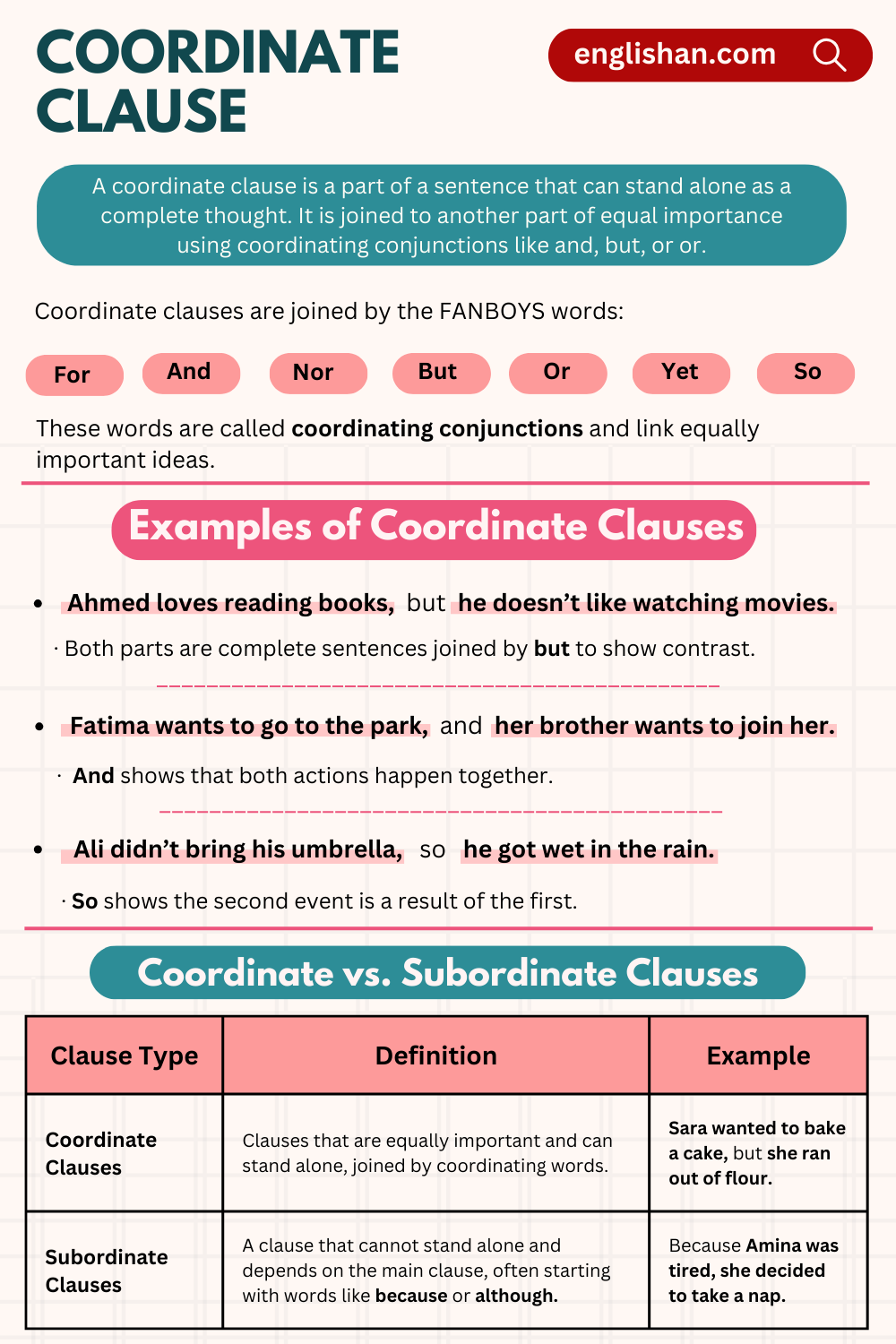
A coordinate clause is an independent clause that is coordinated with another independent clause inside the same sentence. Two grammatical properties define it.
First, the pair-or-more rule: a coordinate clause never occurs alone. It always has at least one sibling coordinate clause in the same sentence.
Second, the equal-rank rule: coordinate clauses have the same grammatical weight. Neither modifies nor depends on the other.
Three worked sentences settle the concept.
Sara ran to the shop, and she bought some milk. Two coordinate clauses (Sara ran to the shop / she bought some milk), joined by the conjunction and. Compound sentence.
Sara ran to the shop. One independent clause. Simple sentence. No coordinate clauses here, because there is nothing coordinated with it.
Because Sara was late, she ran to the shop and bought some milk. One independent clause (she ran to the shop and bought some milk) with a dependent clause in front (Because Sara was late). Complex sentence. Still no coordinate clauses, because ran to the shop and bought some milk is one clause with a compound predicate, not two separate clauses. A compound predicate shares one subject; coordinate clauses each need their own subject.
The Seven FANBOYS Joiners
Coordinate clauses are joined by one of the seven coordinating conjunctions, remembered with the FANBOYS acronym.
- For. Names a reason or cause. She brought an umbrella, for the sky was already darkening.
- And. Adds one clause to another. The rain fell hard, and the streets flooded within an hour.
- Nor. Adds a second negative clause with subject-verb inversion. He does not eat meat, nor does he drink coffee.
- But. Introduces a direct contrast. The meeting ran late, but everyone stayed to the end.
- Or. Presents an alternative. You take the earlier bus, or you wait for the next one.
- Yet. Introduces a stronger contrast, one with a note of surprise. She trained for a month, yet she finished last.
- So. Names a result or consequence. The traffic was bad, so we left an hour earlier.
Each conjunction shifts the relationship between the two coordinate clauses.
Types of Coordinate Clauses by Relationship
Coordinate clauses fall into four relationship types based on the logical link the conjunction sets between them.
Addition
The second clause adds to the first. Joined by and.
The report covered profit and inventory, and the finance team signed off before noon.
Contrast
The second clause contradicts or qualifies the first. Joined by but or yet.
The meeting ran late, but everyone stayed to the end. She trained for a month, yet she finished last.
Cause and Effect
The second clause presents a reason or a result. Joined by for (reason) or so (result).
She brought an umbrella, for the sky was already darkening. The traffic was bad, so we left an hour earlier.
Choice or Alternative
The second clause offers an alternative. Joined by or or nor.
You take the earlier bus, or you wait for the next one. He does not eat meat, nor does he drink coffee.
The four relationship types cover almost every coordinate-clause construction in written English. Each conjunction has a specific semantic weight, and swapping one for another shifts the meaning.
Punctuation Rules for Coordinate Clauses
Three settled punctuation options cover every coordinate-clause pairing.
Rule 1: Comma Before the Coordinating Conjunction
When two coordinate clauses are joined by a coordinating conjunction, place a comma before the conjunction.
- The rain fell hard, and the streets flooded. ✅
- The rain fell hard and the streets flooded. ❌
The comma signals that a new coordinate clause is starting.
Rule 2: Semicolon Alone
When the two coordinate clauses share a close conceptual link, a semicolon replaces the comma-plus-conjunction combination entirely.
The rain fell hard; the streets flooded within an hour.
Both parts stay full coordinate clauses. The semicolon signals a tighter connection than a plain period would create.
Rule 3: Semicolon With a Conjunctive Adverb
When the link between the two coordinate clauses is precise (however, therefore, meanwhile, consequently), place a semicolon before the adverb and a comma after it.
- The meeting ran late; however, everyone stayed. ✅
- The meeting ran late, however, everyone stayed. ❌ (comma splice)
Conjunctive adverbs are not coordinating conjunctions. A plain comma before however creates a comma splice; the semicolon is required.
Coordinate Clauses vs Independent Clauses
The two terms overlap but are not identical. Every coordinate clause is an independent clause, but not every independent clause is a coordinate clause.
An independent clause stands alone as a complete sentence. It has a subject and a finite verb and expresses a complete thought. A sentence that has one independent clause and nothing else is called a simple sentence.
A coordinate clause is an independent clause that is coordinated with at least one other independent clause in the same sentence. The pairing is what makes it coordinate.
Three worked sentences show the difference.
Sara ran to the shop. → One independent clause. Zero coordinate clauses (no pairing).
Sara ran to the shop, and she bought some milk. → Two independent clauses. Two coordinate clauses.
Sara ran to the shop, and she bought some milk, and she came home. → Three independent clauses. Three coordinate clauses.
The rule is the pair-or-more requirement. A solitary independent clause is never called a coordinate clause, even though it has the same grammatical shape.
Coordinate Clauses vs Subordinate Clauses
A subordinate clause depends on another clause for meaning; it cannot stand alone as a full sentence. A coordinate clause stands alone by itself, coordinated with another that also stands alone.
| Feature | Coordinate clause | Subordinate clause |
|---|---|---|
| Grammatical rank | Equal to the paired clause | Lower than the main clause |
| Standalone ability | Yes | No |
| Introduced by | A coordinating conjunction (for, and, nor, but, or, yet, so) | A subordinating conjunction (because, although, when, if, since) or a relative pronoun (who, which, that) |
| Sentence type produced | Compound or compound-complex | Complex or compound-complex |
| Comma placement | Comma before the conjunction | Comma after the subordinate clause when fronted; no comma when it follows the main clause |
| Meaning shift | Adds, contrasts, alternates, or results | Cause, time, condition, concession, description |
Three paired sentences show the split.
The match stopped, and the fans went home. (two coordinate clauses) Because the rain fell hard, the match stopped. (one subordinate clause + one main clause) The match stopped when the rain fell hard. (one main clause + one subordinate clause)
Coordinate Clauses in the Four Sentence Types
Every English sentence falls into one of four types. Coordinate clauses occur in two of them.
Simple sentence: One independent clause, no coordination. Coordinate clauses do not occur here. The train arrived at seven.
Compound sentence: Two or more coordinate clauses joined by a coordinating conjunction or a semicolon. The train arrived at seven, and the passengers rushed onto the platform.
Complex sentence: One main clause and one or more subordinate clauses. Coordinate clauses do not occur here. When the train arrived at seven, the passengers rushed onto the platform.
Compound-complex sentence: Two or more coordinate clauses combined with at least one subordinate clause. When the train arrived at seven, the passengers rushed onto the platform, and the porters began unloading the freight. Two coordinate clauses (the passengers rushed onto the platform, the porters began unloading the freight) plus one subordinate clause (when the train arrived at seven).
The pair-or-more rule holds: coordinate clauses need at least one sibling coordinate clause in the same sentence.
Common Mistakes With Coordinate Clauses
Five errors show up repeatedly in learner and business writing.
1. Comma splice: joining two coordinate clauses with only a comma.
- The rain fell hard, the streets flooded. ❌
- The rain fell hard, and the streets flooded. ✅ (add a coordinating conjunction)
- The rain fell hard; the streets flooded. ✅ (replace the comma with a semicolon)
2. Missing comma before the coordinating conjunction.
- The traffic was bad so we left an hour earlier. ❌
- The traffic was bad, so we left an hour earlier. ✅
3. Mistaking a compound predicate for two coordinate clauses.
A compound predicate is one clause with two verbs on the same subject. Two coordinate clauses are two separate clauses, each with its own subject.
- Sara ran to the shop, and bought some milk. ❌ (compound predicate; the comma is unnecessary)
- Sara ran to the shop and bought some milk. ✅ (compound predicate; one clause, no comma)
- Sara ran to the shop, and she bought some milk. ✅ (two coordinate clauses; comma required)
4. Using a conjunctive adverb as a coordinating conjunction.
Words like however, therefore, and meanwhile are not FANBOYS. They do not join two coordinate clauses with a plain comma.
- The meeting ran late, however, everyone stayed. ❌ (comma splice)
- The meeting ran late; however, everyone stayed. ✅ (semicolon before, comma after)
- The meeting ran late, but everyone stayed. ✅ (proper coordinating conjunction)
5. Treating a participle phrase as a coordinate clause.
An -ing phrase is not a clause; it has no subject of its own.
- The train arrived at seven, and rushing onto the platform. ❌
- The train arrived at seven, and the passengers rushed onto the platform. ✅
Quick Reference
- A coordinate clause is an independent clause coordinated with at least one other independent clause in the same sentence.
- The pair-or-more rule: a solitary independent clause is never a coordinate clause.
- Coordinate clauses occur only in compound and compound-complex sentences.
- FANBOYS joiners: for, and, nor, but, or, yet, so.
- Three punctuation options: comma + FANBOYS, semicolon alone, semicolon + conjunctive adverb.
- Four relationship types: addition, contrast, cause and effect, choice or alternative.
- Common errors: comma splice, missing comma, compound predicate confusion, conjunctive adverb misuse, participle phrase mistaken for a clause.
FAQs
A coordinate clause is an independent clause joined to at least one other independent clause inside a compound or compound-complex sentence. Each has a subject, a finite verb, and stands as a complete thought. Sara ran to the shop, and she bought some milk contains two coordinate clauses.
Every coordinate clause is an independent clause, but not every independent clause is a coordinate clause. An independent clause is any clause that stands as a full sentence on its own. It becomes a coordinate clause only when it is joined to at least one other independent clause in the same sentence. A single independent clause with nothing coordinated to it is not a coordinate clause.
Coordinate clauses have equal grammatical rank and stand alone as complete sentences. Subordinate clauses depend on a main clause for their meaning and cannot stand alone. Coordinate clauses are joined by coordinating conjunctions (for, and, nor, but, or, yet, so). Subordinate clauses are introduced by subordinating conjunctions (because, although, when, if, since) or relative pronouns (who, which, that). Coordinate clauses produce compound sentences; subordinate clauses produce complex sentences.
Principal clause and main clause name the same construct: the clause on which a subordinate clause depends in a complex sentence. The dog barked when the postman knocked has the dog barked as the principal or main clause and when the postman knocked as the subordinate clause. A coordinate clause is a different construct: it is one of two or more independent clauses of equal rank joined by a coordinating conjunction.
Yes. A compound sentence with three, four, or more coordinate clauses is grammatical. Sara ran to the shop, and she bought some milk, and she walked home contains three coordinate clauses joined by two coordinating conjunctions. Three or four coordinate clauses in one sentence is the practical limit; beyond that, the sentence turns into a run-on regardless of punctuation.
You May Also Like
Coordinate Clause Quiz
Coordinate Clause
Which sentence has coordinate clauses?
Two independent clauses of equal rank join with 'but'.
coordinate clauses are equal, joined by FANBOYS
I wanted tea, but they had only coffee.
Which is a coordinating conjunction?
'So' is one of the FANBOYS that join equal clauses.
FANBOYS: for, and, nor, but, or, yet, so
It rained, so we stayed in.
Choose the correctly punctuated sentence.
A comma sits before 'and' when it joins two independent clauses.
comma before a conjunction joining two independent clauses
She studied hard, and she passed easily.
Which joins two equal clauses without a conjunction?
A semicolon links two coordinate clauses.
a semicolon joins two coordinate clauses
The road was icy; we drove slowly.
Which joins clauses of EQUAL rank?
'Yet' coordinates two independent clauses.
coordinate = equal rank; subordinate = unequal
He knocked, yet no one answered.
Choose the best repair for the comma splice.
The plan failed, we tried again.
Adding a coordinating conjunction fixes the splice.
repair a comma splice with a conjunction or semicolon
The plan failed, so we tried again.
Which conjunction joins coordinate clauses?
Choose the coordinating conjunction.
'But' is one of the FANBOYS words that link clauses of equal rank.
coordinate clauses join with FANBOYS (for, and, nor, but, or, yet, so)
I called, but no one answered.
True or false?
Coordinate clauses hold equal grammatical rank.
Each coordinate clause is independent, so neither outranks the other.
coordinate = equal, independent clauses
She cooked and he cleaned.
Choose the correctly punctuated sentence.
Two independent clauses, one conjunction.
A comma sits before the conjunction when it joins two independent clauses.
comma before the conjunction joining two independent clauses
I wanted tea, but they had only coffee.
Which sentence has two coordinate clauses?
Pick the compound sentence.
Two independent clauses joined by 'and' form a compound sentence.
two independent clauses + FANBOYS = coordinate
The sky darkened, and the wind rose.
Join the two clauses with one coordinating conjunction.
She studied hard, ___ she passed with ease.
'So' links two independent clauses and shows the result of the first.
use a FANBOYS word to coordinate two clauses
She studied hard, so she passed with ease.
True or false?
'She ran and jumped' contains two coordinate clauses.
One subject with two verbs is a compound predicate; there is only one clause, not two.
coordinate clauses each need their own subject
She ran, and she jumped.
Choose the correctly punctuated sentence.
Two independent clauses.
A comma sits before 'but' when it joins two independent clauses.
comma before the conjunction joining two independent clauses
He knocked, but nobody answered.
True or false?
A semicolon can join two coordinate clauses without a conjunction.
A semicolon links two closely related independent clauses on its own.
semicolon joins related independent clauses
The sky darkened; the wind rose.
Which sentence has two coordinate clauses?
Pick the compound sentence.
Two independent clauses joined by 'and' form a compound sentence.
two independent clauses + FANBOYS = coordinate
I cooked, and she cleaned.
Choose the conjunction of result.
It rained hard, ___ we stayed inside.
'So' links two independent clauses and marks the result of the first.
so coordinates a result between two clauses
It rained hard, so we stayed inside.
Join the clauses with 'or'.
Hurry up, ___ we'll miss the train.
'Or' links two independent clauses and marks an alternative outcome.
or coordinates two clauses
Hurry up, or we'll miss the train.
True or false?
'She ran fast, but she lost' contains two coordinate clauses.
Each half holds its own subject and verb, joined by 'but'.
each coordinate clause has its own subject and verb
She ran fast, but she lost.
Which is NOT a correct way to join two independent clauses?
Find the error.
A comma with no conjunction between two independent clauses is a comma splice.
avoid the comma splice
I was tired, so I left.
Choose the conjunction of addition.
He plays guitar, ___ she sings.
'And' links two independent clauses and adds one to the other.
and coordinates two clauses by addition
He plays guitar, and she sings.
Turn on JavaScript for the interactive quiz. The full practice set is shown above.