Argumentative essays rely on clear arguments, logical evidence and clear explanations. But even a great idea can lose its value if grammar mistakes make it hard to understand the writing. In academic writing grammar is not about simply following rules. It helps the reader grasp the writer’s viewpoint without confusion.
This is a must for all students, but especially those in high school and at university. In writing argumentatively, each sentence serves a specific purpose. Each sentence in an argumentative piece has a specific purpose. For example, one sentence could present a statement, another might introduce evidence, while a third would explain the importance of that evidence. If grammar errors disrupt this flow, then the argument is weaker. Students often focus on the content and overlook how grammar affects persuasion. This is why noticing common errors can help improve the quality of writing, as well the strength and consistency of the argument.
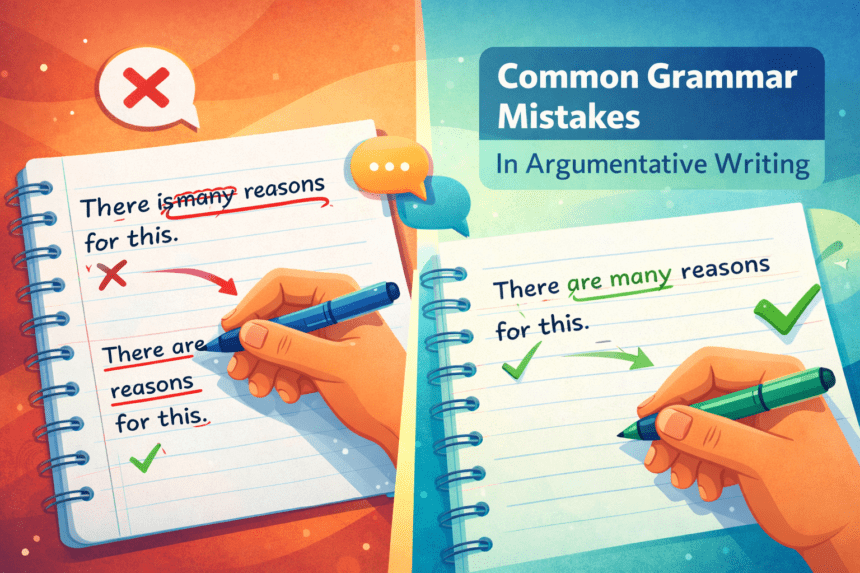
Common Grammar Mistakes In Argumentative Writing
Argumentative essays tend to have more grammar mistakes than others. It is common to have a subject-verb agreement. It is common for students to write a sentence with a complex subject, and then use the wrong form of verb. Also, sentence fragments are frequent. This is especially true when a writer wants to sound professional but leaves out the entire thought. Run-ons create a new problem, as they connect multiple ideas without proper structuring.
Students often seek help with their structure and language from support services, such as write my argumentative essay for me. Understanding the mistakes they make is also important. While incorrect wording can be confusing or make an argument sound unprofessional, punctuation errors are often the cause of these mistakes. This table shows some common errors in argumentative papers.
| Mistake | If you want to know more about this, please click here. | Corrected Version |
| Subject-verb agreement | This is primarily due to poor policies in schools. | This is largely due to poor school policy. |
| Sentence fragment | Most students do not revise well. | Many students make errors because they do no revise thoroughly. |
| Run-on sentence | Social media can affect attention and change reading habits. | Social media changes the way we read and pay attention. |
| Punctuation error | Writing practice is a good example. | Writing practice is an example of where students can benefit from more writing. |
| Incorrect word usage | The new rule affected learning negatively. | The new rule had an adverse effect on the learning process. |
How Grammar Mistakes Affect Argument Clarity
Grammar errors do more to make writing appear untidy than that. The logic of your argument can be damaged by grammar mistakes. When a reader is forced to stop and decode an entire sentence, the main idea loses its force. A fragment could leave the reader in a state of confusion. A sentence that is too long may confuse two ideas which should be explained in order. In both situations, it is harder to follow the reasoning of the writer.
These errors also affect credibility. The reader expects accuracy and control in writing argumentatively. If the writer makes repeated mistakes in grammar, they may appear to be less confident, or unprepared, even if his ideas are sound. It is particularly dangerous to use incorrect words because they can convey a different meaning than the writer intended. In some cases, confusion between words can make an argument sound weaker. A clear and concise grammar is not just a matter of technical proficiency. It helps build trust between a writer and a reader.
How To Avoid Grammar Mistakes In Academic Writing
The majority of grammar errors can easily be corrected by following simple revision habits. Students don’t need to memorize each grammar rule. What is important is that students learn to carefully check their writing and focus on patterns. If you read too quickly after finishing your first draft, it is common for mistakes to be missed. If you take a few minutes to rest before editing, it will be easier for you to identify errors.
How to edit your documents?
- It is important to read each paragraph out loud in order for you to be able catch any awkward phrases or sentence fragments.
- Make sure that all subjects and verbs are matched, particularly in sentences with long clauses.
- After transition words such however, therefore, and for example, use commas.
- Divide sentences if they seem excessively long.
- Look for words commonly used to confuse affect with effect.
- It is better to edit one problem instead of trying everything at once.
Keeping a personal record of errors is helpful. Some students are bad at punctuation. Others have problems with verb forms, or choosing the right words. The revision process becomes quicker and more efficient when writers identify their weaknesses. Over time, both grammar and argument improve with this habit.
Final Thoughts
Students often make grammar mistakes in their writing. However, these errors should never be viewed as minor details. A reader may be confused by mistakes in sentence structure, punctuation or word choice. These errors can undermine even the most well-researched argument. It is important to use language that will help you to communicate your thoughts clearly.
Good news: Grammar usually improves over time with attention, practice and revision. Students don’t need to have perfect writing right from the start. They need to be guided through a process which helps them spot common mistakes before submitting their final draft. Grammar becomes more clear, and arguments become stronger. In the end, an essay is more organized, professional and easier to read.
You May Also Like