There’s a moment many students recognize. The sentence is technically correct, the grammar is clean, and yet it feels flat. Something is missing. Not vocabulary exactly, and not structure either. It is tone. Personality. That subtle sense that the writer actually owns the language.
A few paragraphs later, that same student might start wondering if they should just pay to do my homework and move on. It is a tempting shortcut, especially when writing starts to feel mechanical. But even then, the deeper issue does not disappear. The lack of control over tone and expression stays.
The Problem Most Students Don’t Notice
Students learning English are often told two conflicting things:
- Use idioms to sound natural
- Avoid informal language in academic writing
So they try to do both. The result is predictable. Sentences feel forced, awkward, or slightly off in ways that are hard to explain.
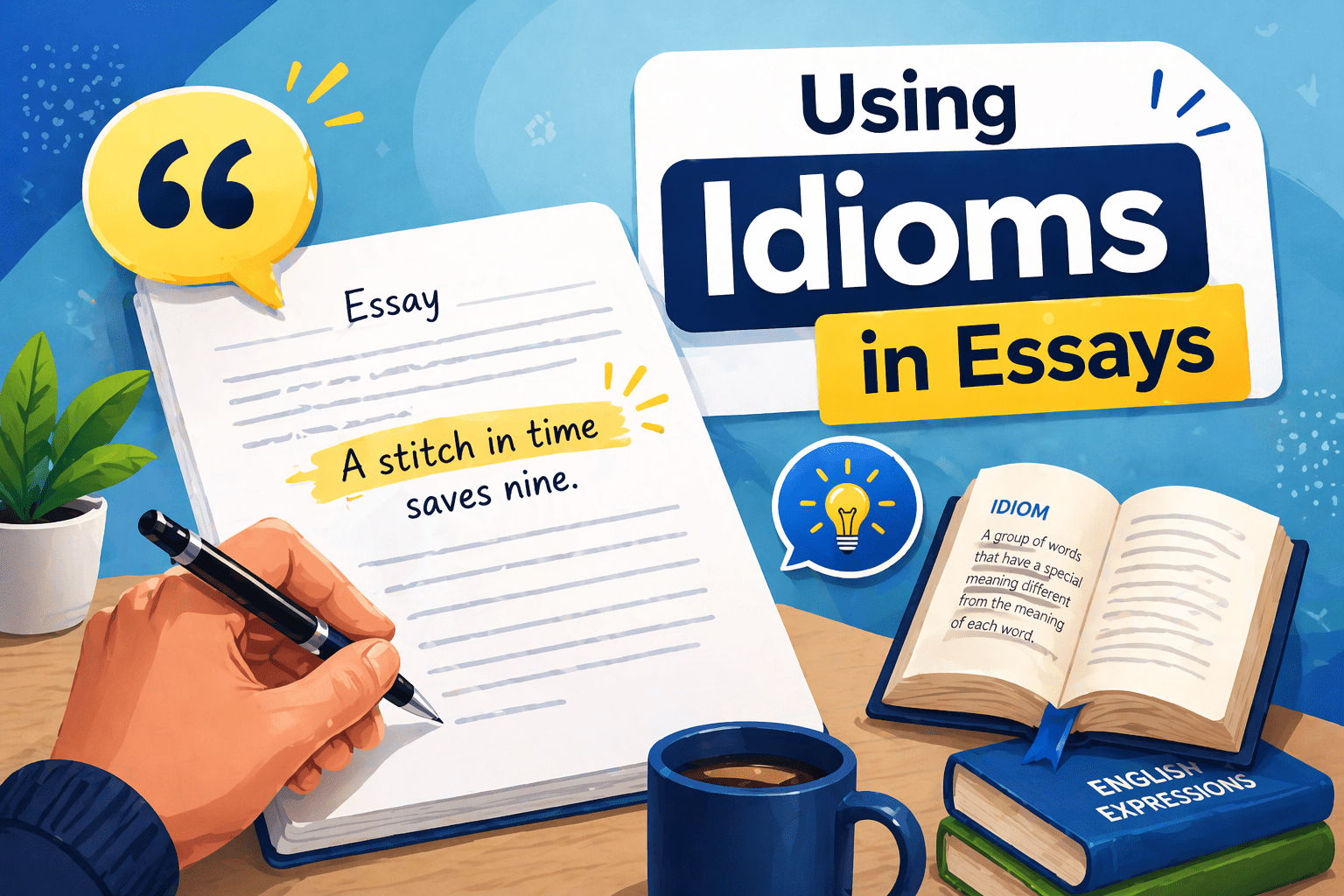
An ESL writing tutor once described reading essays where idioms were “dropped in as decoration, not meaning.” That observation feels accurate. Idioms are not ornaments. They are tools. And when used incorrectly, they stand out immediately.
Another layer of the problem is exposure. Many learners encounter idioms through movies, social media, or casual conversations. Then they try to transfer those expressions into essays without adjusting tone. The mismatch is subtle but important. Academic writing requires filtering, not copying.
English Idioms in Essay Writing: What They Actually Do
Idioms are not there to make writing sound casual. That assumption leads to most mistakes.
Used correctly, they:
- Add clarity through familiar phrasing
- Make arguments more engaging
- Show a deeper level of language awareness
Used poorly, they:
- Reduce credibility
- Confuse the reader
- Make writing feel immature
The difference is not dramatic. It is subtle, which is why it is often missed.
There is also a psychological effect. When a reader encounters a well-placed idiom, the text feels more fluent, even if they cannot explain why. It creates a sense of ease. But when the idiom is wrong, that same reader pauses. The flow breaks. That pause is costly in academic writing.
When Idioms Work and When They Don’t
Experienced academic editors tend to follow a simple internal logic:
| Context | Use Idioms? |
| Formal research paper | Rarely |
| Opinion essay | Sometimes |
| Reflective writing | Often |
| IELTS or TOEFL essays | Carefully, in moderation |
For example:
Weak: This problem is a piece of cake to solve.
Better: This problem may appear straightforward at first glance.
But there is a more refined version:
At first glance, the solution may seem a “piece of cake,” but deeper analysis reveals significant complexity.
Here, the idiom is controlled. It is not simply inserted. It is framed and slightly distanced.
Another useful technique is contrast. Idioms can highlight tension in an argument. For instance, describing a policy as a “double edged sword” immediately signals complexity without long explanation. That efficiency is valuable when word limits are strict.
Common Mistakes Students Make
Patterns repeat across different students and backgrounds.
1. Overuse
More idioms do not improve writing. They usually weaken it.
2. Wrong Context
Conversational idioms appear in formal arguments where they do not belong.
3. Literal Translation
Idioms from another language are translated directly into English. This almost never works.
4. Misunderstood Meaning
The idiom is close to correct, but not quite. That small gap is noticeable.
There is also a fifth mistake that appears less often but is worth mentioning. Some students avoid idioms completely out of fear. This leads to overly rigid writing. While technically correct, it lacks variation and rhythm.
How to Use Idioms in Essays Without Sounding Forced
This is where things become practical.
1. Use Idioms Sparingly
One or two well placed idioms are enough.
2. Choose Neutral Idioms
Some idioms sit closer to academic tone.
Examples:
- On the other hand
- In the long run
- A double edged sword
3. Integrate Naturally
The sentence should work even without the idiom. The idiom adds nuance, not structure.
4. Adapt the Expression
Stronger writers reshape idioms slightly.
Basic: This is a double edged sword.
Improved: This approach presents a double edged sword, offering both benefits and risks.
5. Read the Sentence Aloud
This step is often ignored. Hearing the sentence helps identify whether the idiom feels natural or forced. If it sounds unnatural when spoken, it will likely read the same way.
Academic Writing Idioms Examples That Work
These are not just common English idioms for students, but expressions that consistently work in structured academic arguments.
Some expressions consistently fit academic writing better:
- A double edged sword
- In the long run
- Set the stage for
- Raise the question
- A growing concern
They are not dramatic. That is why they are effective.
Writers sometimes underestimate how powerful simple expressions can be. Academic writing rewards clarity over creativity. These idioms work because they support meaning instead of competing with it.
A Subtle Truth About “Natural” Writing
Students often aim to sound natural, but what they actually want is to sound fluent.
Fluency in academic writing is controlled. It is intentional. It avoids unnecessary complexity.
At some point, many students turn to Write any papers to understand what strong writing looks like. What they often notice is unexpected. The best essays do not try too hard. They do not overload sentences. They stay balanced and clear.
There is also an element of restraint. Strong writers know when not to use a device. That includes idioms. Choosing not to use one can be just as important as choosing to include it.
How Idioms Help Improve Essay Writing
When used correctly, idioms can genuinely improve essay writing with idioms, especially when the goal is to sound fluent without losing clarity.
- Make ideas more memorable
- Add variation to sentence structure
- Show confidence in language use
The improvement is not obvious at first. It appears in how the text flows and how it is perceived.
In longer essays, small variations become more important. Repetition of structure can make writing feel mechanical. A carefully placed idiom can shift rhythm and keep the reader engaged without disrupting tone.
A Quick Self Check Before Using an Idiom
Before adding any idiom, it helps to pause and ask:
- Would this sound appropriate in a university lecture?
- Does it clarify meaning or just decorate the sentence?
- Is there a simpler alternative?
If there is uncertainty, removing the idiom is often the better choice.
The IELTS and TOEFL Reality
Students preparing for exams often overestimate the importance of idioms.
Examiners focus on:
- Clarity
- Coherence
- Accuracy
An incorrect idiom can lower a score faster than a simple sentence ever could.
The safest approach is straightforward. Use idioms only when there is full confidence in their meaning and placement.
A More Honest Way to Think About Idioms
There is something slightly uncomfortable about idioms in academic writing. They exist between formal and informal language. They can strengthen a sentence or quietly weaken it.
Writers who understand this do not rely on idioms. They use them with intention. Rarely, but precisely.
In the end, writing is not about sounding impressive. It is about being understood. And sometimes, it is about allowing one sentence to feel just a bit more human than the rest.
You May Also Like