A compound sentence joins two clauses that would each stand alone, using a comma with a coordinating conjunction, a semicolon, or a semicolon with a conjunctive adverb. The bus was late, and we missed the first act puts two complete statements into one sentence, and the comma with and is what makes it compound. The compound sentence examples that follow all take one of those three routes, starting with the seven coordinating conjunctions.
Compound Sentence Examples
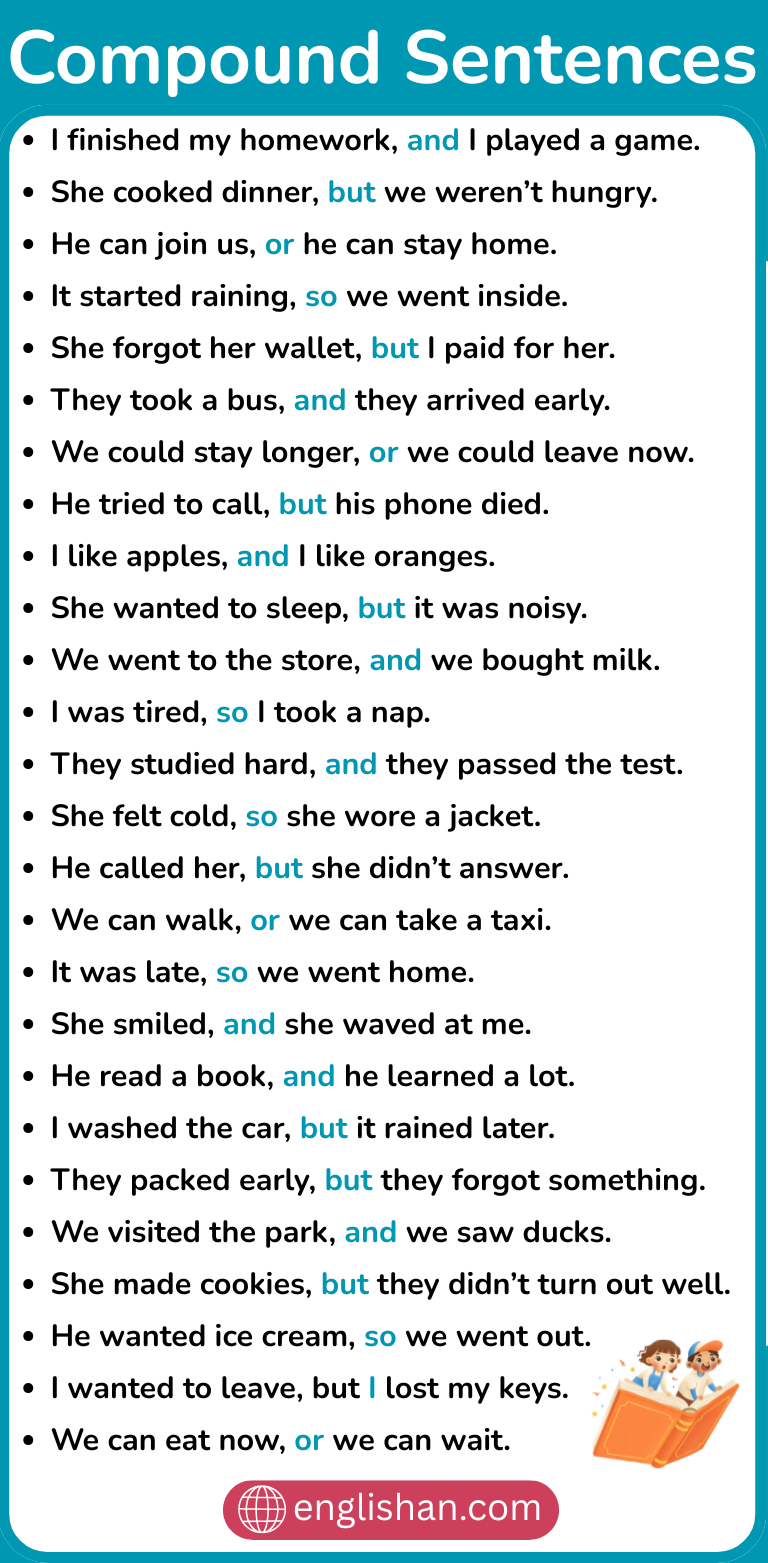
The joining word is bold in each sentence, and both halves of every one would work as a sentence on its own.
- The bus was late, and we missed the first act.
- She studied all week, so the exam felt easy.
- I wanted the window seat, but my brother got there first.
- You can pay now, or you can settle the bill on Friday.
- The kitchen was spotless, yet something still smelled burnt.
- He walked home slowly, for the evening was warm.
- She does not eat meat, nor does she drink milk.
- The rain stopped at noon**;** the streets stayed wet until dark.
- My phone died at the airport, so I borrowed a charger from a stranger.
- Ali finished his homework, and then he helped his sister with hers.
- The film ran three hours, but nobody left before the credits.
- Bring an umbrella, or you will regret it by lunchtime.
- The team trained every morning**;** the results showed by March.
- She apologised twice, yet he refused to answer her messages.
- We took the early train, for the later one was fully booked.
- The engine started, and the whole car shook.
- Maria speaks three languages, but she learned all of them after twenty.
- The lights went out, so we finished dinner by candlelight.
- He does not enjoy crowds, nor does he like loud music.
- The letter arrived on Tuesday**;** nobody opened it until Sunday.
What Is A Compound Sentence
A compound sentence is a sentence that joins two or more independent clauses with a comma and a coordinating conjunction, a semicolon, or a semicolon and a conjunctive adverb. Each clause has its own subject and verb, and each would work as a sentence on its own.
There are seven coordinating conjunctions, remembered by their initials as FANBOYS. Each one signals a different relationship between the two clauses.
| Conjunction | What the second clause does |
|---|---|
| For | Gives the reason |
| And | Adds to the first clause |
| Nor | Adds a second negative |
| But | Contradicts the first clause |
| Or | Offers an alternative |
| Yet | Contradicts what the first clause led you to expect |
| So | Gives the result |
The comma goes before the conjunction, not after it. Two independent clauses joined by a comma alone form a comma splice, which is the most frequent error in compound sentences.
The train was delayed, we waited an hour on the platform. ❌
The train was delayed, so we waited an hour on the platform. ✅
Two rules settle most of the punctuation questions. With two very short clauses the comma becomes optional, which is why It rained so we stayed in needs none. After nor, the clause inverts and the auxiliary verb moves in front of the subject: nor does she drink milk, never nor she drinks milk.
Compound Sentence Examples With And
And adds the second clause to the first without changing direction, which makes it the most common joining word in English.
- The dog barked at the gate, and the neighbours turned on their lights.
- She opened the window, and cold air filled the room.
- My father retired last spring, and he has not stopped gardening since.
- The concert sold out in an hour, and the venue added a second date.
- He packed his bags on Thursday, and he left before anyone woke up.
- The bread came out of the oven, and the whole house smelled of it.
- Sara passed her driving test, and her parents bought her a secondhand car.
- The river froze in January, and children skated on it for a week.
- I answered the phone, and a stranger asked for someone called Daniel.
- The teacher marked the papers, and she returned them the next morning.
- Snow fell all night, and the school closed by seven.
- He fixed the tap himself, and it has not leaked since.
- The band played for two hours, and nobody sat down once.
- She learned Spanish in Madrid, and she now teaches it in Karachi.
- The power came back at midnight, and the fridge started humming again.
- We planted the seeds in March, and the first shoots appeared in April.
- My laptop crashed twice, and I lost the whole afternoon’s work.
- The referee blew the whistle, and both teams walked off the pitch.
- She wrote the letter by hand, and she posted it the same day.
- The market opens at six, and the best fish is gone by seven.
Compound Sentences With But
But turns the sentence, so the second clause contradicts what the first one set up.
- The recipe looked complicated, but it took twenty minutes.
- I called three times, but nobody answered.
- The apartment is small, but the light in the mornings is worth it.
- He trained for a year, but he pulled a muscle in the first mile.
- She speaks quietly, but everyone in the room listens.
- The tickets cost a fortune, but the seats were terrible.
- We arrived on time, but the doors were already locked.
- My grandmother left school at fourteen, but she read more than anyone I know.
- The soup smelled wonderful, but it needed salt.
- He promised to call, but the week went by in silence.
- The exam was short, but every question was a trap.
- She grew up by the sea, but she never learned to swim.
- The hotel looked shabby from outside, but the rooms were spotless.
- I studied French for six years, but I froze at the border.
- The car is fifteen years old, but the engine has never failed.
- He apologised at once, but the damage was already public.
- The road looked clear, but the fog came down within minutes.
- She works six days a week, but she has never missed a school play.
- The film won three awards, but the audience walked out in silence.
- I ordered the same dish twice, but it tasted different each time.
Compound Sentence Examples With Or
Or puts two possibilities side by side, and the second clause names what happens if the first one is refused.
- You can walk to the station, or you can take the bus from the corner.
- Finish the report tonight, or the client will ask about it tomorrow.
- We can eat here, or we can find somewhere quieter down the road.
- She will accept the offer, or she will start again in September.
- Leave now, or you will sit in traffic for an hour.
- He can pay the fine, or he can appeal within thirty days.
- Take the coastal road, or you will miss the best view of the trip.
- You can borrow my notes, or you can ask the tutor for a copy.
- The meeting will run late, or it will be cut short by the fire drill.
- Book the flight today, or the price will double by Friday.
- She can study medicine in Lahore, or she can take the place in Dublin.
- We should call ahead, or we will queue outside for an hour.
- Wear the boots, or your feet will be soaked by noon.
- He will move to a bigger flat, or he will finally throw something away.
- You can send the file by email, or you can drop it at reception.
- Turn the heating down, or the bill will be unbearable in January.
- They will fix the roof this summer, or the leak will spread to the hall.
- Ask her directly, or you will spend the evening guessing.
- We can drive through the night, or we can stop at a motel outside the city.
- Sign the form now, or the application will expire at midnight.
Compound Sentences With So
So gives the result, and the first clause supplies the cause behind it.
- The last bus had gone, so we walked the three miles home.
- Her flight was cancelled, so she spent the night in the terminal.
- The library closed for repairs, so I studied in the café instead.
- He forgot his umbrella, so he arrived at the office dripping.
- The oven broke on Sunday, so dinner came from the shop on the corner.
- She had already read the book, so the ending surprised nobody but me.
- The road was flooded, so the driver took the long way round.
- My alarm never rang, so I missed the first two lectures.
- The dog would not settle, so we took him out at midnight.
- Tickets were free for students, so the hall filled within minutes.
- The wifi kept dropping, so the meeting moved to a phone call.
- He had never used a sewing machine, so his aunt threaded it for him.
- The heating failed in December, so the family slept in one room.
- She saved for two years, so the deposit was ready when the flat came up.
- The recipe called for buttermilk, so I added lemon juice to milk instead.
- Nobody replied to the email, so the decision was made without them.
- The train arrived early, so we had coffee before the interview.
- His passport expired last month, so the trip moved to spring.
- The window was painted shut, so the room stayed warm all summer.
- She spoke first, so the rest of the panel followed her lead.
Compound Sentence Examples With Yet
Yet works like but with more force, because the second clause contradicts what the first one led you to expect.
- He apologised twice, yet she still would not look at him.
- The house is a hundred years old, yet the floors have never creaked.
- She trained through the winter, yet she finished last in the heat.
- The instructions were printed on the box, yet everyone assembled it wrong.
- I have read that poem forty times, yet the last line still catches me.
- The restaurant has no sign, yet there is a queue every evening.
- He earns more than his brother, yet he borrows money every month.
- The forecast promised rain, yet the sky stayed clear until dusk.
- She is the youngest on the team, yet she captains it.
- The engine sounded terrible, yet the car made it to Manchester.
- They met once in 1998, yet they have written to each other ever since.
- The book sold badly, yet it is the one everyone quotes.
- He does not read music, yet he plays four instruments.
- The building was condemned, yet families lived there until March.
- She had every reason to leave, yet she stayed another six years.
- The tin said quick-drying, yet the door was tacky the next morning.
- The village has forty residents, yet it supports two bakeries.
- He never studied grammar, yet his sentences are cleaner than mine.
Compound Sentences With For
For gives the reason, and it reads more formally than because in the same position.
- She left the party early, for the drive home takes two hours.
- He kept the receipt, for the shirt was a gift.
- The gardener watered at dawn, for the afternoon sun scorches everything.
- We took the stairs, for the lift had been broken since Monday.
- She spoke slowly, for half the room was learning English.
- The shop closed at four, for the owner had a funeral to attend.
- He wore two jumpers, for the office heating never works in February.
- They cancelled the picnic, for the forecast was clear about the storm.
- I bought the larger pan, for the family arrives on Thursday.
- The teacher repeated the question, for nobody at the back had heard it.
- She keeps the window open, for the cat comes home at odd hours.
- He learned to cook at twelve, for his mother worked nights.
- The map is worth carrying, for the signal drops in the valley.
- We booked the aisle seats, for the flight lasts eleven hours.
- She wrote everything down, for her memory has never been reliable.
Compound Sentences With Nor
Nor adds a second negative, and the clause after it inverts, so the auxiliary verb comes before the subject.
- He does not smoke, nor does he drink.
- She has not called, nor has she answered a single message.
- The shop does not take cards, nor does it give change for large notes.
- I did not enjoy the film, nor did anyone else in our row.
- They will not apologise, nor will they explain what happened.
- The hotel has no lift, nor does it have air conditioning.
- He cannot swim, nor can he ride a bicycle.
- She does not eat sugar, nor does she touch bread.
- The council did not reply, nor did the local paper print the letter.
- My brother has never flown, nor has he left the country by sea.
- The machine does not print, nor does it scan any more.
- He would not sit down, nor would he say why.
Compound Sentences With A Semicolon
A semicolon joins two clauses with no conjunction at all, and it works when the two are close enough in meaning that naming the relationship adds nothing.
- The rain stopped at four; the puddles lasted until Sunday.
- She reads two books a week; her brother has not finished one since school.
- The kitchen closes at ten; the bar stays open until two.
- He grew up in Karachi; his accent still surprises people in London.
- The first draft took a month; the rewrite took a year.
- Winter came early that year; the harvest was ruined by October.
- She never raised her voice; the class went silent anyway.
- The lights failed at half time; nobody left the stadium.
- His handwriting is unreadable; his spelling is worse.
- The exam lasted three hours; the results took three months.
- Tea grows in the north; the best of it never leaves the country.
- He plays the piano badly; he sings beautifully.
- The bridge opened in 1894; it has closed twice since.
- She packed one suitcase; her sister packed four.
- The engine is quiet; the brakes are not.
- Nobody warned us about the steps; the guidebook mentioned them twice.
- The coffee was cold; the conversation was worth it.
- He finished the marathon; his shoes did not.
Compound Sentences With Conjunctive Adverbs
A conjunctive adverb like however or therefore names the relationship in words, and it takes a semicolon in front of it and a comma after it. Single words and longer connecting phrases follow the same punctuation.
- The train was cancelled; therefore, we took a taxi to the airport.
- She had studied for weeks; however, the questions caught her out.
- The flat is above a bakery; consequently, the whole place smells of bread.
- He missed the deadline; nevertheless, the editor published the piece.
- Tickets sold out in minutes; moreover, the resale prices tripled overnight.
- The road is closed for repairs; meanwhile, the detour adds forty minutes.
- She speaks fluent Arabic; furthermore, she reads classical poetry in it.
- The engine failed twice; consequently, the garage kept the car all week.
- He forgot her birthday; otherwise, the evening would have gone well.
- The forecast promised snow; instead, it rained for three days.
- The council raised the rent; accordingly, half the tenants moved out.
- She trained in Dublin; afterwards, she opened a clinic in Cork.
- The lecture was recorded; therefore, nobody took notes.
- He apologised in writing; still, the friendship never recovered.
- The shop had no stock; likewise, the branch across town was empty.
- Prices rose in March; nonetheless, the queue outside grew longer.
Related:
Positive Compound Sentence Examples
Both clauses report something that went right, which is where and and so do most of the work.
- The results arrived early, and every candidate passed.
- She finished the race, and her whole family was at the finish line.
- The rain held off, so the wedding photographs were taken outside.
- He got the scholarship, and the fees are covered for three years.
- The garden bloomed in May, and the bees came back with it.
- Her book was accepted, so the second one is already commissioned.
- The team played well, and the crowd stayed to the final whistle.
- He learned to drive at forty, and he now takes his mother everywhere.
- The surgery went smoothly, and she was walking by the weekend.
- The bread rose perfectly, and the crust cracked the way it should.
- They found the ring in the drain, and the jeweller cleaned it for free.
- The offer came through on Friday, so the family celebrated all weekend.
- She sang the last verse alone, and the hall stood up for her.
- The loan was approved, and the shop opened before Ramadan.
- He passed on his fourth attempt, and nobody was prouder than his teacher.
Negative Compound Sentences
Both clauses report something that went wrong, and three of them take nor for the second negative.
- The parcel never arrived, and the tracking number showed nothing.
- She did not sleep, nor did she eat before the flight.
- The heating failed, and the landlord ignored every call.
- He missed the interview, so the position went to someone else.
- The crop failed that year, and the price of flour doubled.
- Nobody signed the petition, and the plans went through unopposed.
- The medicine did not work, so the doctor changed the prescription.
- She lost the file, and there was no backup anywhere.
- The bridge was closed, and the detour added two hours each way.
- He did not study, nor did he ask anyone for help.
- The roof leaked all winter, and the ceiling finally came down in March.
- The shop refused the return, so she wrote to the head office.
- The phone died mid-call, and the battery never held a charge again.
- They cancelled the contract, and no reason was ever given.
- She was not invited, nor was anyone else from the old team.
Interrogative Compound Sentences
Two independent questions joined by a coordinating conjunction stay compound, and the question mark comes once, at the very end.
- Did you post the letter, or is it still in your bag?
- Is the shop open, and does it take cards?
- Should we leave now, or can the meeting wait until three?
- Has he called you, or has he gone quiet again?
- Do you want tea, or would coffee suit you better?
- Was the door locked, and did anyone check the windows?
- Will she accept the offer, or is she still considering Dublin?
- Are the results out, and did everyone pass?
- Did the train arrive, or are we still waiting on the platform?
- Can you drive, or should I book a taxi?
- Has the rain stopped, and is the pitch playable?
- Do you know his number, or should I ask his sister?
- Was the film any good, or did you leave halfway?
- Is the deadline Friday, or has it moved again?
- Did she pack the passports, and are the tickets printed?
Short Compound Sentence Examples
Compound sentence examples do not need length. Every sentence here runs under eight words, and each one still joins two independent clauses.
- He knocked, and she answered.
- It rained, so we stayed in.
- I called, but nobody picked up.
- Sit down, or stand at the back.
- She tried, yet she failed.
- He left early, for he was tired.
- It is late; go home.
- They ran, and we followed.
- Eat now, or wait until eight.
- She smiled, but she said nothing.
- He does not read, nor does he write.
- The light failed; the show continued.
- Ask him, and he will explain.
- Slow down, or you will fall.
- It closed, so we walked on.
Compound Sentences For Kids
Short clauses and familiar words let a young reader hear the join, and each sentence connects two halves with a single conjunction.
- The cat sat on the mat, and the dog slept by the door.
- I like apples, but my sister likes bananas.
- It is raining, so we will play inside.
- You can have juice, or you can have milk.
- The bell rang, and everyone ran to the playground.
- Sam was hungry, so he made a sandwich.
- The sun came out, and the snow melted fast.
- I looked under the bed, but my shoe was not there.
- Wash your hands, or you cannot have lunch.
- The baby cried, and Mum picked her up.
- My bike is red, but Ali’s bike is blue.
- We fed the ducks, and they followed us home.
- The film was long, so we ate all the popcorn.
- Put on your coat, or you will feel cold.
- She read a story, and then she fell asleep.
Related:
Compound Sentences About School
Timetables, deadlines, and exam grades give the two clauses a natural cause and effect.
- The exam starts at nine, so the gates close at ten to.
- She forgot her homework, and the teacher kept her in at break.
- The science lab flooded, so all the classes moved to the library.
- He joined the debate club, and he won his first round.
- The bus was late, but the register had not been taken yet.
- Results came out on Thursday, and the whole year group met at the gates.
- She sat at the front, for the board is hard to read from the back.
- The trip was cancelled, so the money went back to the parents.
- He failed the first paper, yet he finished top of the class overall.
- The bell rang twice, and nobody moved.
- You can take French, or you can take German in the second year.
- The library closes at five; the study rooms stay open until nine.
Compound Sentences About Work
Office sentences lean on so and but, because work produces consequences and setbacks faster than anything else.
- The meeting overran, so lunch was cut to fifteen minutes.
- She sent the invoice on Monday, and payment cleared on Friday.
- The server went down at nine, and the whole floor stopped working.
- He applied for the transfer, but the role was filled internally.
- The contract ends in June, so the team is already looking elsewhere.
- She works from home on Tuesdays, and nobody has complained.
- The client changed the brief twice, yet the deadline never moved.
- Print the agenda now, or the meeting will start without it.
- The office closed for refurbishment; the work took eight months.
- He trained the new starter, and she outperformed him by autumn.
- Nobody read the memo, nor did anyone attend the briefing.
- The bonus arrived in December, and the whole department went out.
Related:
Everyday Compound Sentence Examples
Ordinary speech runs on these, because two related events happen and one sentence reports both.
- I put the kettle on, and the doorbell rang.
- The milk had gone off, so we drank the tea black.
- She locked the door, but she left the window open.
- Take the bins out tonight, or they will not be collected.
- The neighbours moved out, and the house has been empty since.
- He walks the dog at six, for the park is quiet then.
- The washing machine finished; the clothes stayed in it all day.
- I found my keys in the fridge, and I have no idea how.
- The shop had no bread, so we bought crackers instead.
- She called at eight, and we talked until midnight.
- The heating clicked on, and the pipes started knocking.
- Turn the light off, or the bill will climb again.
- He cooked, and I washed up.
- The parcel came early, yet nobody was home to sign for it.
- We meant to leave at seven; we left at nine.
Related:
Compound Sentences About Travel And Food
Journeys and meals both produce two-part sentences, since something is planned and something else happens.
- The flight was delayed, so we ate breakfast at the gate.
- She ordered the fish, but the kitchen had run out.
- The train crosses the border at dawn, and the light on the hills is worth waking for.
- We booked a hostel, for the hotels near the station were full.
- The market opens at five, and the best mangoes are gone by seven.
- He does not eat chilli, nor does he touch garlic.
- The bread was still warm, so we ate half of it walking home.
- Take the night ferry, or you will lose a whole day travelling.
- The restaurant had no menu; the waiter told us what was cooking.
- Our bags went to Rome, and we went to Milan.
- She learned to make pasta in Bologna, and she has not bought a packet since.
- The coffee cost four euros, yet nobody complained about the view.
Compound Sentence Examples In Quotes
Writers and speakers build compound sentences constantly, and the ten sharpest are attributed to the people who wrote or said them.
- Lao Tzu: Nature does not hurry, yet everything is accomplished.
- Oscar Wilde, Lady Windermere’s Fan: We are all in the gutter, but some of us are looking at the stars.
- George Orwell, Animal Farm: All animals are equal, but some animals are more equal than others.
- Abraham Lincoln: You can fool all the people some of the time, and some of the people all the time, but you cannot fool all the people all of the time.
- Benjamin Franklin: We must all hang together, or assuredly we shall all hang separately.
- Mark Twain: Get your facts first, and then you can distort them as you please.
- Helen Keller: Alone we can do so little; together we can do so much.
- Maya Angelou: People will forget what you said, people will forget what you did, but people will never forget how you made them feel.
- William Shakespeare, Hamlet: To thine own self be true, and it must follow, as the night the day, thou canst not then be false to any man.
- Alexander Pope, An Essay on Criticism: To err is human; to forgive, divine.
FAQs
Five compound sentences, each built on a different joining word: The bus was late, and we missed the first act. She studied all week, so the exam felt easy. I wanted the window seat, but my brother got there first. You can pay now, or you can settle the bill on Friday. The rain stopped at noon; the streets stayed wet until dark.
The seven coordinating conjunctions are for, and, nor, but, or, yet and so, remembered by their initials as FANBOYS. Each one joins two independent clauses and signals a different relationship between them, from addition with and to contrast with but.
No, not always. The comma goes in when both halves are full independent clauses, as in She rang the bell, and the dog started barking. With two very short clauses it becomes optional, so He knocked and she answered is accepted. No comma is used when the conjunction joins two verbs that share one subject.
Yes. Three or more independent clauses joined by coordinating conjunctions or semicolons still form a compound sentence. The kettle boiled, the toast burned, and the milk went everywhere has three clauses and stays compound, because none of them depends on another.
A comma splice is two independent clauses joined by a comma alone, with no conjunction. The train was delayed, we waited an hour is a comma splice. Three repairs work: add a coordinating conjunction after the comma, replace the comma with a semicolon, or write the clauses as two separate sentences.
A compound sentence joins two independent clauses, each able to stand alone. A complex sentence attaches a dependent clause to an independent one, and the dependent half cannot stand by itself. She left early, so we finished without her is compound, while She left early because the roads were icy is complex. A sentence carrying both patterns at once is a compound-complex sentence.
You May Also Like