
When writing about World War 2, it’s important to understand the main reasons why the war started and how different countries were involved. This essay on the causes of World War 2 explains the key events, leaders, and factors that led to the war. It’s written in 500 words to help students with homework or exams. You can download this World War 2 essay as a free PDF or image to study or print.
10 Lines Causes of World War 2 Essay for Class 2 to Class 5
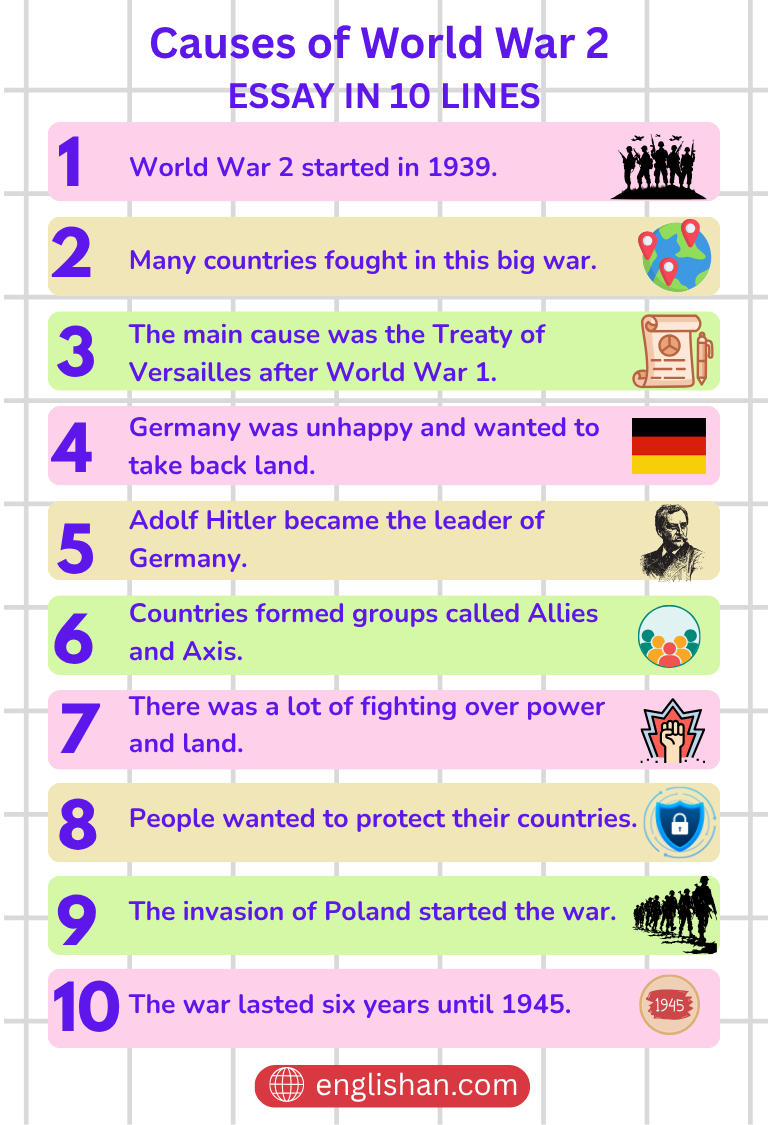
- World War 2 started in 1939.
- Many countries fought in this big war.
- The main cause was the Treaty of Versailles after World War 1.
- Germany was unhappy and wanted to take back land.
- Adolf Hitler became the leader of Germany.
- Countries formed groups called Allies and Axis.
- There was a lot of fighting over power and land.
- People wanted to protect their countries.
- The invasion of Poland started the war.
- The war lasted six years until 1945.
250 Words Essay on Causes of World War 2 for Middle School
World War 2 began in 1939 and lasted for six years. It was a global war involving many countries. Several causes led to this war, and understanding them helps us learn from history.
One important cause was the Treaty of Versailles, signed after World War 1. The treaty punished Germany by taking away its land and making it pay money. Many Germans were unhappy and wanted to regain their power and pride.
Adolf Hitler became the leader of Germany and promised to make the country strong again. He wanted to take back lost land and expand Germany’s borders. This created fear in other countries.
Two big groups were formed during the war: the Allies, including the United States, Britain, and the Soviet Union, and the Axis, led by Germany, Italy, and Japan. These alliances increased tensions.
Another cause was the invasion of Poland by Germany in 1939. This act made other countries declare war on Germany. The fight spread quickly around the world.
In conclusion, the Treaty of Versailles, Germany’s desire to regain power, Hitler’s leadership, alliances, and the invasion of Poland were major causes of World War 2. Learning about these causes helps us understand the importance of peace and cooperation.
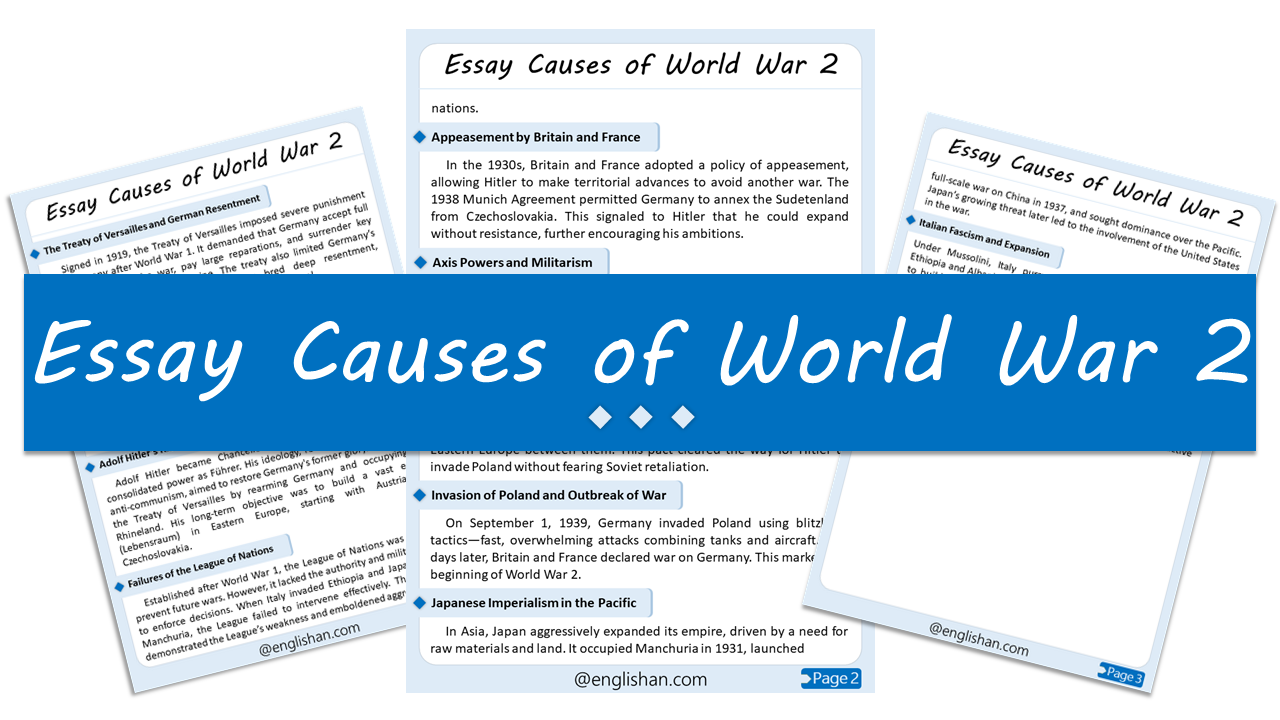
500 Words Causes of World War 2 Essay for Upper Primary and Lower Secondary
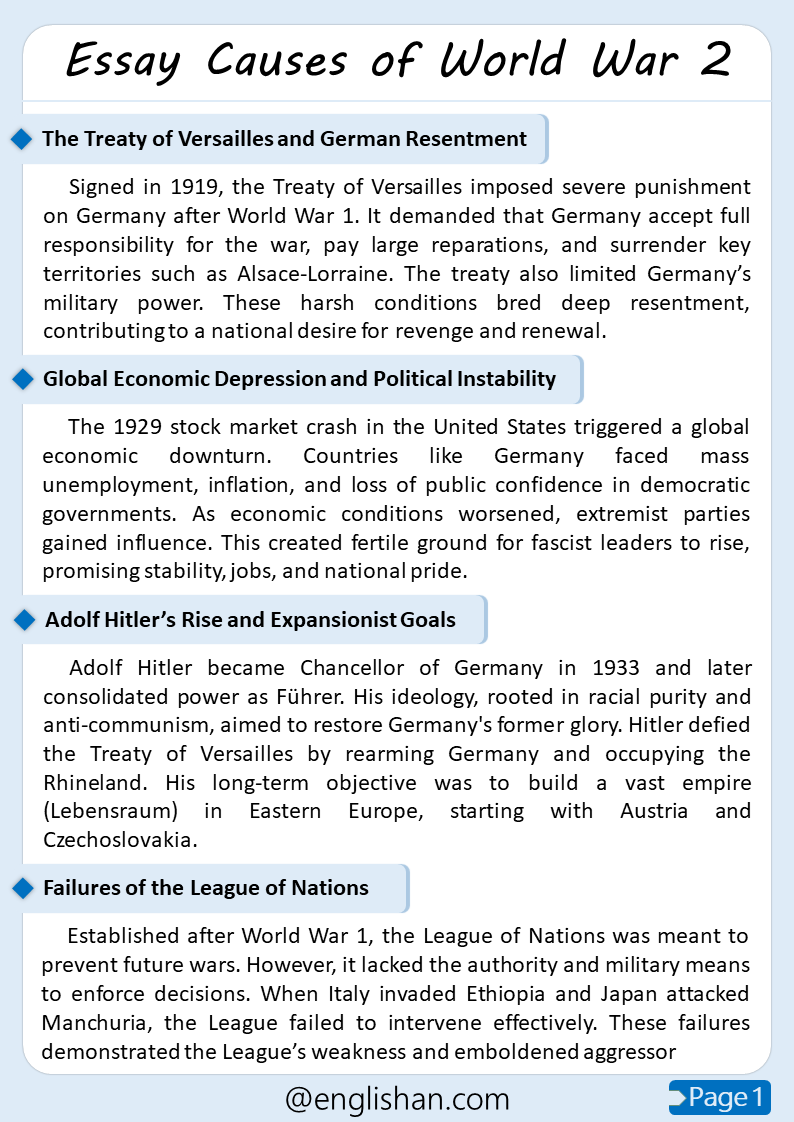
The Treaty of Versailles and German Resentment
Signed in 1919, the Treaty of Versailles imposed severe punishment on Germany after World War 1. It demanded that Germany accept full responsibility for the war, pay large reparations, and surrender key territories such as Alsace-Lorraine. The treaty also limited Germany’s military power. These harsh conditions bred deep resentment, contributing to a national desire for revenge and renewal.
Global Economic Depression and Political Instability
The 1929 stock market crash in the United States triggered a global economic downturn. Countries like Germany faced mass unemployment, inflation, and loss of public confidence in democratic governments. As economic conditions worsened, extremist parties gained influence. This created fertile ground for fascist leaders to rise, promising stability, jobs, and national pride.
Adolf Hitler’s Rise and Expansionist Goals
Adolf Hitler became Chancellor of Germany in 1933 and later consolidated power as Führer. His ideology, rooted in racial purity and anti-communism, aimed to restore Germany’s former glory. Hitler defied the Treaty of Versailles by rearming Germany and occupying the Rhineland. His long-term objective was to build a vast empire (Lebensraum) in Eastern Europe, starting with Austria and Czechoslovakia.
Failures of the League of Nations
Established after World War 1, the League of Nations was meant to prevent future wars. However, it lacked the authority and military means to enforce decisions. When Italy invaded Ethiopia and Japan attacked Manchuria, the League failed to intervene effectively. These failures demonstrated the League’s weakness and emboldened aggressor nations.
Appeasement by Britain and France
In the 1930s, Britain and France adopted a policy of appeasement, allowing Hitler to make territorial advances to avoid another war. The 1938 Munich Agreement permitted Germany to annex the Sudetenland from Czechoslovakia. This signaled to Hitler that he could expand without resistance, further encouraging his ambitions.
Axis Powers and Militarism
Germany, Italy, and Japan formed the Axis alliance, sharing interests in expansion and authoritarian rule. Each began increasing its military strength. Germany rebuilt its army, navy, and air force; Japan expanded its navy and invaded parts of China; Italy pursued African conquests. This arms buildup destabilized global peace.
Nazi-Soviet Non-Aggression Pact
In August 1939, Germany and the Soviet Union signed the Molotov-Ribbentrop Pact, agreeing not to attack each other and secretly dividing Eastern Europe between them. This pact cleared the way for Hitler to invade Poland without fearing Soviet retaliation.
Invasion of Poland and Outbreak of War
On September 1, 1939, Germany invaded Poland using blitzkrieg tactics—fast, overwhelming attacks combining tanks and aircraft. Two days later, Britain and France declared war on Germany. This marked the beginning of World War 2.
Japanese Imperialism in the Pacific
In Asia, Japan aggressively expanded its empire, driven by a need for raw materials and land. It occupied Manchuria in 1931, launched full-scale war on China in 1937, and sought dominance over the Pacific. Japan’s growing threat later led to the involvement of the United States in the war.
Italian Fascism and Expansion
Under Mussolini, Italy pursued its imperial ambitions by invading Ethiopia and Albania. Mussolini aligned Italy with Nazi Germany, hoping to build a new Roman Empire. Italian fascism, characterized by strict nationalism and suppression of opposition, contributed to the war’s spread across continents.
Conclusion
World War 2 was not triggered by a single cause but by a series of interconnected events. Economic hardship, political failures, aggressive ideologies, and international inaction allowed militaristic regimes to dominate. These factors combined to create one of the most destructive wars in human history.
Difficult Words Used in 500 Causes of World War 2 Essay
| Word | Meaning |
|---|---|
| Reparations | Money a defeated country pays for damage caused in war |
| Inflation | A rapid rise in prices, reducing currency value |
| Lebensraum | Hitler’s concept of “living space” for German expansion |
| Blitzkrieg | Military tactic involving sudden, overwhelming attacks |
| Fascism | Authoritarian system with nationalism and one-party rule |
| Annexation | Taking over a territory and adding it to another country |
| Appeasement | Giving in to demands to avoid conflict |
| Imperialism | Extending a country’s power through conquest |
| Authoritarian | Enforcing strict obedience at the cost of personal freedom |
| Expansionism | Policy of increasing national territory or influence |
Causes of World War 2 Essay PDF
You May Also Like