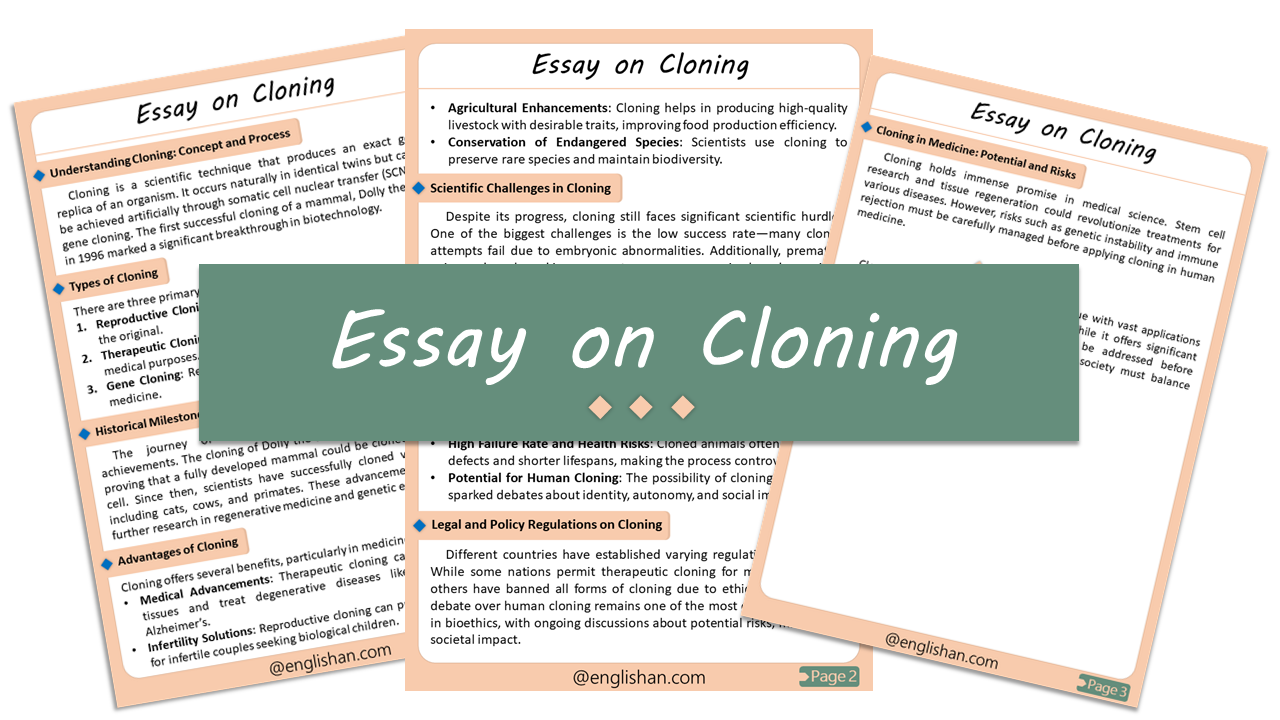
When writing about cloning, it’s important to understand how scientists create identical copies of living organisms. This essay on cloning explains the main types, common uses, benefits, risks, and ethical concerns. It’s written in 500 words to help students with homework or exams. You can download this cloning essay as a free PDF or image to study or print.
10 Lines Cloning Essay for Class 2 to Class 5
- Cloning means making a copy of a living thing.
- It is like creating a twin with the same genes.
- Scientists can clone plants, animals, and sometimes cells.
- Cloning helps in saving endangered animals.
- It can be used to grow healthy plants faster.
- Some people think cloning can help cure diseases.
- Cloning is still a new and tricky science.
- It raises questions about ethics and safety.
- Cloning does not always work perfectly.
- Learning about cloning helps us understand science better.

250 Words Essay on Cloning for Middle School
Cloning is a scientific process of creating an exact copy of a living organism. This means the new organism has the same genes as the original one. Scientists have been able to clone plants, animals, and cells to help in many areas of science and medicine.
One important use of cloning is to save endangered species. By cloning animals at risk of extinction, scientists hope to protect them and increase their numbers. Cloning also helps farmers by producing plants that grow faster and are more resistant to diseases.
In medicine, cloning may help cure diseases by creating tissues and organs for patients who need transplants. This could reduce the problem of organ shortages. However, cloning raises many ethical questions, such as the rights of cloned animals and people.
Cloning is not yet perfect. Sometimes, cloned animals do not survive or have health problems. Scientists are still working hard to improve the process and understand the risks involved.
In conclusion, cloning is an exciting but complex area of science. It has many benefits but also challenges and questions. Learning about cloning helps students understand genetics, biology, and the future possibilities in medicine and farming.
500 Words Cloning Essay for Upper Primary and Lower Secondary
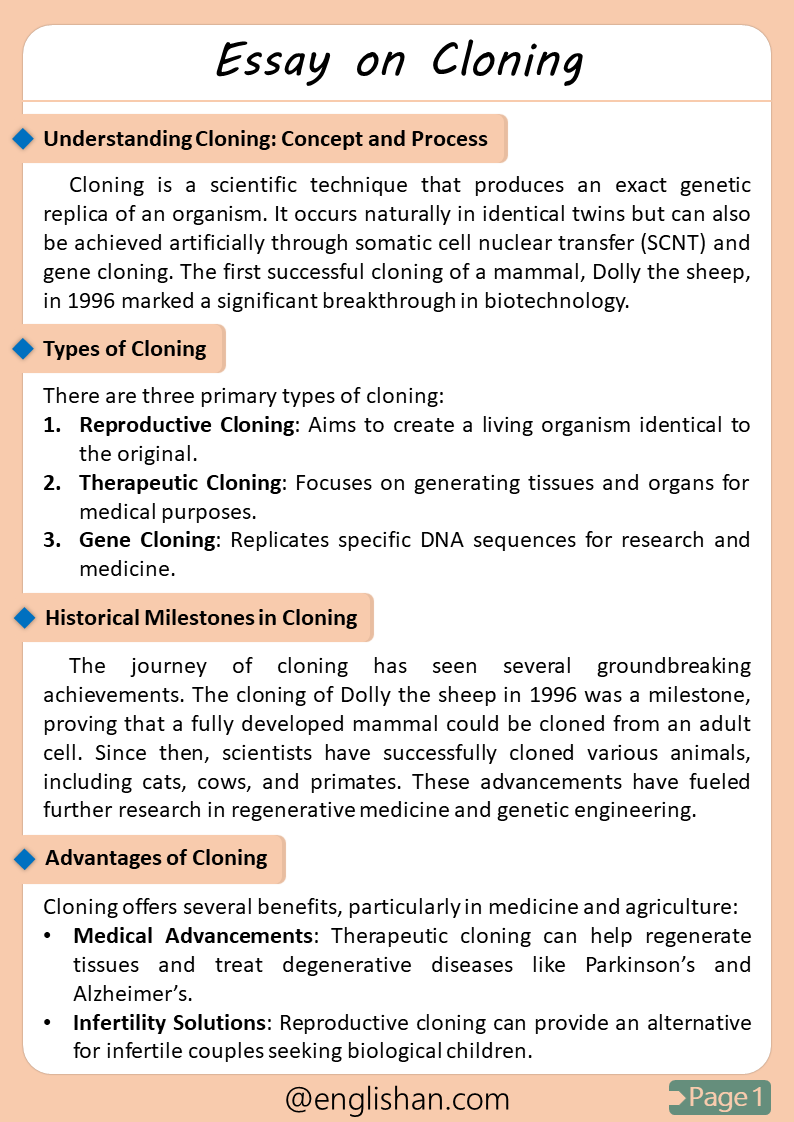
Understanding Cloning: Concept and Process
Cloning is a scientific technique that produces an exact genetic replica of an organism. It occurs naturally in identical twins but can also be achieved artificially through somatic cell nuclear transfer (SCNT) and gene cloning. The first successful cloning of a mammal, Dolly the sheep, in 1996 marked a significant breakthrough in biotechnology.
Types of Cloning
There are three primary types of cloning:
- Reproductive Cloning: Aims to create a living organism identical to the original.
- Therapeutic Cloning: Focuses on generating tissues and organs for medical purposes.
- Gene Cloning: Replicates specific DNA sequences for research and medicine.
Historical Milestones in Cloning
The journey of cloning has seen several groundbreaking achievements. The cloning of Dolly the sheep in 1996 was a milestone, proving that a fully developed mammal could be cloned from an adult cell. Since then, scientists have successfully cloned various animals, including cats, cows, and primates. These advancements have fueled further research in regenerative medicine and genetic engineering.
Advantages of Cloning
Cloning offers several benefits, particularly in medicine and agriculture:
- Medical Advancements: Therapeutic cloning can help regenerate tissues and treat degenerative diseases like Parkinson’s and Alzheimer’s.
- Infertility Solutions: Reproductive cloning can provide an alternative for infertile couples seeking biological children.
- Agricultural Enhancements: Cloning helps in producing high-quality livestock with desirable traits, improving food production efficiency.
- Conservation of Endangered Species: Scientists use cloning to preserve rare species and maintain biodiversity.
Scientific Challenges in Cloning
Despite its progress, cloning still faces significant scientific hurdles. One of the biggest challenges is the low success rate—many cloning attempts fail due to embryonic abnormalities. Additionally, premature aging and weakened immune systems are common in cloned organisms. Researchers continue to study ways to enhance cloning efficiency and reduce health risks associated with the process.
Ethical and Moral Concerns
Despite its benefits, cloning raises several ethical concerns:
- Loss of Genetic Diversity: Cloning reduces genetic variation, which is vital for species adaptation.
- Moral and Religious Objections: Many believe cloning interferes with natural life processes, raising ethical dilemmas.
- High Failure Rate and Health Risks: Cloned animals often suffer from defects and shorter lifespans, making the process controversial.
- Potential for Human Cloning: The possibility of cloning humans has sparked debates about identity, autonomy, and social implications.
Legal and Policy Regulations on Cloning
Different countries have established varying regulations on cloning. While some nations permit therapeutic cloning for medical research, others have banned all forms of cloning due to ethical concerns. The debate over human cloning remains one of the most contentious topics in bioethics, with ongoing discussions about potential risks, misuse, and societal impact.
Cloning in Medicine: Potential and Risks
Cloning holds immense promise in medical science. Stem cell research and tissue regeneration could revolutionize treatments for various diseases. However, risks such as genetic instability and immune rejection must be carefully managed before applying cloning in human medicine.
Conclusion
Cloning is a revolutionary scientific technique with vast applications in medicine, agriculture, and conservation. While it offers significant benefits, ethical and health concerns must be addressed before widespread adoption. As research progresses, society must balance innovation with ethical responsibility.
Difficult Words Used in 500 Cloning Essay
| Word | Meaning |
|---|---|
| Somatic Cell Nuclear Transfer (SCNT) | A cloning technique where a nucleus is transferred to an egg cell. |
| Biodiversity | Variety of life forms in an ecosystem. |
| Degenerative Diseases | Conditions causing gradual tissue or organ deterioration. |
| Genetic Variation | Differences in DNA among individuals of a species. |
| Ethical Dilemmas | Complex moral issues with no clear solution. |
| Stem Cell Research | Study of undifferentiated cells that can develop into various tissues. |
| Immune Rejection | The body’s defense system attacking transplanted or cloned tissues. |
Cloning Essay PDF
You May Also Like