

When writing about the joint family system, it’s important to understand how living together helps family members support and care for each other. This essay on the joint family system explains its meaning, benefits, challenges, and why it matters. It’s written in 500 words to help students with homework or exams. You can download this joint family system essay as a free PDF or image to study or print.
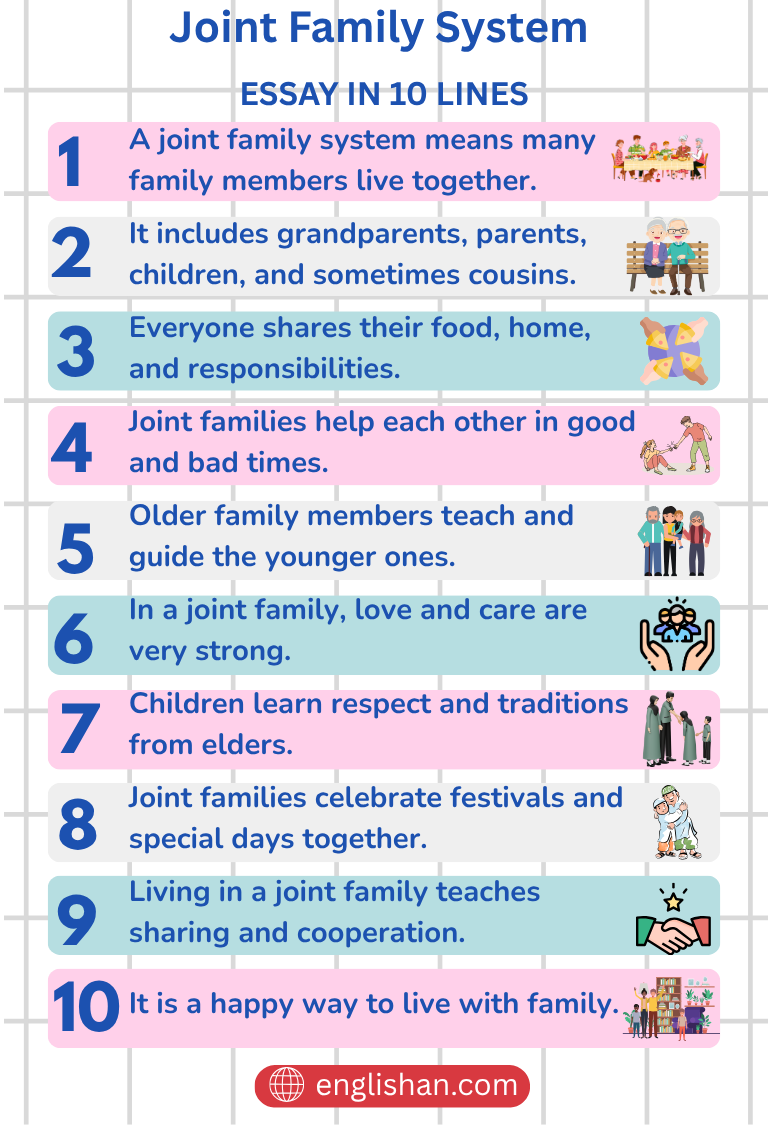
10 Lines Joint Family System Essay for Class 2 to Class 5
- A joint family system means many family members live together.
- It includes grandparents, parents, children, and sometimes cousins.
- Everyone shares their food, home, and responsibilities.
- Joint families help each other in good and bad times.
- Older family members teach and guide the younger ones.
- In a joint family, love and care are very strong.
- Children learn respect and traditions from elders.
- Joint families celebrate festivals and special days together.
- Living in a joint family teaches sharing and cooperation.
- It is a happy way to live with family.
250 Words Essay on Joint Family System for Middle School
The joint family system is a traditional way of living where many family members live together in one home. It usually includes grandparents, parents, children, uncles, aunts, and cousins. This system is common in many cultures and is known for its strong family bonds and support.
In a joint family, everyone shares food, chores, and responsibilities. The older members take care of the younger ones and guide them in life. This system helps create a loving and caring environment where members support each other during happy and difficult times.
Children in joint families learn important values like respect, cooperation, and sharing. They get to spend time with their grandparents and learn family traditions and stories. Celebrations and festivals become more joyful because the whole family joins in.
However, living in a joint family also requires patience and understanding since many people live together. Sometimes there may be disagreements, but family members work together to solve problems.
In today’s fast world, joint families are becoming less common as many people prefer to live separately. But the joint family system still teaches us the importance of love, unity, and helping one another.
In conclusion, the joint family system is a special way of living that brings family members closer and helps them support each other in life.
500 Words Joint Family System Essay for Upper Primary and Lower Secondary
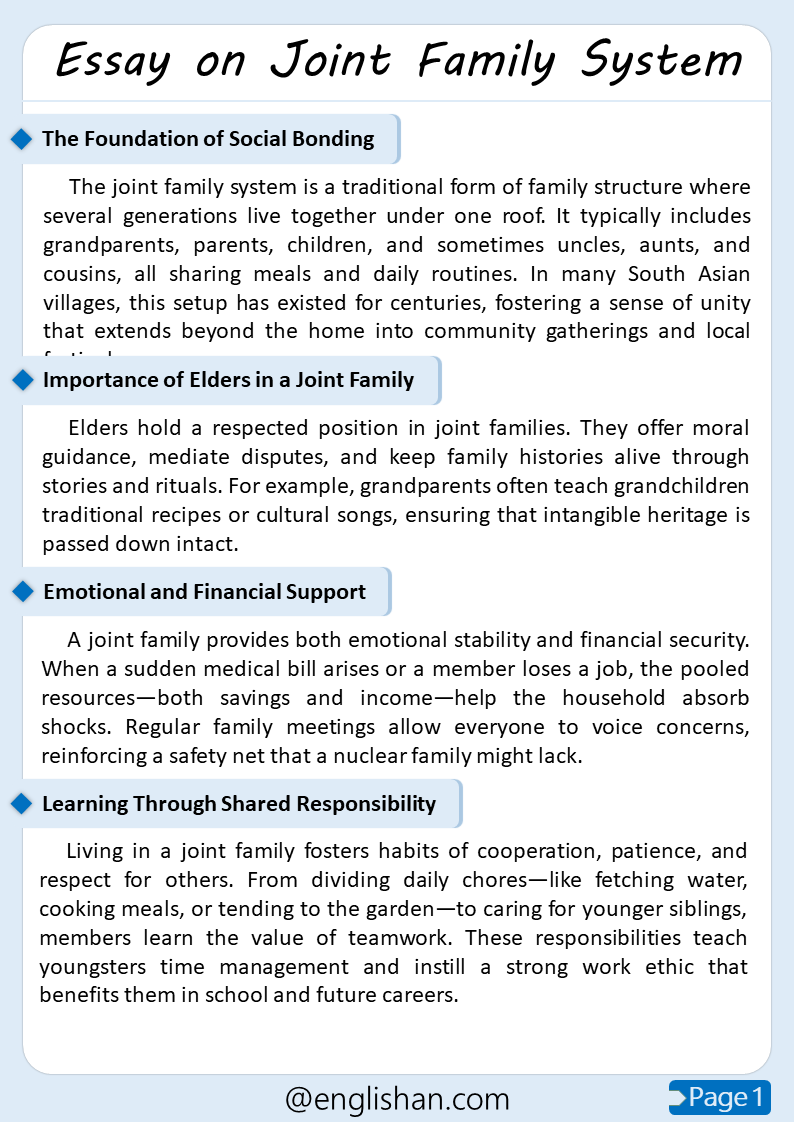
The Foundation of Social Bonding
The joint family system is a traditional form of family structure where several generations live together under one roof. It typically includes grandparents, parents, children, and sometimes uncles, aunts, and cousins, all sharing meals and daily routines. In many South Asian villages, this setup has existed for centuries, fostering a sense of unity that extends beyond the home into community gatherings and local festivals.
Importance of Elders in a Joint Family
Elders hold a respected position in joint families. They offer moral guidance, mediate disputes, and keep family histories alive through stories and rituals. For example, grandparents often teach grandchildren traditional recipes or cultural songs, ensuring that intangible heritage is passed down intact.
Emotional and Financial Support
A joint family provides both emotional stability and financial security. When a sudden medical bill arises or a member loses a job, the pooled resources—both savings and income—help the household absorb shocks. Regular family meetings allow everyone to voice concerns, reinforcing a safety net that a nuclear family might lack.
Learning Through Shared Responsibility
Living in a joint family fosters habits of cooperation, patience, and respect for others. From dividing daily chores—like fetching water, cooking meals, or tending to the garden—to caring for younger siblings, members learn the value of teamwork. These responsibilities teach youngsters time management and instill a strong work ethic that benefits them in school and future careers.
Impact on Children’s Development
Children in joint families interact with relatives of all ages, which accelerates their social skills. They learn conflict resolution by observing elder cousins or develop leadership when guiding younger siblings. Studies have shown that such children often display higher empathy scores and better group-work abilities in school settings.
Role of Women in Joint Families
Women often play a central role in maintaining harmony. Beyond household management, they organize festivals, coordinate family finances, and mentor younger women. In many households, mothers and aunts collaborate to start small home-based ventures—like handicrafts or tiffin services—demonstrating entrepreneurial spirit grounded in family support.
Conflict Resolution and Mediation
Joint families may face conflicts due to differing opinions and personalities. However, the presence of elders offers a structured mediation process: an elder might call a family council where each member speaks, and a consensus is reached. This model often resolves issues more sustainably than external arbitrators because it draws on shared history and mutual respect.
Cultural Celebrations and Collective Joy
Joint families actively participate in festivals, religious events, and weddings, turning ordinary rituals into grand celebrations. For instance, during Diwali, every generation contributes to decorating the house and preparing sweets. Such collective involvement not only lightens the workload but also deepens emotional bonds.
Challenges in Modern Times
Despite its advantages, the joint family system faces several challenges today. Urban apartments often lack space for large gatherings, and dual-career households struggle to find time for extended family activities. Moreover, younger members exposed to global media may adopt individualistic values, creating occasional friction over lifestyle choices.
Conclusion
The joint family system remains a symbol of cultural strength and emotional bonding. By adopting flexible arrangements—such as separate living quarters within a shared compound or rotational weekend visits—families can preserve core values while respecting privacy. Embracing technology, like family group chats and shared calendars, also helps modern joint families stay connected and organized.
Difficult Words Used in 500 Joint Family System Essay
| Word | Meaning |
|---|---|
| Generations | All of the people born and living around the same time within a family |
| Interconnected | Linked or related to each other |
| Stability | A condition of being steady and not changing |
| Nurturing | Providing care and encouragement for growth |
| Empathy | The ability to understand and share another person’s feelings |
| Accountability | Responsibility for one’s actions |
| Urbanization | Growth of cities and movement of people from rural to urban areas |
| Adaptation | Adjustment to new conditions |
Joint Family System Essay PDF
You May Also Like