

When writing about Malala Yousafzai, it’s important to understand how she stood up for girls’ education and inspired the world with her bravery. This essay on Malala Yousafzai explains her early life, her fight for education, the attack she survived, and her work through the Malala Fund. It’s written in 500 words to help students with homework or exams. You can download this Malala Yousafzai essay as a free PDF or image to study or print.
10 Lines Malala Yousafzai Essay for Class 2 to Class 5
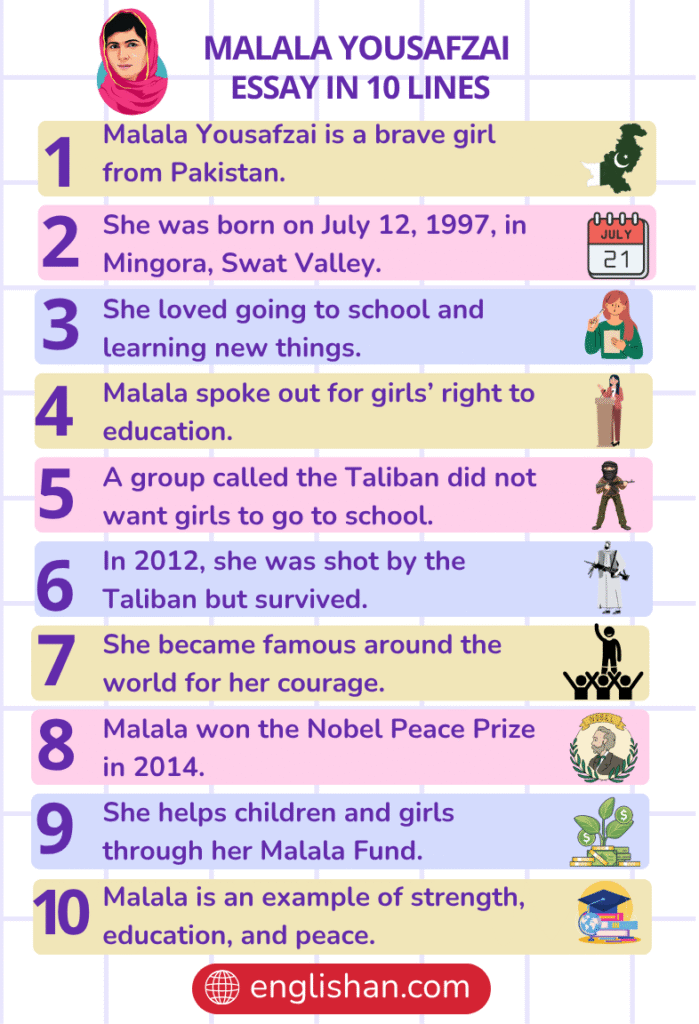
- Malala Yousafzai is a brave girl from Pakistan.
- She was born on July 12, 1997, in Mingora, Swat Valley.
- She loved going to school and learning new things.
- Malala spoke out for girls’ right to education.
- A group called the Taliban did not want girls to go to school.
- In 2012, she was shot by the Taliban but survived.
- She became famous around the world for her courage.
- Malala won the Nobel Peace Prize in 2014.
- She helps children and girls through her Malala Fund.
- Malala is an example of strength, education, and peace.
250 Words Essay on Malala Yousafzai for Middle School
Malala Yousafzai is a Pakistani girl who became known around the world for her brave stand for education. She was born on July 12, 1997, in the Swat Valley of Pakistan. From a young age, Malala loved school and wanted to learn. However, the Taliban, a militant group, tried to stop girls from going to school in her region.
Malala began speaking out publicly for girls’ education when she was just 11 years old. She wrote a blog for the BBC under a fake name, sharing the difficulties faced by girls. Her brave voice inspired many, but it also made her a target. In 2012, when she was only 15, Malala was shot in the head by a Taliban gunman while riding a school bus. She was badly injured but survived and was treated in the UK.
After her recovery, Malala continued to speak for children’s rights and girls’ education. In 2014, she became the youngest person ever to win the Nobel Peace Prize. She also started the Malala Fund, which supports education for girls all over the world.
Today, Malala is a symbol of courage and hope. She teaches us that education is a basic right for everyone, and that even a young voice can make a big difference. Her story inspires children everywhere to be brave and stand up for what is right.
500 Words Malala Yousafzai Essay for Upper Primary and Lower Secondary
Early Life and Background
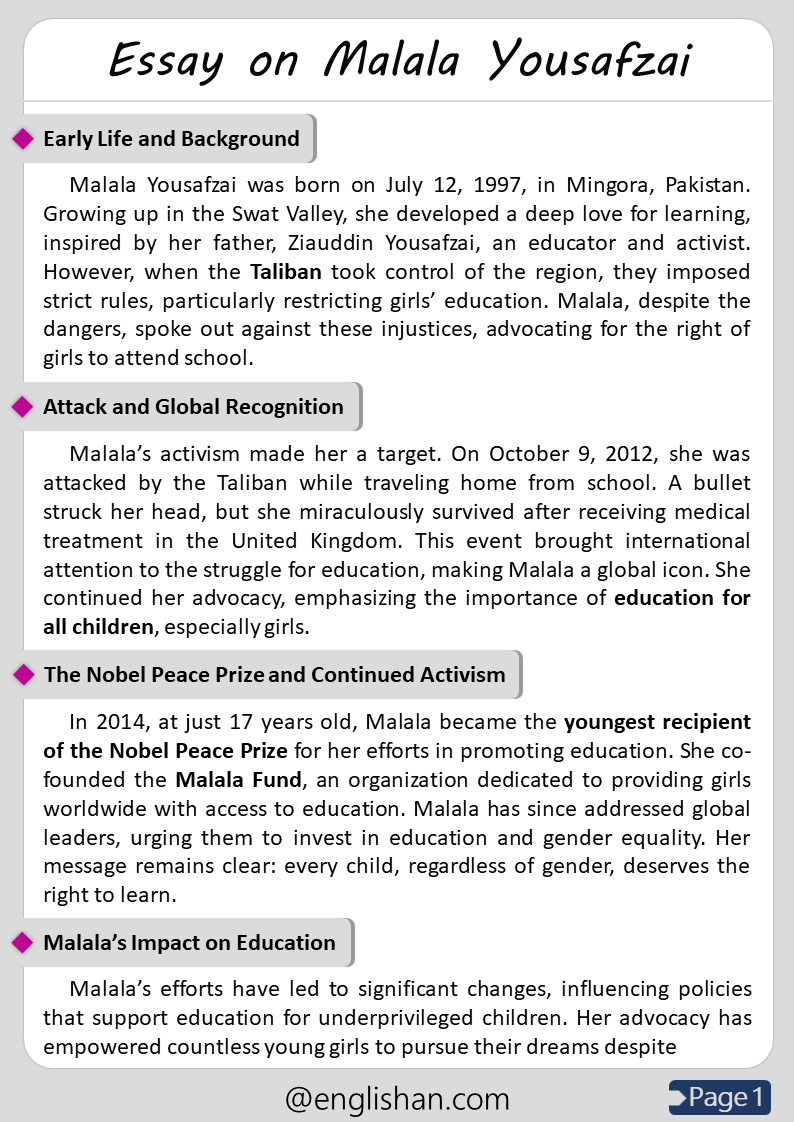
Malala Yousafzai was born on July 12, 1997, in Mingora, Pakistan. Growing up in the Swat Valley, she developed a deep love for learning, inspired by her father, Ziauddin Yousafzai, an educator and activist. However, when the Taliban took control of the region, they imposed strict rules, particularly restricting girls’ education. Malala, despite the dangers, spoke out against these injustices, advocating for the right of girls to attend school.
Attack and Global Recognition
Malala’s activism made her a target. On October 9, 2012, she was attacked by the Taliban while traveling home from school. A bullet struck her head, but she miraculously survived after receiving medical treatment in the United Kingdom. This event brought international attention to the struggle for education, making Malala a global icon. She continued her advocacy, emphasizing the importance of education for all children, especially girls.
The Nobel Peace Prize and Continued Activism
In 2014, at just 17 years old, Malala became the youngest recipient of the Nobel Peace Prize for her efforts in promoting education. She co-founded the Malala Fund, an organization dedicated to providing girls worldwide with access to education. Malala has since addressed global leaders, urging them to invest in education and gender equality. Her message remains clear: every child, regardless of gender, deserves the right to learn.
Malala’s Impact on Education
Malala’s efforts have led to significant changes, influencing policies that support education for underprivileged children. Her advocacy has empowered countless young girls to pursue their dreams despite societal and political challenges. Her influence contributed to the Right to Education Bill in Pakistan (2012), ensuring free education for children aged 5 to 16. Today, she continues to work on initiatives that ensure quality education for all, proving that one voice can spark a global movement.
Challenges and Criticism
Despite her global recognition, Malala has faced criticism from certain groups who view her activism as a political agenda. Some argue that Western nations have used her story for their own interests. However, Malala remains steadfast in her mission, focusing solely on education and empowerment.
Malala’s Influence on Youth
Malala has become a role model for young people worldwide. Her story teaches the importance of standing up for what is right, even in the face of danger. Many young activists have been inspired by her courage and have started their own initiatives for education and equality.
Malala’s Books and Speeches
Malala has authored several books, including ‘I Am Malala’, which details her journey and fight for education. She has also delivered powerful speeches at the United Nations, urging world leaders to take action. Her words continue to resonate with millions who believe in the power of education.
Malala’s Advocacy Beyond Education
Beyond education, Malala actively supports refugee rights, climate action, and gender equality. She collaborates with global organizations to create opportunities for marginalized communities, proving that education is the foundation for broader societal change.
The Role of Media in Malala’s Story
Media coverage played a significant role in amplifying Malala’s voice. Her story was shared worldwide, drawing attention to the struggles of girls’ education in conflict zones. The media’s support helped strengthen her influence and mobilize international support for her cause.
Future Aspirations
Malala continues her education at Oxford University while working towards global educational reforms. She envisions a world where every girl has access to quality education, free from oppression. Her efforts ensure that future generations will benefit from her legacy.
Conclusion of Malala Yousafzai Essay
Malala Yousafzai’s journey proves that one voice can inspire millions. Her relentless efforts continue to shape the future of education, empowering generations to come. She has transformed personal adversity into a worldwide campaign for education and gender equality. Her legacy serves as an inspiration for young people to stand up for their rights and pursue knowledge fearlessly. Malala’s journey reminds us that education is the key to empowerment and progress.
Difficult Words Used in 500 Malala Yousafzai Essay
| Word | Meaning |
|---|---|
| Resilience | The ability to recover quickly from hardships |
| Advocacy | Public support for a cause or policy |
| Underprivileged | Lacking basic needs or opportunities |
| Activism | Efforts to bring about social or political change |
| Icon | A widely recognized and admired person |
| Adversity | Difficulties or misfortunes |
| Gender Equality | The state of equal rights for all genders |
Malala Yousafzai Essay PDF
You May Also Like