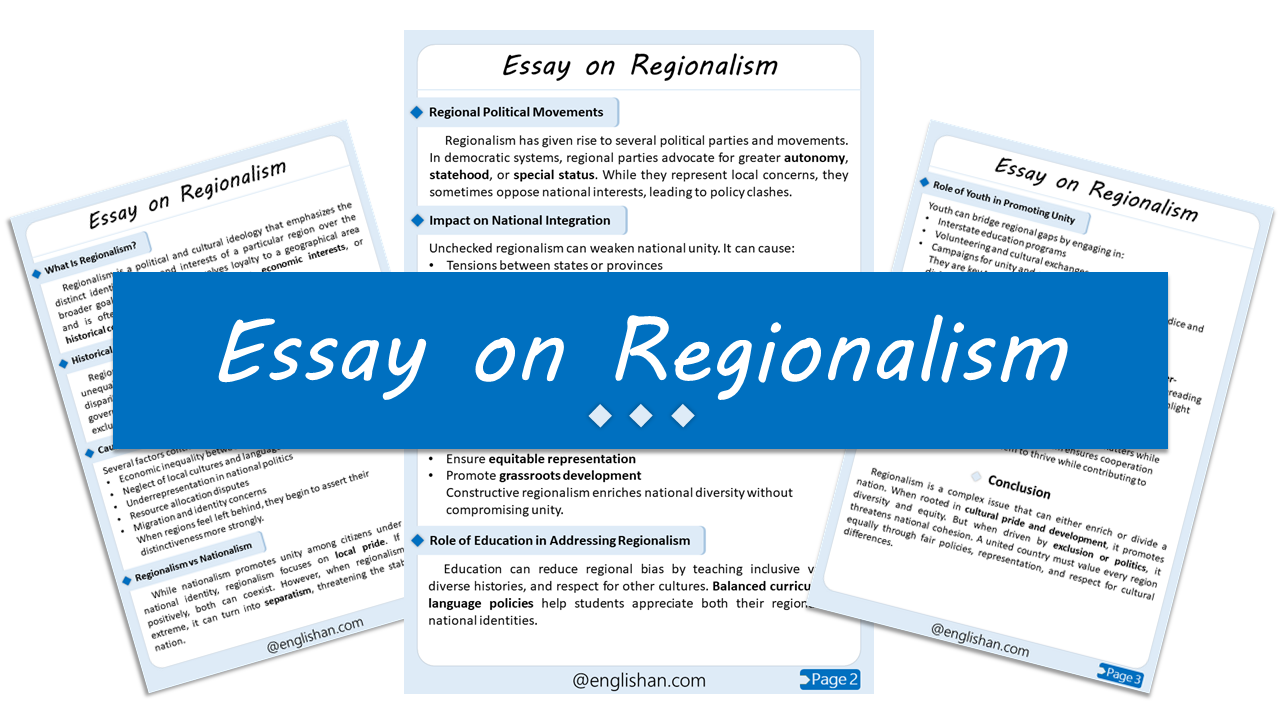
When writing about regionalism, it’s important to understand how people feel connected to their local culture, language, and traditions. This essay on regionalism explains what it means, its positive and negative effects, and why respecting all regions matters. It’s written in 500 words to help students with school projects, exams, or assignments. You can download this regionalism essay as a free PDF or image to study or print.
10 Lines Regionalism Essay for Class 2 to Class 5
- Regionalism means showing love and support for your own region or area.
- It can be seen in food, clothes, language, and traditions.
- People feel proud of their culture and hometown.
- Regional festivals bring people together with joy and unity.
- Sometimes, too much regionalism can cause fights or unfair treatment.
- It is important to respect all regions and their people.
- India has many regions with different cultures and languages.
- All regions are special and add to the country’s beauty.
- Good regionalism means celebrating differences and staying united.
- We should love our region but also respect others equally.

250 Words Essay on Regionalism for Middle School
Regionalism is the strong feeling of love and support for one’s own region, state, or local culture. It is a natural emotion where people feel proud of their language, traditions, food, festivals, and way of life. Every region has its own special identity, and people enjoy celebrating it.
In a country like India, which has many different states and cultures, regionalism is very common. People often show it through their clothing, language, music, and food. Celebrating regional festivals like Pongal, Bihu, or Onam helps people feel connected to their roots.
However, regionalism can become a problem when people think their region is better than others. This can lead to unfair treatment, arguments, or even fights between groups. It can harm national unity if people start caring only about their own region and ignore the rest of the country.
Positive regionalism means taking pride in your culture while also respecting others. It brings color and diversity to a country and helps people learn from one another. Schools, families, and communities should teach children to value every region equally.
In conclusion, regionalism is good when it helps people feel connected to their culture. But it should never lead to hate or division. A strong and happy country needs both local pride and national unity. Respecting all regions helps build peace and friendship.
500 Words Regionalism Essay for Upper Primary and Lower Secondary
What Is Regionalism?
Regionalism is a political and cultural ideology that emphasizes the distinct identity, needs, and interests of a particular region over the broader goals of the nation. It involves loyalty to a geographical area and is often rooted in language, culture, economic interests, or historical context.
Historical Development of Regionalism
Regionalism in many countries began during colonial rule, where unequal policies and administrative divisions created regional disparities. These imbalances continued after independence due to poor governance and centralized planning. Over time, this fostered a sense of exclusion in many regions.
Causes of Regionalism
Several factors contribute to the rise of regionalism:
- Economic inequality between regions
- Neglect of local cultures and languages
- Underrepresentation in national politics
- Resource allocation disputes
- Migration and identity concerns
When regions feel left behind, they begin to assert their distinctiveness more strongly.
Regionalism vs Nationalism
While nationalism promotes unity among citizens under a single national identity, regionalism focuses on local pride. If managed positively, both can coexist. However, when regionalism becomes extreme, it can turn into separatism, threatening the stability of the nation.
Regional Political Movements
Regionalism has given rise to several political parties and movements. In democratic systems, regional parties advocate for greater autonomy, statehood, or special status. While they represent local concerns, they sometimes oppose national interests, leading to policy clashes.
Impact on National Integration
Unchecked regionalism can weaken national unity. It can cause:
- Tensions between states or provinces
- Discrimination against people from other regions
- Social unrest and protests
Such situations harm internal harmony and delay national development.
Positive Aspects of Regionalism
Not all forms of regionalism are harmful. When expressed constructively, it can:
- Encourage cultural preservation
- Strengthen local governance
- Ensure equitable representation
- Promote grassroots development
Constructive regionalism enriches national diversity without compromising unity.
Role of Education in Addressing Regionalism
Education can reduce regional bias by teaching inclusive values, diverse histories, and respect for other cultures. Balanced curricula and language policies help students appreciate both their regional and national identities.
Role of Youth in Promoting Unity
Youth can bridge regional gaps by engaging in:
- Interstate education programs
- Volunteering and cultural exchanges
- Campaigns for unity and equality
They are key to creating an inclusive future, free of prejudice and division.
Role of Media and Technology
Media must avoid biased reporting and instead focus on inter-regional understanding. Technology can also unite regions by spreading awareness of development schemes and sharing stories that highlight unity.
Federalism as a Solution
A federal structure gives states control over local matters while maintaining a strong center. True federalism ensures cooperation between regions and allows them to thrive while contributing to national progress.
Conclusion of Regionalism Essay
Regionalism is a complex issue that can either enrich or divide a nation. When rooted in cultural pride and development, it promotes diversity and equity. But when driven by exclusion or politics, it threatens national cohesion. A united country must value every region equally through fair policies, representation, and respect for cultural differences.

Difficult Words Used in 500 Regionalism Essay
| Word | Meaning |
|---|---|
| Regionalism | Loyalty to a specific region rather than the nation as a whole |
| Disparity | A great difference or inequality |
| Separatism | Desire for a region to break away and become independent |
| Autonomy | Self-governance or independent control over one’s own affairs |
| Marginalization | Pushing a group to the edge of society with limited access or power |
| Federalism | A system where central and state governments share power |
| Cohesion | Unity or sticking together in harmony |
| Decentralized | Not concentrated in one central authority; spread across areas |
Regionalism Essay PDF
You May Also Like