When writing about the Uniform Civil Code, it’s important to understand how it aims to make personal laws equal for all citizens, no matter their religion. This essay on the Uniform Civil Code explains what it means, why it matters, the benefits, concerns, and its role in Indian society. It’s written in 500 words to help students with homework or exams. You can download this Uniform Civil Code essay as a free PDF or image to study or print.
10 Lines Uniform Civil Code Essay for Class 2 to Class 5
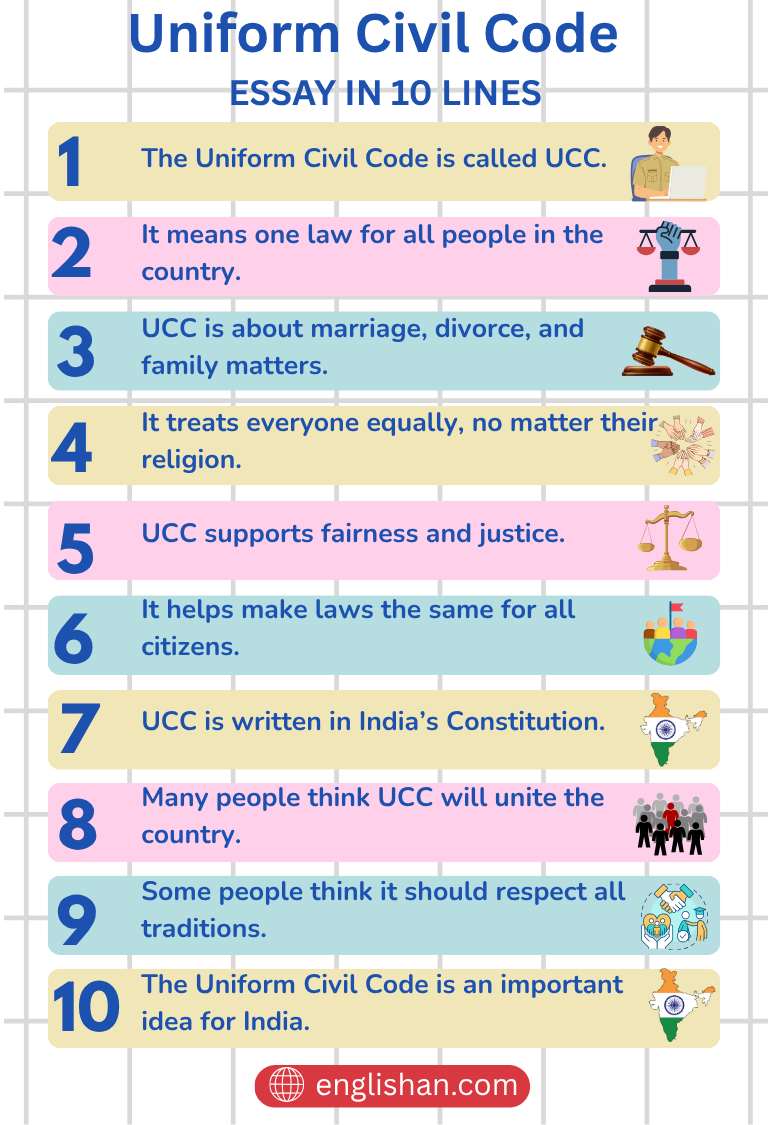
- The Uniform Civil Code is called UCC.
- It means one law for all people in the country.
- UCC is about marriage, divorce, and family matters.
- It treats everyone equally, no matter their religion.
- UCC supports fairness and justice.
- It helps make laws the same for all citizens.
- UCC is written in India’s Constitution.
- Many people think UCC will unite the country.
- Some people think it should respect all traditions.
- The Uniform Civil Code is an important idea for India.
250 Words Essay on Uniform Civil Code for Middle School
The Uniform Civil Code, or UCC, is a law idea in India that means all citizens should be treated the same in personal matters like marriage, divorce, inheritance, and adoption. Right now, different religious groups follow their own personal laws, but the UCC would make one law for everyone, no matter what religion they follow.
The main goal of the Uniform Civil Code is to give equal rights to all people. It is written in Article 44 of the Indian Constitution. The idea behind it is to treat everyone fairly and remove unfair rules that are different for different religions. For example, people from one religion might have a different rule about divorce than people from another religion. UCC wants to make these rules the same for everyone.
Many people support the Uniform Civil Code because they believe it will bring unity and equality. They say it will help women and other groups get fair treatment. But some people are worried that it might take away the traditions and beliefs of different communities. That is why there are different opinions about this law.
In conclusion, the Uniform Civil Code is an important idea that wants to make laws fair and equal for all. It can help the country become more united, but it is also important to respect people’s traditions and beliefs. Students should understand both sides of this topic to think clearly about fairness and equality.
500 Words Uniform Civil Code Essay for Upper Primary and Lower Secondary
Meaning of the Uniform Civil Code (UCC)
The Uniform Civil Code (UCC) is a proposed legal framework in India aimed at replacing personal laws based on religion with a unified set of civil laws. It seeks to create one set of laws governing personal matters such as marriage, divorce, adoption, and inheritance for all citizens, regardless of religion. The objective is to ensure legal equality and non-discrimination across communities.
Historical Context and Origins
The concept of UCC dates back to British colonial rule, where separate personal laws were maintained for different religious groups. Post-independence, Dr. B.R. Ambedkar strongly advocated for a common civil code to uphold constitutional values of equality and justice. However, due to opposition from religious groups, it was placed in the Directive Principles of State Policy rather than being made enforceable law.
Constitutional Provision for UCC
Article 44 of the Indian Constitution encourages the state to “secure for the citizens a uniform civil code throughout the territory of India.” Although not legally binding, this directive principle reflects the founding vision of a unified legal system that protects individual rights over community laws.
UCC and Secularism in India
India follows a unique model of secularism, where all religions are respected, but not separated from the state. The UCC supports this principle by ensuring that the same civil laws apply to all citizens, thereby reinforcing equal treatment and avoiding religious privilege under the law.
Social Benefits of UCC Implementation
UCC can simplify India’s complex legal system by removing overlapping and conflicting personal laws. It can strengthen national integration, promote gender justice, and reduce the burden on courts caused by contradictory legal claims. A unified system also promotes a stronger sense of citizenship identity.
UCC and Gender Equality
Many existing personal laws, especially in matters like triple talaq, property rights, and child custody, discriminate against women. A UCC would establish uniform standards that protect women’s rights, ensure equal inheritance, and promote fairness in family matters. This has been a strong argument from human rights and women’s organizations.
Legal Support from Indian Judiciary
Indian courts have repeatedly supported the implementation of UCC. In the Shah Bano case (1985), the Supreme Court ruled in favor of alimony rights for a Muslim woman under secular law, highlighting the need for a common civil code. Other verdicts have emphasized the urgency of legal reforms to uphold constitutional guarantees.
Public Resistance and Political Concerns
The UCC remains one of the most debated topics in Indian politics. Religious groups argue that it may interfere with their traditions and customs. Political parties have often used the issue to appeal to specific vote banks, resulting in polarized debates. The absence of consensus has hindered its nationwide application.
Examples from Indian States
The state of Goa is often cited as a working model of UCC in India. Here, a common civil code is applied to all communities with few exceptions. In 2024, Uttarakhand became the first Indian state to announce a draft UCC bill, inviting public opinion. These localized efforts could serve as pilot models for nationwide implementation.
Steps Toward National Consensus
Introducing UCC at a national level requires extensive public consultation, legal analysis, and socio-cultural sensitivity. A phased approach, beginning with less controversial areas such as property and adoption, could allow smoother adoption. Draft laws should reflect both constitutional values and community concerns.
International View on Uniform Civil Laws
Several democratic countries such as France, Turkey, and Japan have successfully implemented common civil codes without infringing on religious freedom. These models show that legal uniformity and religious freedom can co-exist when the law ensures basic human rights and fair governance.
Conclusion
The Uniform Civil Code offers a legal pathway toward ensuring equal rights and justice for all citizens. While challenges exist, especially regarding cultural diversity, the long-term advantages in terms of legal clarity, social justice, and constitutional integrity make it a goal worth striving for. With careful planning and inclusive discussion, UCC can lead India closer to true legal equality.

Difficult Words Used in 500 Uniform Civil Code Essay
| Word | Meaning |
|---|---|
| Inheritance | Receiving property or rights after someone’s death |
| Directive | An official instruction or order |
| Secularism | Equal treatment of all religions by the state |
| Discrimination | Unjust treatment based on identity or belief |
| Alimony | Financial support paid to a spouse after divorce |
| Custody | Legal right to take care of a child |
| Resistance | Opposition or unwillingness to accept change |
| Consensus | General agreement among a group |
| Citizenship | Legal membership and responsibilities in a country |
| Polarized | Divided into opposing groups or views |
Uniform Civil Code Essay PDF
You May Also Like
You May Also Like