A bee carries a compact yet highly specialized insect anatomy that supports flight, nectar collection, and hive defense. When you describe how it senses flowers, gathers pollen, or protects the colony, accuracy depends on knowing names like antennae, thorax, or stinger rather than relying on general wording.
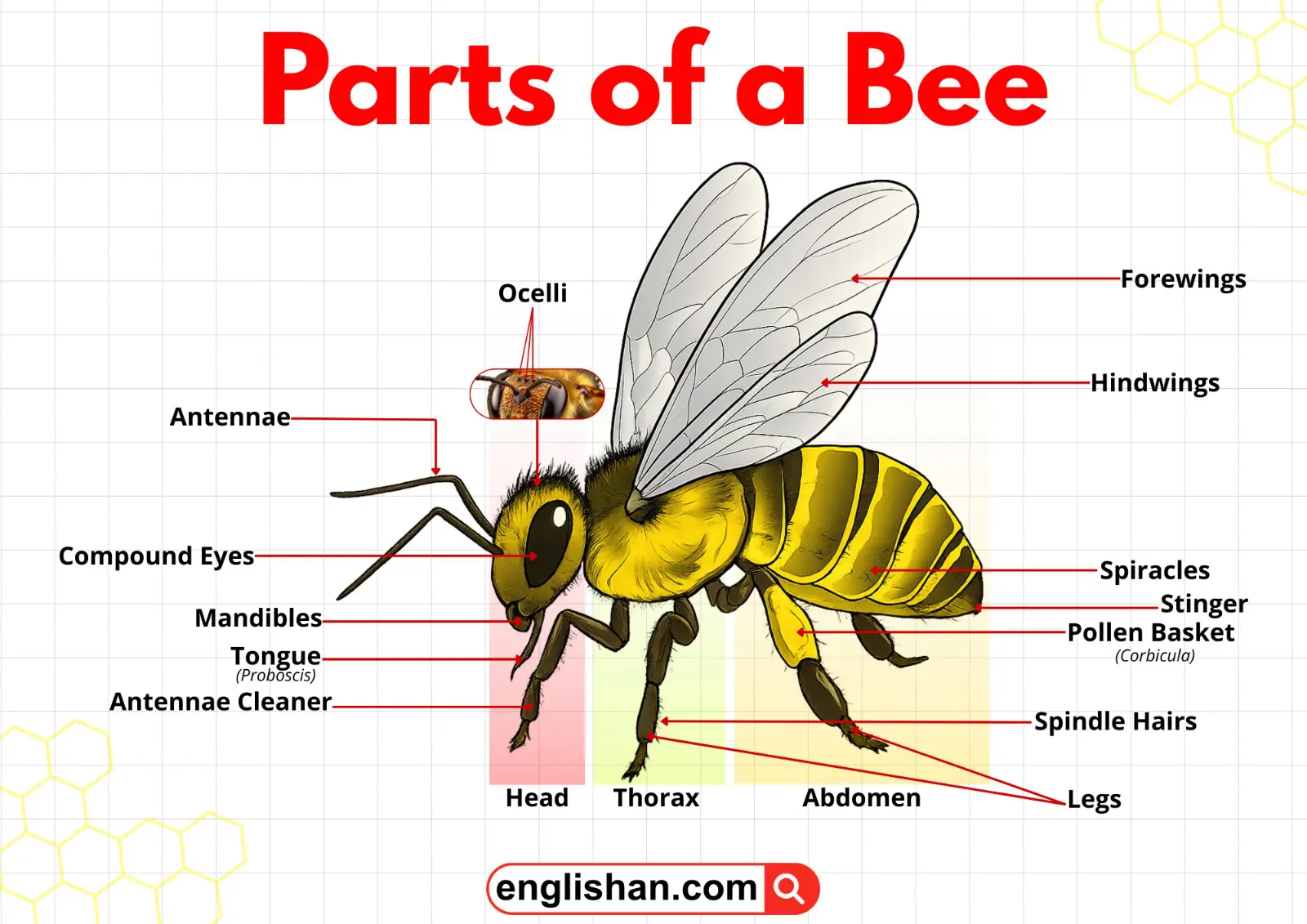
In this article, we break down the parts of a bee with focus on the common worker bee. The coverage moves through the head, compound eyes, antennae, proboscis, thorax, wings, legs, pollen baskets, abdomen, and stinger, noting key structural features. The labeled diagram below helps connect each name to its exact position on the body.
Complete List Of Bee Parts With Names
A bee’s body is divided into three main sections: the head, thorax, and abdomen. Each section carries specific organs and structures that allow the bee to sense, feed, move, gather pollen, breathe, and defend itself. Below is a complete list of bee parts arranged in natural body order from front to back.
- Head
- Antennae
- Compound Eye
- Ocelli
- Mandibles
- Tongue
- Thorax
- Forewing
- Hindwing
- Foreleg
- Middle Leg
- Hindleg
- Pollen Basket
- Pollen Press
- Antennae Cleaner
- Abdomen
- Spiracle
- Stinger
- Spindle Hair
Bee Parts Diagram With Names
A bee is a segmented insect built from three main body regions: the head, the thorax, and the abdomen. Each region contains specialized structures that support feeding, sensing, movement, respiration, and defense. Unlike simple insects, bees are highly adapted for pollen collection and flight. When observing a bee closely, its body shows a coordinated system of sensory organs, jointed appendages, and protective features working together for survival and pollination.
Bee Head Parts
The head houses the bee’s sensory organs and feeding structures. It controls perception, food collection, and interaction with the environment.
Head
The head forms the forward body segment and supports sensory and mouth structures. It provides attachment for antennae and eyes while housing the brain. It connects directly to the thorax through a narrow flexible joint.
Antennae
The antennae function as primary sensory organs. They detect:
- Smell
- Touch
- Air vibration
- Chemical signals
These segmented structures project forward from the upper portion of the head.
Compound Eye
The compound eyes consist of thousands of tiny lenses called ommatidia. They provide wide-angle vision and motion detection, helping bees navigate and locate flowers. These large eyes occupy the sides of the head.
Ocelli
The ocelli are three small simple eyes that detect light intensity. They assist with orientation and flight stability, particularly in bright daylight. They are positioned on the top surface of the head.
Mandibles
The mandibles are strong jaw-like structures used for cutting, shaping wax, and handling materials. They assist in:
- Building honeycomb
- Defending the colony
- Manipulating food
They operate at the front of the mouth opening.
Tongue
The tongue, also called the proboscis, is a flexible feeding organ used to collect nectar. It extends outward to draw liquid from flowers. When not in use, it folds beneath the head.
Bee Thorax And Wing Parts
The thorax powers movement. It contains the muscles that control wings and legs.
Thorax
The thorax is the central body segment that supports locomotion. It contains strong flight muscles and attachment points for wings and legs. It connects the head to the abdomen.
Forewing
The forewings are the larger pair of wings responsible for generating lift. They beat rapidly to sustain flight and are connected to powerful thoracic muscles. They attach along the upper sides of the thorax.
Hindwing
The hindwings are the smaller rear pair that link to the forewings during flight. Together, they create coordinated lift and stability. They are positioned just behind the forewings.
Bee Leg Parts
Bees have three pairs of jointed legs attached to the thorax. Each pair serves a slightly different function.
Foreleg
The forelegs assist in cleaning antennae and manipulating food. They contain specialized structures for grooming. These legs attach near the front of the thorax.
Middle Leg
The middle legs support walking and stabilization. They help balance the body during movement and landing.
Hindleg
The hindlegs are highly specialized for pollen collection in worker bees. They provide:
- Pollen transport
- Surface cleaning
- Stability during landing
They attach toward the rear section of the thorax.
Pollen Basket
The pollen basket, also called the corbicula, is a flattened area on the hind leg. It stores collected pollen during foraging trips.
Pollen Press
The pollen press compacts pollen into firm pellets before storage in the pollen basket.
Antennae Cleaner
The antennae cleaner is a small notch-like structure on the foreleg. It removes dust and debris from the antennae to maintain sensory accuracy.
Bee Abdomen Parts
The abdomen contains digestive, respiratory, and defensive systems. It is flexible and segmented, allowing expansion and movement.
Abdomen
The abdomen forms the rear body section. It houses internal organs responsible for digestion, reproduction, and respiration. It connects behind the thorax.
Spiracle
Spiracles are small breathing openings along the abdomen. They allow air to enter the respiratory system through internal air tubes called tracheae.
Stinger
The stinger is a defensive structure derived from a modified ovipositor in worker bees. It injects venom during defense. It is located at the tip of the abdomen.
Spindle Hair
Spindle hairs cover the bee’s body and assist in pollen collection. Their branched structure allows pollen grains to cling during flower visits.
Key Takeaways
A bee functions as a segmented insect system where the head manages sensing and feeding, the thorax powers flight and leg movement, and the abdomen supports respiration and defense. Wings generate lift through thoracic muscle action, legs collect and transport pollen, and sensory organs guide navigation. Though size and features vary among species, all bee parts work together to support pollination, survival, and colony activity.
You May Also Like