A compass is a simple yet very useful tool that helps us find direction. It has several important parts that work together to show north, south, east, and west. From the magnetic needle that points toward north to the rotating dial and baseplate used for navigation, each component plays a specific role. In this article, we’ll explore the different parts of a compass and understand how each one helps us navigate and find our way.
List of Compass Parts With Names
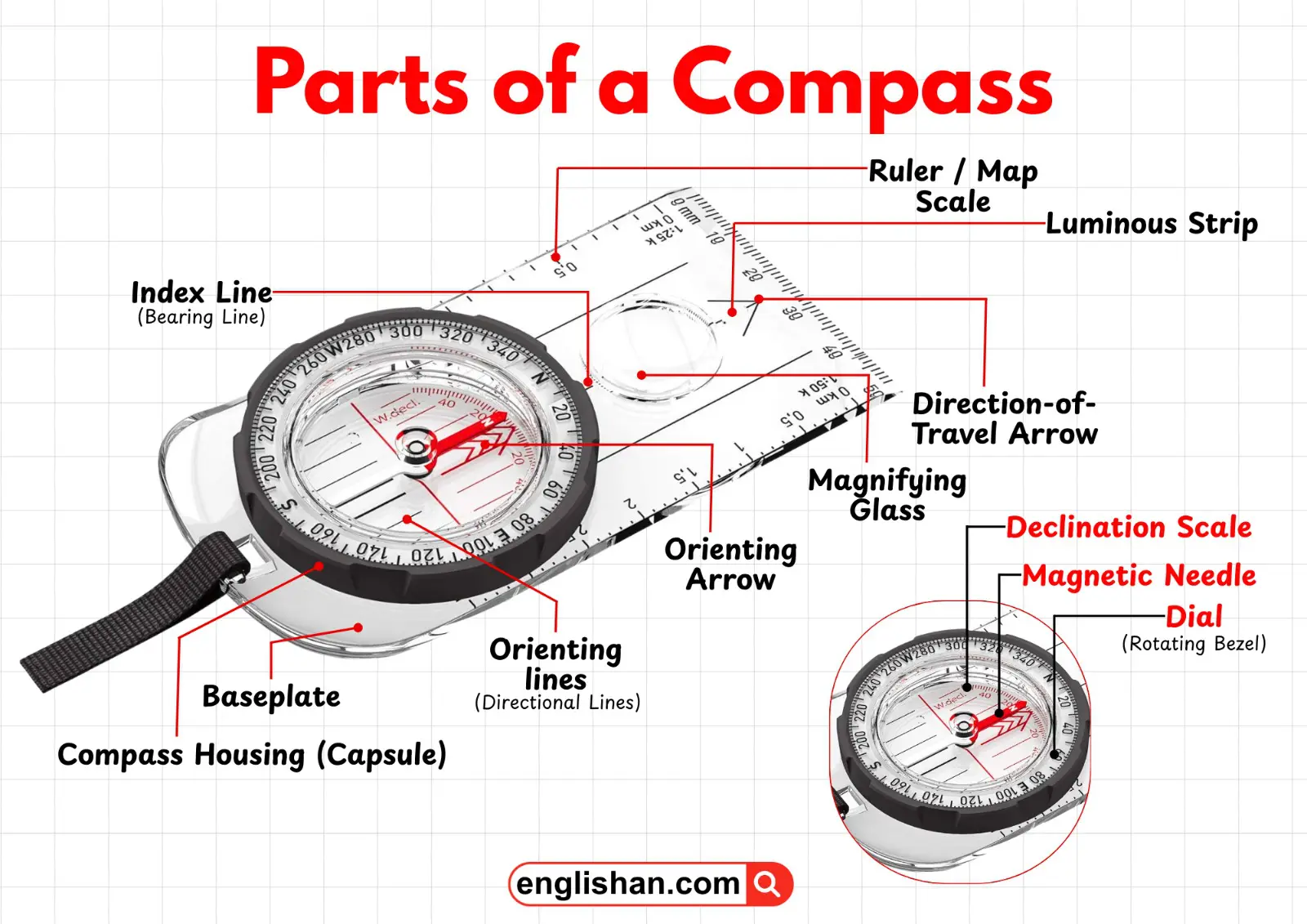
- Scales / Rulers
- Direction of Travel Arrow
- Declination Scale
- Rotating Bezel
- Housing
- Orienteering Lines
- Bearing (Index) Line
- Orienteering Arrow
- Magnetic Needle
- Base Plate
Parts of a Compass Diagram With Names
A compass is a handy tool that helps us find directions and navigate with ease. The magnetic needle always points toward the north, making it the most important part of a compass. The rotating dial or bezel shows the 360-degree markings, helping users measure angles and bearings accurately. The baseplate provides support and often includes rulers or scales for map reading. Some compasses also have a sighting mirror or magnifier to improve precision. Each part, from the needle to the baseplate, works together to ensure accurate navigation and makes finding your way simple and reliable.
External Structure (Body & Measurement Parts)
Scales / Rulers
Scales or rulers are marked with measurement lines printed along the edges of the base plate. They allow users to measure distances directly on a map using different units such as centimeters, millimeters, or map scales (e.g., 1:25,000 or 1:50,000). These markings help hikers and navigators calculate real-world distances accurately and plan routes efficiently.
Base Plate
The base plate is the flat, transparent foundation of the compass. It supports all other components and allows the user to see the map underneath while navigating. Its clear design makes it easy to align the compass with map features, draw routes, and maintain precise directional readings.
Housing
The housing is the circular capsule that contains the magnetic needle and liquid inside the compass. It protects sensitive internal components from damage while allowing smooth needle movement. The liquid filling reduces vibration and stabilizes the needle for faster and more accurate readings.
Rotating Bezel
The rotating bezel is the movable circular ring around the housing marked with degrees from 0° to 360°. Users rotate it to set a desired bearing or direction. Once aligned properly, it helps maintain consistent navigation by allowing the user to follow a fixed heading.
Navigation & Direction Guides
Direction of Travel Arrow
The direction of travel arrow is a large arrow printed on the base plate pointing away from the compass. It indicates the direction you should physically move once the compass is aligned. This arrow acts as the final guide for walking toward your chosen destination.
Bearing (Index) Line
The bearing or index line is a fixed reference line used to read the exact degree measurement from the rotating bezel. When a bearing is set, the number aligned with this line represents the direction of travel in degrees.
Orienteering Lines
Orienteering lines are parallel lines printed inside the compass housing. They help align the compass with the north–south grid lines on a map. Proper alignment ensures accurate navigation between the map and real-world terrain.
Orienteering Arrow
The orienteering arrow is located inside the housing and usually points toward north on the compass dial. When setting a bearing, the magnetic needle must align with this arrow (“put red in the shed”). This alignment ensures correct directional orientation.
Magnetic & Adjustment Components
Magnetic Needle
The magnetic needle is the most important moving part of the compass. It is magnetized and automatically aligns itself with Earth’s magnetic field, pointing toward magnetic north. One end is typically colored red to clearly indicate the north direction.
Declination Scale
The declination scale allows users to adjust for the difference between magnetic north and true north, known as magnetic declination. By setting the correct declination value for a location, navigators can achieve more accurate map readings and prevent directional errors.
Key Takeaway
As we learned, a compass works by combining a stable physical structure, precise directional guides, and a magnetic needle that aligns with Earth’s magnetic field. Each part plays a specific role, from measuring distances and setting bearings to aligning with maps, allowing users to navigate accurately and confidently in outdoor environments.
You May Also Like