A boat carries movement and control across water, and its form is understood through the words used to describe it. When you talk about boating, prepare for lessons, or follow explanations about watercraft, the right terms help keep every detail grounded, from the outer shell in the water to the working areas above it.
In this blog post, we explain the parts of a boat, starting with the hull and moving through the bow, stern, deck, keel, rudder, propeller, mast, and cabin. We focus on the most common small boats first, since names can shift by type. The labeled diagram that follows helps connect each word to its exact place.
List of Parts of a Boat
- Hull
- Keel
- Bilge
- Bow
- Stern
- Transom
- Port Side
- Starboard Side
- Midships
- Gunwales
- Deck
- Foredeck
- Aft Deck
- Bow Pulpit
- Handrails
- Cleats
- Fender
- Forward Hatch
- Anchor
- Anchor Chain
- Windlass
- Mooring Line
- Mast
- Navigation Mast
- Antenna
- Flag Staff
- Sidelights
- Sternlight
- All-Round White Light
- Cabin
- Cockpit
- Helm
- Steering Wheel
- Throttle Control
- Instrument Panel
- Windshield
- Seats
- Storage Locker
- Fuel Tank
- Fuel Line
- Engine
- Propeller
- Propeller Shaft
- Rudder
- Bilge Pump
- Drain Plug
- Ladder
- Swim Platform
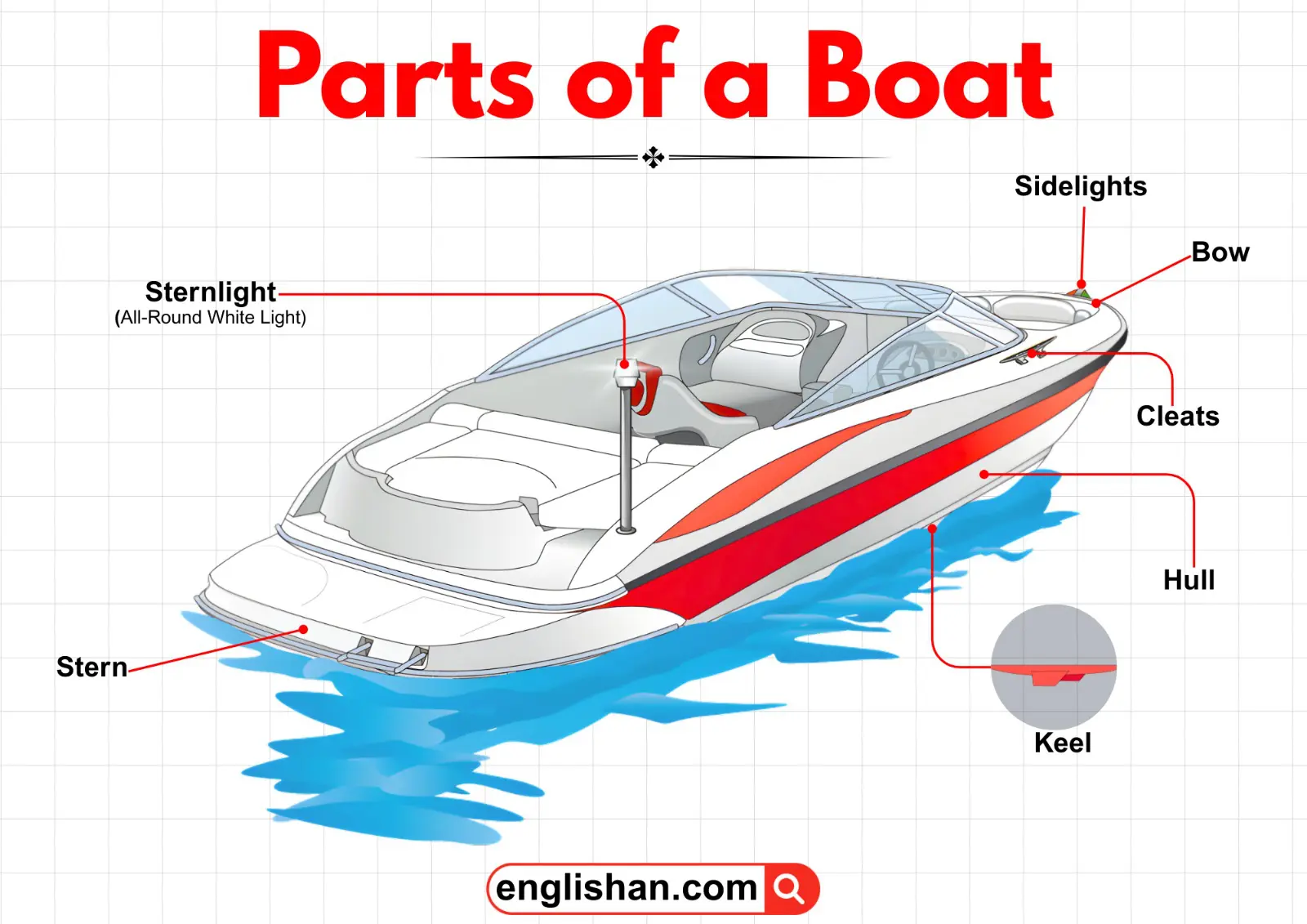
Boat Parts Diagram With Names
A boat is a floating craft where each visible section has a fixed name and position. From the bottom of the hull to the lights mounted above deck level, every part sits in a known place and plays a role in balance, movement, or safety on water.
Hull And Bottom
The hull and bottom form the floating body of the boat. These parts stay in constant contact with water and support all other structures.
Hull
The hull is the main outer body that stays in the water. It provides:
- Buoyancy that keeps the boat afloat
- Shape that affects water movement
- Support for the deck and fittings above
Keel
The keel runs along the center of the bottom, from front to back. It helps by:
- Keeping the boat upright
- Reducing side slip
- Improving straight tracking
Bilge
The bilge is the lowest inside area of the hull. Water collects here because:
- It sits below all other interior spaces
- Gravity directs water downward
Bow And Front Deck
These parts are located at the front of the boat and support forward movement and anchoring.
Bow
The bow is the front end of the boat. Its shape:
- Meets the water first
- Helps the boat cut through waves
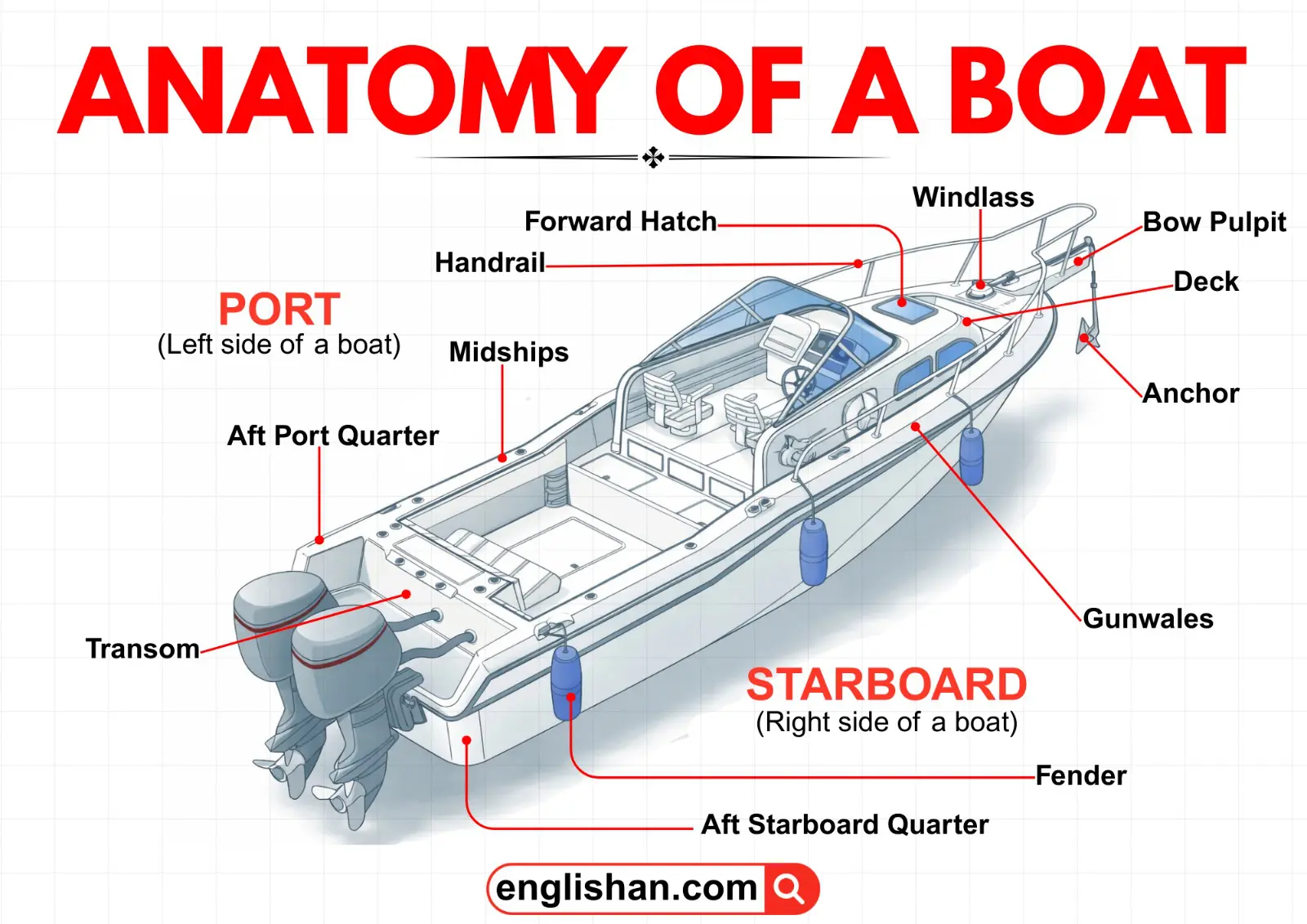
Bow Pulpit
The bow pulpit is a raised rail structure at the front deck edge. It is used for:
- Supporting safety rails
- Handling the anchor
Deck
The deck is the flat surface on top of the hull. It allows:
- Walking space for people
- Placement of equipment
Forward Hatch
A forward hatch is an opening in the front deck. It provides:
- Access to interior spaces
- Ventilation below deck
Anchor
The anchor is stored at the bow, close to the waterline. It is used to:
- Hold the boat in position
- Prevent drifting
Windlass
The windlass is mounted on the front deck near the anchor. It:
- Lowers the anchor
- Raises the anchor using power
Stern And Rear
These parts sit at the back of the boat and relate to structure and mounting points.
Stern
The stern is the rear end of the boat. It:
- Follows water flow
- Supports steering and propulsion fittings
Transom
The transom is the flat rear surface of the hull. It is used for:
- Mounting outboard motors
- Attaching ladders or fittings
Sides And Positions
These terms describe directional positions on a boat and are used for navigation and communication.
Port
Port means the left side of the boat when facing forward.
Starboard
Starboard means the right side of the boat when facing forward.
Midships
Midships refers to the middle section of the boat, between bow and stern.
Aft Port Quarter
The aft port quarter is the rear left section, close to the stern.
Aft Starboard Quarter
The aft starboard quarter is the rear right section, near the stern.
Edges And Hardware
These parts are fixed along deck edges and hull sides to support handling and protection.
Gunwales
Gunwales form the upper edges of the hull sides. They:
- Strengthen the hull
- Support mounted hardware
Cleats
Cleats are fixed on the deck or gunwales. They are used to:
- Tie ropes
- Secure the boat
Handrail
Handrails run along deck edges and cabin sides. They provide:
- Support while moving
- Added safety
Fender
Fenders hang along the sides near the hull. They:
- Cushion contact with docks
- Protect the hull surface
Lights
Boat lights are mounted above deck level and at the stern for visibility.
Sidelights
Sidelights are placed on the port and starboard sides near the bow. They:
- Show direction of travel
- Indicate boat orientation
Sternlight
The sternlight is mounted at the rear of the boat, facing backward. It:
- Makes the stern visible at night
All-Round White Light
The all-round white light is positioned high on the boat, often on a pole. It:
- Shines in all directions
- Signals the boat’s presence
Boat Key Takeaways
A boat works as a floating structure where bottom parts support buoyancy, front parts manage movement and anchoring, rear parts define structure, side positions guide direction, deck hardware supports handling, and lights provide visibility. The hull carries the load, the keel steadies motion, and fittings along the deck manage control and safety. Some variation exists in layout and size, and we summarize the parts of a boat as a connected layout that supports controlled movement on water.