Butterflies are one of the most beautiful and fascinating insects in nature. From their colorful wings to their delicate bodies, every part of a butterfly has a special purpose. In this article, we will explore all the main parts of a butterfly, understand what each part does, and see how they work together to help the butterfly fly, feed, and survive. Whether you are a student, nature lover, or just curious, this article will make it easy to understand butterfly anatomy.
List Of Butterfly Parts With Names
- Head
- Antennae
- Compound eyes
- Proboscis
- Thorax
- Foreleg
- Midleg
- Hind leg
- Abdomen
- Spiracle
- Wings
- Forewing
- Hind wing
- Wing veins
Butterfly Parts Diagram With Names
A butterfly’s body is a delicate and highly specialized system made up of three main segments: the head, thorax, and abdomen, along with two pairs of wings. The head contains sensory organs like the antennae and compound eyes, which help the butterfly navigate and locate food. The thorax is the central hub for movement, supporting the forelegs, midlegs, hind legs, and wing attachments, allowing flight and mobility. The abdomen houses vital organs and spiracles, which facilitate respiration. Every part works together to ensure balance, efficient movement, and survival in its environment.
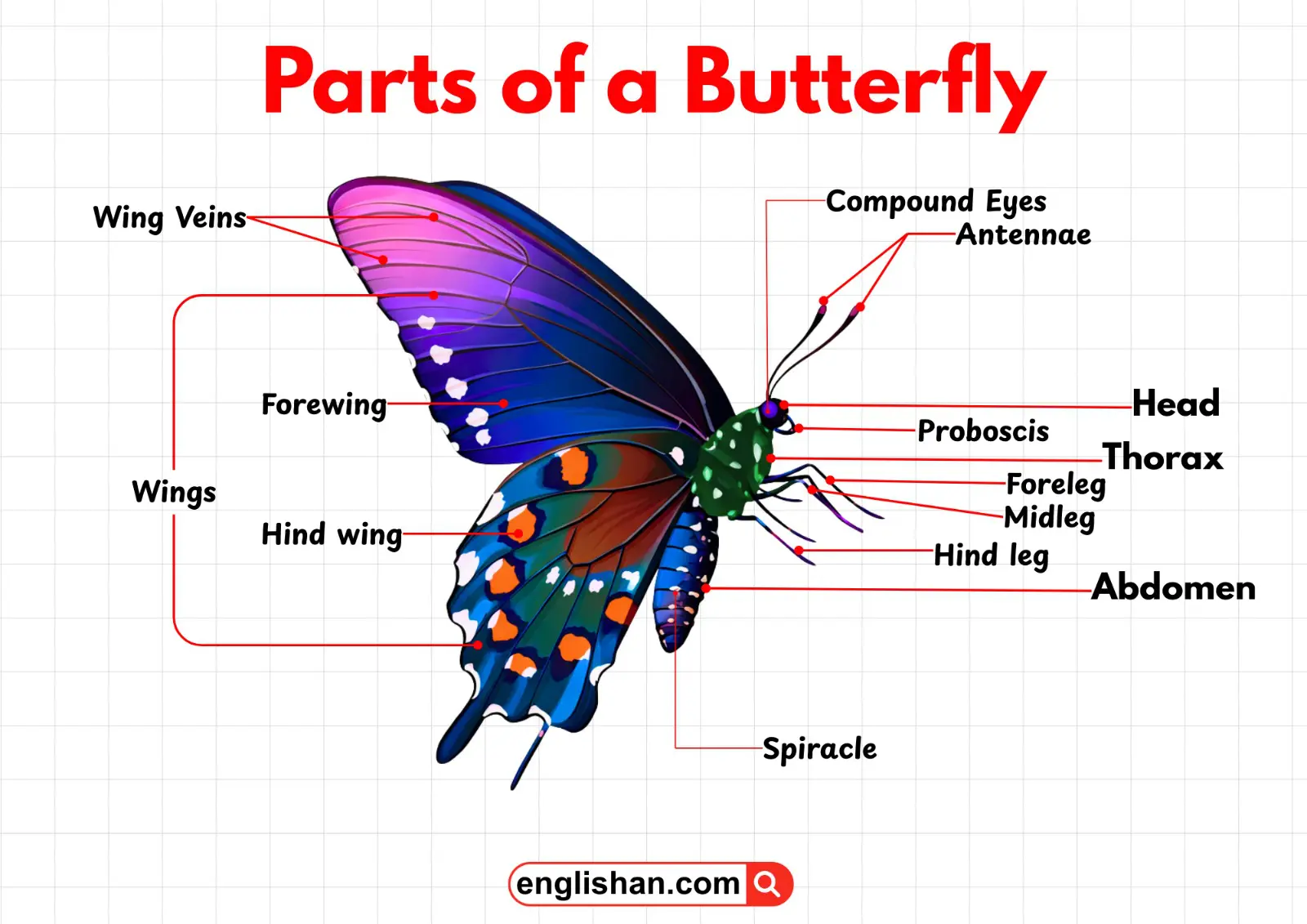
Head
The head is the sensory and feeding center of a butterfly. It is small but packed with organs that allow the butterfly to perceive its surroundings and consume food efficiently.
Antennae
Antennae are long, slender, and segmented structures projecting from the head. They function like the butterfly’s nose and balance tool combined. These organs detect scents, pheromones released by other butterflies, and even changes in humidity or wind direction. Covered with tiny sensory hairs, antennae are vital for navigation, mating, and finding flowers or host plants for laying eggs.
Compound eyes
Compound eyes are made up of thousands of tiny lenses called ommatidia. Each lens captures a small portion of the visual field, allowing butterflies to see movement and colors in a mosaic-like vision. This helps them avoid predators, locate flowers, and identify mates. They can see ultraviolet patterns on flowers that humans cannot, which guides them directly to nectar.
Proboscis
The proboscis is a long, coiled feeding tube that works like a straw. When not in use, it coils neatly under the head. During feeding, it extends to sip nectar from deep inside flowers. Some butterflies also use it to drink water or absorb minerals from damp soil (a behavior called puddling). Its flexibility and length make it a highly specialized feeding tool.
Thorax
The thorax is the muscular middle section of the butterfly, connecting the head to the abdomen. It contains strong muscles that power the wings and legs, enabling flight and movement.
Foreleg
The forelegs are the front pair of legs attached to the thorax. In some species, these legs are shorter and not used for walking but contain sensory hairs to taste surfaces. This helps the butterfly determine whether a plant is suitable for laying eggs or feeding.
Midleg
The midlegs, attached in the middle segment of the thorax, assist in walking and clinging to surfaces. They provide stability when the butterfly rests or moves on leaves and flowers.
Hind leg
The hind legs are the rear pair and are generally stronger, giving additional support and balance. Together with the other legs, they allow the butterfly to hold onto uneven surfaces, perch safely, and adjust its posture while feeding.
Abdomen
The abdomen is the segmented rear section of the butterfly and contains most of the internal organs for digestion, reproduction, and respiration.
Spiracle
Spiracles are tiny openings located along the sides of the abdomen. They are the entry points to the butterfly’s tracheal system, which carries oxygen directly to the tissues. By opening and closing these spiracles, butterflies can regulate airflow and prevent water loss, which is critical for survival.
Wings
Butterfly wings are large, flat structures that provide lift, enable flight, and serve as communication tools through color and pattern.
Forewing
The forewings are the front pair of wings, generally larger and more rigid. They provide the primary lift and help steer the butterfly in flight. Forewings often display striking patterns that can camouflage the butterfly or warn predators of toxicity.
Hind wing
The hind wings are located behind the forewings. They stabilize the butterfly during flight and allow precise maneuvers. When at rest, hind wings often cover the forewings partially, protecting them from damage.
Wing veins
Wing veins are the rigid, branching lines visible on the wings. They serve multiple functions: providing structural support, carrying hemolymph (insect blood), and sometimes regulating heat. Veins also create patterns that can help with species identification and predator deterrence.
Key Takeaway
Every part of a butterfly’s anatomy is exquisitely adapted for survival. The head senses the environment and feeds, the thorax powers movement, the abdomen supports vital life functions, and the wings enable flight, communication, and protection. Together, these systems allow butterflies to navigate, find food, reproduce, and thrive in diverse habitats.
You May Also Like