A sword may appear as a single blade and handle, yet each section plays a role in balance, grip, and striking control. When you describe how a weapon is held, how force travels through the blade, or how guard and grip protect the hand, the discussion weakens if the proper names are missing.
In this article, we break down the parts of a sword using traditional European designs as reference. The coverage includes the blade, edge, fuller, tip, ricasso, guard, grip, pommel, and tang, while noting that styles vary across cultures. The labeled diagram below helps connect each name to its exact position.

Sword Parts Diagram With Names
A sword is a bladed weapon engineered for balance, leverage, and controlled force delivery. Its structure is divided into the hilt for grip and control, the blade for cutting and thrusting, and the scabbard for protection. Every component contributes to weight distribution, impact resistance, and handling stability. When force is applied through the grip, it transfers through the tang into the blade, where geometry and edge structure determine performance.
Sword Hilt Parts
The hilt forms the control assembly of the sword. It anchors the blade to the hand while protecting the fingers during offensive and defensive movements. A well-constructed hilt improves balance, shock absorption, and directional precision.

Grip
The grip provides the surface where the hand applies force and control. It is shaped for secure handling and often wrapped in leather, cord, or textured material to prevent slipping during motion. A properly formed grip enhances:
- Hand stability during swings
- Control during thrusts
- Comfort during extended use
It encloses the tang and forms the central holding section of the hilt.
Pommel
The pommel acts as a counterweight and structural anchor. It balances the forward mass of the blade and locks the hilt assembly together. Beyond balance, it contributes to:
- Improved point control
- Shock distribution after impact
- Reinforcement of the tang connection
It secures the end of the tang at the rear of the hilt.
Guard
The guard separates the blade from the grip and prevents opposing blades from sliding toward the hand. It serves both protective and structural roles. A strong guard provides:
- Hand protection during contact
- Lateral stability
- Defensive leverage
It forms the barrier between blade base and grip.
Crossguard
The crossguard extends outward from the center of the hilt, forming a horizontal protective bar. It deflects incoming strikes and can trap an opponent’s blade during close engagement. Its design supports:
- Blade redirection
- Defensive spacing
- Controlled parrying
It spans across the front of the grip.
Quillon
Quillons are the projecting arms of the crossguard. They may curve or remain straight depending on design style. Their structure enhances:
- Opponent blade control
- Defensive leverage
- Structural rigidity
They extend outward from each side of the guard.
Basket Guard
A basket guard encloses the hand with a metal framework. It offers expanded protection beyond a simple crossguard, especially in close combat. This design increases:
- Full hand coverage
- Finger safety
- Defensive security
It surrounds the grip area within the hilt assembly.
Sword Blade Parts
The blade is the functional striking component. Its shape, thickness, and edge geometry determine cutting efficiency and thrusting precision.

Point
The point is shaped to concentrate force during thrusts. Its taper and symmetry influence penetration and accuracy. A well-forged point improves:
- Target precision
- Controlled entry
- Structural durability
It forms the tapered termination of the blade.
Edge
The edge is the sharpened portion responsible for cutting. Its bevel angle and finish affect slicing performance and durability. A properly honed edge provides:
- Clean cutting action
- Efficient force transfer
- Consistent sharpness
It runs along one or both sides of the blade length.
False Edge
The false edge is a partially sharpened section along the upper blade near the tip. It increases cutting surface during reverse or thrust motions. This feature enhances:
- Tip cutting performance
- Secondary slicing ability
It appears along the spine side near the blade’s forward end.
Spine
The spine is the thick, unsharpened back of the blade. It provides rigidity and structural strength, preventing excessive flex under stress. A solid spine supports:
- Impact resistance
- Blade stability
- Weight distribution
It runs opposite the primary cutting edge.
Fuller
The fuller is a longitudinal groove forged into the blade. It reduces weight while maintaining structural strength, improving balance and handling speed. The fuller contributes to:
- Efficient weight reduction
- Balanced mass distribution
- Controlled swing momentum
It extends along the flat surface of the blade.
Ricasso
The ricasso is the unsharpened section between the blade edge and the guard. It allows closer grip control in certain techniques and reinforces the blade’s base. It supports:
- Transition strength
- Enhanced grip options
- Structural stability
It lies directly above the guard.
Tang
The tang is the internal extension of the blade that forms the core of the hilt assembly. It determines the overall strength and reliability of the sword. A full tang ensures:
- Secure hilt construction
- Improved balance
- Greater durability
It passes through the grip and connects to the pommel.
Sword Scabbard Parts
The scabbard protects the blade from environmental damage and prevents unintended injury during transport. It also stabilizes the sword when worn.
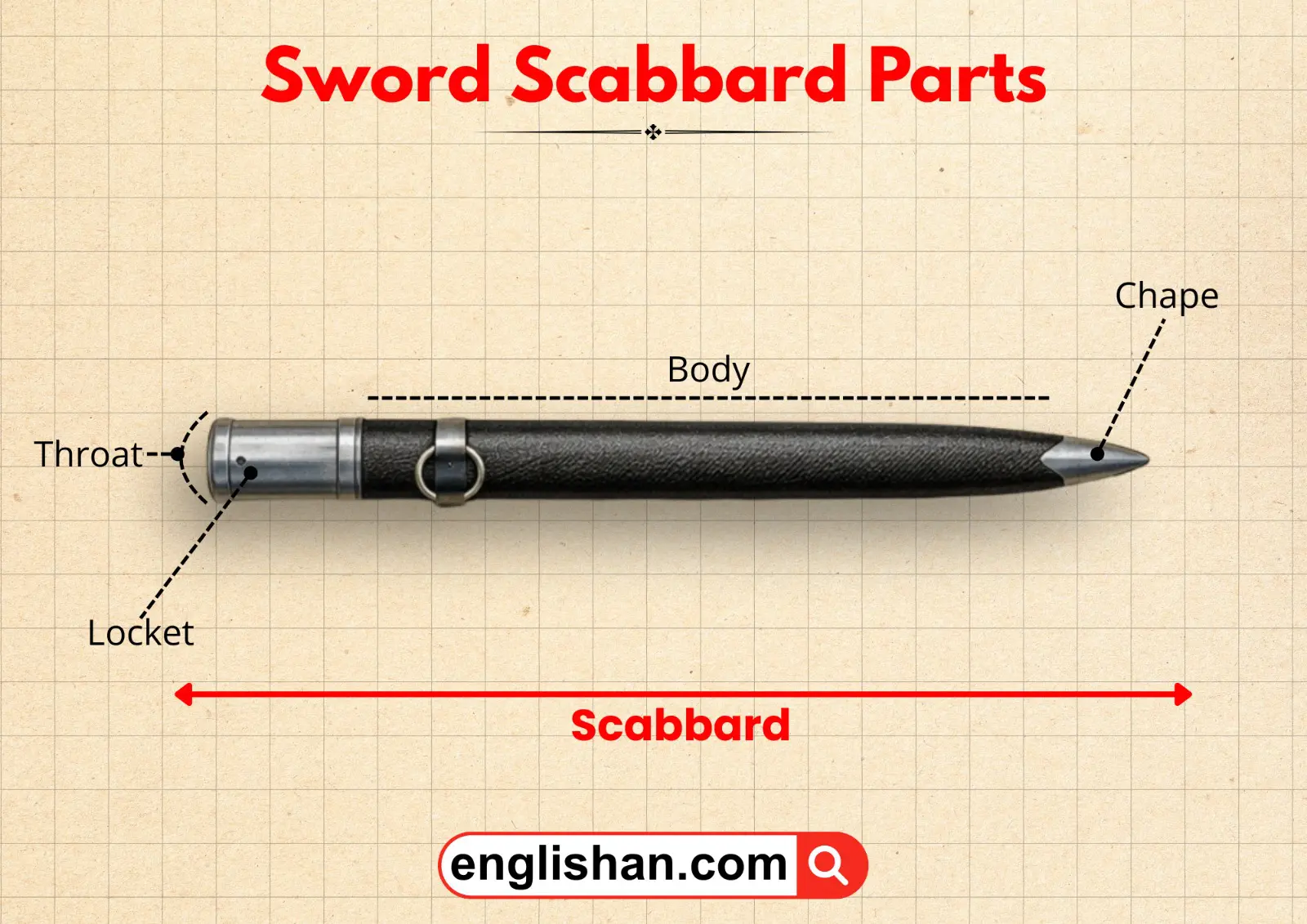
Scabbard
The scabbard encloses the blade when not in use. It shields the edge from moisture and abrasion while preserving sharpness. It provides:
- Safe storage
- Blade protection
- Carry stability
It houses the blade along its full length.
Throat
The throat reinforces the entry point of the scabbard. It prevents wear during repeated drawing and sheathing. This fitting improves:
- Smooth blade insertion
- Structural reinforcement
It forms the opening of the scabbard.
Locket
The locket strengthens the upper scabbard and connects to suspension hardware. It supports:
- Secure belt attachment
- Upper scabbard durability
It is mounted near the scabbard opening.
Chape
The chape protects the lower end of the scabbard from impact. It adds:
- End reinforcement
- Surface durability
It caps the tip of the sheath.
Frog
The frog is the attachment that secures the scabbard to a belt. It allows angled carrying and stable positioning during movement. It provides:
- Secure suspension
- Controlled draw angle
It connects the scabbard to the wearer’s belt system.
Key Takeaways
A sword functions as a balanced weapon system where the hilt provides grip and protection, the blade delivers cutting and thrusting force, and the scabbard ensures safe storage and transport. Force transfers from the hand through the tang into the blade, where edge geometry and structural features control performance. Though designs vary across historical forms, all sword parts work together to maintain balance, durability, and controlled strike capability.
You May Also Like