People online sometimes talk about someone who follows the crowd or reacts in predictable ways. It describes behavior that feels automatic or unoriginal.
The term comes from gaming: non playable character. It describes someone scripted, unaware, or stuck on repeat. The tone can be joking, critical, or ironic, depending on context. It carries social commentary rather than literal meaning.
This guide explains npc meaning across memes, comments, and videos, with examples. By the end, you will know when it is humor versus criticism and never misread the intent.
What Does NPC Mean?
The slang term NPC describes a person who supposedly lacks independent thought or originality. It suggests that the individual simply follows trends and repeats popular opinions without questioning them, much like a background character in a video game. Users call others this to imply they are predictable and boring.
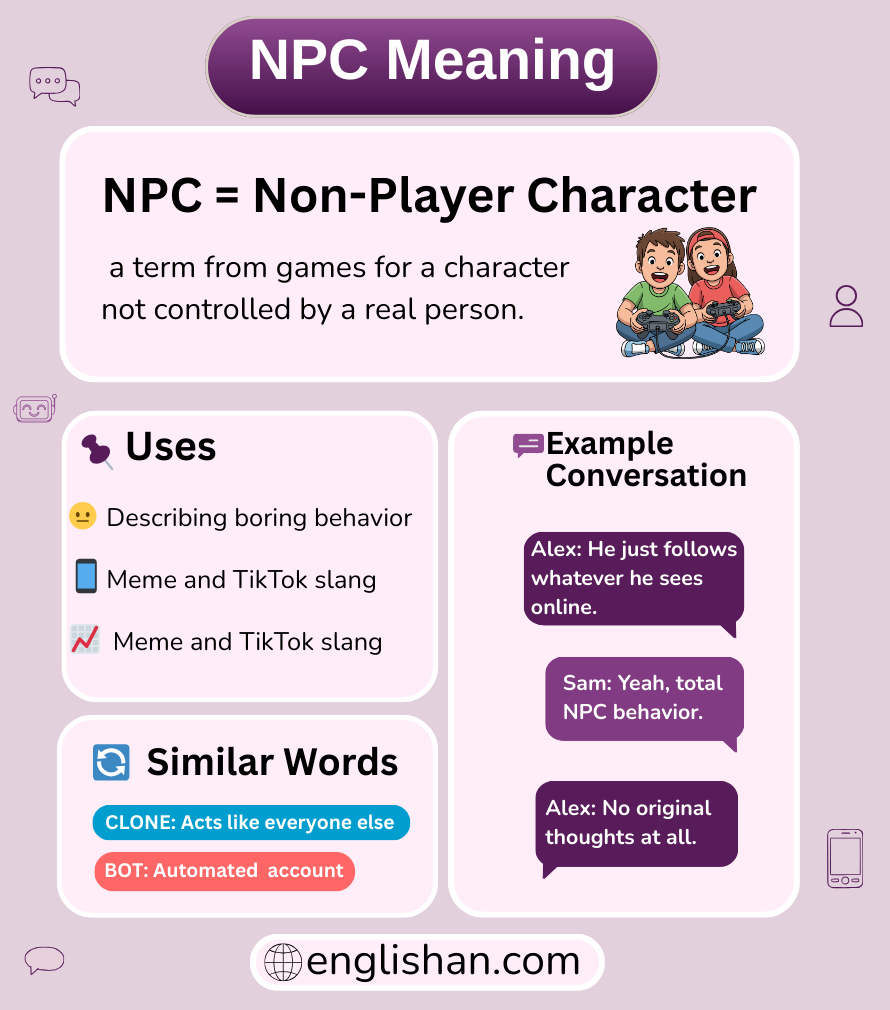
What Does NPC Stand For
This three-letter acronym stands strictly for Non-Player Character. In its literal sense, it refers to any character in a game that is controlled by the computer rather than a human. While the slang definition attacks a person’s personality, the letters always represent this specific technical gaming term.
How NPC Is Used Online
People use this label in comment sections to mock users who post generic or repetitive responses. It serves as a way to dismiss someone’s argument by claiming they are programmed to think that way rather than having a genuine opinion. You will also see it used to describe awkward behavior, such as staring blankly or walking in a strange rhythm.
NPC Examples And Conversations
These dialogues illustrate how the term transitions from a gaming definition to a social insult.
Jason: Why are you walking back and forth in the hallway like that?
Mike: I forgot what I was doing, so I am just rebooting.
Jason: You are acting like such an NPC right now.
Sarah: I think this new movie is the best film ever made.
Emily: Everyone says that exact same sentence. You sound like an NPC.
Sarah: No, I just really enjoyed the plot.
David: We need to find the blacksmith to fix our swords.
Jessica: He is over by the village gate.
David: I hope this NPC has some new items for sale this time.
NPC Origin
The technical term originated in tabletop role-playing games like Dungeons & Dragons during the 1970s to describe characters controlled by the game master. It became a viral slang insult in 2018 through internet memes that depicted people as gray, expressionless faces. These memes argued that many people do not have an internal monologue.
Is NPC Offensive
Calling someone an NPC is generally considered rude and dehumanizing. It implies that the person has no soul, agency, or intelligence, reducing them to a mere computer program. While some friends use it for light teasing about clumsy behavior, using it in an argument is a direct attack on someone’s humanity.
Common Confusions About NPC
A frequent misunderstanding is equating NPC with “Bot.” While both terms describe robotic behavior, “bot” usually implies a fake automated account used to spam, whereas NPC describes a real human who acts boring. Additionally, some people confuse it with “Main Character,” which is the exact opposite personality type.
Other Related Slang Words
These terms also categorize people based on their behavior or social standing.
- Main Character: Someone who thinks they are the center of attention.
- Normie: A person with mainstream interests.
- Bot: A slang insult for someone who is bad at gaming.
- Mob: A generic video game enemy or monster.
Key Takeaways
We define this acronym as a dual-purpose term that stands for “Non-Player Character,” originating from role-playing games. In modern slang, it serves as an insult to describe a person who lacks critical thinking or behaves in a predictable, robotic manner. While it effectively criticizes herd mentality, it is often viewed as dehumanizing and arrogant. Remember to use NPC carefully, as calling a real person a computer program is rarely taken as a compliment.
FAQs
In slang, yes. It means you are boring or unoriginal.
It refers to acting awkward or robotic in public situations.
No, they are opposites. Main Characters seek attention; NPCs blend in.
It was used politically in 2018 to mock liberal viewpoints, but now it is general slang.
You say the letters N-P-C.
You May Also Like