Is it bear with me or bare with me? This is one of those English phrases people often spell wrong because both words sound exactly alike. The correct phrase is bear with me, and it means be patient with me or please wait a moment.
The confusion happens because bare usually means uncovered or exposed, while bear has an older meaning connected to enduring or tolerating something. In this phrase, bear is the word that fits, so bare with me is incorrect.
In this article, you will learn what bear with me means, why bare with me is wrong, how to remember the correct spelling, and what to say instead in formal or casual situations.
Bear With Me or Bare With Me: Quick Answer
The correct phrase is bear with me.
| Phrase | Correct? | Meaning | Best Use |
|---|---|---|---|
| bear with me | yes | be patient with me | delays, waiting, polite requests |
| bare with me | no | would suggest uncovering or exposing | not correct in this meaning |
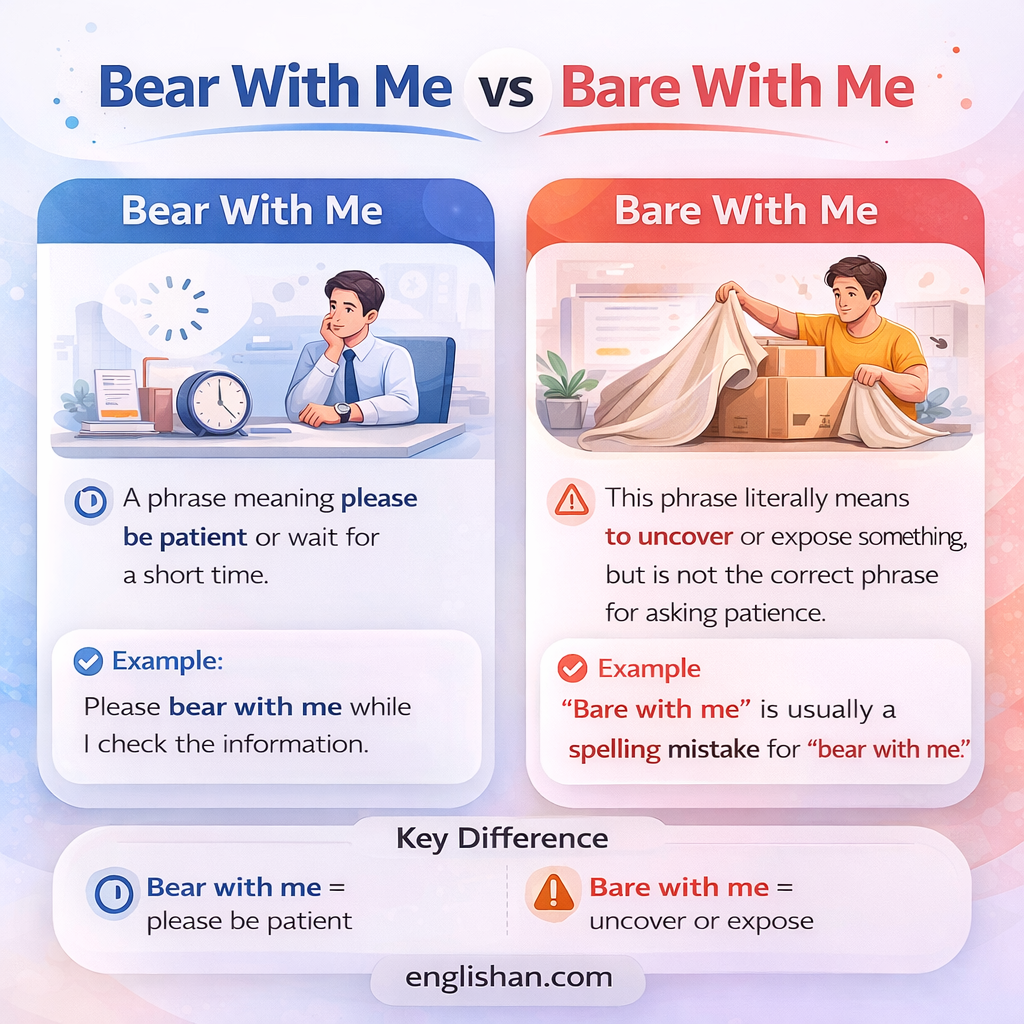
If you are asking someone to wait patiently, the phrase is always bear with me.
What Does “Bear With Me” Mean?
Bear with me means be patient with me, wait for a moment, or stay with me while I finish something.
People often use it when they need a little more time. It is polite, familiar, and useful in both speech and writing.
You will often hear or read it in situations like these:
- while checking an order or account
- while solving a technical issue
- while finishing a thought or explanation
- while opening a file or document
- while fixing a delay
Here are a few examples:
- Please bear with me while I check your booking details.
- Bear with me for a moment while I pull up the report.
- We ask that you bear with us while service is being restored.
- Thank you for bearing with me while I worked through the issue.
In each sentence, the idea is patience.
Why “Bear With Me” Is Correct and “Bare With Me” Is Wrong
The confusion comes from sound. Bear and bare are homophones, so they are pronounced the same in many accents. That makes the mistake easy to make on the page.
But their meanings are different.
Bear can mean endure, carry, or put up with something. In the phrase bear with me, that sense is still active. You are asking someone to put up with a short delay or to stay patient with you.
Bare, on the other hand, usually means uncover, expose, or reveal.
For example:
- bare your feet
- bare your arms
- bare your feelings
That is why bare with me does not fit the intended meaning. It does not express patience, waiting, or tolerance.
How to Remember the Correct Spelling
A good way to remember the phrase is to connect the word bear with the idea of enduring something.
Think of it like this:
- bear with me = stay patient with me
- bare = uncover or expose
Another memory link is the word bearing. It often relates to carrying or enduring, which fits the idea behind bear with me much better than bare does.
If the phrase is about waiting, patience, or tolerance, choose bear.
When and How to Use “Bear With Me”
Bear with me works best when you need a little time and want to sound polite. It is common in service language, work communication, meetings, presentations, and everyday conversation.
You might use it:
- in an email while checking a detail
- during a presentation if you need a moment
- in customer support while solving a problem
- in conversation while gathering your thoughts
- in team or company messages as bear with us
Examples:
- Please bear with me while I confirm your payment details.
- Bear with me for a second while I finish this point.
- If the system is running slowly, please bear with us.
- Bear with me while I find the page you mentioned.
The phrase is polite, but it can sound a little formal depending on the setting. In a workplace or service setting, that tone often fits well. In casual conversation, people may prefer shorter options.
Other Variations of “Bear With Me”
The phrase bear with me can change form depending on the subject, tense, or sentence pattern. This is useful when you want to talk about patience in the present, the past, or an ongoing situation.
Present Simple Forms
Use the present simple for general statements or repeated situations.
- You bear with me when I need extra time.
- They bear with me during technical problems.
- He bears with me when I get stuck.
- She bears with me when I lose my place.
This form is less common in everyday conversation than direct requests like please bear with me, but it still appears in normal sentence writing.
Present Continuous Forms
Use the present continuous when the patience is happening now or around the present time.
- You are bearing with me while I explain the issue.
- They are bearing with me during the delay.
- He is bearing with me as I work through the problem.
- She is bearing with me while I sort everything out.
This form is grammatical, though it sounds more natural in full sentences than as a fixed phrase on its own.
Past Forms
Use past forms when you are talking about patience that someone showed earlier.
- You bore with me during the long meeting.
- They bore with me while I fixed the error.
- She bore with me when I needed more time.
- Thank you for bearing with me yesterday.
The form bore with me is correct, but many writers prefer bearing with me in sentences like Thank you for bearing with me because it sounds more natural in modern usage.
Future Forms
Use future forms when referring to patience someone may show later.
- I hope you will bear with me while I finish this.
- They will bear with us until service returns.
- She said she would bear with me if the delay continued.
Other Ways to Say “Bear With Me”
Sometimes you may want a phrase that sounds more formal, more casual, or better suited to professional writing.
More Formal Alternatives
- Please hold on for a moment.
- One moment, please.
- Thank you for your patience.
- Please stand by.
- Please be patient.
More Casual Alternatives
- Hang on.
- Hold on.
- Give me a second.
- Just a minute.
- Stick with me.
The best option depends on the situation. In customer service or work messages, thank you for your patience often sounds smoother than repeating bear with me several times.
“Bear With Me” in Sentences
Here are more examples of the phrase used correctly:
- Could you bear with me while I look up the information?
- Please bear with me as I make a few final edits.
- Bear with me for a moment while I bring up the slide.
- We appreciate your patience and ask that you bear with us while the update finishes.
- I know this is taking longer than expected, so thank you for bearing with me.
These examples cover different situations, from workplace messages to live conversation.
Common Mistakes With “Bear With Me”
One common mistake is writing bare with me instead of bear with me.
Incorrect:
- Please bare with me while I finish the report.
Correct:
- Please bear with me while I finish the report.
Another mistake is using the phrase too often in professional writing. It is polite, but if you repeat it again and again, it can start to feel tired. In some cases, a stronger alternative is:
- Thank you for your patience.
- One moment, please.
- Please hold on briefly.
There is also a tone issue to watch. In casual speech, bear with me can sound a little stiff. If the setting is relaxed, hang on or give me a second may sound more natural.
Bear With Me vs Bear With Us
Use bear with me when you are speaking for yourself.
- Please bear with me while I finish this task.
Use bear with us when you are speaking for a group, team, company, or service.
- Please bear with us while we restore access.
The meaning stays the same. Only the speaker changes.
Summary
The correct phrase is bear with me, not bare with me. It means be patient with me or wait for me for a moment. The spelling bare with me is wrong in this meaning because bare relates to uncovering or exposing something, not waiting patiently. Once you connect bear with endurance and patience, the correct phrase becomes easier to remember.
FAQs
The correct phrase is bear with me. Bare with me is incorrect in this context.
Bear with me means be patient with me or please wait for a moment while something is being finished, checked, or explained.
It is wrong because bare means uncover, reveal, or make something naked. That meaning does not fit the idea of asking someone to be patient.
You can say please hold on for a moment, one moment, please, thank you for your patience, hang on, or give me a second.
You May Also Like