Many people confuse biannual and biennial because the words look almost identical, yet they describe different time intervals. Biannual means something happens twice a year, while biennial means something happens once every two years. This distinction affects schedules, reports, events, and long-term planning.
Confusing pairs like this often cause problems in writing and communication. If a meeting is biannual, it happens two times in one year. If it is biennial, it does not occur again until two years later.
In this article, you will learn the difference between biannual and biennial, how to use each word in sentences, why semiannual is sometimes a clearer choice, and how to remember the meanings. By the end, you will use both words with more confidence.
Biannual vs Biennial: Quick Difference
The fastest way to separate these words is this:
| Word | Meaning | Timing | Example |
|---|---|---|---|
| Biannual | twice a year | every six months | a biannual review |
| Biennial | every two years | once in two years | a biennial festival |
So if something happens in June and December, it is biannual.
If it happens in 2026 and then again in 2028, it is biennial.
What Does Biannual Mean?
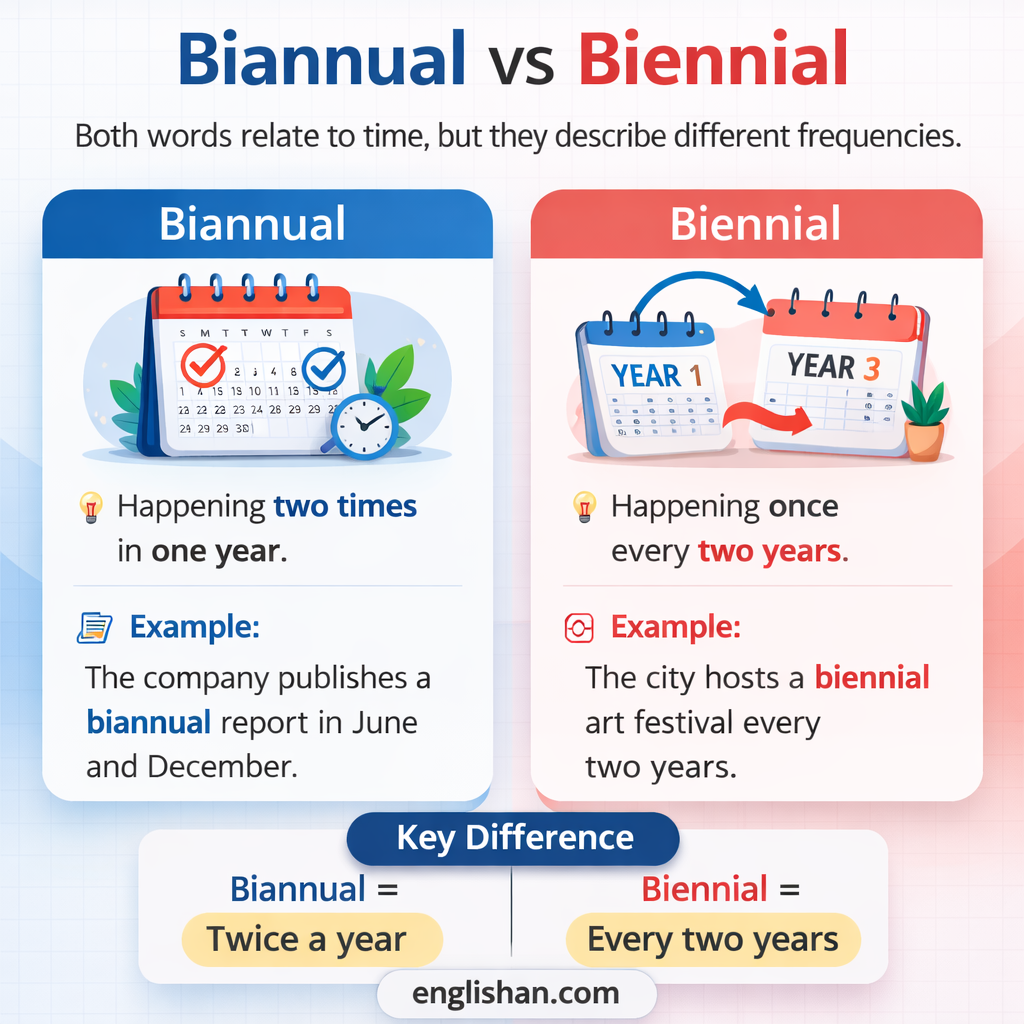
Biannual means twice in one year.
It is used for events, tasks, or reports that happen two times during a single year, often about six months apart.
Common Examples of Biannual
- a biannual meeting
- a biannual report
- a biannual inspection
- a biannual sale
- a biannual health check
Biannual in a Sentence
- The company holds biannual reviews in spring and fall.
- Staff complete biannual training in June and December.
- The school sends biannual progress reports to parents.
What Does Biennial Mean?
Biennial means every two years.
It describes something that takes place once in a two-year cycle.
Common Examples of Biennial
- a biennial conference
- a biennial exhibition
- a biennial election
- a biennial budget review
- a biennial festival
In plant vocabulary, biennial can also describe a plant that completes its life cycle in two years.
Biennial in a Sentence
- The city hosts a biennial arts festival.
- Their international conference is a biennial event.
- Some biennial plants grow leaves in the first year and flower in the second.
Biannual vs Semiannual
This is one of the most useful parts of the topic.
Biannual and semiannual both commonly mean twice a year.
| Word | Meaning | Notes |
|---|---|---|
| Biannual | twice a year | correct, but sometimes confused with biennial |
| Semiannual | twice a year | often clearer in formal writing |
Because biannual looks and sounds close to biennial, some writers prefer semiannual when they want to avoid confusion.
Example
- The company issues a semiannual report in January and July.
That sentence may feel clearer to some readers than:
- The company issues a biannual report in January and July.
Both can be correct, but semiannual often reduces misunderstanding.
Common Mistakes With Biannual and Biennial
Using Biannual When You Mean Every Two Years
This is the most common mistake.
Incorrect idea:
- The biennial trade show returns every spring and fall.
Better:
- The biannual trade show returns every spring and fall.
Using Biennial for Twice-a-Year Events
If an event happens every six months, it is not biennial.
Incorrect idea:
- Employees attend biennial safety training in March and September.
Better:
- Employees attend biannual safety training in March and September.
Forgetting That Semiannual May Be Clearer
In calendars, contracts, business writing, and reports, semiannual may help readers understand the timing faster.
Biannual and Biennial in Real Situations
In Work and Business
- A biannual report may come out twice a year
- A biennial conference may be held every two years
In Education
- A school may send biannual progress summaries
- A department may host a biennial research event
In Gardening and Science
- A biennial plant completes its growth cycle in two years
These examples help show that the difference is about timing, not subject area.
Simple Way to Remember the Difference
A good way to remember it is this:
- Biannual = two times in one year
- Biennial = one time in two years
You can also remember that biennial often refers to longer cycles like festivals, conferences, elections, and plant life cycles.
Which Word Should You Use?
Use biannual when something happens twice a year.
Use biennial when something happens every two years.
Use semiannual when you mean twice a year and want the wording to be easier for readers to interpret quickly.
Summary
Biannual and biennial are easy to confuse, but they describe very different time periods. Biannual means twice a year, while biennial means once every two years. In many situations, semiannual can also be useful because it gives the meaning of twice a year with less chance of confusion. Once you connect biannual to one year and biennial to a two-year cycle, the difference becomes much easier to remember.
FAQs
Biannual means twice a year. Biennial means once every two years.
Usually, yes. Both are commonly used to mean twice a year. However, semiannual is often clearer because it is less likely to be confused with biennial.
No. Biennial means every two years, not twice a year.
A conference held in 2026 and then again in 2028 is biennial.
A report published in June and December is biannual.
You May Also Like