Some chemistry words starting with Q explain key processes. For instance, quenching means cooling a hot metal quickly, and quinone is a chemical compound used in reactions. Both help understand how chemicals behave.
Knowing chemistry words that start with Q makes it easier to learn new vocabulary and use these words in English confidently.
Complete List of Chemistry Words That Begin With Q
- Quark
- Quaternary
- Quinone
- Quinol
- Quinuclidine
- Quicksilver
- Quaternization
- Quenching
- Quasistatic
- Quantitative
- Quasi-equilibrium
- Quasielastic
- Quaternization reaction
- Quinidine
- Quercetin
- Quinolone
- Quinacrine
- Quinizarin
- Quinuclidinyl
- Quinolyl
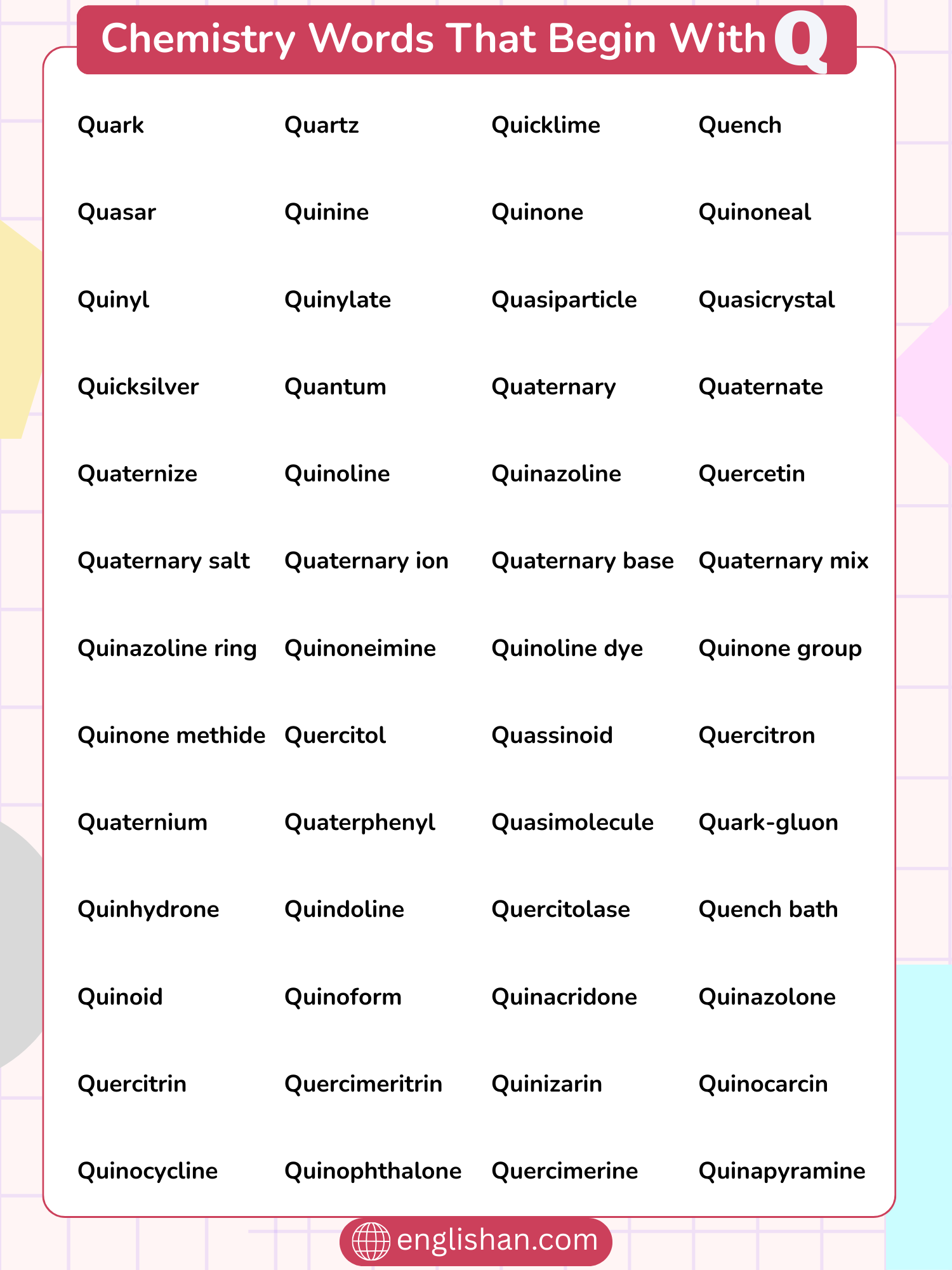
Common Chemistry Words That Start With Q
- Quark
- Quinone
- Quinol
- Quenching
- Quicksilver
- Quaternary
- Quantitative
- Quinolone
Rare and Uncommon Chemistry Words That Begin With Q
- Quinuclidine: A bicyclic amine used in organic synthesis
- Quaternization: A chemical reaction forming quaternary ammonium salts
- Quasistatic: Describes a process that changes very slowly in chemistry
- Quasi-equilibrium: A state close to chemical equilibrium
- Quasielastic: Refers to nearly elastic collisions in molecular interactions
- Quinidine: An alkaloid used in chemistry and medicine
- Quercetin: A plant flavonoid with chemical activity
- Quinacrine: A chemical compound used in medicinal chemistry
- Quinizarin: An anthraquinone dye used in chemistry
- Quinuclidinyl: A functional group derived from quinuclidine
- Quinolyl: Referring to a chemical group derived from quinoline
Organic Chemistry Words That Start With Q
- Quinone
- Quinol
- Quinuclidine
- Quinoline
- Quinolone
- Quinacrine
- Quercetin
- Quinizarin
Inorganic Chemistry Words That Begin With Q
- Quicksilver
- Quaternary
- Quaternization
- Quantitative
- Quasi-equilibrium
- Quasistatic
Chemistry Terms in Reactions That Start With Q
- Quenching
- Quaternization
- Quantitative
- Quasi-equilibrium
- Quasielastic
Use Chemistry Words Beginning With Q in Sentences
- Quark is a fundamental particle in physics and chemistry
- Quinone plays a role in electron transfer reactions
- Quinol is used in the synthesis of organic compounds
- Quenching stops a chemical reaction quickly
- Quicksilver refers to mercury in chemical contexts
- Quaternary compounds have four substituents
- Quaternization reaction forms quaternary ammonium salts
- Quantitative analysis measures the amount of chemical substances
FAQs About Chemistry Words That Start With Q
No, there are only a few chemistry-related words beginning with Q, but they are important in scientific studies.
Quartz is a common word—it’s a mineral made of silicon dioxide (SiO₂).
Yes. In chemistry and physics, “quantum” refers to the smallest unit of energy or matter that can exist independently.
“Quenching” means stopping a chemical reaction suddenly, often by cooling or adding another substance.
It refers to a structure made of four parts, such as a quaternary ammonium compound or a quaternary protein structure.
“Quinone” is an organic compound used in dyes and involved in biological reactions like photosynthesis.