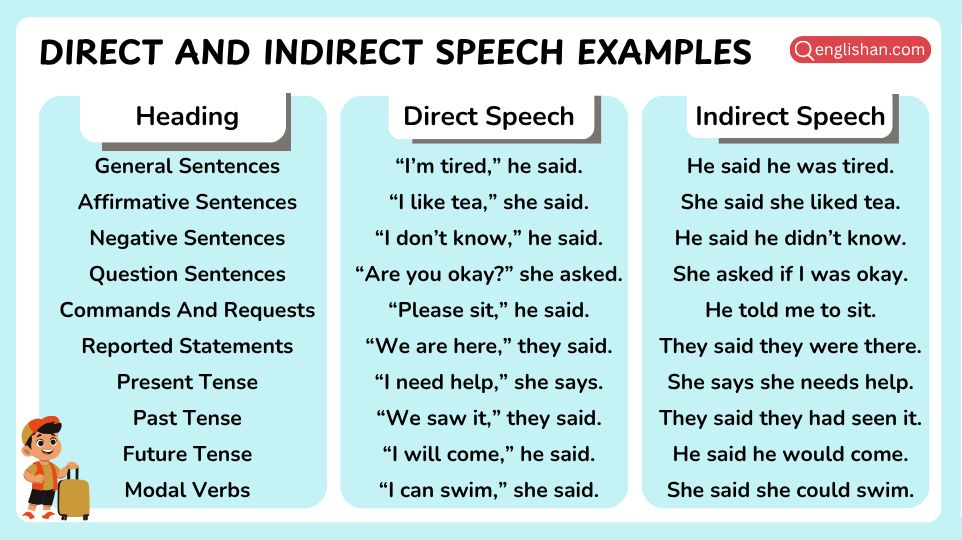
Direct speech is when you use a speaker’s exact words, usually in quotation marks. Indirect speech tells what someone said without using their exact words. For example, “I am tired,” she said is direct, while she said that she was tired is indirect. Both are correct in English grammar.
In this post, you will learn how direct and indirect speech examples make English grammar easier and help learners write or speak correctly.
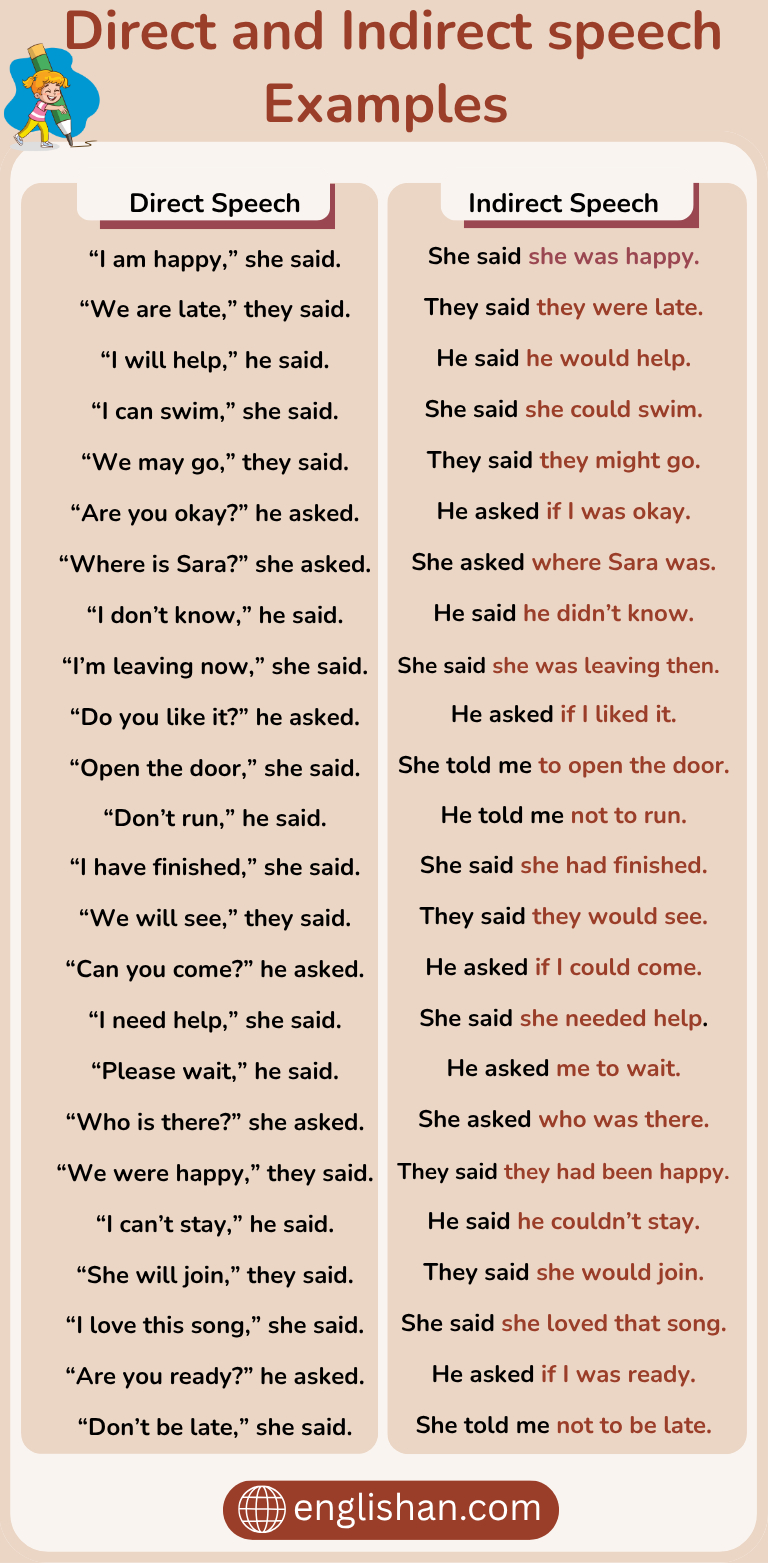
Definition Of Direct And Indirect Speech
Direct speech records the speaker’s exact words, usually in quotation marks. Indirect speech, also called reported speech, tells what someone said without quoting them directly. For example, “I am hungry,” he said is direct, while he said that he was hungry is indirect. Both forms are correct and commonly used in English grammar.
Sentences of Direct And Indirect Speech
Below is a list showing direct and indirect speech in simple, clear sentences, helping you notice how sentences transform when reporting.
- Sara said, “I am tired.” → Sara said she was tired.
- “I will come tomorrow,” he said. → He said he would come the next day.
- They said, “We have finished.” → They said they had finished.
- “Do you like pizza?” she asked. → She asked if I liked pizza.
- “Don’t shout,” the teacher said. → The teacher told us not to shout.
- “I can help,” he said. → He said he could help.
- “Are you okay?” they asked. → They asked if I was okay.
- “It’s raining,” Tom said. → Tom said it was raining.
- “I need a pen,” she said. → She said she needed a pen.
- “Will you come?” he asked. → He asked if I would come.
- “I’m reading a book,” she said. → She said she was reading a book.
- “We are going home,” they said. → They said they were going home.
- “Did you see that?” he asked. → He asked if I had seen that.
- “Please sit down,” the teacher said. → The teacher asked us to sit down.
- “I love this song,” she said. → She said she loved that song.
Affirmative Sentences In Direct And Indirect Speech
Below is a list focusing on affirmative statements, helping you see how to report positive sentences clearly.
- “I like coffee,” he said. → He said he liked coffee.
- “We are studying,” they said. → They said they were studying.
- “She will come soon,” Tom said. → Tom said she would come soon.
- “I can swim,” Sara said. → Sara said she could swim.
- “We have a car,” they said. → They said they had a car.
- “I am happy,” she said. → She said she was happy.
- “You did a great job,” the teacher said. → The teacher said I had done a great job.
- “I want to help,” he said. → He said he wanted to help.
- “It looks nice,” she said. → She said it looked nice.
- “I love reading,” he said. → He said he loved reading.
- “We are friends,” they said. → They said they were friends.
- “I’m learning English,” she said. → She said she was learning English.
- “You can join us,” they said. → They said I could join them.
- “We like this place,” they said. → They said they liked that place.
- “I need your help,” he said. → He said he needed my help.
Negative Sentences In Direct And Indirect Speech
Below is a list focusing on negative sentences in direct and indirect speech for clearer practice.
- “I don’t like tea,” she said. → She said she didn’t like tea.
- “We are not ready,” they said. → They said they were not ready.
- “I can’t swim,” Tom said. → Tom said he couldn’t swim.
- “I haven’t finished,” she said. → She said she hadn’t finished.
- “I won’t go,” he said. → He said he wouldn’t go.
- “We don’t have any milk,” they said. → They said they didn’t have any milk.
- “I am not tired,” she said. → She said she was not tired.
- “He didn’t call me,” Sara said. → Sara said he hadn’t called her.
- “I don’t want it,” he said. → He said he didn’t want it.
- “They aren’t coming,” she said. → She said they weren’t coming.
- “I can’t hear you,” he said. → He said he couldn’t hear me.
- “She doesn’t know,” Tom said. → Tom said she didn’t know.
- “I won’t tell,” he said. → He said he wouldn’t tell.
- “We can’t stay,” they said. → They said they couldn’t stay.
- “I’m not hungry,” she said. → She said she wasn’t hungry.
Question Sentences In Direct And Indirect Speech
Below is a list of questions turned into indirect speech for better sentence structure understanding.
- “Where are you going?” he asked. → He asked where I was going.
- “What is your name?” she asked. → She asked what my name was.
- “Are you coming?” they asked. → They asked if I was coming.
- “Did you see it?” he asked. → He asked if I had seen it.
- “Can you help me?” she asked. → She asked if I could help her.
- “Do you like apples?” they asked. → They asked if I liked apples.
- “Will you join us?” he asked. → He asked if I would join them.
- “Have you done your work?” she asked. → She asked if I had done my work.
- “Is it raining?” he asked. → He asked if it was raining.
- “When will you come?” she asked. → She asked when I would come.
- “Why are you late?” the teacher asked. → The teacher asked why I was late.
- “Who is your friend?” he asked. → He asked who my friend was.
- “Does he live here?” she asked. → She asked if he lived here.
- “Was it easy?” they asked. → They asked if it was easy.
- “Are you ready?” he asked. → He asked if I was ready.
Commands And Requests In Direct And Indirect Speech
Below is a list showing how commands and requests appear in indirect speech for practice.
- “Sit down,” the teacher said. → The teacher told us to sit down.
- “Please open the window,” she said. → She asked me to open the window.
- “Don’t make noise,” he said. → He told them not to make noise.
- “Come here,” she said. → She told me to come there.
- “Don’t touch that,” he said. → He told me not to touch that.
- “Please wait here,” she said. → She asked me to wait there.
- “Read this book,” the teacher said. → The teacher told me to read that book.
- “Close the door,” he said. → He told me to close the door.
- “Don’t be late,” she said. → She told me not to be late.
- “Help your sister,” Mom said. → Mom told me to help my sister.
- “Don’t forget,” he said. → He told me not to forget.
- “Come early,” she said. → She told me to come early.
- “Write your name,” he said. → He told me to write my name.
- “Stop talking,” the teacher said. → The teacher told us to stop talking.
- “Don’t run,” she said. → She told me not to run.
Reported Statements In Direct And Indirect Speech
Below is a list showing reported statements in direct and indirect speech to see sentence changes naturally.
- “I am going home,” she said. → She said she was going home.
- “We are happy,” they said. → They said they were happy.
- “I need help,” he said. → He said he needed help.
- “They have a car,” she said. → She said they had a car.
- “He is tired,” Sara said. → Sara said he was tired.
- “I like this place,” she said. → She said she liked that place.
- “We can stay,” they said. → They said they could stay.
- “I will come back,” he said. → He said he would come back.
- “It looks good,” she said. → She said it looked good.
- “I’m learning,” he said. → He said he was learning.
- “We are friends,” they said. → They said they were friends.
- “I feel sick,” she said. → She said she felt sick.
- “I have finished,” he said. → He said he had finished.
- “They went home,” she said. → She said they had gone home.
- “I trust you,” he said. → He said he trusted me.
Present Tense Sentences In Direct And Indirect Speech
Below is a list using present tense direct and indirect speech examples.
- “I like music,” she says. → She says she likes music.
- “We are ready,” they say. → They say they are ready.
- “He wants to play,” Sara says. → Sara says he wants to play.
- “I need a pen,” he says. → He says he needs a pen.
- “They live here,” she says. → She says they live here.
- “I feel fine,” he says. → He says he feels fine.
- “It looks great,” she says. → She says it looks great.
- “We like this game,” they say. → They say they like this game.
- “She is here,” Tom says. → Tom says she is here.
- “I am tired,” she says. → She says she is tired.
- “We are studying,” they say. → They say they are studying.
- “He works hard,” she says. → She says he works hard.
- “They have a dog,” he says. → He says they have a dog.
- “I see you,” she says. → She says she sees me.
- “It rains a lot,” they say. → They say it rains a lot.
Past Tense Sentences In Direct And Indirect Speech
Below is a list using past tense sentences in direct and indirect speech.
- “I saw a cat,” she said. → She said she had seen a cat.
- “We went home,” they said. → They said they had gone home.
- “He was tired,” she said. → She said he had been tired.
- “They played football,” he said. → He said they had played football.
- “I did my work,” she said. → She said she had done her work.
- “We were happy,” they said. → They said they had been happy.
- “He felt sick,” she said. → She said he had felt sick.
- “I loved that song,” he said. → He said he had loved that song.
- “They visited us,” she said. → She said they had visited them.
- “I knew him,” he said. → He said he had known him.
- “We stayed here,” they said. → They said they had stayed there.
- “She came early,” he said. → He said she had come early.
- “I thought so,” she said. → She said she had thought so.
- “They called me,” he said. → He said they had called him.
- “I met her,” she said. → She said she had met her.
Future Tense Sentences In Direct And Indirect Speech
Below is a list using future tense direct and indirect speech examples.
- “I will call you,” he said. → He said he would call me.
- “We will come,” they said. → They said they would come.
- “She will help,” Tom said. → Tom said she would help.
- “I will join later,” she said. → She said she would join later.
- “They will visit us,” he said. → He said they would visit them.
- “I will finish soon,” she said. → She said she would finish soon.
- “He will stay here,” they said. → They said he would stay there.
- “We will leave now,” he said. → He said they would leave then.
- “I will send it,” she said. → She said she would send it.
- “They will play tomorrow,” he said. → He said they would play the next day.
- “I will wait,” she said. → She said she would wait.
- “We will see,” they said. → They said they would see.
- “He will write,” she said. → She said he would write.
- “I will talk to him,” he said. → He said he would talk to him.
- “She will read the book,” they said. → They said she would read the book.
Modal Verb Sentences In Direct And Indirect Speech
Below is a list using modal verb sentences in direct and indirect speech.
- “I can swim,” she said. → She said she could swim.
- “We may go,” they said. → They said they might go.
- “He should study,” she said. → She said he should study.
- “I must leave,” he said. → He said he had to leave.
- “They could come,” she said. → She said they could come.
- “I might stay,” he said. → He said he might stay.
- “She will help,” Tom said. → Tom said she would help.
- “We should wait,” they said. → They said they should wait.
- “He can help,” she said. → She said he could help.
- “I must finish,” he said. → He said he had to finish.
- “They may join,” she said. → She said they might join.
- “She can come,” he said. → He said she could come.
- “I might call you,” she said. → She said she might call me.
- “We should start,” they said. → They said they should start.
- “He could stay,” she said. → She said he could stay.
Everyday Conversation Sentences In Direct And Indirect Speech
Below is a list of everyday conversation examples for practice.
- “I’m hungry,” he said. → He said he was hungry.
- “Can you help me?” she asked. → She asked if I could help her.
- “We are late,” they said. → They said they were late.
- “Please wait here,” she said. → She asked me to wait there.
- “I don’t know,” he said. → He said he didn’t know.
- “What time is it?” she asked. → She asked what time it was.
- “I will come later,” he said. → He said he would come later.
- “It’s cold,” she said. → She said it was cold.
- “Don’t worry,” he said. → He told me not to worry.
- “Are you okay?” she asked. → She asked if I was okay.
- “I love this place,” he said. → He said he loved that place.
- “They can join us,” she said. → She said they could join them.
- “Please call me,” he said. → He asked me to call him.
- “I’m leaving now,” she said. → She said she was leaving then.
- “Is it raining?” he asked. → He asked if it was raining.
You May Also Like