

When writing about Allama Muhammad Iqbal, it’s important to understand his role as a great poet, philosopher, and thinker who inspired millions. This essay on Allama Iqbal explains his early life, education, poetry, and ideas about self-respect and freedom. It highlights how he encouraged people to work hard and be proud of their identity. This essay is written in 250 words to help middle school students with their homework or exams. You can download this Allama Muhammad Iqbal essay as a free PDF or image to study or print.
10 Lines Allama Muhammad Iqbal Essay for Class 2 to Class 5
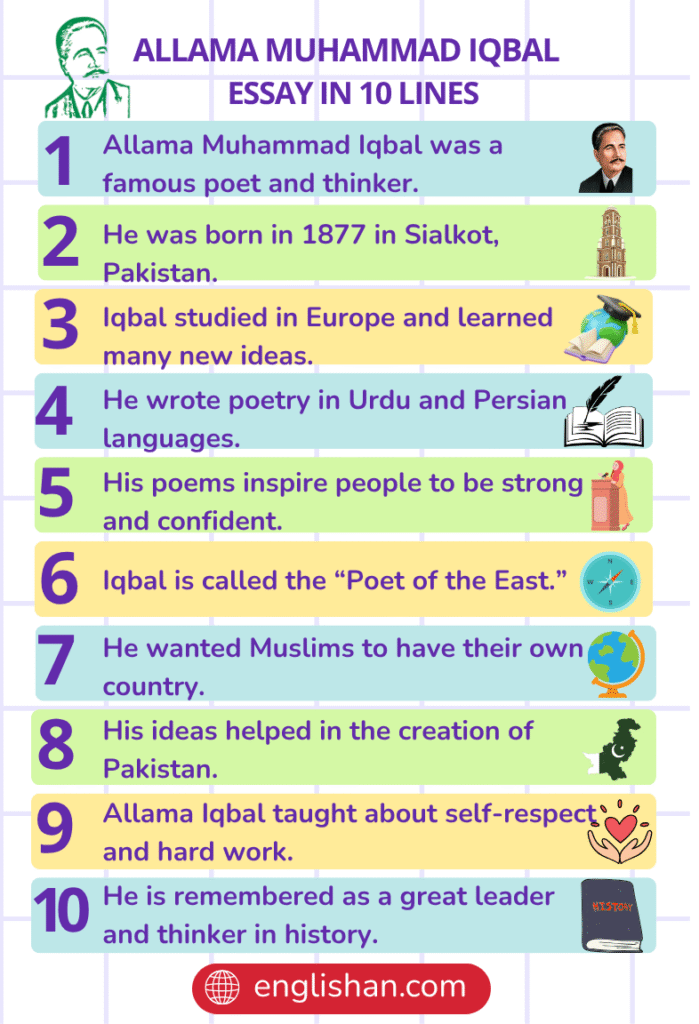
- Allama Muhammad Iqbal was a famous poet and thinker.
- He was born in 1877 in Sialkot, Pakistan.
- Iqbal studied in Europe and learned many new ideas.
- He wrote poetry in Urdu and Persian languages.
- His poems inspire people to be strong and confident.
- Iqbal is called the “Poet of the East.”
- He wanted Muslims to have their own country.
- His ideas helped in the creation of Pakistan.
- Allama Iqbal taught about self-respect and hard work.
- He is remembered as a great leader and thinker in history.
250 Words Essay on Allama Muhammad Iqbal for Middle School
Allama Muhammad Iqbal was a famous poet, philosopher, and politician who played a key role in inspiring the Pakistan Movement. He was born on November 9, 1877, in Sialkot, which is now in Pakistan. From a young age, Iqbal showed great interest in literature and philosophy. He went to Europe for higher education, where he studied law and philosophy in London and Germany.
Iqbal’s poetry is famous for its powerful messages of self-respect, freedom, and unity. He wrote in both Urdu and Persian and used his poems to encourage people to think about their identity and future. One of his most important ideas was “Khudi,” which means self-awareness and self-respect. He believed that if people understand their worth, they can achieve great things.
Iqbal wanted Muslims to have their own homeland where they could live freely and follow their culture and religion. His thoughts influenced many leaders of the Pakistan Movement. Today, Allama Iqbal is honored as the national poet of Pakistan, and his birthday is celebrated as Iqbal Day.
This essay helps middle school students learn about Allama Muhammad Iqbal’s life, his poetry, and his lasting impact. You can download this essay as a free PDF or image for study or printing.
500 Words Allama Muhammad Iqbal Essay for Upper Primary and Lower Secondary
Early Life and Education
Born on November 9, 1877, in Sialkot, British India, Allama Iqbal belonged to a religious Kashmiri family. His early education at Sialkot Mission School laid the foundation for his intellectual growth. He later pursued higher education at Government College Lahore, excelling in philosophy and literature. To further expand his knowledge, he studied law and philosophy at Cambridge University and the University of Munich, where he earned a doctorate. His exposure to Western philosophy and Islamic thought shaped his intellectual outlook.
Literary Contributions and Philosophy
Iqbal’s poetry reflects deep philosophical and spiritual themes. Writing primarily in Persian and Urdu, he emphasized self-discovery, unity, and empowerment. His notable works include “Bang-e-Dra,” “Asrar-e-Khudi,” “Payam-e-Mashriq,” and “Bal-e-Jibril.” Through his poetry, he introduced the concept of “Khudi” (selfhood), urging Muslims to realize their potential and strive for excellence. His philosophy blended Eastern spirituality with modern intellectualism.
Political Vision and Role in Pakistan’s Ideology
Iqbal was a strong advocate for Muslim rights in the subcontinent. In his historic Allahabad Address (1930), he proposed the idea of a separate homeland for Muslims, which later became the foundation for Pakistan. Though he did not live to see Pakistan’s creation in 1947, his vision significantly influenced its formation. He inspired Muhammad Ali Jinnah and the Muslim League to strive for an independent Muslim state. His correspondence with Jinnah further reinforced the idea of a separate Muslim nation, emphasizing the importance of preserving Muslim identity and culture.
Influence on the Muslim World
Iqbal’s ideas extended beyond South Asia, inspiring the broader Muslim world. He emphasized the revival of Islamic values, unity among Muslims, and intellectual progress. His philosophy continues to shape discussions on Islamic thought and modernity, making him a revered figure in global Muslim scholarship. Many Islamic leaders and thinkers draw upon his ideas to address contemporary challenges.
Major Poetic Themes
Iqbal’s poetry revolves around themes of self-awareness, spiritual awakening, and unity. He encouraged individuals to strive for greatness, promoting ideals of independence and self-sufficiency. His poetry calls for breaking free from colonial mindsets and embracing a spirit of self-determination.
Iqbal’s Enduring Influence on Contemporary Thought
Many modern scholars and thinkers continue to analyze Iqbal’s philosophy, applying his teachings to contemporary issues in education, leadership, and governance. His concept of Khudi is particularly relevant in today’s discussions on self-empowerment and personal development.
Iqbal and Rumi: A Spiritual Connection
Iqbal regarded Jalaluddin Rumi as his spiritual guide, often referencing him in his poetry. He saw Rumi’s teachings as a source of wisdom and guidance in understanding Islamic philosophy. This connection between Iqbal and Rumi highlights the influence of Sufi thought on Iqbal’s literary and philosophical works.
Iqbal’s Contributions to Education
Iqbal strongly believed in education as a means of empowerment. His vision inspired the establishment of educational institutions that continue to shape intellectual growth in the Muslim world. Many universities and scholars continue to explore his educational philosophies. He emphasized critical thinking and a balance between religious and secular knowledge.
Legacy and Commemoration
Allama Iqbal is honored annually on Iqbal Day (November 9) in Pakistan. His contributions are remembered through literary discussions, national events, and academic research. His tomb in Lahore remains a site of historical and cultural significance.
Conclusion
Allama Muhammad Iqbal was more than a poet; he was a philosopher, political thinker, and the ideological father of Pakistan. His poetry and vision continue to inspire generations. His ideas on self-empowerment, education, and political awareness remain relevant today. Students can benefit from studying his works to understand their significance in shaping history and literature.

Difficult Words Used in 500 Allama Muhammad Iqbal Essay
| Word | Meaning |
|---|---|
| Philosopher | A thinker who studies the nature of knowledge and existence. |
| Ideology | A system of beliefs or principles. |
| Selfhood | The sense of individual identity and purpose. |
| Advocacy | Public support for a cause or policy. |
| Intellectual | Relating to deep thinking and reasoning. |
Allama Muhammad Iqbal Essay PDF
You May Also Like