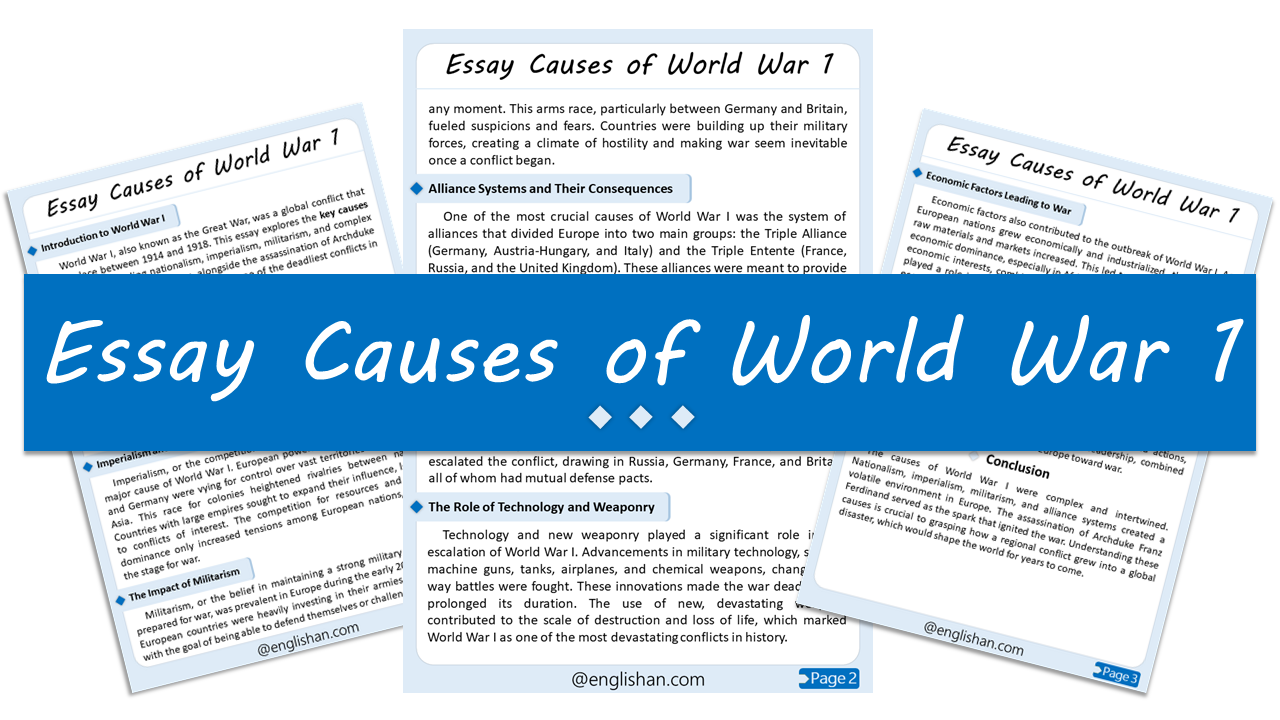
When writing about World War 1, it’s important to understand the main reasons why the war started and how different countries were involved. This essay on the causes of World War 1 explains the key events, alliances, and factors that led to the war. It’s written in 500 words to help students with homework or exams. You can download this World War 1 essay as a free PDF or image to study or print.
10 Lines Causes of World War 1 Essay for Class 2 to Class 5
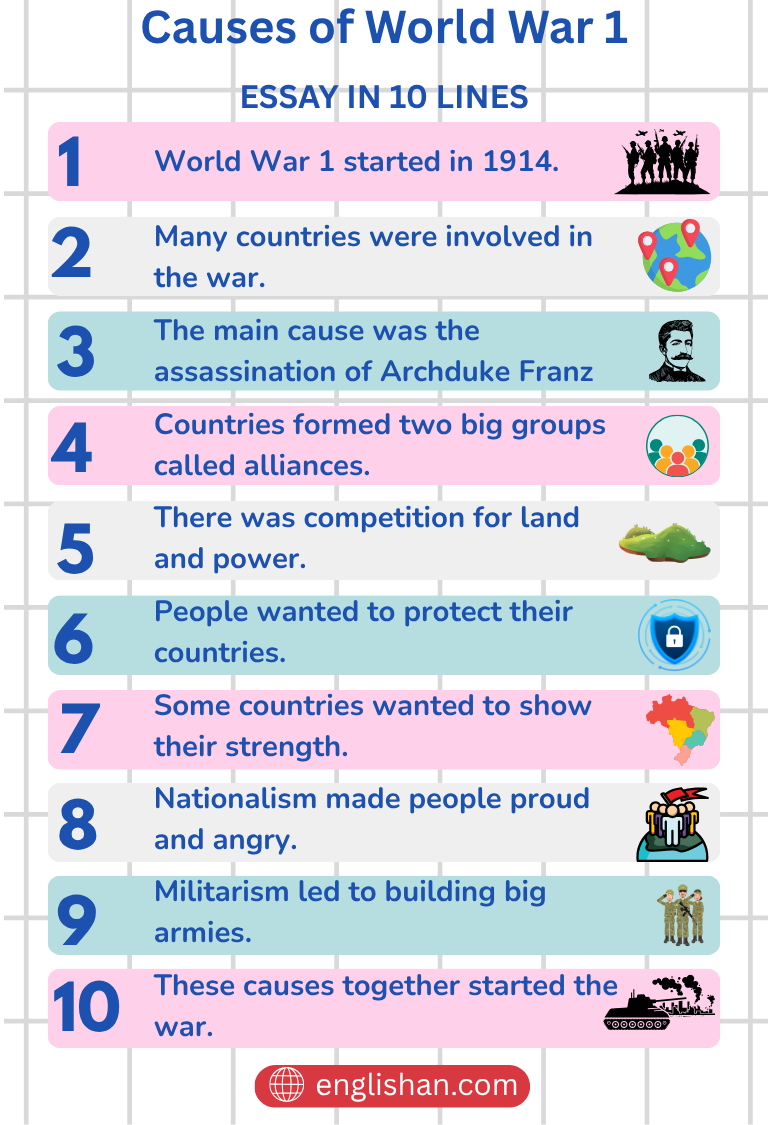
- World War 1 started in 1914.
- Many countries were involved in the war.
- The main cause was the assassination of Archduke Franz Ferdinand.
- Countries formed two big groups called alliances.
- There was competition for land and power.
- People wanted to protect their countries.
- Some countries wanted to show their strength.
- Nationalism made people proud and angry.
- Militarism led to building big armies.
- These causes together started the war.
250 Words Essay on Causes of World War 1 for Middle School
World War 1 began in 1914 and lasted for four years. It involved many countries from around the world. The war started because of several important causes. The most immediate cause was the assassination of Archduke Franz Ferdinand of Austria-Hungary. This event made countries angry and ready for war.
Before the war, Europe was divided into two big groups called alliances. One group was called the Allies, and the other was the Central Powers. These alliances made small fights grow into a big war because countries promised to help their friends.
Another cause was competition for land and power. Many countries wanted to control more colonies and show their strength. This made tensions rise between nations. Nationalism, or pride in one’s country, also played a role. People felt very proud of their nations and wanted to protect their interests.
Militarism was another important cause. Countries built large armies and weapons to be ready for war. This made countries more prepared and more likely to fight.
In conclusion, the assassination of Archduke Franz Ferdinand, alliances, competition for power, nationalism, and militarism were the main causes of World War 1. Understanding these causes helps us learn about the importance of peace and cooperation between nations.
500 Words Causes of World War 1 Essay for Upper Primary and Lower Secondary
Introduction to World War I
World War I, also known as the Great War, was a global conflict that took place between 1914 and 1918. This essay explores the key causes of the war, including nationalism, imperialism, militarism, and complex alliance systems. These factors, alongside the assassination of Archduke Franz Ferdinand, led to the outbreak of one of the deadliest conflicts in history.
The Role of Nationalism
Nationalism played a significant role in the events leading to World War I. It refers to the strong sense of pride and loyalty to one’s country. In the years leading up to the war, many nations, especially in Europe, were experiencing intense nationalism. Ethnic groups within large empires, such as the Austro-Hungarian Empire, desired independence, which created tension. Nationalism led countries to believe they were superior to others and willing to fight to defend their interests.
Imperialism and Competition for Colonies
Imperialism, or the competition for overseas colonies, was another major cause of World War I. European powers such as Britain, France, and Germany were vying for control over vast territories in Africa and Asia. This race for colonies heightened rivalries between nations. Countries with large empires sought to expand their influence, leading to conflicts of interest. The competition for resources and global dominance only increased tensions among European nations, setting the stage for war.
The Impact of Militarism
Militarism, or the belief in maintaining a strong military and being prepared for war, was prevalent in Europe during the early 20th century. European countries were heavily investing in their armies and navies, with the goal of being able to defend themselves or challenge rivals at any moment. This arms race, particularly between Germany and Britain, fueled suspicions and fears. Countries were building up their military forces, creating a climate of hostility and making war seem inevitable once a conflict began.
Alliance Systems and Their Consequences
One of the most crucial causes of World War I was the system of alliances that divided Europe into two main groups: the Triple Alliance (Germany, Austria-Hungary, and Italy) and the Triple Entente (France, Russia, and the United Kingdom). These alliances were meant to provide protection and prevent war, but they ended up escalating a small conflict into a world war. When one country was attacked, its allies were obligated to defend it, creating a domino effect that rapidly involved many nations.
The Spark: Assassination of Archduke Franz Ferdinand
The immediate cause of World War I was the assassination of Archduke Franz Ferdinand, heir to the Austro-Hungarian throne, on June 28, 1914, in Sarajevo. This event triggered a series of diplomatic crises, as Austria-Hungary declared war on Serbia. The alliance system quickly escalated the conflict, drawing in Russia, Germany, France, and Britain, all of whom had mutual defense pacts.
The Role of Technology and Weaponry
Technology and new weaponry played a significant role in the escalation of World War I. Advancements in military technology, such as machine guns, tanks, airplanes, and chemical weapons, changed the way battles were fought. These innovations made the war deadlier and prolonged its duration. The use of new, devastating weapons contributed to the scale of destruction and loss of life, which marked World War I as one of the most devastating conflicts in history.
Economic Factors Leading to War
Economic factors also contributed to the outbreak of World War I. As European nations grew economically and industrialized, the need for raw materials and markets increased. This led to fierce competition for economic dominance, especially in Africa and Asia. The desire to protect economic interests, combined with mounting tensions over resources, played a role in escalating the conflict. Nations sought to secure their economic survival, further contributing to the unstable political atmosphere.
The Influence of Political Leaders
Political leaders in Europe played an important role in the lead-up to World War I. Some leaders were motivated by national pride or imperial ambitions, while others sought to preserve their political power. The decisions made by figures like Kaiser Wilhelm II of Germany and Tsar Nicholas II of Russia influenced their nations’ positions and actions, creating a complex political environment. Their leadership, combined with nationalist sentiment, helped lead Europe toward war.
Conclusion
The causes of World War I were complex and intertwined. Nationalism, imperialism, militarism, and alliance systems created a volatile environment in Europe. The assassination of Archduke Franz Ferdinand served as the spark that ignited the war. Understanding these causes is crucial to grasping how a regional conflict grew into a global disaster, which would shape the world for years to come.

Difficult Words Used in 500 Causes of World War 1 Essay
| Word | Definition |
|---|---|
| Nationalism | The belief that a country’s interests and culture are superior to others. |
| Imperialism | The policy of extending a country’s power and influence through colonization. |
| Militarism | The belief in building up strong armed forces to prepare for war. |
| Alliance | An agreement between countries to support each other in case of conflict. |
| Domino Effect | A situation where one event sets off a chain reaction of similar events. |
| Reparations | Payments made by a defeated country to compensate for damages caused during a war. |
Causes of World War 1 Essay PDF
You May Also Like