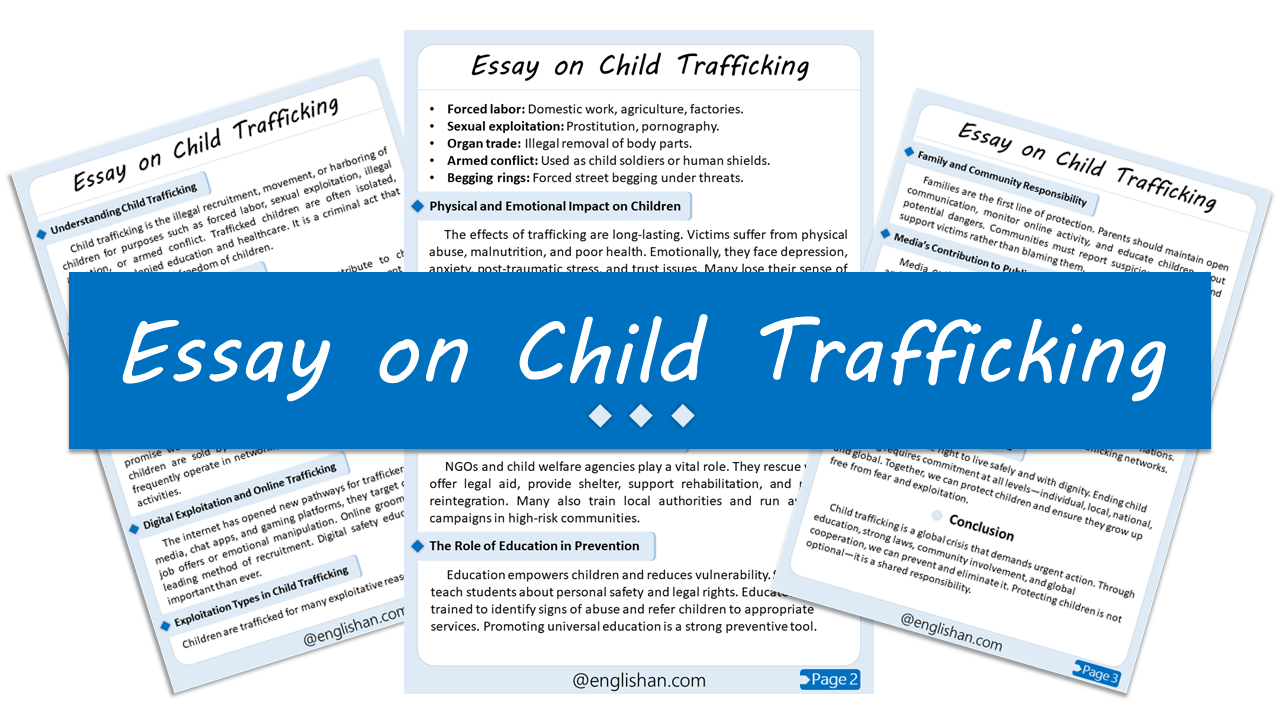
When writing about child trafficking, it’s important to understand how this serious crime affects the lives of children around the world. This essay on child trafficking explains what it means, why it happens, its harmful effects, and what we can do to stop it. It’s written in 500 words to help students prepare for homework or exams. You can download this child trafficking essay as a free PDF or image to study or print.
10 Lines Child Trafficking Essay for Class 2 to Class 5
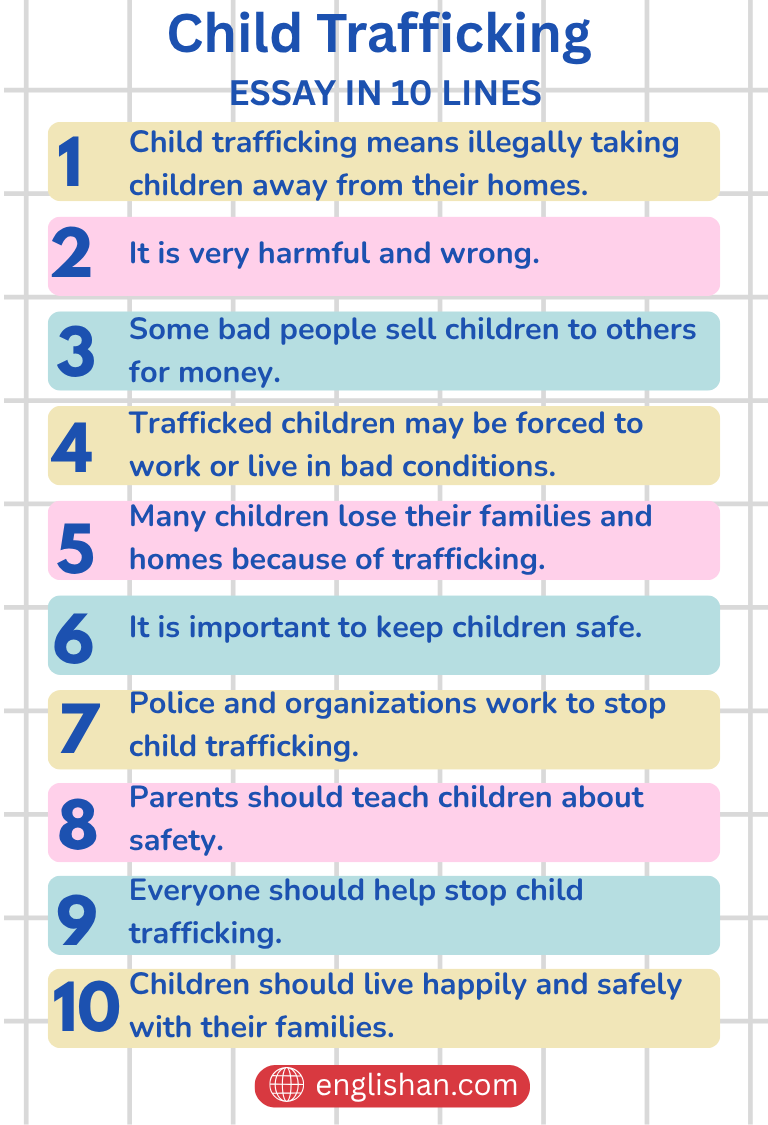
- Child trafficking means illegally taking children away from their homes.
- It is very harmful and wrong.
- Some bad people sell children to others for money.
- Trafficked children may be forced to work or live in bad conditions.
- Many children lose their families and homes because of trafficking.
- It is important to keep children safe.
- Police and organizations work to stop child trafficking.
- Parents should teach children about safety.
- Everyone should help stop child trafficking.
- Children should live happily and safely with their families.
250 Words Essay on Child Trafficking for Middle School
Child trafficking is a serious crime where children are taken from their families without permission and sold or forced to work against their will. This illegal activity happens in many parts of the world. Bad people exploit children for labor, begging, or even illegal activities.
Children who are trafficked often face terrible conditions. They may be forced to work long hours, suffer abuse, or live without proper food and shelter. Many lose their chance to go to school and live a normal childhood. Child trafficking breaks families apart and harms children’s futures.
It is very important to fight against child trafficking. Governments, police, and many organizations work together to rescue children and protect them. Laws have been made to punish traffickers and help victims. People must also be aware of the dangers and report any suspicious activities.
Parents and communities should teach children about safety and the importance of staying close to trusted adults. Schools can help by educating children on how to protect themselves.
In conclusion, child trafficking is a grave problem that needs everyone’s attention. Protecting children and giving them a safe, happy childhood is the responsibility of all. Together, we can stop child trafficking and create a better world for children.
500 Words Child Trafficking Essay for Upper Primary and Lower Secondary
Understanding Child Trafficking
Child trafficking is the illegal recruitment, movement, or harboring of children for purposes such as forced labor, sexual exploitation, illegal adoption, or armed conflict. Trafficked children are often isolated, abused, and denied education and healthcare. It is a criminal act that affects the dignity and freedom of children.
Root Causes Behind Child Trafficking
Several socio-economic and political factors contribute to child trafficking. Poverty, lack of education, unemployment, displacement due to conflict or disasters, and weak law enforcement make children more vulnerable. In some regions, cultural practices or a lack of awareness also play a role.
Common Tactics Used by Traffickers
Traffickers often use deception, threats, and coercion. They may promise work, education, or better living conditions. In some cases, children are sold by their families under false pretenses. Traffickers frequently operate in networks, making it hard to detect and stop their activities.
Digital Exploitation and Online Trafficking
The internet has opened new pathways for traffickers. Through social media, chat apps, and gaming platforms, they target children with fake job offers or emotional manipulation. Online grooming has become a leading method of recruitment. Digital safety education is now more important than ever.
Exploitation Types in Child Trafficking
Children are trafficked for many exploitative reasons:
- Forced labor: Domestic work, agriculture, factories.
- Sexual exploitation: Prostitution, pornography.
- Organ trade: Illegal removal of body parts.
- Armed conflict: Used as child soldiers or human shields.
- Begging rings: Forced street begging under threats.
Physical and Emotional Impact on Children
The effects of trafficking are long-lasting. Victims suffer from physical abuse, malnutrition, and poor health. Emotionally, they face depression, anxiety, post-traumatic stress, and trust issues. Many lose their sense of identity and hope for the future.
Legal Frameworks That Protect Children
Key international laws include the UN Convention on the Rights of the Child, the Palermo Protocol, and ILO conventions. National laws vary but often include penalties for trafficking and support services for victims. Enforcement remains a challenge in many countries due to corruption and limited resources.
Non-Governmental Organizations’ Efforts
NGOs and child welfare agencies play a vital role. They rescue victims, offer legal aid, provide shelter, support rehabilitation, and promote reintegration. Many also train local authorities and run awareness campaigns in high-risk communities.
The Role of Education in Prevention
Education empowers children and reduces vulnerability. Schools can teach students about personal safety and legal rights. Educators must be trained to identify signs of abuse and refer children to appropriate services. Promoting universal education is a strong preventive tool.
Family and Community Responsibility
Families are the first line of protection. Parents should maintain open communication, monitor online activity, and educate children about potential dangers. Communities must report suspicious activities and support victims rather than blaming them.
Media’s Contribution to Public Awareness
Media outlets can highlight trafficking cases, share survivor stories, and pressure authorities to act. Responsible journalism plays a crucial role in shaping public opinion and influencing policies. Social media campaigns also raise awareness on a large scale.
Global Collaboration and Government Action
Stopping child trafficking requires cross-border cooperation. Governments must strengthen laws, fund child protection services, train police and social workers, and collaborate with other nations. Information-sharing between countries can disrupt trafficking networks.
Creating a Safe Future for Every Child
Every child has the right to live safely and with dignity. Ending child trafficking requires commitment at all levels—individual, local, national, and global. Together, we can protect children and ensure they grow up free from fear and exploitation.
Conclusion
Child trafficking is a global crisis that demands urgent action. Through education, strong laws, community involvement, and global cooperation, we can prevent and eliminate it. Protecting children is not optional—it is a shared responsibility.

Difficult Words Used in 500 Child Trafficking Essay
| Word | Meaning |
|---|---|
| Trafficking | The illegal trade or movement of people, often for exploitation |
| Exploitation | The act of using someone unfairly for personal gain |
| Reintegration | The process of returning someone to society after isolation or trauma |
| Rehabilitation | The process of restoring someone to health or normal life |
| Vulnerable | At risk or in danger due to weakness or lack of protection |
| Impunity | Freedom from punishment or harm |
| Deception | The act of misleading or tricking someone |
| Protocol | A formal set of rules or procedures |
| Grooming | Building trust with a child to exploit them later |
| Displacement | Being forced to leave home due to conflict or disaster |
Child Trafficking Essay PDF
You May Also Like