
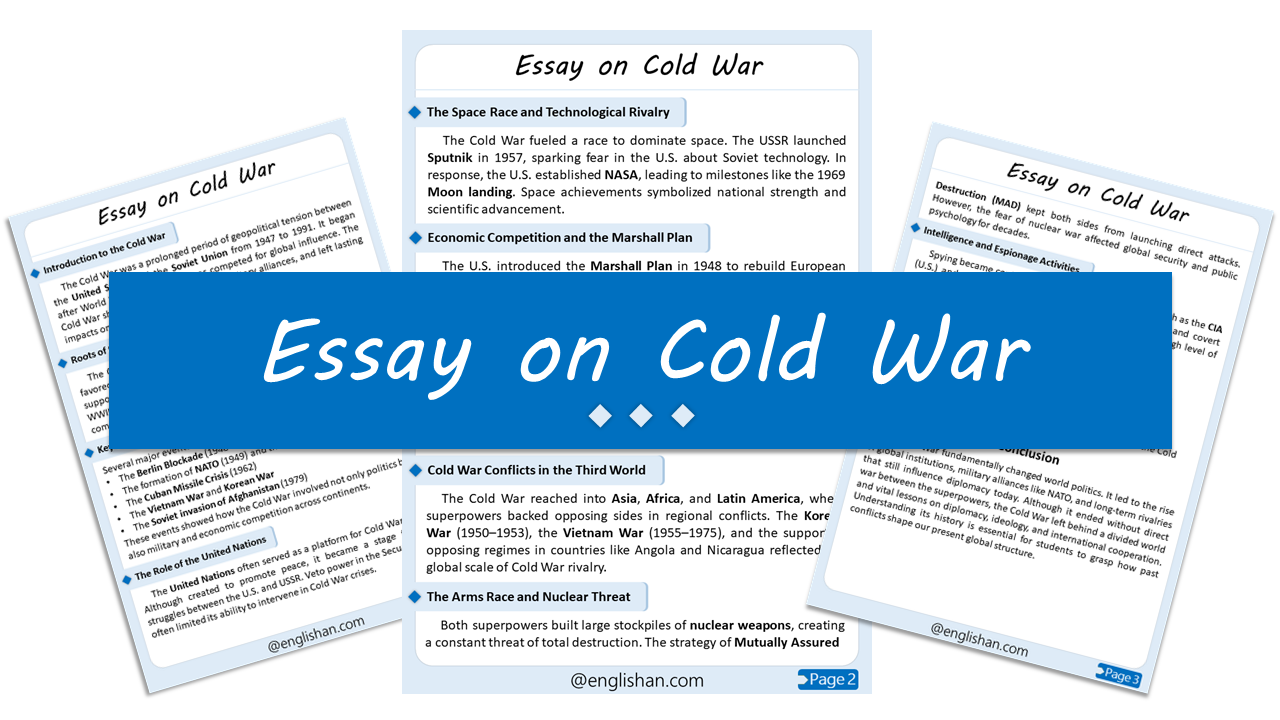
When writing about the Cold War, it’s important to understand how two world powers, the USA and the Soviet Union, competed without fighting directly. This Cold War essay explains the causes, key events, effects on the world, and how it finally ended. It’s written in 500 words to help students with school homework, assignments, or exams. You can download this Cold War essay as a free PDF or image to read, print, or study anytime.
10 Lines Cold War Essay for Class 2 to Class 5
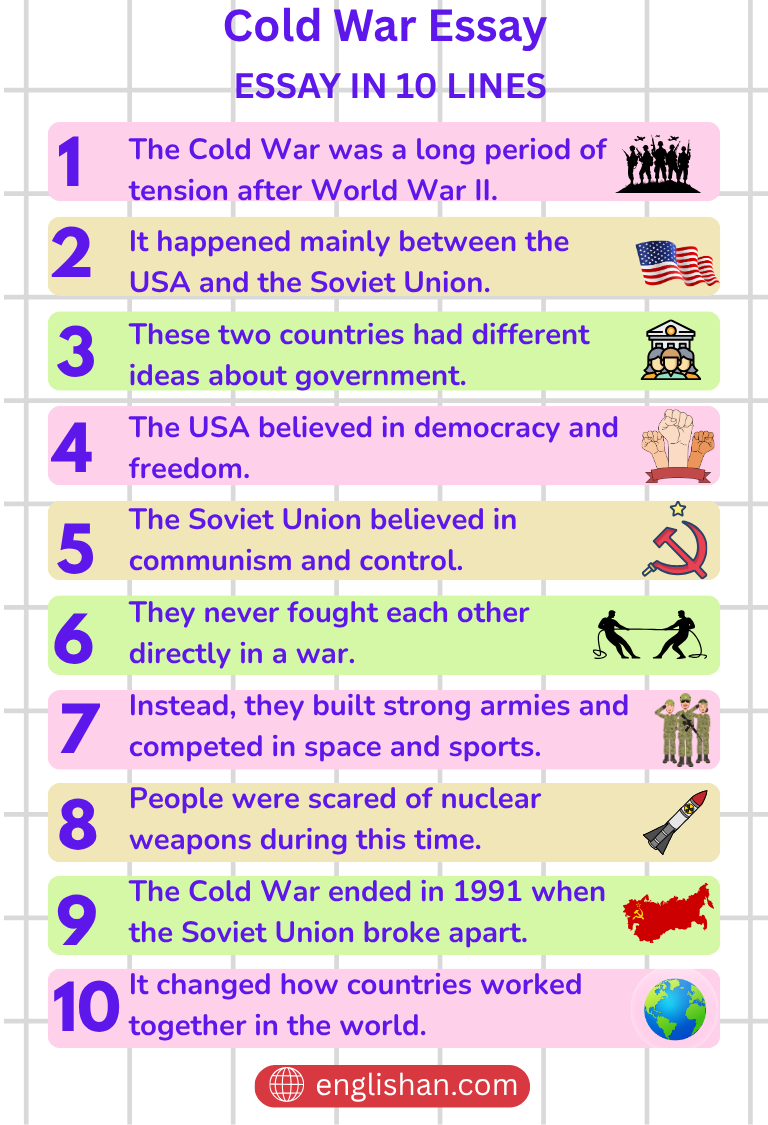
- The Cold War was a long period of tension after World War II.
- It happened mainly between the USA and the Soviet Union.
- These two countries had different ideas about government.
- The USA believed in democracy and freedom.
- The Soviet Union believed in communism and control.
- They never fought each other directly in a war.
- Instead, they built strong armies and competed in space and sports.
- People were scared of nuclear weapons during this time.
- The Cold War ended in 1991 when the Soviet Union broke apart.
- It changed how countries worked together in the world.
250 Words Essay on Cold War for Middle School
The Cold War was a period of political and military tension between two superpowers the United States and the Soviet Union from the end of World War II in 1945 until the Soviet Union collapsed in 1991. Although they never fought each other directly, their rivalry affected many parts of the world.
The United States supported democracy and capitalism, while the Soviet Union supported communism. Both sides feared the spread of each other’s ideas. This led to many conflicts in other countries, such as Korea and Vietnam, where each side supported different groups. These are known as proxy wars.
Another important part of the Cold War was the arms race, especially the building of nuclear weapons. Both countries also competed in the space race, trying to prove who was more advanced in science and technology. The Soviet Union sent the first satellite, Sputnik, into space, but the USA was the first to land a man on the moon.
People lived in fear of a possible nuclear war during the Cold War. Walls were built, like the Berlin Wall, to divide people with different beliefs. Over time, both countries realized that peace was better than conflict.
The Cold War finally ended in 1991 when the Soviet Union broke apart into several smaller countries. This marked the end of the major rivalry and a new beginning for cooperation between former enemies.
500 Words Cold War Essay for Upper Primary and Lower Secondary
Introduction to the Cold War
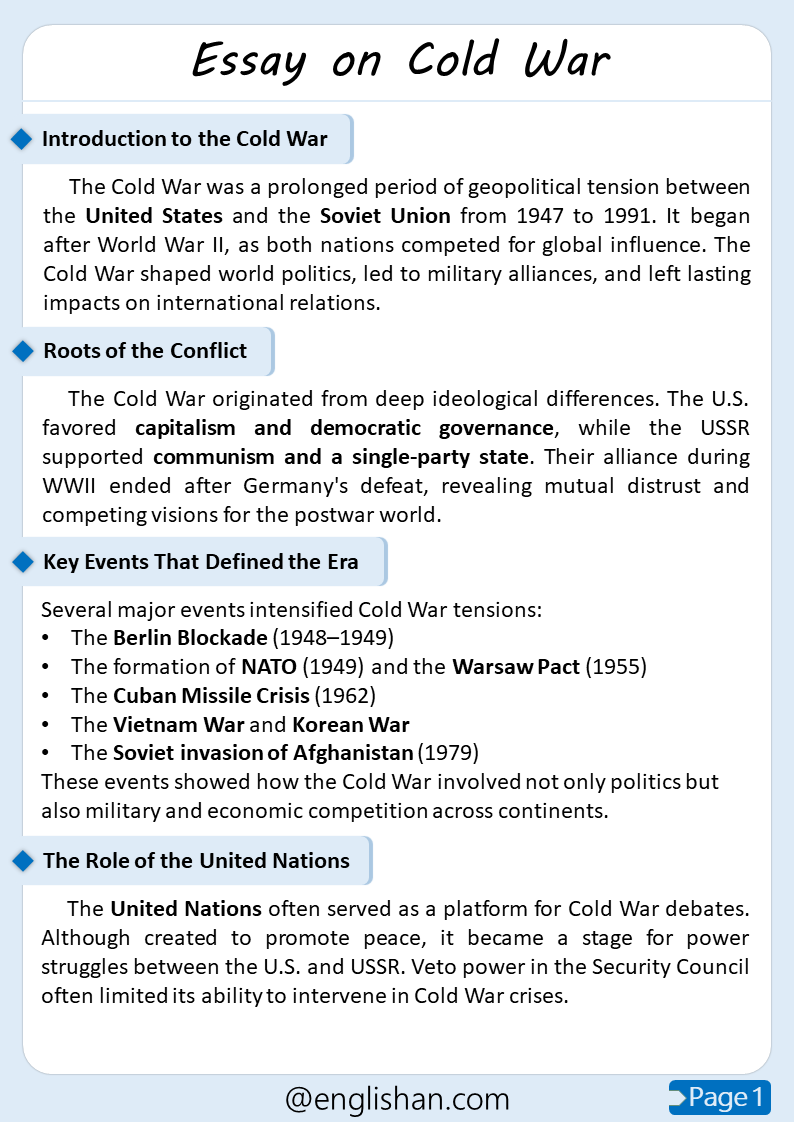
The Cold War was a prolonged period of geopolitical tension between the United States and the Soviet Union from 1947 to 1991. It began after World War II, as both nations competed for global influence. The Cold War shaped world politics, led to military alliances, and left lasting impacts on international relations.
Roots of the Conflict
The Cold War originated from deep ideological differences. The U.S. favored capitalism and democratic governance, while the USSR supported communism and a single-party state. Their alliance during WWII ended after Germany’s defeat, revealing mutual distrust and competing visions for the postwar world.
Key Events That Defined the Era
Several major events intensified Cold War tensions:
- The Berlin Blockade (1948–1949)
- The formation of NATO (1949) and the Warsaw Pact (1955)
- The Cuban Missile Crisis (1962)
- The Vietnam War and Korean War
- The Soviet invasion of Afghanistan (1979)
These events showed how the Cold War involved not only politics but also military and economic competition across continents.
The Role of the United Nations
The United Nations often served as a platform for Cold War debates. Although created to promote peace, it became a stage for power struggles between the U.S. and USSR. Veto power in the Security Council often limited its ability to intervene in Cold War crises.
The Space Race and Technological Rivalry
The Cold War fueled a race to dominate space. The USSR launched Sputnik in 1957, sparking fear in the U.S. about Soviet technology. In response, the U.S. established NASA, leading to milestones like the 1969 Moon landing. Space achievements symbolized national strength and scientific advancement.
Economic Competition and the Marshall Plan
The U.S. introduced the Marshall Plan in 1948 to rebuild European economies and contain communism. In contrast, the Soviet Union promoted economic collectivism and established COMECON to coordinate socialist economies. These efforts were about more than aid—they were strategic tools in global influence.
Propaganda and Cultural Influence
Both sides used propaganda to sway domestic and international opinion. American media portrayed communism as a threat to freedom, while Soviet media depicted capitalism as exploitative. Educational materials, films, and art became tools of ideological warfare.
Cold War Conflicts in the Third World
The Cold War reached into Asia, Africa, and Latin America, where superpowers backed opposing sides in regional conflicts. The Korean War (1950–1953), the Vietnam War (1955–1975), and the support of opposing regimes in countries like Angola and Nicaragua reflected the global scale of Cold War rivalry.
The Arms Race and Nuclear Threat
Both superpowers built large stockpiles of nuclear weapons, creating a constant threat of total destruction. The strategy of Mutually Assured Destruction (MAD) kept both sides from launching direct attacks. However, the fear of nuclear war affected global security and public psychology for decades.
Intelligence and Espionage Activities
Spying became central to Cold War strategy. Agencies such as the CIA (U.S.) and KGB (USSR) engaged in surveillance, sabotage, and covert operations. Famous spy cases and defections exposed the high level of paranoia and mistrust during this period.
Internal Reforms and the End of the Cold War
In the 1980s, Mikhail Gorbachev introduced reforms in the USSR:
- Perestroika (economic restructuring)
- Glasnost (openness and transparency)
These efforts backfired, weakening the state and encouraging independence movements. In 1991, the USSR collapsed, and the Cold War officially ended.
Conclusion
The Cold War fundamentally changed world politics. It led to the rise of global institutions, military alliances like NATO, and long-term rivalries that still influence diplomacy today. Although it ended without direct war between the superpowers, the Cold War left behind a divided world and vital lessons on diplomacy, ideology, and international cooperation. Understanding its history is essential for students to grasp how past conflicts shape our present global structure.
Difficult Words Used in 500 Cold War Essay
| Word | Meaning |
|---|---|
| Geopolitical | Related to global politics influenced by geography |
| Proxy war | A war instigated by major powers but fought by other nations |
| Espionage | The act of spying, often for military or political gain |
| Propaganda | Biased information used to influence opinion |
| Perestroika | Economic reform in the Soviet Union introduced by Gorbachev |
| Glasnost | Policy of openness and freedom of information in the USSR |
| Containment | U.S. strategy to stop the spread of communism |
| Arms race | Competition to build powerful weapons, especially nuclear ones |
| Collectivism | A political principle of centralized social and economic control |
| Deterrent | Something that discourages or prevents action, often through threat |
Cold War Essay PDF
You May Also Like