
When writing about consumerism, it’s important to understand how people buy and use goods and services in daily life. This essay on consumerism explains its meaning, benefits, and challenges, and how to be a smart buyer. It’s written in 500 words to help students with homework, exams, or projects. You can download this consumerism essay as a free PDF or image to study or print.
10 Lines Consumerism Essay for Class 2 to Class 5
- Consumerism means buying things we need or want.
- People buy food, clothes, toys, and gadgets every day.
- Sometimes, buying too much is not good for the planet.
- We should buy only what is useful and needed.
- Saving money helps us buy important things later.
- Advertisements try to make us buy more things.
- It is good to think before spending money.
- Sharing things with others is better than buying new ones.
- Consumerism can help businesses grow and create jobs.
- Smart buying helps us live happily and wisely.

250 Words Essay on Consumerism for Middle School
Consumerism is the act of buying and using goods and services. It plays a big role in our daily lives because everyone needs things like food, clothes, and school supplies. Consumerism helps businesses grow by encouraging people to buy their products. It also creates jobs for many people.
However, consumerism can have negative effects when people buy too much or waste things. Buying too many things can harm the environment because of more waste and pollution. It can also cause people to spend money they do not have, leading to problems.
Advertisements often influence people to buy things they do not really need. It is important to be careful and think before buying. Smart consumers buy only what is necessary and avoid wasteful purchases.
Another important idea is to reuse and share things to reduce waste. For example, using old clothes or giving toys to others can help save money and protect the planet.
In conclusion, consumerism is part of modern life and has both good and bad sides. By being careful and thoughtful buyers, we can support the economy while protecting the environment and saving money. Learning to be smart consumers helps us live better and make the world a cleaner place.
500 Words Consumerism Essay for Upper Primary and Lower Secondary
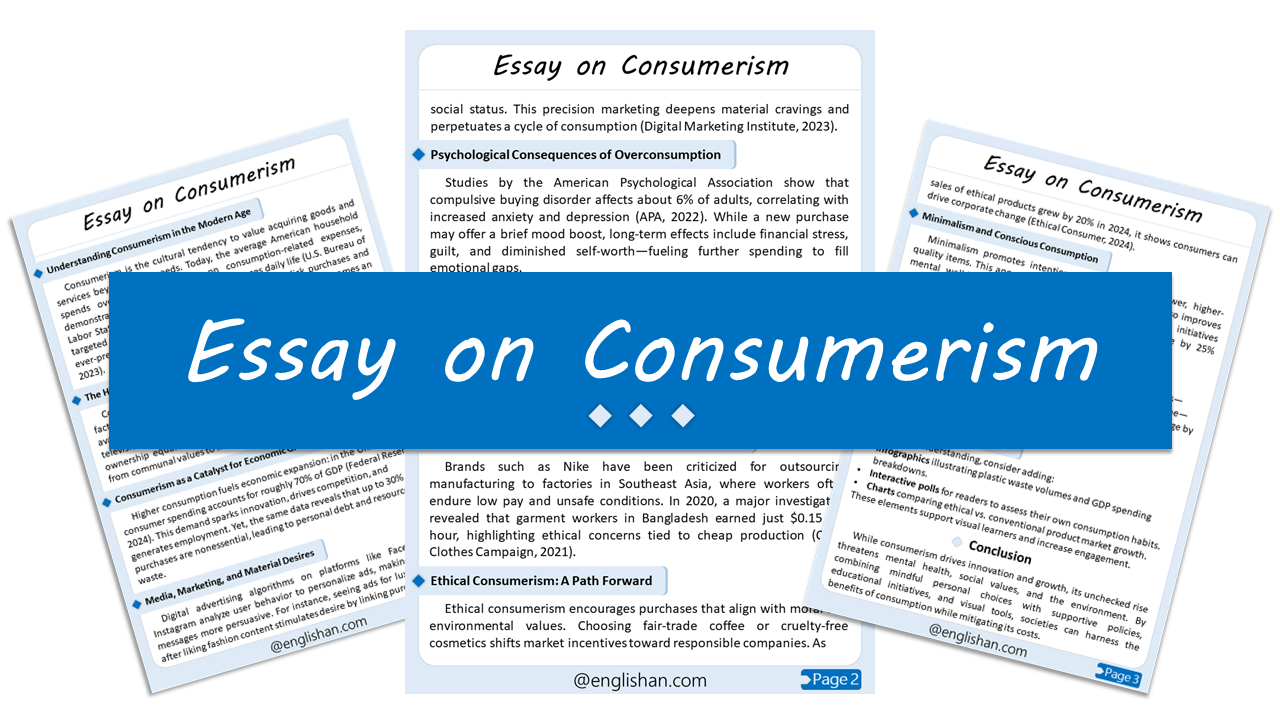
Understanding Consumerism in the Modern Age
Consumerism is the cultural tendency to value acquiring goods and services beyond basic needs. Today, the average American household spends over $60,000 annually on consumption-related expenses, demonstrating how deeply shopping influences daily life (U.S. Bureau of Labor Statistics, 2024). As mobile apps enable one-click purchases and targeted adverts trigger emotional responses, consumerism becomes an ever-present force shaping identity and well-being (Smith & Jones, 2023).
The Historical Roots of Consumerism
Consumerism emerged during the Industrial Revolution, when factories mass-produced items, lowering costs and increasing availability. By the mid-20th century, postwar economic prosperity and television advertising convinced the growing middle class that material ownership equaled success (Brown, 2019). This shift redirected focus from communal values to individual achievement through consumption.
Consumerism as a Catalyst for Economic Growth
Higher consumption fuels economic expansion: in the United States, consumer spending accounts for roughly 70% of GDP (Federal Reserve, 2024). This demand sparks innovation, drives competition, and generates employment. Yet, the same data reveals that up to 30% of purchases are nonessential, leading to personal debt and resource waste.
Media, Marketing, and Material Desires
Digital advertising algorithms on platforms like Facebook and Instagram analyze user behavior to personalize ads, making marketing messages more persuasive. For instance, seeing ads for luxury watches after liking fashion content stimulates desire by linking purchases to social status. This precision marketing deepens material cravings and perpetuates a cycle of consumption (Digital Marketing Institute, 2023).
Psychological Consequences of Overconsumption
Studies by the American Psychological Association show that compulsive buying disorder affects about 6% of adults, correlating with increased anxiety and depression (APA, 2022). While a new purchase may offer a brief mood boost, long-term effects include financial stress, guilt, and diminished self-worth—fueling further spending to fill emotional gaps.
The Environmental Toll of Consumerism
Overproduction to satisfy consumer demand generates 400 million tonnes of plastic waste annually, much from single-use products like water bottles and fast fashion (World Wildlife Fund, 2023). Deforestation for raw materials further reduces biodiversity and accelerates climate change, underscoring the urgent need for sustainable alternatives.
Labor Exploitation in the Age of Global Consumerism
Brands such as Nike have been criticized for outsourcing manufacturing to factories in Southeast Asia, where workers often endure low pay and unsafe conditions. In 2020, a major investigation revealed that garment workers in Bangladesh earned just $0.15 per hour, highlighting ethical concerns tied to cheap production (Clean Clothes Campaign, 2021).
Ethical Consumerism: A Path Forward
Ethical consumerism encourages purchases that align with moral and environmental values. Choosing fair-trade coffee or cruelty-free cosmetics shifts market incentives toward responsible companies. As sales of ethical products grew by 20% in 2024, it shows consumers can drive corporate change (Ethical Consumer, 2024).
Minimalism and Conscious Consumption
Minimalism promotes intentional living by owning fewer, higher-quality items. This approach not only reduces waste but also improves mental well-being. Communities practicing “buy nothing” initiatives report increased social cohesion and reduced expenditure by 25% annually (Minimalism Studies Journal, 2023).
The Role of Education and Policy Reform
Effective responses include teaching financial literacy in schools—Finland’s curriculum integrates sustainability lessons from grade one—and enacting policies like the UK’s plastic bag charge, which cut usage by 90% (European Environment Agency, 2022). Such measures demonstrate how education and regulation can curb harmful consumerism.
Visual and Interactive Elements
To enhance understanding, consider adding:
- Infographics illustrating plastic waste volumes and GDP spending breakdowns.
- Interactive polls for readers to assess their own consumption habits.
- Charts comparing ethical vs. conventional product market growth.
These elements support visual learners and increase engagement.
Conclusion of Consumerism Essay
While consumerism drives innovation and growth, its unchecked rise threatens mental health, social values, and the environment. By combining mindful personal choices with supportive policies, educational initiatives, and visual tools, societies can harness the benefits of consumption while mitigating its costs.

Difficult Words Used in Consumerism Essay
| Word | Meaning |
|---|---|
| Acquisition | The act of gaining or obtaining something |
| Embedded | Deeply ingrained or firmly fixed |
| Catalyst | An agent that provokes significant change |
| Depletion | Reduction in quantity or resources |
| Validation | Recognition or affirmation of worth or value |
| Degradation | The process of decline or damage |
| Outsource | To contract out a business function to an external supplier |
| Minimalism | A lifestyle emphasizing simplicity and fewer possessions |
| Conscious | Intentional and aware in decisions |
| Collective | Pertaining to actions or efforts by a group |
Consumerism Essay PDF
You May Also Like