When writing about the French Revolution, it’s important to understand why people wanted change and how it affected France and the world. This essay on the French Revolution explains the causes, main events, and its impact on government and society. It’s written in 500 words to help students with homework or exams. You can download this French Revolution essay as a free PDF or image to study or print.
10 Lines French Revolution Essay for Class 2 to Class 5
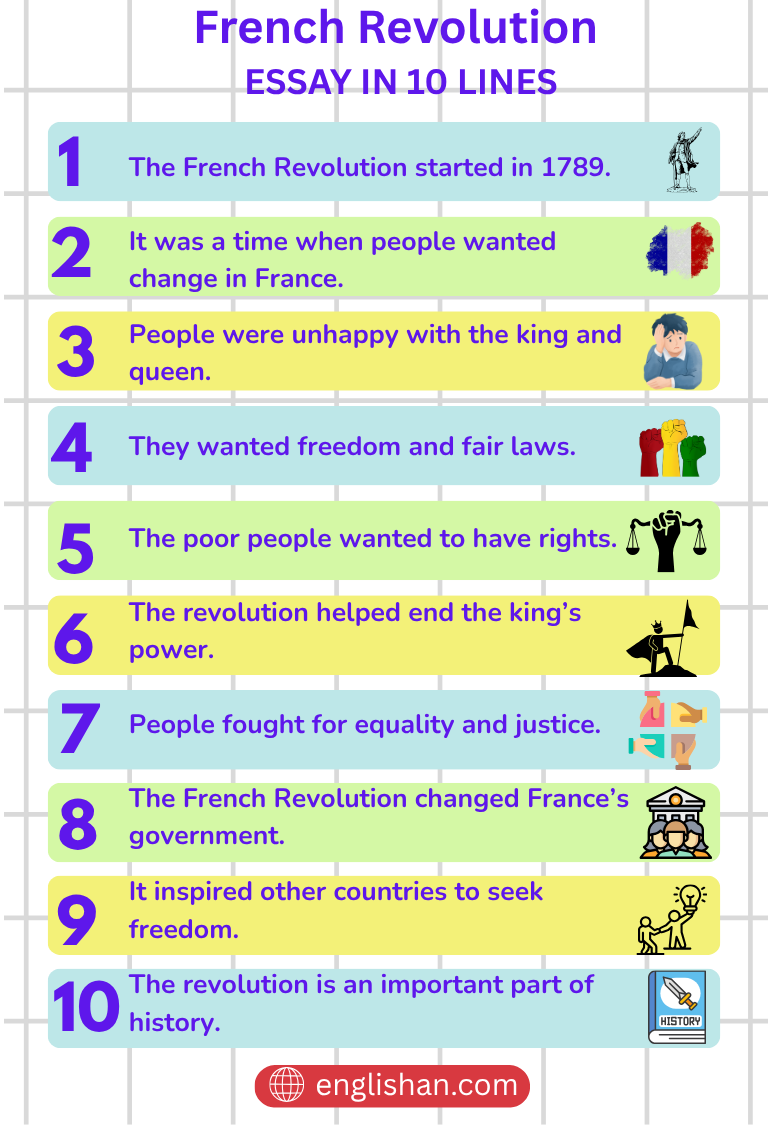
- The French Revolution started in 1789.
- It was a time when people wanted change in France.
- People were unhappy with the king and queen.
- They wanted freedom and fair laws.
- The poor people wanted to have rights.
- The revolution helped end the king’s power.
- People fought for equality and justice.
- The French Revolution changed France’s government.
- It inspired other countries to seek freedom.
- The revolution is an important part of history.
250 Words Essay on French Revolution for Middle School
The French Revolution began in 1789 and was a major event in history that changed France and the world. People in France were unhappy because the king and queen had too much power, and most people were poor and had no rights. They wanted a government that was fair and gave everyone freedom and equality.
Before the revolution, the country was divided into three groups called estates. The rich and powerful people belonged to the first two estates, while the poor made up the third estate. The third estate had to pay most of the taxes but had little say in the government. This made the people angry.
The revolution started when the third estate decided to fight for their rights. They wanted to create a government that represented all people, not just the rich. The king tried to stop them, but the people fought hard. Important events like the storming of the Bastille prison showed their strong will for change.
The French Revolution ended the monarchy and helped start a republic where people could vote and have rights. It inspired many other countries to fight for freedom and equality.
In conclusion, the French Revolution was important because it gave people rights and changed how countries were ruled. Learning about it helps us understand the value of freedom and justice.
500 Words French Revolution Essay for Upper Primary and Lower Secondary
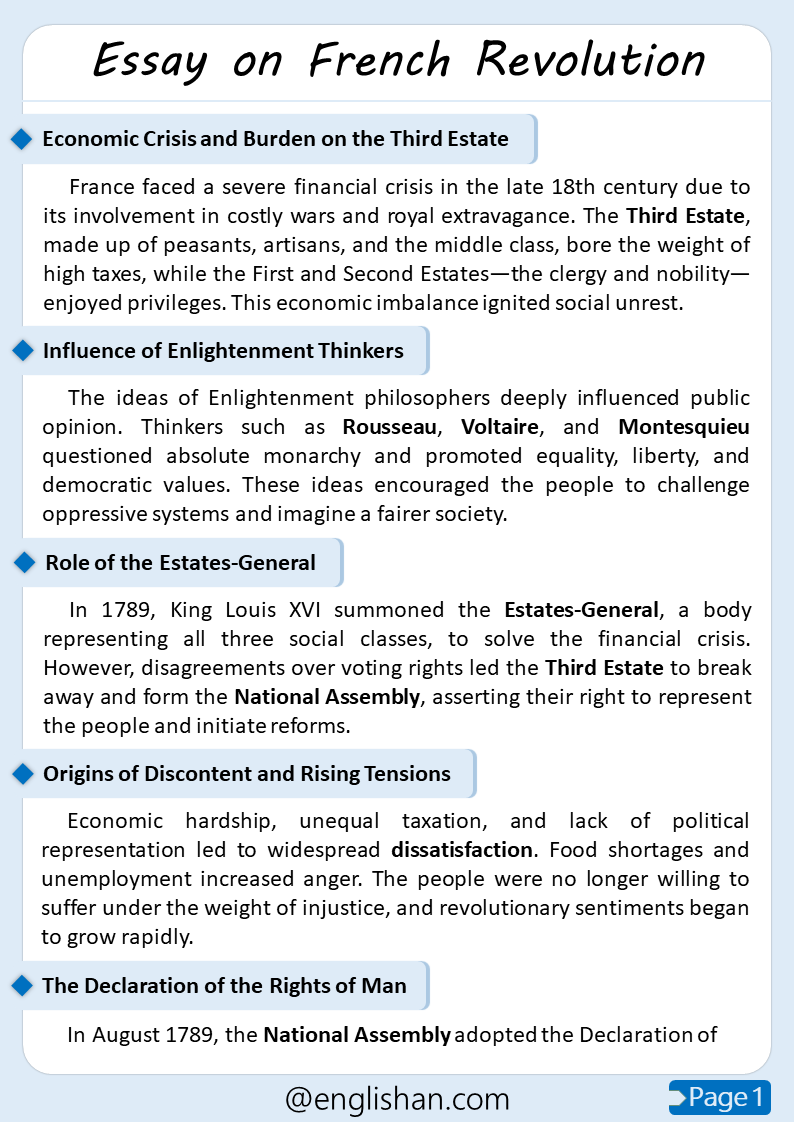
Economic Crisis and Burden on the Third Estate
France faced a severe financial crisis in the late 18th century due to its involvement in costly wars and royal extravagance. The Third Estate, made up of peasants, artisans, and the middle class, bore the weight of high taxes, while the First and Second Estates—the clergy and nobility—enjoyed privileges. This economic imbalance ignited social unrest.
Influence of Enlightenment Thinkers
The ideas of Enlightenment philosophers deeply influenced public opinion. Thinkers such as Rousseau, Voltaire, and Montesquieu questioned absolute monarchy and promoted equality, liberty, and democratic values. These ideas encouraged the people to challenge oppressive systems and imagine a fairer society.
Role of the Estates-General
In 1789, King Louis XVI summoned the Estates-General, a body representing all three social classes, to solve the financial crisis. However, disagreements over voting rights led the Third Estate to break away and form the National Assembly, asserting their right to represent the people and initiate reforms.
Origins of Discontent and Rising Tensions
Economic hardship, unequal taxation, and lack of political representation led to widespread dissatisfaction. Food shortages and unemployment increased anger. The people were no longer willing to suffer under the weight of injustice, and revolutionary sentiments began to grow rapidly.
The Declaration of the Rights of Man
In August 1789, the National Assembly adopted the Declaration of the Rights of Man and of the Citizen. It proclaimed freedom of speech, equality before the law, and protection of property. This landmark document became a symbol of modern democracy and human rights.
Collapse of the Monarchy
King Louis XVI’s refusal to implement meaningful reforms and his failed attempt to flee France in 1791 destroyed public trust. He was arrested, tried, and executed by guillotine in 1793. The monarchy was abolished, and France was declared a republic.
Reign of Terror and Radical Measures
Following the king’s execution, the revolution entered its most violent phase—the Reign of Terror. Led by Robespierre and the Jacobins, thousands were executed for allegedly opposing the revolution. While intended to protect the republic, these actions caused widespread fear and instability.
Women’s Participation in the Revolution
Women were active participants in revolutionary events. In the Women’s March to Versailles, they demanded bread and accountability from the king. Though often overlooked, their role in protests, political clubs, and revolutionary change was significant.
Rise of Napoleon Bonaparte
Political instability created a power vacuum that Napoleon Bonaparte exploited. In 1799, he seized control through a coup d’état. Though he brought order and reforms, his rise to power marked the end of the revolution and a shift toward authoritarian rule.
Lasting Impact on France and the World
The French Revolution had far-reaching effects. It ended feudalism in France, promoted civil rights, and influenced democratic movements around the world. Ideas born during the revolution—liberty, equality, and fraternity—continue to shape modern political thought.
Conclusion
The French Revolution was a turning point in both French and global history. It marked the collapse of absolute monarchy and the rise of democratic ideals. Rooted in inequality, economic hardship, and the influence of Enlightenment ideas, the revolution reshaped France’s political and social structure. Although it passed through phases of violence and instability, its core principles—liberty, equality, and fraternity—remain central to modern democratic societies. The revolution not only changed France but inspired movements for justice and rights around the world.
Difficult Words Used in 500 French Revolution Essay
| Word | Meaning |
|---|---|
| Dissatisfaction | A feeling of unhappiness or discontent |
| Enlightenment | A movement promoting reason and individual rights in the 18th century |
| Guillotine | A device used for executions during the revolution |
| Republic | A system where citizens elect representatives and not ruled by a king |
| Coup | A sudden seizure of power by force or strategy |
| Authoritarian | A government with strict control and limited individual freedoms |
| Estates-General | An assembly representing the three social classes in pre-revolution France |
| Jacobins | A radical revolutionary group during the French Revolution |
| Fraternity | Brotherhood; a key revolutionary ideal |
French Revolution Essay PDF
You May Also Like