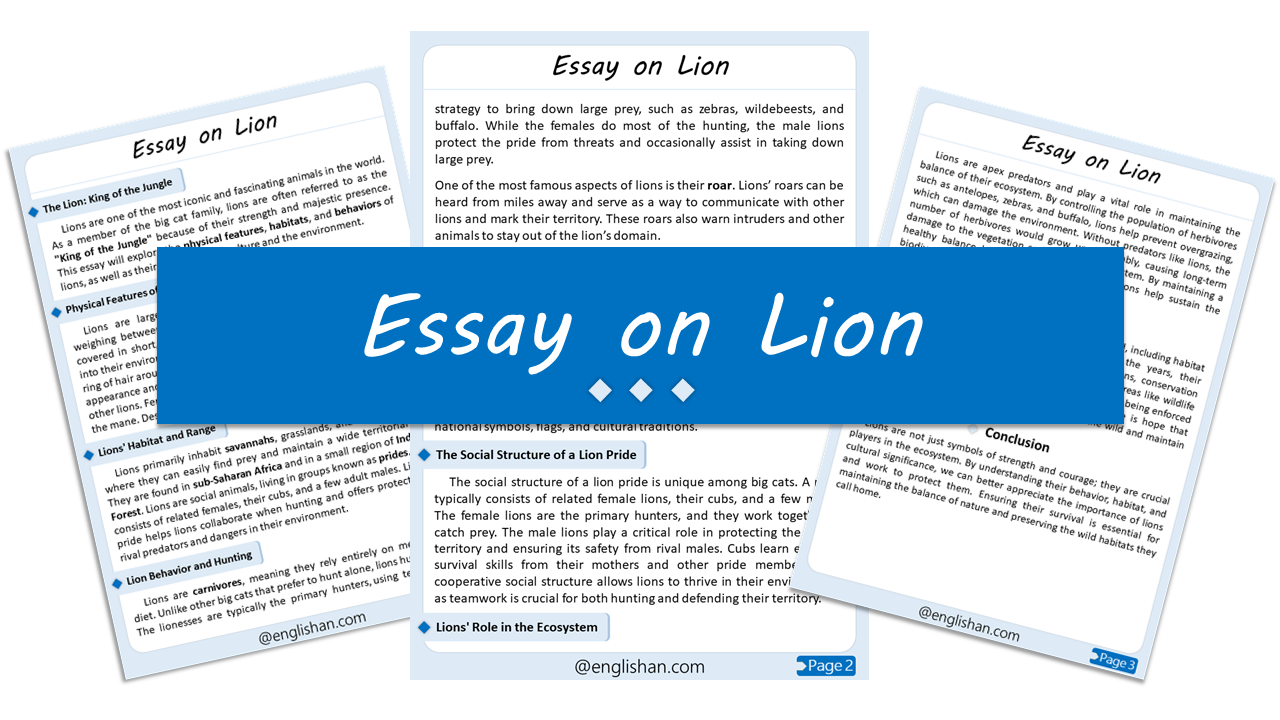
When writing about the lion, it’s important to understand how this strong and social animal lives, hunts, and communicates with others. This essay on the lion explains its appearance, behavior, role in nature, and the challenges it faces. It’s written in 500 words to help students with homework or exams. You can download this lion essay as a free PDF or image to study or print.
10 Lines Lion Essay for Class 2 to Class 5
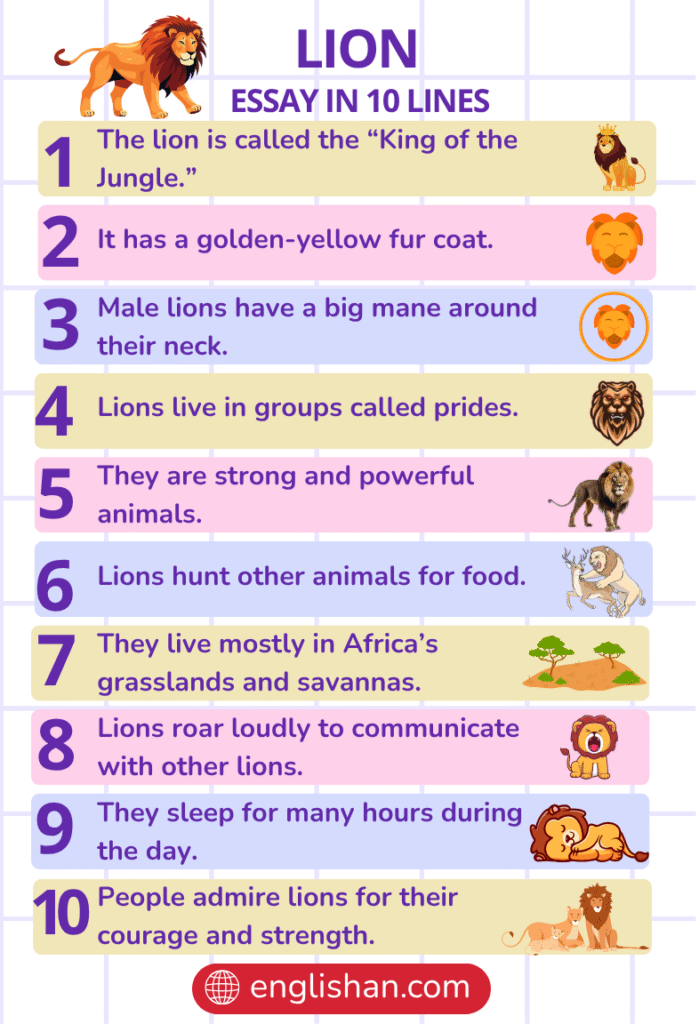
- The lion is called the “King of the Jungle.”
- It has a golden-yellow fur coat.
- Male lions have a big mane around their neck.
- Lions live in groups called prides.
- They are strong and powerful animals.
- Lions hunt other animals for food.
- They live mostly in Africa’s grasslands and savannas.
- Lions roar loudly to communicate with other lions.
- They sleep for many hours during the day.
- People admire lions for their courage and strength.
250 Words Essay on Lion for Middle School
The lion is one of the most famous and majestic animals in the wild. Known as the “King of the Jungle,” lions are large and powerful cats with golden-yellow fur. Male lions have a thick mane of hair around their neck, which makes them look even stronger and more impressive.
Lions live in groups called prides. A pride usually has several females, their cubs, and one or more males. Lions are social animals and work together when hunting. They mainly hunt large animals like zebras, antelopes, and buffalo. Lions are carnivores, which means they eat meat.
Lions are mostly found in the grasslands and savannas of Africa. They are active during the night and early morning. Their loud roar can be heard from several miles away, helping them communicate and mark their territory.
These animals spend much of their time resting, often sleeping up to 20 hours a day. Lions are known for their bravery, strength, and leadership, which is why they are often called the “King of the Jungle.”
Lions face threats from habitat loss and hunting, so conservation efforts are important to protect them. By learning about lions, students can understand the importance of wildlife and the need to keep these amazing animals safe in their natural homes.
500 Words Lion Essay for Upper Primary and Lower Secondary
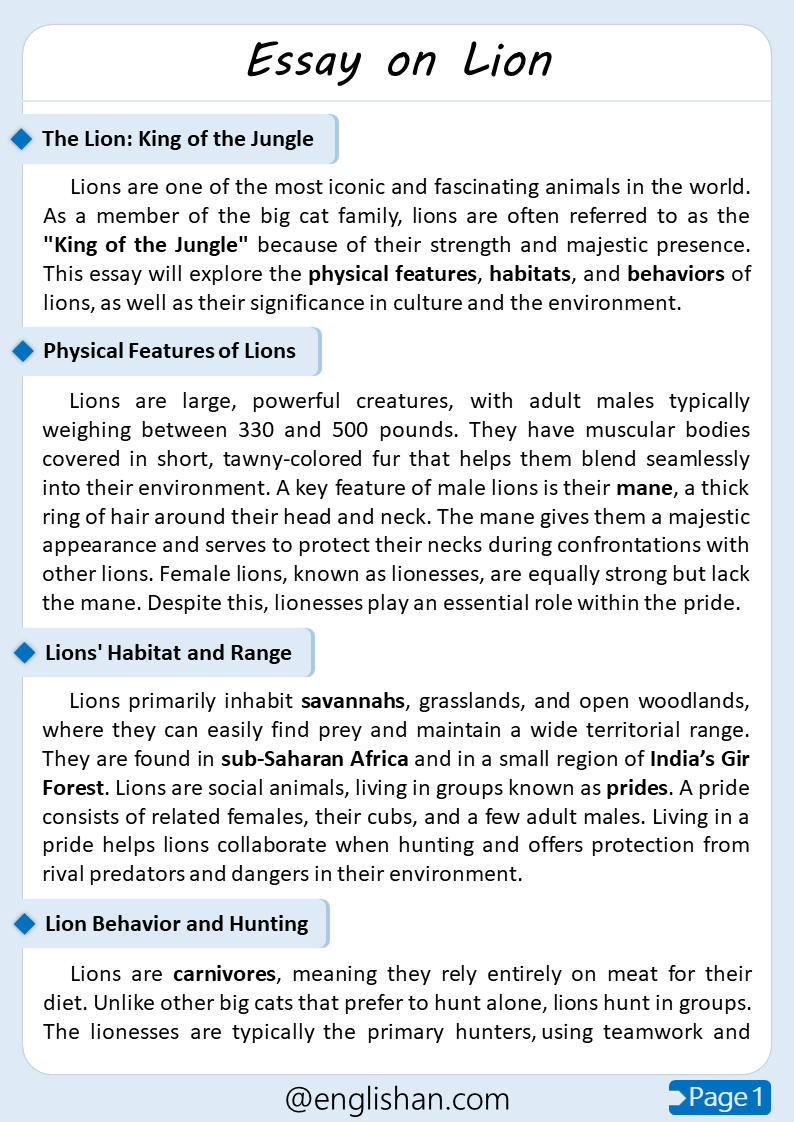
The Lion: King of the Jungle
Lions are one of the most iconic and fascinating animals in the world. As a member of the big cat family, lions are often referred to as the “King of the Jungle” because of their strength and majestic presence. This essay will explore the physical features, habitats, and behaviors of lions, as well as their significance in culture and the environment.
Physical Features of Lions
Lions are large, powerful creatures, with adult males typically weighing between 330 and 500 pounds. They have muscular bodies covered in short, tawny-colored fur that helps them blend seamlessly into their environment. A key feature of male lions is their mane, a thick ring of hair around their head and neck. The mane gives them a majestic appearance and serves to protect their necks during confrontations with other lions. Female lions, known as lionesses, are equally strong but lack the mane. Despite this, lionesses play an essential role within the pride.
Lions’ Habitat and Range
Lions primarily inhabit savannahs, grasslands, and open woodlands, where they can easily find prey and maintain a wide territorial range. They are found in sub-Saharan Africa and in a small region of India’s Gir Forest. Lions are social animals, living in groups known as prides. A pride consists of related females, their cubs, and a few adult males. Living in a pride helps lions collaborate when hunting and offers protection from rival predators and dangers in their environment.
Lion Behavior and Hunting
Lions are carnivores, meaning they rely entirely on meat for their diet. Unlike other big cats that prefer to hunt alone, lions hunt in groups. The lionesses are typically the primary hunters, using teamwork and strategy to bring down large prey, such as zebras, wildebeests, and buffalo. While the females do most of the hunting, the male lions protect the pride from threats and occasionally assist in taking down large prey.
One of the most famous aspects of lions is their roar. Lions’ roars can be heard from miles away and serve as a way to communicate with other lions and mark their territory. These roars also warn intruders and other animals to stay out of the lion’s domain.
Lions in Culture and Mythology
Lions have been revered and symbolized in cultures around the world for centuries. They are often associated with strength, bravery, and royalty. In ancient Egypt, lions were depicted as powerful protectors alongside pharaohs, symbolizing divine guardianship. In Greek mythology, the Nemean Lion was an invincible creature, whose skin was impervious to weapons. Hercules was tasked with slaying this lion as one of his twelve labors, symbolizing the triumph of human strength over the wild. Lions continue to represent power and courage in various national symbols, flags, and cultural traditions.
The Social Structure of a Lion Pride
The social structure of a lion pride is unique among big cats. A pride typically consists of related female lions, their cubs, and a few males. The female lions are the primary hunters, and they work together to catch prey. The male lions play a critical role in protecting the pride’s territory and ensuring its safety from rival males. Cubs learn essential survival skills from their mothers and other pride members. This cooperative social structure allows lions to thrive in their environment, as teamwork is crucial for both hunting and defending their territory.
Lions’ Role in the Ecosystem
Lions are apex predators and play a vital role in maintaining the balance of their ecosystem. By controlling the population of herbivores such as antelopes, zebras, and buffalo, lions help prevent overgrazing, which can damage the environment. Without predators like lions, the number of herbivores would grow uncontrollably, causing long-term damage to the vegetation and the entire ecosystem. By maintaining a healthy balance between predator and prey, lions help sustain the biodiversity of their habitats.
Conservation of Lions
Unfortunately, lions face several threats in the wild, including habitat loss, poaching, and conflicts with humans. Over the years, their numbers have significantly decreased. To protect lions, conservation efforts are underway, focusing on creating protected areas like wildlife reserves and national parks. Anti-poaching laws are also being enforced to prevent illegal hunting. Through these efforts, there is hope that future generations of lions will continue to roam the wild and maintain their important role in the ecosystem.
Conclusion
Lions are not just symbols of strength and courage; they are crucial players in the ecosystem. By understanding their behavior, habitat, and cultural significance, we can better appreciate the importance of lions and work to protect them. Ensuring their survival is essential for maintaining the balance of nature and preserving the wild habitats they call home.
Difficult Words Used in 500 Lion Essay
| Word | Meaning |
|---|---|
| Carnivores | Animals that eat meat. |
| Mane | A long, thick mass of hair around the neck and head of male lions. |
| Prides | Groups of lions, usually consisting of related females, their cubs, and a few males. |
| Apex Predators | Animals at the top of the food chain, with no natural predators. |
| Poaching | The illegal hunting or capturing of animals, often for profit. |
| Mythology | A collection of myths or stories, often involving gods, heroes, and creatures, used to explain natural events. |
Lion Essay PDF
You May Also Like