Man vs. machine essays help students understand the key differences between human skills and technology. This essay supports writing clear essays in three common lengths: 10-line short essays, 250-word, and 500-word detailed essays. These samples are designed to save time by offering structured essays that improve writing for middle school learners. They provide clear ways to explain how humans and machines interact in real life and in writing.
10 Lines Man vs. Machine Essay for Class 2 to Class 5
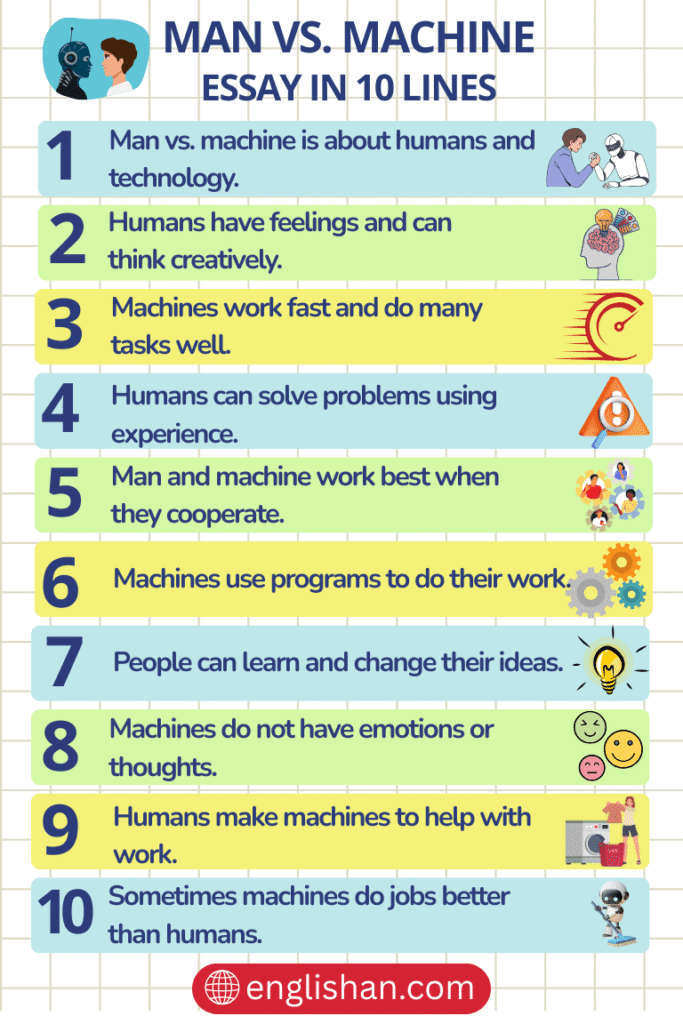
- Man vs. machine is about humans and technology.
- Humans have feelings and can think creatively.
- Machines work fast and do many tasks well.
- Humans can solve problems using experience.
- Machines use programs to do their work.
- People can learn and change their ideas.
- Machines do not have emotions or thoughts.
- Humans make machines to help with work.
- Sometimes machines do jobs better than humans.
- Man and machine work best when they cooperate.
250 Words Essay on Man vs. Machine for Middle School
Man vs. machine is a topic that shows how humans and machines are different. It helps us understand the abilities of both in real life. Humans have feelings, creativity, and can learn from experience. Machines, on the other hand, are fast and can do many jobs without getting tired. These differences make the topic interesting for essay writing.
First, humans think carefully and make decisions based on emotions and knowledge. Machines follow programs and rules to finish tasks. This means humans are good at solving new problems, but machines are better at repeating the same work. Also, humans can change their minds, while machines cannot.
Then, machines are used in many fields like factories, medicine, and transport. They help people do jobs faster and safer. Because machines do work without breaks, they are useful for difficult or dangerous tasks. However, humans control machines and decide how to use them well.
In the end, man vs. machine essays teach students how to compare and explain these differences. Writing these essays helps learners organize ideas and understand important points clearly. These samples save time by showing clear ways to write about man and machine in 10-line, 250-word, and longer essays.
500 Words Man vs. Machine Essay for Upper Primary and Lower Secondary
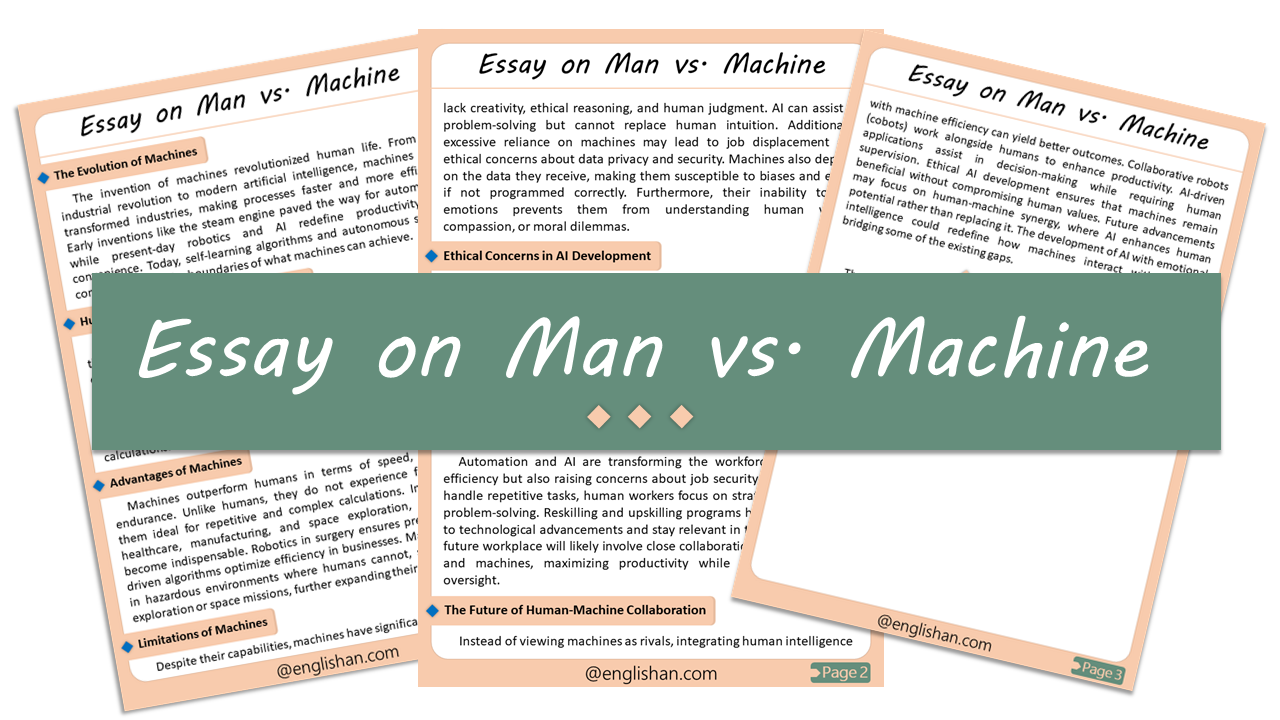
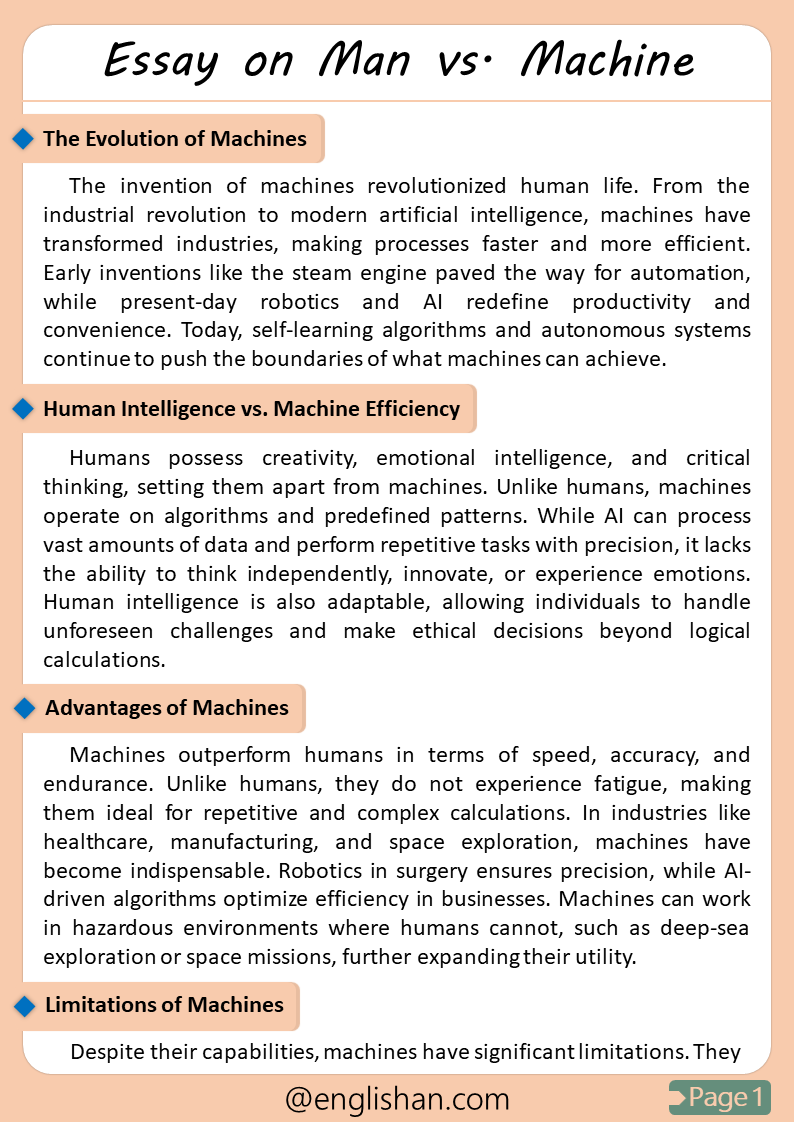
The Evolution of Machines
The invention of machines revolutionized human life. From the industrial revolution to modern artificial intelligence, machines have transformed industries, making processes faster and more efficient. Early inventions like the steam engine paved the way for automation, while present-day robotics and AI redefine productivity and convenience. Today, self-learning algorithms and autonomous systems continue to push the boundaries of what machines can achieve.
Human Intelligence vs. Machine Efficiency
Humans possess creativity, emotional intelligence, and critical thinking, setting them apart from machines. Unlike humans, machines operate on algorithms and predefined patterns. While AI can process vast amounts of data and perform repetitive tasks with precision, it lacks the ability to think independently, innovate, or experience emotions. Human intelligence is also adaptable, allowing individuals to handle unforeseen challenges and make ethical decisions beyond logical calculations.
Advantages of Machines
Machines outperform humans in terms of speed, accuracy, and endurance. Unlike humans, they do not experience fatigue, making them ideal for repetitive and complex calculations. In industries like healthcare, manufacturing, and space exploration, machines have become indispensable. Robotics in surgery ensures precision, while AI-driven algorithms optimize efficiency in businesses. Machines can work in hazardous environments where humans cannot, such as deep-sea exploration or space missions, further expanding their utility.
Limitations of Machines
Despite their capabilities, machines have significant limitations. They lack creativity, ethical reasoning, and human judgment. AI can assist in problem-solving but cannot replace human intuition. Additionally, excessive reliance on machines may lead to job displacement and ethical concerns about data privacy and security. Machines also depend on the data they receive, making them susceptible to biases and errors if not programmed correctly. Furthermore, their inability to feel emotions prevents them from understanding human values, compassion, or moral dilemmas.
Ethical Concerns in AI Development
As AI continues to evolve, ethical concerns surrounding its use have gained importance. Issues such as data privacy, surveillance, and decision-making biases raise questions about the responsible development of artificial intelligence. Regulations and policies are essential to ensure that AI technologies align with ethical standards and do not harm human interests. Transparency in AI decision-making and accountability for errors are necessary to prevent misuse and unintended consequences.
The Role of Machines in the Workplace
Automation and AI are transforming the workforce by increasing efficiency but also raising concerns about job security. While machines handle repetitive tasks, human workers focus on strategic thinking and problem-solving. Reskilling and upskilling programs help workers adapt to technological advancements and stay relevant in the job market. The future workplace will likely involve close collaboration between humans and machines, maximizing productivity while maintaining human oversight.
The Future of Human-Machine Collaboration
Instead of viewing machines as rivals, integrating human intelligence with machine efficiency can yield better outcomes. Collaborative robots (cobots) work alongside humans to enhance productivity. AI-driven applications assist in decision-making while requiring human supervision. Ethical AI development ensures that machines remain beneficial without compromising human values. Future advancements may focus on human-machine synergy, where AI enhances human potential rather than replacing it. The development of AI with emotional intelligence could redefine how machines interact with humans, bridging some of the existing gaps.
Conclusion
The debate between man and machine is not about competition but about coexistence. Machines enhance efficiency, while human intelligence provides ethical and creative oversight. The future lies in striking a balance where machines assist rather than replace humans. By embracing this synergy, society can benefit from technological advancements while preserving the unique qualities that define human intelligence.
Difficult Words Used in 500 Man vs. Machine Essay
| Word | Meaning |
|---|---|
| Automation | The use of machines to perform tasks |
| Algorithm | A step-by-step procedure for problem-solving |
| Precision | The quality of being accurate and exact |
| Intuition | The ability to understand without reasoning |
| Ethical | Related to moral principles |
| Displacement | The removal of someone from a position |
| Synergy | The combined effect of working together |
| Autonomous | Able to function independently |
| Adaptability | The ability to adjust to new conditions |
| Compassion | The ability to feel sympathy for others |
Man vs. Machine Essay PDF
You May Also Like